Category Archives: Book Reviews

In which the reader shares his thoughts on the books that possess his imagination throughout the year.

Thirteen Phantasms and Other Stories

/images/thirteenphantasms.jpg

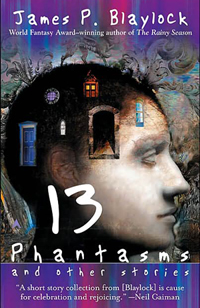
Thirteen Phantasms and Other Stories by James P. Blaylock is a book that jumped out at me last year as I was walking through my local Barnes and Noble bookstore; I recognized the cover art as a work by Greg Spalenka. As I picked up the book to examine the cover I felt like the proverbial fish being caught by the shiny worm…there on the front cover was a quote of recommendation from none other than Neil Gaiman. Flipping the book over was like biting down harder on the hook as there was an even longer quote from Patricia A. McKillip! Needless to say this little unassuming paperback book of short stories ended up coming home with me. And I am so glad that it did.

Patricia A. McKillip’s quote alone makes a perfect review of the book: “[James Blaylock’s] range is quite wonderful…He brings magic into urban fantasy…His characters are people who might occupy the house next door to us; they might be spooky or unkind or even dead, but they are always fully realized. His instinict for the quirky detail is unerring; he takes a clear look at the marvels in his world and makes us remember the marvels in ours.”

Herein Blaylock gives us 16 engrossing tales that find their home in no one set genre: within these pages lie modern fantasy, science fiction, mystery, horror, steampunk, comedy, and suspense. The titular story alone was worth the $6.99 cover price. Like any book of short stories there are some that make more of a connection than others, however each was worth reading at least once and several were so good that I turned around and immediately read them aloud to my wife. Two tales in the later half of the book, Two Views of a Cave Painting and The Idol’s Eye, featured a cast of early 20th century English scientific adventurers that read like a cross between P.G. Wodehouse, G.K. Chesterton, Sir Arthur Conan Doyle and H.G. Wells. Needless to say I was thrilled to later find out that these characters are featured in two Blaylock novels, Homunculus and Lord Kelvin’s Machine: A Novel. Another favorite was the World Fantasy Award winning story, Paper Dragons. The language of Paper Dragons evoked reminiscences of the beautiful language found in Patricia A. McKillip’s work. There is even a story celebrating the wonder of doughnuts.

At the risk of sounding like Forrest Gump, reading a book of short stories is like eating a box of chocolates. If short stories are not to your taste I would venture to say that you have just cracked open too many coconut filled ones. The short stories of Neil Gaiman, Patricia McKillip, Roald Dahl, Gene Wolfe, P.G. Wodehouse (the list could go on and on) and now James P. Blaylock are like sitting down to a large assortment of the best Godiva truffles with each bite better than the last…where each is a favorite to be savored and treasured and the memory shared with friends. Take a bite…you won’t be disappointed.
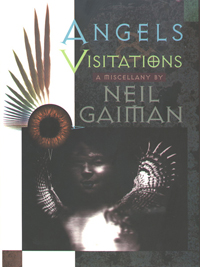
Angels and Visitations

Angels and Visitations is a collection by Neil Gaiman, given to me by Jeff as a birthday gift. It is a wonderfully illustrated book containing short stories, poems, and book introductions. At least half of the short stories are also included in Gaiman’s later short story collection Smoke and Mirrors but there were a handful of gems that I had not had the privilege to read.

Let me start by talking about the packaging. I frequently find myself thinking that the ability to make a good book is a lost art. On fewer and fewer occasions do I find new books that show craftsmanship and attention to detail. Angels and Visitations is published by a small publishing company, DreamHaven Books, which also runs a local comic shop in Neil Gaiman’s residence of Minneapolis. DreamHaven got it right. The book has a terrific dust jacket illustrated by Gaiman’s Sandman cover artist and fellow movie maker (Mirrormask) Dave McKean. Underneath the dust jacket lies an amazingly solid book with a cool gold embossed angel of death design. Inside are illustrations by graphic artists Charles Vess, P. Craig Russell, Michael Zulli, and Bill Sienkiewicz to name a few.

But what about the stories? If you have read Gaiman, then you know they are good. Angels and Visitations combines some of my absolute favorites that are in Smoke and Mirrors and adds some great new work. Among the previously read stories are two wonderful stories, Chivalry and We Can Get Them For You Wholesale. Chivalry is a quaint story in which a little old woman in modern day England discovers the Holy Grail in a second hand store, buys it, and begins getting visits from Galaad, a Knight of King Arthur’s Court, who hopes to barter for it thus completing his Holy Quest. We Can Get Them For You Wholesale is a Twilight Zone-ish horror story about a guy who just cannot pass up a good bargain. New stories for me included Webs which is a creepy fairy tale with spiders and the The Case of the Four and Twenty Blackbirds, a comical hard-boiled detective story set in the world of Mother Goose. There was also a terrific review of Josiah Thompson’s book Gumshoe that primarily involved the reviewer’s inability to find the book he was meant to be reviewing…quite entertaining. The book also includes poems, a prologue written for someone else’s story and a wonderful essay about G.K. Chesterton’s Father Brown mysteries. Being a fan of Chesterton after only reading one book I had been wondering about these stories and am now anxious to add them to my reading pile.

If you love a good short story you owe it to yourself to check out Neil Gaiman’s work. When he is at his best his shorter fiction can stand to anything. If you are a Neil Gaiman addict like myself, this book also makes a marvelous collector’s item as its production quality is marvelous.

The Planets

The Planets is a collection of essays about, you guessed it…the planets, written by long-time science journalist Dava Sobel. I first discovered Ms. Sobel’s work a few years ago when I picked up the newly released trade paperback book Galileo’s Daughter, a book that continues to be one of the most cherised nonfiction books I have read.

I grew up in the country, where the lack of city lights generated night time skies that were literally strewn with stars. My wonder and longing for space grew through a combination of Star Wars, Battlestar Galactica, my uncle Dean’s generosity with his science fiction collection and my 6th grade teacher, Mrs. Stewart, who brought in an inflatable indoor planetarium during that year. I really hoped as a child that we would be in space by now…as an adult I continue that dream through science fiction, looking at the stars, and stumbling across marvelous works by writers like Dava Sobel.

In Galileo’s Daughter Ms. Sobel chronicles Galileo Galilei’s great discoveries and crisis of faith when the truths he discovered contradicted long held church beliefs. The story is reconstructed through 124 surviving letters written between Galileo and his daughter, Sister Marie Celeste. It is a marvelous book that not only gives amazing insight into the astronomy of that day but also gives us a glimpse into the life of the convent. It also details the love that father and daughter had for each other and the great conflicts Galileo went through as he tried to honor the church while discovering great new wonders about the heavens of God’s creation.

The Planets continues Ms. Sobel’s love affair with the universe by taking reader’s on a “guided tour” of the universe. Each planet of the solar system is treated with its own chapter and each chapter is a unique and interesting essay of the wonders of these heavenly bodies. No two chapters are alike, Ms. Sobel uses the Bible, mythology, astrology, science fiction, art, music and even popular culture to share wondrous insights into our universe. Far from being a scientific textbook, Dava Sobel has an ease with words and a remarkable ability to make science real and tangible and understandable. Ms. Sobel herself states “If reading these pages [helps] someone befriend the planets, recognizing in them the stalwarts of centuries of popular culture and the inspiration for much high-minded human endeavor, then I have accomplished what I set out to do. For myself, I confess that none of the truly staggering data I have been privileged to share here has altered the planets’ fundamental appeal to me as an assortment of magic beans or precious gems in a little private cabinet of wonder…portable, evocative, and swirled in beauty.” This was her goal, and in this she succeeded. Some chapters were more interesting than others and some were downright fascinating, but overall they each contained insights that I did not know and feel the better for having learned. The most fascinating for me were the later chapters discussing Uranus, Neptune, Pluto and beyond in light of the more recent space vessels that have made the long journeys and sent us back pictures of what we could only once dream about. It is no wonder we have such wonderful, fantastical science fiction stories from when man first began dreaming of the stars up through today with such an amazing solar system as inspiration.

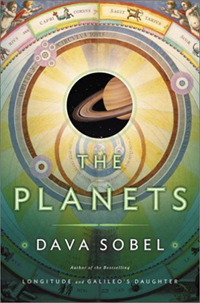
The packaging of The Planets is marvelous in and of itself. I love a well put together book and this one is beautiful. The dust jacket displays an illustration from a 1661 work by Andreas Cellarius. The center whole gives a window to the actual book art (you can see Saturn peeking through on the cover image above) which is Saturn set in a field of stars that covers the entire book. The typset, the interior illustrations…everything about this book is a labor of love…kudos to the craftsmen…and women…of Viking Press.

If you, like me, occasionally look up in the night sky and marvel (Orion the Hunter in these winter months, looming large in the night sky, takes me right back to that 6th grade planetarium) and/or you are just in the mood for some well written nonfiction I highly encourage you to read The Planets. I also can’t recommend Galileo’s Daugther enough. As Jack Horkheimer the Star Hustler says, “keep looking up!”

The Knight and The Wizard

As profound of an experience as I’ve just had with these two books I’ve decided to write a joint review on Gene Wolfe’s two-book The Wizard Knight series, The Knight and The Wizard.

At 74 years of age Gene Wolfe is considered by many authors and readers to be one of the greatest, if not the greatest, science fiction and fantasy author alive today. Over the years I have heard friends and favorite authors alike sing the praises of Gene Wolfe, particularly for the four books that make up his The Book of the New Sun series. Considering the reading experience I had just had with The Time Traveler’s Wife (review here), I had resigned myself to the fact that it would be a long time before I was so enthralled with another book. I could not have been more wrong nor more pleasantly surprised when I decided to give Gene Wolfe a try and picked up The Knight.

These stories center on a teenager who takes a walk in the woods in the “real” world and through a series of seemingly innocent actions finds himself no longer in America but in a magical realm consisting of seven levels of reality. Unable to remember entirely who he is or how he got to this new realm he is soon given the name Able and in his heart the desire to become a knight begins to grow. A meeting with an Aelf Queen named Disiri results in this young boy being turned into a man of heroic proportions. A man whose destiny is to find a fabled magical sword named Eterne, the finding of which he believes will allow him to return to Disiri whom he loves above all else. And so a quest begins that will take the reader along with Able of the High Heart as he travels through various planes of this realm meeting aelfs and dragons, kings and queens, knights, gods, goddesses, ogres and many others too numerous to name.

Taken as I’ve written it one could easily say that all this has been done before in many other fantasy stories. What makes this different is that Gene Wolfe takes all these archetypes of fantasy and creates a tale told in a wholly original, fascinating way. These stories are written in the form of a letter from Able to his brother Ben in the “real” world. Despite his body-changing experience with Disiri, Able remains but a boy in a man’s body and his narration is told in the voice of a teenager. A teenager who knows there are memories that have been taken from him and realizes that a part of his quest will be to discover more about who he is and why he has been taken to this realm. Told as a letter the reader realizes that time has passed but doesn’t know how old Able is when he is writing this letter. In this “letter” Able casually references events that have happened to him but that won’t occur until much later in the narration thus giving the story depth and intrigue. The reader is made to wonder where this brother Ben is and does he get this letter that Able is writing and how did this all occur in the first place. These and other mysteries make for a compelling read.

It is very hard to describe Gene Wolfe’s writing style as it is like nothing I have read before. It is obvious that there is a classic mythology and folklore running throughout the story and it is written so well that one is tempted to do research to see if this mythology exists or if it was simply made up in Wolfe’s imagination. Although there is a linear progression to the story Wolfe does not write everything in a dry “this happened and then that happened” format. Instead the reader is sometimes given sketchy or incomplete information from the narrator that is fleshed out later on. This makes for a more intelligent, thought provoking read and compels the reader to continue on devouring the books to see what happens next. Though written only a few years ago these books had the feel of classic literature in the vein of Dickens or Stoker and yet Wolfe’s voice is quite unique.

The Wizard completes the tale that was abruptly ended with The Knight. In The Wizard Sir Able is older still and the voice in which he continues his letter shows the effects of his time and adventures in this realm. In The Wizard Wolfe strays from his first person narrative at times to show what is happening to other characters. Early on Sir Able indicates that the part he is writing about others has been relayed to him by someone present and the reader assumes that this continues to be the case as it happens later in the tale. The Wizard is a more action oriented tale than The Knight, containing accounts of battles with many and varied residents of the seven realms.

Both The Knight and The Wizard are wonderful examples of the craft of bookmaking as well. The hardcover editions have raised lettering and embossed images with wonderful paintings done by artist Gregory Manchess. Inside the books each beginning chapter page has a pencil illustration done by Manchess, and they are lush, detailed, and amazing. I love a book that is put together well and these are two marvelous examples.

At its heart The Wizard Knight series is a love story. A story in which a young man choses to be a knight and sets about on a quest to become one and win the love of a the woman who fills his every thought and inspires his every action. During the quest he meets many characters who make a profound difference in his life as well as a number who are profoundly changed by meeting him. Through it all Wolfe writes a tale in which you quickly become attached to many of the characters and although the end of the tale is quite satisfying it leaves you saddened that you have to leave this world and these characters behind. I have not done these two books justice at all in my reviews. They are truly fascinating and inspiring and thought provoking. I literally could not put this story down and read both 470ish page stories in a very brief period of time. These are amazing books and I highly recommend them.

Mark Schultz: Various Drawings Vol. 1

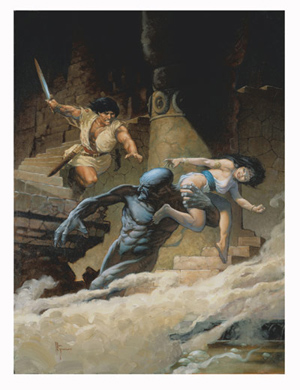
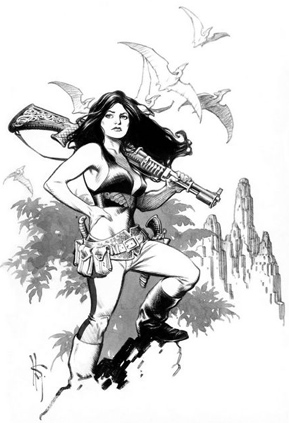
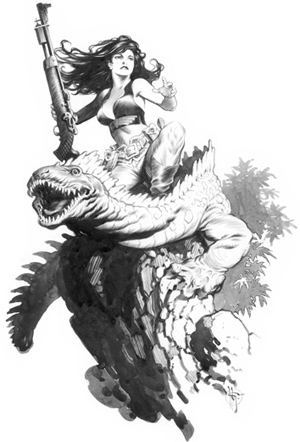
I have been a fan of Mark Schultz’s work since I first laid eyes on it in his amazing comic series, Xenozoic Tales. With a unique dry brush technique he produces lavish illustrations of heroes, heroines, dinosaurs and the like. His pencil, ink and painted works evoke the spirit of classic American illustrators like N.C. Wyeth, Howard Pyle, and William Stout as well as comic illustrators Al Williamson, Alex Raymond and Hal Foster. The following image is a color painting for the recently released collection of Robert E. Howard stories, The Coming of Conan the Cimmerian.

The most well known work of Mark Schultz is the aforementioned comic series Xenozoic Tales, recently released in graphic novel format. Xenozoic Tales‘s publisher, Dark Horse Comics, states that “Mark Schultz’s vision of the future includes ruined cities, guano-powered Cadillacs, warring factions of humanity, reborn dinosaurs, and their intelligent, humanoid descendants. The tough-as-nails shaman, Jack Tenrec, and the beautiful scientist, Hannah Dundee, yearn to uncover the origins and secrets of their violent world while dealing with their own rocky relationship.” Hannah Dundee and Jack Tenrec are by far Schultz’s most popular creations.

Mark Schultz: Various Drawings Volume 1 is published by Flesk Publications. Flesk is a small publisher specializing in high quality illustration books. Mark Schultz had very specific desires in relation to the materials used to make this book and it shows. Various Drawings is a slight book containing only 49 illustrations but the museum quality paper and meticulous reproduction of the originals make this one of the better art books that I’ve seen. The lavish print quality and soft focus element of Schultz’s art make each piece seem almost 3 dimensional. The hardback edition is limited to only 500 copies and ordering directly from the publisher netted me number 34 of 500. The tipped in, hand signed signature page is gorgeous. I love well put together books and Flesk Publications garners high praise with this release.

If you are a fan of Tarzan, Conan, or similar adventures stories then I guarantee you would enjoy the work of Mark Schultz. In addition to being an amazing artist he is also a talented writer and the world he created in Xenozoic Tales is a world worth visiting. Interestingly enough Xenozoic Tales was turned into an animated series that aired on CBS in 1993-94 entitled Cadillacs and Dinosaurs.

Although nothing has been announced I’m looking forward to more volumes of Schultz’s artwork in the future.