Category Archives: Book Reviews

In which the reader shares his thoughts on the books that possess his imagination throughout the year.

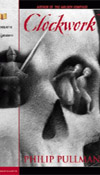
Clockwork

An apprentice clockmaker facing failure…a writer with a story he can’t control…a girl whose courage will need to match her kindness…a prince whose mechanical heart is winding down…a clockwork knight with murderous tendencies…and a doctor who just may be the Devil.

Their stories come together piece by piece in this chilling tale where nothing is as it seems, but like the gears of a strange and wonderful clock, everything fits together.

And so reads the summary on the back of the multiple award winning 1996 children’s tale, Clockwork, or All Wound Up. Written by Philip Pullman (of His Dark Trilogy fame) and wonderfully illustrated by Leonid Gore, Clockwork tells a story within a story of adventure, deceit, clockmaking, storytelling, the high cost of failure and the triumph of love. Clockmakers, a writer, a royal family, clockwork beings, a mysterious doctor, a courageous heroine, a dying prince…all are contained within a scant 107 pages. It is actually quite amazing how much storytelling is done in such a small book.

Pullman sets his tale in “old” Germany and writes under the inspiration of the tales of the Brothers Grimm, Frankenstein, and Dr. Faustus. The story opens on a cold snowy night in a tavern on the eve of two special occurrences-Fritz’s latest tale of suspense and the revelation of Karl’s apprenticeship-ending edition to the town clock. The element of suspense is set immediately due in part to Pullman’s excellent storytelling ability coupled with the lush, gothic imagery of Gore’s illustrations. In the tradition of the fairytales of old, Clockwork has its share of dark, macabre moments that will appeal to children and to those adults who remember the childlike thrill of a good ghost story.

I sat and read this book cover to cover in about an hour and have to admit that I was disappointed when it all came to an end. While on the surface Clockwork has a deceptively simple, straightforward story there are hidden depths and meanings put forth in the tale that make it an intriguing read for an adult. I picked up this book in a used bookstore on our vacation earlier this summer and am thrilled to realize now just what a bargain I received. This book is wonderful. A perfect balance of suspense, creepiness, heriosm, and romance make it a great book to read yourself or to read aloud to your children. For some inexplicable reason Pullman includes one instant of cursing in the book which is my only real complaint as its wholly unnecessary and takes away from rather than adds to the book.

Clockwork is a great tale to read in the fall/winter when darkness descends early and the nights turn cool. Enjoy.

The Time Traveler’s Wife

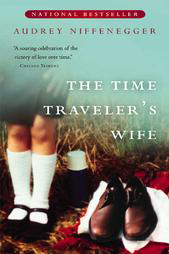
Four library employees, including my darling wife, and a host of bloggers had recommended The Time Traveler’s Wife by Audrey Niffenegger. I had a Border’s 30% off coupon burning a hole in my pocket last week and so I took their advice and picked up a copy. I had been meaning to pick up this book since I first laid eyes on it as I was struck by the cover image and colors as well as the intriguing title. Showing uncharacteristic restraint, however, I managed to put it off until now in an effort to reduce my reading pile. Let me tell you right now, reading pile be damned, quit reading this review and start reading this book now! It is that good.

It is no secret that reading is one of my great loves and I have a pretty good knack for choosing books that I end up enjoying. That being said the books that grab on to me and won’t let go…those that talk to me while I am sleeping and say “Quit wasting time, read me!” are few and far between. The Time Traveler’s Wife is one of those books. Despite clocking in at a hearty 536 pages the time literally flew by as I was lost in its pages.

Though the title may indicate otherwise, this is not a science fiction book. There are no Dr. Who-ish travels to visit the dinosaurs or trips into future space-age realms. The Time Traveler’s Wife is a love story. It is the story of Henry DeTamble, a Chicago librarian with Chrono-displacement Disorder, and the love of his life, Clare. It is the story about a man whose time travels are involuntary and often unwanted. This is also the story about a woman who chooses to love and live with this very difficult disorder. It is also a story about living life to its fullest in the time that is given.

This is, unbelievably, Audrey Niffenegger’s first mainstream novel. It is so well crafted and flows so well that I am in awe of her talent and aching for another book. The story is told entirely by Henry and Clare in vignettes describing the occurences on certain dates. While Clare’s story is relatively chronological, Henry’s jumps around in time. Each vingette begins with the date and time and the ages of both Henry and Clare. While Henry is 8 years older than Clare in “real time” he actually meets her at various ages beginning when she is 6 years old. It has been a long time since I’ve read Time and Again by Jack Finney (another amazing book) but something about this book felt like Time and Again. The time travel element is no doubt part of that similarity but I think the fact that both books focus on the relationship of characters in a real world vs. a science fiction focus on time travel gives them a similar feel.

Niffenegger does a marvelous job of infusing Henry and Clare with life. Each character has hobbies and talents (again no spoilers) that give the story such depth and dimension. Their sexual relationship (this is an adult story, not for kids) is not gratuitous and is handled in a loving way that gives richness and realism to their relationship. Also both characters have very interesting careers. Henry works in a fascinating library in Chicago and Clare is an artist who makes hand crafted papers, a hobby Niffenegger shares.

Audrey Niffenegger is a professor in the MFA program at the Columbia College Chicago Center for Book and Paper Arts. The program teaches such things as bookbinding, papermaking, and letterpress printing. Niffenegger’s previous books were small print runs of visual books with letterpress type and aquatint illustrations that she hand made. A self-professed woman “fixated on oddity” her previous creations touched on ideas surrounding “mutants, peculiar nature things, taxidermy, [and] amputation.” Her website gives a hint of what some of her other work may look like but is sadly still largely under construction.

I cannot recommend this book highly enough. It is rare that I find myself so easily enthralled in a story. Like any good love story this tale has happy and sad moments, both of which are powerfully rendered. Be prepared to smile but also to shed a few tears. I’m not ashamed to admit that at one point in the story I began crying and was still crying some 40 or 50 pages later. The Time Traveler’s Wife is an inspiring tale about the power of love, the value of good relationships, and the need to make the most of every moment in life.

I know many of you have read this book so I’m doing something a little different and am allowing and encouraging spoiler conversations in the comments. Please comment away but if you don’t want to read anything specific about the book then you may want to avoid reading the comments. Thanks!

Eisner Awards


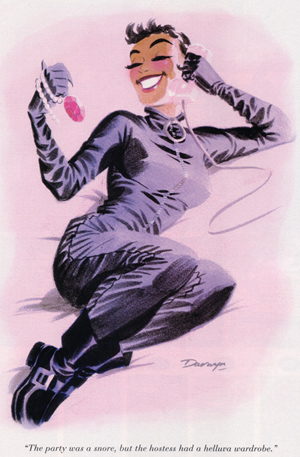
(Selina Kyle-Catwoman)

Congratulations to Darwyn Cooke who won an Eisner Award for Best Limited Series for The New Frontier on Friday at the San Diego Comic-Con. The Eisner awards are essentially the Oscars for the comic book world.


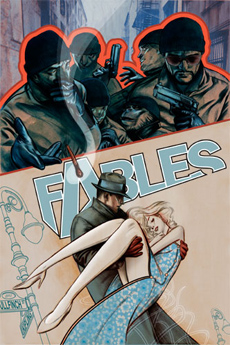
(Covers for Fables issues 12 and 18)

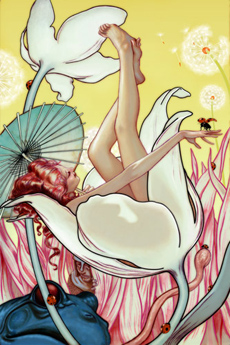
James Jean won an Eisner Award for Best Cover Artist for his work on Fables (as well as Green Arrow and Batgirl) and Fables itself won an Eisner for Best Serialized Story. Both Fables and James Jean are favorites so I’m really happy for their wins as well as Cooke’s. James Jean’s art is stunning. To sample the goods first hand you can download the first issue of Fables free in pdf format here and a sneak preview of the first several pages of The New Frontier here.

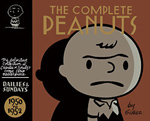
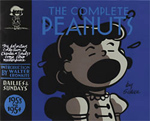
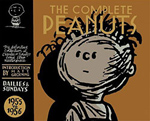
Fantagraphics won for Best Publication Design for their wonderful, magical ongoing series of Peanuts reprints. The first 3 volumes of this 25 volume set have been published thus far.

Every strip of Charles Schulz’s beloved series is being reprinted in book format in chronological order. I have all 3 volumes and they are beautiful books. The plan is to release 25 volumes, 2 per year, for 12 and a half years. More details on these books and the project can be found here.

These are the Eisner winners that matter most to me but the complete list of this years winners can be found here.

To close I’ll include a brief shout of congratulations to Eric Powell for his Eisner wins for The Goon and to Brian K. Vaughn for his Eisners for the new series Ex Machina. Both are really fun comics worth checking out. And a hearty congratulations to Jeff Smith for winning an Eisner for Best Graphic Album-Reprint for Bone: One Volume Edition. This is a grand, epic, and entertaining tale, especially if you are a fantasy/Lord of the Rings fan.

Speaking of LOTR, let me also point out that today in 1954 The Fellowship of the Ring was first published! A truly red letter day for fantasy geeks everywhere (present company included)!!!

Darwyn Cooke and the New Frontier


(cover image of issue 6 of The New Frontier)

Yes kids, it is Wednesday once again and I’m in the mood for a little comic book chatter. Jeff Smith, in a cunning ploy to take more of my money, recently loaned me his issues of the DC comics 6 issue series The New Frontier, written and drawn by Darwyn Cooke. It is safe to say that I have another comic book idol and I’m going to have to pick up copies of this for myself.


(back cover image)

Before giving it a proper read I flipped through issue number one. As I gazed at Darwyn Cooke’s art my heart skipped a beat, streams of light burst forth from the heavens and I could hear an aria in the background. Well, it felt like that anyway. Cooke’s art is reminiscent of mid-century “retro” science fiction art, advertising, and the “good girl” art of the 1950’s, all of which are personal favorites. Darwyn Cooke has a background in animation but his art cannot be relegated to being merely ‘cartoony’. His work has such a historic feel to it. I cannot say enough about how much I like the look of this book. Darwyn’s inks are very tight and Dave Stewart’s coloring is phenomenal. The New Frontier is nostalgia in print form.
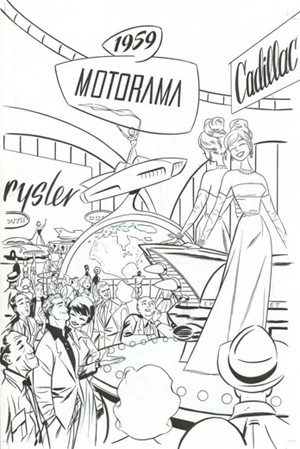

(New Frontier art page sans color)

The New Frontier not only showcases Cooke’s amazing artistic talent, which he has in spades, but proves he has the chops to write a good story. Set in the time between the Golden and Silver Ages of comics, Cooke has fashioned a tale that places DC’s comic heroes amidst real world events that were taking place during and right after WWII. In this period of war and paranoia the government outlawed all but the most stalwart of superheroes (Superman, Wonder Woman). Events, however, lead the world to a point in which heroes of all kinds had to be summoned in order to avert total destruction.

The New Frontier is told in a series of vignettes focusing on both well-known and lesser known characters from the history of the DC universe. While bound as 6 separate issues each issue was actually three times the standard comic book length. The varied plotlines are tied together within the framework of the rise of Hal Jordan to the role of the Green Lantern. Cooke uses the origin story of Hal Jordan to personify the real life “fly boy” pilot heroes of WWII and it works to great effect.


(Hal Jordan and Carol Ferris)

I love Darwyn Cooke’s response in this interview as to why he focused on the Hal Jordan character:
“Most importantly, I suppose, was my personal attachment to Green Lantern and Hal, coupled with the Mercury and Apollo Space programs. These were the stuff of my childhood imagination. It is almost impossible to explain to someone what it was like to be a kid during that era unless you were there. Today we worship fey actors and millionaire children who throw or hit balls. But the Astronaut — good f***, they strapped in on top of huge jerry-rigged tubes of unstable fuel and fired themselves toward the heavens!” (The entire interview is terrific)

Cooke does a masterful job of weaving these tales together in such a way that each issue builds upon the other and he then brings all the characters together for the climatic, world changing event. The story is fascinating on so many levels. It includes characters that I either hadn’t heard of or knew little about in addition to the major superhero characters. Cooke penned the tale in such a way that you can follow the story even if you don’t know all the players but also whets your appetite to find out more about these characters’ history. The inclusion of a portion of John F. Kennedy’s New Frontier speech in the denouement was a stroke of brilliance and evoked powerful emotions in me as I closed the final page of issue 6.

This tale speaks so well to the times we are in right now. It speaks to the need for men and women of courage and intelligence and belief to rise up and face the challenges of today’s world. It touches on the fact that heroes are not perfect but that we can rise above our base humanity during times of great need and touch the lives of those around us. And in both tone and art it points back to a time that we today glamorize as being a simpler time but one that Cooke believes is quite similar to our own. The stories are collected in trade form and continue to be available in their original format and I highly recommend giving this a read. Few comic stories grab me like this one did and I’m still in awe this creative masterpiece. You can glimpse a ‘sneak peek’ on the DC Comics site here.

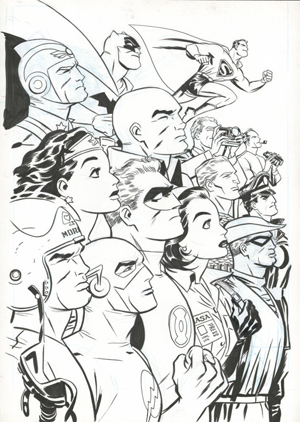
Here are some more examples of panels/pages from The New Frontier. These are from the original inked pages before colorization.
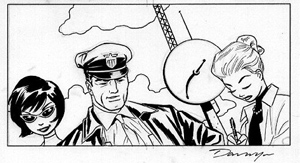
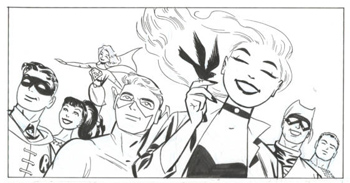
For fans old and new here is a link to a page featuring examples of Cooke’s art as well as some really cool sidewalk murals inspired by his art.

I’ll end this with the exciting news (at least to Jeff and I) that Darwyn Cooke plans on releasing a creator owned original graphic novel. In discussing this he mentions pondering whether “the notion of the heroic ideal [is] still valid today? Could I tell an exciting story that convincingly portrayed people doing the right thing in today’s society without seeming naive or nostalgic? It also deals with something I prefer to spandex — Giant Robots! I’m hard at work on this now, and I hope for a late 2005 release. Tentatively this book will be about 150 pages and will see a hardcover release first, with softcover to follow.”

Darwyn Cooke and giant robots!?!?!? Exciting days ahead, indeed!!!
The Faces of Fantasy

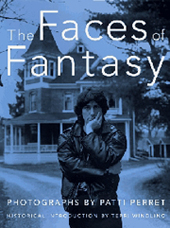
The Faces of Fantasy is a book of photographs taken by Patti Perret in and around 1996. She had published a book years earlier called The Faces of Science Fiction and found herself wanting to do a similar project and so, young children in tow, she traveled across American, Britain, and Ireland photographing various fantasy authors. That, unfortunately, is about as much information as you get from her introduction to this book. The book, borrowed from Jeff (thank you!), is a nice coffee table book-sized hefty paperback book and Ms. Perret’s black and white photographs range from commonplace to quite fantastic. The facing page of each photograph contains a brief comment by the author and at the bottom is a list of 2 or 3 of the author’s books.

All the authors, as the title suggests, are those considered to have written fiction that could be categorized as fantasy. I counted 101 authors whose photos are included. There are many things missing from this book that I would’ve liked to have seen. As I stated above there is little written about the motivation behind this project. There is no explanation as to why the authors in this book were chosen for the project. There is likewise no explanation as to why the books listed at the bottom of each author’s page were the ones chosen to be included as examples of their work. Were these books she has read, books that won awards, books the author picked him/herself to be included? Also, what were the stipulations given to the authors about what to write for their page? Some authors filled up the large space while others made one or two word statements. One author had unfortunately died while the book was awaiting publication and his facing page simply read “Edward Whittemore passed away.” What?!?!? The page is approximately 12X14 and all I get is that he died?!? Granted, everyone else wrote their own artist statements but surely someone could’ve submitted something about this guy to include with his photograph, otherwise what is the point? I would have also like to see Ms. Perret include some stories about this adventure of hers. She traveled the world and sat in the homes of some of the most amazing authors of our time and the only information we get about this is a few lines in the introduction written by Terri Windling. You get the impression that she traveled countless miles only to snap a quick photograph and leave. Maybe that is exactly what happened but it would be interesting to know this. I look at this book and see a great deal of lost potential.

Lest you get the idea that I completely disliked this book, please let me change my focus and tell you that I really enjoyed reading it. While there is a great deal of lost potential this book also holds a great deal of hidden potential. The introduction by Terri Windling is a fascinating historical look at the fantasy genre and is not one to be missed. One could simply jot down the authors and books that she mentions and have quality reading material for years to come. On a similar note there are many authors whose pictures are included that I had not heard of before. This is again potential for books to add to one’s reading list. And I gather that more than anything this was the point of this book. To introduce you to authors that you may or may not have heard of as a way of encouraging you to read their material. I enjoyed discovering the images of authors who I hadn’t seen before. I also liked getting a glimpse into the homes and yards of authors that I had seen. The cover image is a photograph of Neil Gaiman standing in front of the “Addams Family House” that he frequently talks about on his blog. Peter David, in a glamour shot pose reminiscent of George Costanza on Seinfeld, was the most entertaining picture. I also enjoyed seeing a more recent picture of Harry Harrison, whose appreciation for his readers was evident in his quote. Over all it was an entertaining and quick read. I was glad that I hadn’t purchased it but feel like I was bettered by the experience of reading it. I have more appreciation for authors that I already enjoyed, am curious about authors I hadn’t heard of, and I have a list of books spanning the last century that I would like to read.

(Terri Windlings’ site, The Endicott Studio, contains many excellent recommendations for fantasy reading along with many non-fiction articles about fantasy. Her essays entitled Les Contes de Fées: The Literary Fairy Tales of France and Women and Fairy Tales contain a great deal of the material she discussed in her introduction to this book.)