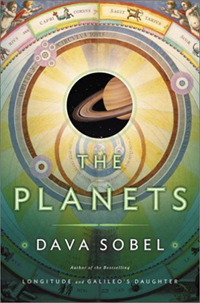
The Planets is a collection of essays about, you guessed it…the planets, written by long-time science journalist Dava Sobel. I first discovered Ms. Sobel’s work a few years ago when I picked up the newly released trade paperback book Galileo’s Daughter, a book that continues to be one of the most cherised nonfiction books I have read.
I grew up in the country, where the lack of city lights generated night time skies that were literally strewn with stars. My wonder and longing for space grew through a combination of Star Wars, Battlestar Galactica, my uncle Dean’s generosity with his science fiction collection and my 6th grade teacher, Mrs. Stewart, who brought in an inflatable indoor planetarium during that year. I really hoped as a child that we would be in space by now…as an adult I continue that dream through science fiction, looking at the stars, and stumbling across marvelous works by writers like Dava Sobel.
In Galileo’s Daughter Ms. Sobel chronicles Galileo Galilei’s great discoveries and crisis of faith when the truths he discovered contradicted long held church beliefs. The story is reconstructed through 124 surviving letters written between Galileo and his daughter, Sister Marie Celeste. It is a marvelous book that not only gives amazing insight into the astronomy of that day but also gives us a glimpse into the life of the convent. It also details the love that father and daughter had for each other and the great conflicts Galileo went through as he tried to honor the church while discovering great new wonders about the heavens of God’s creation.
The Planets continues Ms. Sobel’s love affair with the universe by taking reader’s on a “guided tour” of the universe. Each planet of the solar system is treated with its own chapter and each chapter is a unique and interesting essay of the wonders of these heavenly bodies. No two chapters are alike, Ms. Sobel uses the Bible, mythology, astrology, science fiction, art, music and even popular culture to share wondrous insights into our universe. Far from being a scientific textbook, Dava Sobel has an ease with words and a remarkable ability to make science real and tangible and understandable. Ms. Sobel herself states “If reading these pages [helps] someone befriend the planets, recognizing in them the stalwarts of centuries of popular culture and the inspiration for much high-minded human endeavor, then I have accomplished what I set out to do. For myself, I confess that none of the truly staggering data I have been privileged to share here has altered the planets’ fundamental appeal to me as an assortment of magic beans or precious gems in a little private cabinet of wonder…portable, evocative, and swirled in beauty.” This was her goal, and in this she succeeded. Some chapters were more interesting than others and some were downright fascinating, but overall they each contained insights that I did not know and feel the better for having learned. The most fascinating for me were the later chapters discussing Uranus, Neptune, Pluto and beyond in light of the more recent space vessels that have made the long journeys and sent us back pictures of what we could only once dream about. It is no wonder we have such wonderful, fantastical science fiction stories from when man first began dreaming of the stars up through today with such an amazing solar system as inspiration.
The packaging of The Planets is marvelous in and of itself. I love a well put together book and this one is beautiful. The dust jacket displays an illustration from a 1661 work by Andreas Cellarius. The center whole gives a window to the actual book art (you can see Saturn peeking through on the cover image above) which is Saturn set in a field of stars that covers the entire book. The typset, the interior illustrations…everything about this book is a labor of love…kudos to the craftsmen…and women…of Viking Press.
If you, like me, occasionally look up in the night sky and marvel (Orion the Hunter in these winter months, looming large in the night sky, takes me right back to that 6th grade planetarium) and/or you are just in the mood for some well written nonfiction I highly encourage you to read The Planets. I also can’t recommend Galileo’s Daugther enough. As Jack Horkheimer the Star Hustler says, “keep looking up!”
I love the cover of this book. It sounds great although I think I’m more interested in Galileo’s Daughter after reading the review. I hadn’t thought much about his struggle between his findings and his religous beliefs. That sounds very interesting. Thanks for the review.
The beliefs held at that time was that everything revolved around the earth but discoveries by Galileo and others really started to challenge that at a time when the church was not ready to hear it and the Inquisitors were around every corner. Good stuff.
Orion is totally the constellation i identify with.
Its the one I remember the most from that 6th grade class because, with the belt, its the easiest one to find.