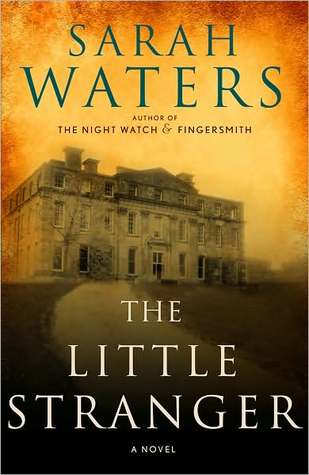
I was so excited when Andi and Heather offered to host a group read for this year’s R.eaders I.mbibing P.eril event. That excitement increased significantly when they announced that The Little Stranger by Sarah Waters would be their chosen book. The Little Stranger has been cropping up on RIP lists and reviews since its release and I have repeatedly felt drawn to the book. It was great to have this extra push to finally experience it for myself.
The Little Stranger is set in postwar Britain and its focus is on the decaying great house, Hundreds Hall, and its three lone inhabitants–Mrs. Aryes and her adult children, Roderick and Caroline. The story is told by a local physician, Dr. Faraday, who is called to the house to attend to the illness of a young servant girl named Betty who shares with him her feelings that there is something scary and unnerving in Hundreds Hall. As Dr. Faraday finds himself pulled more and more into the lives of the Aryes family, the strange and unexplainable occurrences slowly increase in frequency and intensity. Is Hundreds Hall a house that is truly haunted by something evil or is there a more rational explanation to be found amongst those tasked with keeping up the responsibilities of a life that may no longer be possible in the wake of World War II?
The Little Stranger builds in a slow, satisfying manner that relies on building up tension and on things unseen rather than on things that happen out in the open. In examining the lives of the Aryes family through the eyes of Dr. Faraday we get glimpses into the way Hundreds Hall must have been at one time and the sadness of what it has become. We get to know the three Aryes residents and Dr. Faraday intimately and they are fascinating characters. In Waters’ hands the reader is pulled into the story so subtly that I cannot help but think of the boiling frog analogy–you are sucked into the home by such small degrees that you don’t realize that it, and the novel itself, has taken hold of you until it is too late. I read The Little Stranger in gulps, taking in as much as I could as quickly as I could because I just didn’t want to put it down. For most of the novel it was a beautiful, eerie, engaging experience. I was, and in some ways still am, haunted by the story.
I say ‘for the most part’ because I found the end to be a disappointment, not for what occurred so much as my feelings that the ending was more murky than it needed to be and happened more rapidly than the story called for. Sarah Waters spent so much of the novel telling a nuanced story that the ending felt like too jarring a change of pace. That ending turned what would have been a great experience into a good one for me. But as you’ll see after the jump, that seemingly simple statement is far from that simple and my own words may put my assertions to the test. I am not merely trying to play on words when I say the novel has haunted me as it truly has. It has been on my mind steadily since I closed the final page and I don’t think it is a story that will leave me any time soon.
The Little Stranger has been praised by many and if you like a good gothic novel it is one that you may want to add to your list. I suspect I will be one of the lone voices of caution amongst the group readers and that is okay. I didn’t hate the book. I didn’t even dislike it. I liked it. Up until the very end I can honestly say I was loving it. But alas that feeling did not stay with me all the way through to the final page.
What follows is a SPOILER-FILLED discussion about the book. If you don’t want to be spoiled I suggest you stop right here. You will save yourself the disappointment should you choose to read the book at some point plus you won’t be subjected to my endless rambling that follows.
You’ve been warned.
And now for the SPOILER-FILLED conversation:
And I’ll just warn you here and now, I’ve had long, LONG conversations in my head about this book probably a dozen times since I finished it last week. I’ve composed many a mental blog post about it because for various reasons I continue to be haunted by the presence of this book. Suffice it to say this SPOILER-FILLED (is that enough warning?) discussion may meander all over the place. Apologies offered in advance.
As I indicated above, The Little Stranger had all the hallmarks of being a great book for me, one whose title I breathed out in reverent tones the way I do when I talk/write about Diane Setterfield’s The Thirteenth Tale. And quite frankly every time I read a contemporary (when it was written, not the setting) gothic novel I am consciously and unconsciously comparing it to my experience with Setterfield’s book. What stopped this from happening to me and left me with the feeling of The Little Stranger being merely good is the ending. It was not how it ended that bothered me. Not one bit. It was the execution of the ending that let me down.
I don’t have any problem investing my time and attention to a book that builds slowly, layering mood on top of mood to create an unsettling atmosphere that also has glimpses of a hopeful solution only to have it end in tragedy. Would I have preferred a more happy ending? To be sure, but that would have been very disingenuous to the story as it was written, as I’ll discuss in more detail later. What I hope for in that instance though is that the reveal of what is really going on is a) clear instead of ‘clear as mud’; and b) is executed with the same care, precision and nuance that the other three quarters of the novel demonstrated.
So lets take those two things separately. I am a fairly self-assured person in regards to my own intelligence and am self-aware enough to acknowledge that I don’t read with a Sherlock Holmes mindset. I am generally not trying to deduce what is happening and instead prefer to let the events wash over me so that I can be as surprised as the cast of characters at the result of the climax and denouement of a story. So I’ll readily admit that when I came to the end of The Little Stranger my first thought was ‘Whuh?’ It probably didn’t help that I was in a state of cold-medicine induced euphoria, but even had I had full control of my senses I suspect I would not have quite gotten exactly what Sarah Waters wanted me to get out of that ending. And thus I did two things: I went back and did some re-reading and then I used the magic of the interweb to find out what smarter people could tell me about what was supposed to have happened in the book. And as it always is with these things, once a clue or two is pointed out it becomes very obvious. I’ll take my share of blame for that but I’m not going to absolve Sarah Waters of hers either.
So what did happen? Well, my own opinion formed from reading a couple of different oft-repeated trains of thought in reviews/discussions and pondering the novel as a whole is that while the idea of “the little stranger” put forth by Seeley (I think it was him) and pondered by Dr. Faraday in relation to the house and later more particularly Caroline is the more probable explanation for the occurrences at Hundreds Hall, it is not Caroline from whom this energy/emanation came but was from Dr. Faraday himself. Which makes perfect sense once it is pointed out. After all, Sarah Waters essentially reveals that at the very beginning of the novel when we see Faraday as a child, a ‘little stranger’ allowed a moments freedom in Hundreds Hall, vandalize the home in his adoration for it. He makes the statement in his present narration, looking over that event, “it was simply that, in admiring the house, I wanted to possess a piece of it–or rather, as if the admiration itself, which I suspected a more ordinary child would not have felt, entitled me to it.”
In retrospect this is a brilliant scene as Waters essentially hides the truth in plain site, that Hundreds Hall is indeed a haunted home, but its possession is not the result of some unexplained occurrence but finds its root in that of a little boy obsessed. That line itself also reveals very cleverly that we should expect Faraday to be an unreliable narrator, which is something that did not occur to me until much later on when he began to unravel. And it is because I believe that the little stranger is a part of Dr. Faraday that I believe he didn’t physically enter into the home on that fateful night near the end of the story to push Caroline over the edge of the balcony but instead the part of him that had splintered off and was possessing the house did so, that it finally went from mischievous to full malevolence once Dr. Faraday’s romantic advances were well and truly rejected and the prospect of him losing Hundreds Hall was all but assured.
The fact that there is speculation on either side, while interesting to converse about, is to me one of the weaknesses of the execution of the ending. That small part of the story where he falls asleep in his car and has a dream which could be interpreted as a memory of him killing Caroline is just not as nuanced and carefully crafted as the rest of the book and seems jarringly brief and vague in comparison. I read several comments from people who interpret this part of the book as him very much doing the physical act of killing her. I can’t do that. It just doesn’t ring true to me with the story as Waters set it up. There is way too much time spent on the supernatural occurring in the home for there not to be some sort of supernatural manifestation going on. It is too elaborate of a red-herring and most of the rest of the story to me falls apart in the face of Faraday actually killing Caroline himself.
One of the reasons people were espousing this theory is that the occurrences in the home started before Faraday arrived, because as we are told he first goes out to the house as an adult when the servant Betty has an experience. But what we are also told is that Faraday has been hanging out near the house on that drive, the place where he later takes Caroline after the dance. It is a place he is familiar with. A place from which his obsession with Hundreds Hall could and would eventually birth a physical, haunting presence in the home. Also, Waters goes out of her way to tell us that Betty heard no footsteps in the house before Caroline plunged to her death, that there was no indication of another person in the house. I don’t see an author of Waters’ talent playing both sides like that, telling us that there is no evidence of him being in the house and then expecting us to interpret his dream as evidence that he was. What makes more sense is that there really was a ‘little stranger’ in the home, and given the fact that the story ends with all the Aryes’ family out of the home permanently, it makes the most sense that this was an extension of Farady.
So there is my take on that. I’m not saying I’m right, that is just what I believe based on what I read of others’ thoughts and came to on my own further examination. It is what makes the most sense to me. As for b) I don’t mind a bit of ambiguity if there is the potential for figuring the thing out. I think there is a real, palpable ending here and one that has its own deliciously sinister elements, I just don’t think it was as (and here I’m using this word again) nuanced as the rest of the book.
For hundreds of pages Waters lovingly crafts this slow moving story that allows us to get a real sense of Hundreds Hall and its inhabitants, and also of its narrator, and at the end I felt like she gave us too little. I don’t know if the intent was to make the end climactic by creating a false sense of tension based on the pace of the story being quickened or what, but I personally just felt cheated by an ending that rushed too quickly to wrap things up. Watching Faraday’s unraveling into obsessive madness was great, and is another sign of Waters’ skill as a writer, but in that madness I felt that things were either too conveniently wrapped up, or to quickly wrapped up, or some combination of the two. It is hard to exactly put my finger on it and all I can really say by way of explanation is that the last part of the book did not feel at all like the first and greater part of the story.
So after all this rambling, and it is indeed rambling, would it be right to conclude that despite my non-spoiler thoughts at the beginning that I really didn’t like this book. No it wouldn’t. This is a great book…until the end. And the end doesn’t turn it into a bad book, it just put a wet blanket over the whole of the story for me. In looking back over the story for the past week and examining it more minutely in my memory, there is so much of brilliance here. Waters leaves hints and clues everywhere and she is so very successful at building up the atmosphere of Hundreds Hall that even though in reality very little happens, you can still feel the house haunting the lives of those present.
In addition to its mystery I found it a great examination of the fate of the upper class in the wake of World War II. I knew little about this part of British history until I watched Foyle’s War and read Bill Bryson’s book At Home a few years ago (both would be great companion pieces to The Little Stranger is examining this time in British history). There is something both hopeful and sad about the fall of the great houses in England. Hope springs from the idea that there would be less of the haves and have-nots (though that is probably a false hope) and yet there is also something melancholy in looking back through our romantic, rose-colored glasses at a time when there were ladies and gentleman, when there was a below-stairs and above-stairs. And I think that period of history is fascinating and is deftly woven throughout Waters’ tale.
There is a nice Fall of the House of Usher feel to the book that I particularly enjoyed. I had to laugh when I first saw that the male heir of the home was named Roderick as I have no doubt that was a nod to Poe’s famous story about the madness and downfall of a great house. Like a young Faraday, and later an older Faraday, I found myself hating the idea of Hundreds House falling further and further into disrepair. I hated seeing the land so close to the house sold for what would be cookie cutter housing options. There is something very romantic about sprawling estates, enormous gardens and huge houses like this and I thought Sarah Waters conveyed the sadness of this passing of time very genuinely and authentically without being obvious about it. It made the story lovely, sad and of course eerie at the same time.
I thought her handling of Dr. Faraday was brilliant. He seems so normal and at first you really find yourself rooting for him and for Caroline but there is something that is always a bit off about their relationship and the longer the story goes on you start to sense there is something off about Dr. Faraday himself, a fact that is born out once he is rebuffed by Caroline and then reacts more strongly to the idea of losing Hundreds Hall than he ultimately does at losing Caroline. As I mentioned above, it would have been disingenuous to the way in which Waters wrote this character to actually have things work out for him and Caroline. Examining him over the course of the whole novel it becomes very clear that he is an unreliable narrator, not because he is purposefully skewing the truth but that in his very inability to accurate diagnose himself and the source of the troubles he is actually oblivious to that truth.
I am so very glad that I read this book and while it did not live up to my very high expectations and ultimately left me disappointed with the ending, it should be obvious by now that it is a novel that will stick with me for a long, long time. Looking at it as a whole I would give it a 7/10 stars, which may seem generous from my complaints but given that up until the end I was considering it a 10/10 and the fact that I was so deeply engaged in it from start to finish, this seems to me to be a fair assessment of my experience with the story.
Feel free to disagree with me, point out my mistaken assertions (after all, I did admit to being the guy who had to go out and get someone to tell him what happened at the end), or what have you. I think this could be a fun book to talk about and you are not going to hurt my feelings. I don’t expect anyone to follow after me, this is just the way I feel a week after the fact.
Thank you so much Andi and Heather for hosting this thing. It felt like a RIP book, and that alone is high praise in my book as it is that feeling that I am chasing every year with the books I choose to read in September and October.
For those interested in what other people thought, here is the link to everyone’s wrap up post.
I loved the ending of The Little Stranger, and I think it’s a wonderful book, but it’s not my favorite of Sarah Waters’s books. It’s wonderful! Quite quite wonderful, but I didn’t find the characters and plot quite as compelling as in, say, Fingersmith or The Night Watch. I do LOVE the direction she went with the story and the poltergeist though.
I liked that part of the direction of the story too, Jenny. I wanted it to be a story of a haunting and liked that she tried to ground it in some degree of plausibility, for lack of a better word, with some of the theories that would have been out there in that time period. I just wish it had been executed better, or differently, or something. I guess in the end I found it lacking a bit and that is why it is hard for me to pinpoint just where or how it went off the rails a bit for me.
Interesting response. I was fine with the ending. The book grew on me and I ended up loving it.
Did you make anything of the photograph that might or might not include his mother. I kept expecting it to do more somehow in the plot.
I know towards the end he looks at the objects he’s collected – a medal, a photograph, a whistle, a pair of keys and an unworn wedding ring and talks about how they would have told a story with himself as hero of the tale. He looks for a meaning and is defeated. But I wondered about correspondences to the dead and removed (Gyp, Rod, Mrs. Ayers, and Caroline) and if those possessions somehow allowed him to gain supernatural access to the house and its inhabitants though it seems that would have been mentioned if that were the case.
I hadn’t really made much of anything of the photograph and although it didn’t make a huge impression it does make sense looking back that maybe it should have done more, or perhaps I just didn’t get it. Then again I also think his collection of treasures from Hundreds Hall, which included that picture, were yet another clue that he was the one who was most deeply attached to the home and that it would have essentially been him that the house used to works its will.
I certainly think those items could have been an extra grounding for him to the house, now that you mention it. Good point.
I felt the same way about the book, Carl. Everything was going really great up until the end. I still think it’s a great book (and so is The Thirteenth tale, but that story felt more “complete”), except for that ending. That being said I would very much like to read other novels by Waters, perhaps Fingersmith.
I’m not as interested in her other books myself. This is the one whose description has always caught my eye so I’m glad I read it. She is very talented, no doubt about it. I guess one of my wishes would be to find a copy of this in Lucien’s library (a reference to a place in Neil Gaiman’s Sandman universe) that would have the ending handled in a way that would make me giddy.
If you do read another of her books you’ll have to let me know how this compares. Glad I’m not alone. But I have to say that I don’t entirely mind given that most of the book was so good. I mean it does take the edge off the disappointment, doesn’t it? It sort of reminds me of this exchange in Anne of Green Gables:
“I can’t help flying up on the wings of anticipation. It’s as glorious as soaring through a sunset… almost pays for the thud.”
— Anne, from Anne of Green Gables
“I’d rather walk calmly along and do without the flying and the thud.” – Marilla Cuthbert, from Anne of Green Gables
I’d rather experience the flying when I read, even if for one reason or another it brings with it the occasional thud. The reason I cannot shake The Little Stranger is because for the majority of the novel I was flying, and I didn’t even realize I was falling until I hit at the very end. And as I landed relatively unscathed it is hard not to let the memory of the landing fade into the background when remembering all the joys of the flight.
I’m obviously getting sleepy as I’m getting all goofy and sentimental with my remembrances. 🙂
I read this too long ago to “having feelings about it” now.. however I do remember being somewhat disappointed,but then again I DO still compair many books to The 13th Tale. Can’t help it ..maybe because I read 13th Tale 3 times? Anyway, Like others here I also liked Fingersmith more than Little Stranger
Yes, we both see eye to eye on The Thirteenth Tale. It is hard not to hold that up as an example since it mesmerized us so much.
I had a similar reaction to the end, but it never crossed my mind that it could have been the Dr. all along, but not physically him. I kind of assumed her physically killed her, but your explanation is actually much more satisfying because it explains the entire supernatural theme in the book. I love your quote from Anne as well. I feel the same way about books. Sometimes it’s worth flying even if the end lets you down. I also tend to judge a book more harshly if it’s wonderful right up until the end and then disappoints becase my hopes are so high for what it could have been.
It wouldn’t have crossed my mind either if I hadn’t done a bit of digging around to kick the little gray cells into gear. Once I had a hint or two then my mind was off to the races.
Anne of Green Gable is so full of wonderful quotes, isn’t it?
This sounds good, I’ll have to track down a copy! Our local sports talk station has been playing Bob Frescoe’s rant about KC sport teams. Someone needs to slip him a Valium!
I’d be very interested in your thoughts on it George.
And while he has every right to rant about this disaster of a team, it is ridiculous that he should do so. After all, he is technically a ‘professional’ and should act like it.
I think you’ve said everything on the book that could be said 🙂 My annoyance with the slowness (and indeed, Waters could have used all these pages in a more efficient way, because I didn’t feel much love for the house, the family or Faraday at all) of the story probably worked as a blinding veil, because I completely missed out on the Faraday = Little stranger theory. It does make a lot of sense though. But I’m not sure either whether it was Faraday who (sleeping pretty close to the house, lying in his car) went into the house – spirit or no – and chased Caroline to her death. I’d really liked to have seen Faraday come to a terrible end. That is why I think the ending of the book is a disappointment.
I didn’t mind Faraday not meeting his just end, per se, as I suspect he will crumble and collapse in on himself in that house and honestly I loved the slowness of the build up but it becomes hard to justify it when the end is confusing or misleading or at best not given the same amount of attention as the rest of the book. You bring up the house and I would have actually liked to have spent even more time in the house, exploring other corners of it. It would have made the house more of a character than it was and might have helped to sell the idea of what was really happening more effectively.
I am sorry this was a disappointment. I have wanted to read it for a while, but didn’t happen yet…
I would still recommend you give it a try at some point. There is a lot to like here and going into it with tempered expectations might leave you feeling blown away by the experience.
Carl, thanks so much for such a wonderful, thoughtful post on this book!!! It’s one of my favorites (and my first completed novel by Waters), and I am looking forward to finding out how her other work stacks up against this one.
I’m so thrilled to have finally read it. Although I had some problems with it I am very glad I read it and am pleased with so many of the moody, gothic elements of the story. It isn’t easy to find stories with such thick atmosphere and so in that sense this was a real pleasure.
Very nice write up. I too enjoyed this book and wouldn’t hesitate to pick up another Sarah Waters book.
I noticed the pace of the book picked up at the end and I was OK with it. We had all the nuanced background and it was time to do something with it. I did NOT expect the ending tho – the final death and Faraday’s reaction. That is always a bonus for me – a book catching me off guard and going beyond what I expect the writer to do.
I didn’t mind the pace picking up so much as that the increased pace made the unveiling of the ending feel very rushed and didn’t, in my opinion, make the connections with the rest of the story with the clarity that would have made this and excellent book for me.
I do like being caught off guard too, I just don’t feel that I should have to go outside of the book to make all the connections leading to the surprise.
I first read this for one of your RIPs, can’t remember which at this point, but like you I decided to read it after seeing it on so many blogs getting so much praise. I loved the slow build up, loved the mood Waters created, and honestly? I can’t remember the ending now. How embarrassing is that?! But, I’m rereading it with my book club, as I suggested it for October, so I’ll have a chance to refresh my memory. Still, it remains one of my favorite autmnal reads; eerie without being necessarily evil.
Okay, just a little evil.
That isn’t embarrassing at all, Bellezza. I do that all the time. It is what makes re-reading beloved books so much fun. It is just a ‘little’ evil, a perfect amount really. It isn’t so sinister that you feel dirty after reading it which is the right level for me.
I’ve read many of the books you talked about on your blog, including this one and I feel the same as you about it. Off topic: I’m finally reading Gaiman. I loved the Cemetary Book (heard about it here) and that’s where my experience ended, for a bit. One day, I was googling audio books and noticed that Lenny Henry did the reading of Anansi Boys. I adore his voice, so thought…why not give it a try and I’m glad I did! I was concurrently reading American Gods (The Tenth Anniversary Edition) with this book, and can’t wait to devote myself to it! So good! Thanks, Carl 🙂
I am thrilled to hear that you are reading, and loving, Gaiman! The Graveyard Book is a lovely one. Lenny Henry does a fantastic job with narrating Anansi Boys. I read it when it first came out and every subsequent “re-read” has been with the audio book. You are so welcome, and welcome onboard the Gaiman fan wagon!!!
I read this a while ago and whilst I enjoyed the writing style I was also disappointed with the ending and also I didn’t find it quite a chilling as I was hoping. I do think the author has a fantastic turn of phrase though.
I also thought The Thirteenth Tale was a great read – that definitely had a few ‘hairs on the back of your neck standing up’ moments.
Lynn 😀
Waters definitely can write, there is no doubt about it. I didn’t mind it not being as chilling, but like you I did expect it to be more so than it ultimately was.
From your review, I think this would be a book I’d really enjoy. Alas, no time in the near future, but maybe I can catch up next year.
I so know that feeling Chay! I do hope you can take some time with it someday.
Like you I didn’t like the ending. I felt it was far too open-ended. I felt there were too many options at the end that were never cleared up.
Was it something in the house all along
Was it Susan
Was it the Doctor, and if it was, was it intentional or some sort of subconscious obsessive supernatural event.
but since then I’ve read a few reviews, especially over at Fig and Thistle, and I think that a reread at some point might prove useful 🙂
I think a re-read with that knowledge would certainly make the book come alive more and I’d catch more things, but I can’t imagine ever actually doing it. I miss re-reading books as I don’t do it nearly as often as I used to, but the allure of new, to me, books has proven so powerful over the last few years especially that even the best laid plans to re-read often fall by the wayside.
Carl,
I missed the readalong for this as well but I ended up picking it up at the bookstore when I kept seeing people mention it around the web. I totally agree that I was very disappointed with the ending, but can’t really imagine another. I tried to think from Faraday’s perspective and question if I’d actually believe that strange things were occurring without a rational explanation. In the beginning it seems that he is confident in his diagnosis of her brother, but much less so as those begin to perish one after another. You’re right in saying that he’s so attached to Hundreds House, or what it embodies, that he’s willing to do anything to prevent losing it. My biggest issue was the pacing. It was so slow and uneventful at times. I applaud Waters and her ability to build the setting but I just felt there were lags that didn’t necessarily need to be there to set the mood.
I can’t imagine another ending either and I would really have been more okay with the ending had it been handled with the same care as the rest of the book. It felt to me that she did not take enough time at the end to really savor it, especially after such a slow, deliberate build up. I didn’t mind the slowness at all but I do know that I just happened to hit it at the right time. Most of the time I would have been annoyed by the pacing but I was very much in the mood for that kind of book when I picked it up so it worked for me.