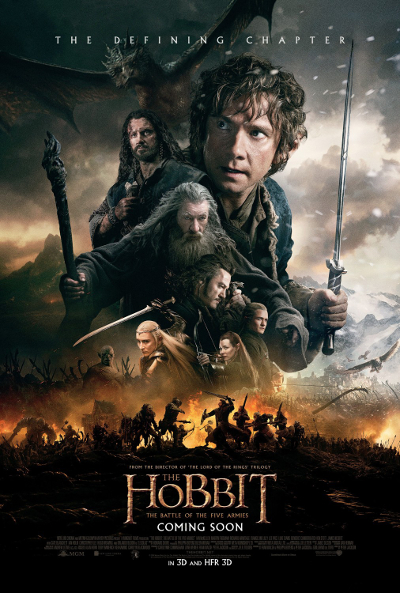
There…and back again. Thus ends* the Middle-earth journey of Peter Jackson and the crew of film makers who made the worlds imagined by J.R.R. Tolkien come alive on the big screen.
It is with a degree of sadness, which will undoubtedly grow over the coming weeks, that I say ‘goodbye’** to these characters, the lovely country that is Middle-earth (er…New Zealand), and to the dedicated people, seen and unseen, who made this journey special.
On Friday evening I sat in front of a forty foot curved screen and watched The Hobbit: The Battle of the Five Armies bring Bilbo’s unexpected journey to an end. It was a spectacle, filled with some memorable performances. It had some flaws, to be sure, but that did not stop me from enjoying the moment.
The following thoughts on The Hobbit: The Battle of the Five Armies presumes that you have seen the previous two films and, unlike my normal Film Review process, will contain spoilers.
The Battle of the Five Armies is certainly the weakest of the three films in regards to plot. What you essentially have here is the climax of the story, without the natural arc of a beginning, middle and end, and because of this has fueled, and will continue to fuel, the criticism for The Hobbit having been stretched to three films. Incidentally, there are some interesting things revealed in the extras in the Extended Edition of The Desolation of Smaug regarding this, which tempers my criticism to some degree.
The film, of necessity, throws you right into the thick of things with Smaug descending upon Lake Town to exact his vengeance. It is an all-too-brief moment of fiery destruction for those who enjoy Benedict Cumberbatch and the digital production team’s realization of the last great fire-drake in Middle-earth. What you do see of Smaug is impressive, and Cumberbatch gets a chance to upstage all the other performers with a few meaty lines of dialogue. I have been, and remain, impressed with what Weta Digital accomplished here.
As the people of Lake Town turn to seek the promised aid of Thorin Oakenshield, the film takes us inside the heart of Erebor, where Thorin’s madness, his gold lust, is coming to affect his judgment.
The Hobbit was always an emotionally turbulent story in this regard: from the very beginning we find ourselves torn between wanting desperately to care about these characters while at the same time seeing evidence that these are people groups divided by racial prejudice, self-centered world views and questionable motives. Sure, there is a grander scheme at play that means salvation for, or damnation of, all the peoples of Middle-earth, as Gandalf reminds us with references that are cryptic to his companions and to those who have not seen nor read The Lord of the Rings. I am thankful for those moments in the story, shown in An Unexpected Journey, where Bilbo (and Bofur) articulate the plight of the dwarves being without a place of their own to call “home”. It is important to cling to that deeper motivation as you see Thorin overcome with dragon sickness, greed for both gold and power consuming him.
The first half of The Battle of Five Armies is gut-wrenching in this sense. There are fewer moments of natural humor to lighten the weight of watching a group of people suddenly bereft of home being rejected by those sho caused their grief by the reclamation of their own home. And it was always going to be this way near the end, as you could see the faults in Thorin’s character in the first film. This continues long enough to be uncomfortable, which is fortunate because it does not minimize or marginalize the trials that Thorin is facing…and failing.
Mercifully, however, the film takes its turn at the crucial moment and we begin to see the rising of one of the themes of Tolkien’s work: hope. Hope in the most desperate of circumstances. Hope…the opposite of despair. The latter half of the film is very engaging and in it Peter Jackson works to bring this trilogy to the kind of end which gives viewers satisfaction and glimmers of the aforementioned hope, while also acknowledging that the battle for Middle-earth has just begun.
I WARNED YOU BEFORE, BUT HERE BE MAJOR SPOILERS!
It has been fourteen years since the one, and only, time I have read The Hobbit. To say I barely remember anything of the story is a gross understatement. It has been a great pleasure to watch these films and experience the bulk of the story as if I had no previous knowledge. Thus it was a great surprise to see Fili die, followed by Kili, followed by Thorin. I half expected the oft-seen magical recovery moment to happen, at least for one of them. It gives me a new level of respect for J.R.R. Tolkien in that he wrote a book for children which had some very grown-up ideas for readers to confront.
I’ve read some of the complaints for the previous films of the inclusion of Azog the Defiler. While Azog only has a brief mention in Tolkien’s work, as the “goblin” who killed Thror in the Mines of Moria, it makes sense to give Thorin and company a worthy opponent in the films. I credit Peter, Fran and Philippa for using an existing character in the history of Middle-earth, and one for whom Thorin would have a legitimate enmity. Did I enjoy everything about the Azog storyline? No. But overall I did like having a central villain upon whom the heroes, flawed as they were, could focus. I found the scene in which Azog floated under the surface of the ice, while Thorin paced his body from above, to be riveting. You knew it wasn’t over, but the scene was slow enough to unfold that it made the time leading up to that moment all the more tense.
I also know there was some complaint about the inclusion of the invented character, Tauriel, but I had no problem with it. Tauriel gave the adaptation of Tolkien’s work a much needed onscreen female presence, her love story with Kili gave the story a romantic element that it otherwise would not have possessed, and she was a character who provided a bridge, and thus a level of hope, that these two disparate peoples may be able to come together. It was a calculated risk, mitigated in large part because Peter Jackson knew from the start that Kili would have to die. I admit to being curious throughout this process at how they would end that story line in a way that did not minimize the unexpected friendship of Legolas and Gimli. Kili’s death allows that to happen without devaluing the love between Tauriel and Kili. I was also impressed by the way in which that love gives Thranduil an opening to be decent near the film’s end.
Did anyone else want to stand up and cheer when Thranduil sent Legolas to the North, in hopes that he would meet a certain Ranger?
The Hobbit films may never be something I love with the same passion as I do the film adaptations of The Lord of the Rings. That is perfectly okay, I never expected them to be. The source material, absent the ability for the writers to access information from The Silmarillion, is too thin for a film trilogy. Yet I am happy that a film trilogy exists, all the same. My appreciation for each of the first two films grew exponentially after watching the behind the scenes documentaries on the Extended Editions, and I suspect that will be the case with The Battle of Five Armies.
I’m appreciative that these films were made because a decade ago I was introduced to a cast and crew in New Zealand that did something incredibly special, a group whose dedication and passion inspired me then and inspires me now. The films sparked a passion for the life and works of J.R.R. Tolkien and for that I am eternally grateful. I was happy to see the reins of The Hobbit returned to Peter Jackson. I am a fan of Guilermo del Toro, but I never wanted anyone else to be at the helm. Do I agree with everything Jackson did here? No, but I had a few (very few) issues with The Lord of the Rings as well.
I found the video-game like stone-hopping of Legolas in The Battle of Five Armies to be very stupid. Sending Legolas and Tauriel to the North, while it explained some plot points, did not really work well (though I’m holding out hope for more footage in the Extended Editions). Legolas’ bat-riding was equally silly and while I don’t expect fantasy and science fiction films to fully honor the sciences, I do think Beorn’s legs would have shattered into thousands of tiny splintered bones given the distance from which he dropped onto the battlefield. He is a shape changer, but he is not Odo.
Despite those ultimately minor issues, and the more major issue of the film taking a while to find its emotional core, I truly enjoyed The Battle of Five Armies. As I sat between my wife, Mary, and my friend Jeff, watching Alan Lee’s art accompanying the credits and listening to Billy Boyd sing, I was both satisfied and saddened that this will be the end of fresh journeys to Middle-earth…
**at least until the Extended Edition comes out in November 2015.
*and I’m still holding out hope that the Tolkien Estate will come to their financial senses and give Peter Jackson the rights to The Silmarillion.
It is a big-screen film, do yourself a favor and take in a holiday viewing at your local theater. Love it, hate it, or fall somewhere in between, it is a spectacle best suited for the big screen.
Like you, I hope the Tolkien Estate lets Peter Jackson make a movie (or three!) of The Silmarillion. Rick Robinson plans to buy the EXTENDED EDITION DVDs when they become available, too. He already has THE HOBBIT: BATTLE OF THE FIVE ARMIES soundtrack.
The Extended Editions of Unexpected Journey and The Desolation of Smaug are terrific. I enjoy the added footage, and the hours and hours of behind the scenes documentaries are such a rare treat. We took Desolation with us to a friend’s house tonight and all watched the three-part documentary on bringing Smaug to life and followed it up with the doc on the music for the film. It is all so good.
Peter Jackson and his crew know how to “enhance” the viewing experience for fans of Tolkien. All those extras on the DVDs and Blu-rays make them “must-buys.”
Yes they do. I love those extras.
I’ll be honest, if I had to sum up tBotFA in one word it would be disappointing. I know all three are flawed and suffer from padding and, as you say, stretching, but I enjoyed the previous two much more than this one. It really was like butter spread over too much bread 🙂
I think a lot of people will feel that way, Fence. I’m still glad there were three films, in part because we will get to see even more stuff in the Extended Edition when it comes out. I wish they had been able to find a way to bring more of the non-battle story into this third movie, though.
Since I have seen none of these, I couldn’t read your review. I’m waiting for the super deluxe extended versions box set with tons of extras to come out (in a year or so?) to see the whole shooting’ match. I saw each of the LOTR films in theater, but knowing Jackson was stretching one book into three films kept me away from these. So some day, I guess, I’ll see these three and then I can read your review. Meanwhile, in a word, did you like it?
Yes. Not as much as the first two, but this one feels more like the second film was cut into two parts, like they are doing with Mockingjay, and I kind of entered it with that mentality and it wasn’t such a big deal.
The crew who makes these films are so talented and passionate about Middle-earth that I was thrilled when they decided to make this a trilogy. More has always been better for me when it comes to Peter Jackson adapting Tolkien.
I agree it would be great to have the Silmarillion on film, but no more than two films, please.
The Simarillion covers thousands of years of Middle-earth history, there is more than enough material in there for several films.
My brother and I went to see this one yesterday (it’s a tradition: we’ve been to see all the Middle Earth films the weekend they come out), and I actually liked this one better after leaving the theater than I did about Desolation of Smaug. (Although that one improved for me after watching the extended edition.) Although it didn’t have the strong narrative arc contained within it, I felt like we were finally watching the payoff that’s been building up through the first two films, and some of Jackson’s decisions finally made sense to me. (I haven’t made it through all the EE extras yet.) I hadn’t been sold on the Tauriel/Kili relationship, but the emotional resonance it brought to Kili’s death made it worth it. I also liked the decision to seperate Thorin, Kili, and Fili (plus Bilbo and Dwalin) from the rest of the battle as I thought it made it easier cinematically to tell their story. In some ways I still feel that the films could be made more concise and recut into two, but all in all I like the trilogy of the Hobbit in the end, just not as much as The Lord of the Rings.
As for the Legolas defying gravity stair steps, not to mention the whole tower stays together until we bump into it even though it’s suspended on its side over a chasm and doesn’t appear to be held together by so much as mortar, that didn’t annoy me so much as making me laugh–not out loud as no one else was!–but I was thoroughly amused. I imagine the design/concept team having a whole lot of fun with that one….
That is a fun tradition!
I enjoyed Desolation in the theater, but like you felt much more pleased with it because of the extras added in to the Extended Edition, particularly the scenes with Beorn.
We did a bit of laughing out loud at the Legolas part, or at least chuckling, as it was far too silly. But this was a movie adapted from a children’s book, so I can give them the silliness. If I could self-edit the movie I would cut that part out, but it didn’t ultimately affect my enjoyment of the movie.
The extras on Smaug indicate that principal filming was done by the time the studio decided to add another film, which involved calling the cast back and a lot of re-editing of both Smaug and Battle, so it does make sense that this one doesn’t have the same story arc as the other films.
I’ve been reading comments and replies to this thread, and I’m a bit surprized that folks refer to The Hobbit as a “children’s story”. I always considered Tolkien’s work as adult fiction, primarily because of the depth of the story. While The Hobbit is written with a lighter spirit than the LOTR, it always seemed to me that was because it is represented as being written in by Bilbo, who has a jovial nature.
The LOTR also starts out somewhat lighthearted with the “Long Expected Party” chapter, but it quickly turns much darker and more serious as some of the “Great” folk are introduced (Aragorn, Boromir, Theoden, etc).
Taken together I would consider the set more of a tragedy than a child’s story, with the painful but necessary passing of the 3 rings, and the ending of the Third Age.
One interesting twist to the Battle of Five Armies – did anyone else notice the addition of the Sand Worms? For just a short time I felt like I switched the channel and jumped into the middle of Dune! But it fit well, and explained how the goblins were able to sneak up on the hosts already in the area, something the book never did a very good job of. Overall, I really enjoyed the production, and look forward to seeing the extended version.
While Tolkien had been working on elements of his overall mythology for a long time, he did make up stories for his children often and The Hobbit was born in part out of that. The Hobbit is certainly much lighter than The Lord of the Rings, although Tolkien didn’t sugar coat some elements of the story, like death.
I had the same Dune thought when the worms came out. I was surprised that they looked that similar to the Dune worms, I would have expected Peter Jackson to want something wholly different.
I’m with you, I’m already looking forward to November next year and the EE of this film. I cannot wait to see what they add, but I also look forward to the documentaries where the cast and crew say goodbye, maybe forever, to Middle-earth.
Sand worms? In The Hobbit? Now I am afraid.
I could never be a critic! I don’t think I could say anything not right in any of the Tolkien movies that Peter Jackson made (nor King Kong). Even Legalos outrunning the destruction of the tower made sense to me after watching Legalos do the things he did in the other movies… even how far and wide he could jump during the water barrel scene.
I will forever admire Peter Jackson imaginative view of all the books… they certainly brought them to life for me, and I am more than sad they are over. (I am not a lover of The Simarillion but would see it for no other reason then Peter Jackson) I have seen the movie twice now…and I am glad I don’t see faults when I go to the movies! If I do see a fault anywhere..it has to be a hum-dinger! lol