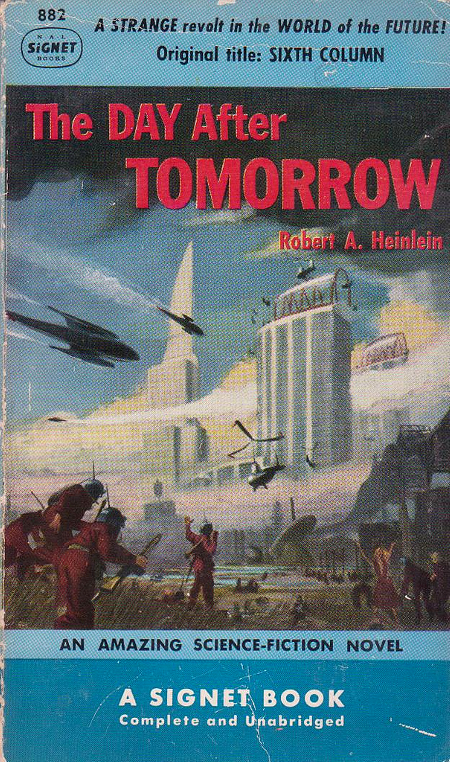
6 Men–against 400,000,000
So the dramatic language of the back cover states, a battle against impossible odds, “the adventures of a handful of soldiers of the future, fighting to save America from a deadly invasion”.
Major Ardmore has just arrived at the secret location of a small scientific enclave as the news is broken that the United States has been summarily defeated by a combined Japanese/Chinese force referred to in this undisclosed future as the PanAsians. In an effort to stay protected from the spread of communism in Russia the United States had spent decades essentially ignoring the world outside its borders only to see Europe fall and the red menace coalesce the Asian and Indian continents into a juggernaut of world power. The PanAsians look upon the Americans as a lower species and with superior forces occupy and enslave the American people, creating a system in which the citizens of the United States are by and large an impotent and cowed populace.
Ardmore arrives to find that this group of scientists has discovered, through an accident of testing, a weapon that may provide the key to the return of freedom to the nation. That is, if Major Ardmore can marshal this 6-person team into a strategic force to infiltrate and reclaim America.
Robert A. Heinlein’s tale, originally published in serialized form in the early months of 1941 as a story entitled “Sixth Column”, could be accused of being a racially insensitive jingoist tract or is quite possibly one of the most eerily prescient stories ever written. Given the complicated nature of Heinlein and the curious origins of this story, I suspect that both are fair assessments of what is a compelling and highly readable novel, especially when considered in the light of the time period in which it was written.
America had not yet entered the conflict of World War II when Heinlein’s tale was published over the first three months of 1941 in Astounding Science Fiction. According to Wikipedia the story goes that Heinlein’s editor, John W. Campbell, had suggested this story after Campbell himself had written a story that was deemed unpublishable. Heinlein stated that he “had to reslant it to remove racist aspects of the original story line”. Given the story as it exists today, one can only wonder just how overtly racist Campbell’s story was.
The Day After Tomorrow presents this future amalgamated “Asiatic” nation as highly racist in their own right, enslaving and degrading the “whites”. In turn the language used by the Americans featured in the story points to the PanAsians as “yellow” and frequently uses variations of the words “monkey” or “ape” to describe them. If taken on a solely surface level one could start reading The Day After Tomorrow and quickly dismiss it as a racially insensitive, slur-filled piece of fiction from a time when those viewpoints were considered okay. Personally I think that is selling the novel short and I believe that Heinlein, even when he wrote it, realized its potential to incite a negative reaction and took steps to subtly tell the audience to look a little deeper.
America had already been part of one World War a scant two decades before and it was apparent that they were going to be drawn into a conflict again based on what was going on in Europe at the time. War was inevitable and in a time period in history when you saw nations wholly invading and occupying other nations, American fears that “we could be next” had to be understandable. There was no love loss between America and many other countries at the time including Asian nations. Heinlein very quickly establishes in the story that this imagined future was not one in which America was being invaded solely for its wealth or resources but that the PanAsian forces had no other aim than to obliterate the whole of the United States and its people.
“Even more depressing than the miseries he saw and heard about were the reports of the planned elimination of the American culture as such. The schools were closed. No word might be printed in English. There was a suggestion of a time, one generation away, when English would be an illiterate language, used orally alone by helpless peons who would never be able to revolt for sheer lack of means of communication on any wide scale.”
As he lays this groundwork and introduces a decidedly biased American view towards its invaders, he includes a very brief scene that I believe encourages the reader to keep the events of the story in perspective by having one of the lead characters run across a fellow American on the run who did not have a “whites” vs “yellows” viewpoint.
“…since the anarchist believed that all government was wrong and that all men were to him in fact brothers, the difference to him was one of degree only. Looking at the PanAsians through Finney’s eyes there was nothing to hate; they were simply more misguided souls whose excesses were deplorable.”
After establishing the state of affairs, a portion of the novel is taken up with the scientific explanations of the potential weapon that was discovered and the highly imaginative way in which Heinlein’s protagonists set about exacting their revenge while regaining power. Without going into the kind of detail that would spoil the story, Heinlein uses religion as a potential vessel for American victory. I give him kudos because he did this in such a way that I felt was respectful to organized religion while at the same time being somewhat ludicrous and funny, one of those “so crazy it just might work” ideas.
Robert A. Heinlein was never one to shy away from trying to include plausible scientific/technical explanation in his works of fiction in a way that does not dumb it down for the audience but at the same time doesn’t overwhelm the story with mind-numbing jargon. He does this in The Day After Tomorrow with varying degrees of success, cleverly placing the reader in the hands of a protagonist who is not a scientist and can be counted on to tell the other cast members to “get to the point” when the narrative teeters too close to losing the audience.
The Day After Tomorrow is a short, 160 page novel that spends most of its time on set up making the final confrontation a more brief part of the story. The novel succeeds in that the moment isn’t too brief. Action is interspersed within longer periods of dialogue-based explanation in a manner that maintains a good strong pacing. There is the presence of subtle moments of humor that I suspect resonate more strongly with those who are old enough to remember the world in the pre-internet days.
If you have not experienced the early works of Robert A. Heinlein (pre-late 1960’s) then you are missing out on a real treat. The Day After Tomorrow is not my favorite Heinlein novel, but even with its character flaws it is vintage Heinlein replete with his consummate skill in telling a good story. I have read quite a bit of engaging classic science fiction lately from talented, highly respected authors and when I pick up a Heinlein and start reading it there is something about it that sings. He was very good at what he did. The Day After Tomorrow is interesting in its own right but as a story that was published just months before the Japanese attacked America at Pearl Harbor, drawing this nation inexorably into World War II, it is fascinating. I cannot imagine what readers must have felt who experienced this serialized story in early 1941 and then sat stunned on December 7th of that same year. Wow!
If you can get past the “us” vs “them” racial issues of the story this is a piece of history that should be experienced.
Here is a link to my review: http://chimeradave.blogspot.com/2010/08/thoughts-on-sixth-column.html
Jim Harris was nice enough to send me a copy of the original Campbell but I still have yet to read it.
Thanks John, I’ll check it out. Can’t say that I have any desire to read the Campbell story though. I did like this one though.
Here is the statement I left on John’s blog regarding his review. Wanted to post it here as well:
“Like you I certainly saw some elements in the story that could be construed as racism and how one feels about it probably comes largely from interpretation of motive and willingness to see it as a product of the time it was written. As I said in my review I found the whole novel incredibly fascinating given that it was published mere months before the Japanese invaded Pearl Harbor, making the idea of a PanAsian invasion (say that three times real fast!) a palpable reality. I cannot imagine what it would have been like on Dec. 7th if I was alive then and had just read these three issues of Astounding. I think it would have freaked me out a bit.
The PanAsians are definitely presented as one sided but I don’t find that racist so much as I do a natural reaction to a country that was a potential threat at the time. I do think, as Jim points out, there are several examples where Heinlein makes an effort to show the reader that he doesn’t have a black and white view of the races. I’m not sure what happened to all the non-white Americans but I think this was more of a storytelling device to make it easier for the PanAsians to slander Americans as “whiteys” vs. the American slanders of “yellow” present in the book. He also has women getting involved, albeit in small roles, in the story which was somewhat forward thinking for the time period.
Heinlein was a complicated man, in my opinion, although I suspect we all are when it comes right down to it.
Despite its flaws I found the book to be a fantastic page-turner. “
Hmm… I read this book atleast three or more years ago now based on a friends recommendation. I can’t remember much of the details anymore except for the racial slurs angle that stood out to me at the time. I too chalked that up to the times and forgave the author as I didn’t feel he was preaching hatred yet was using unfortunately terms that were common at the time. I feel, as a reader, this is something you just have to wade through many times in classic novels.
As for the story I remember the it being an ok Heinlein tale. Not nearly as good as his juvenile novels in my opinion or say The Puppet Masters. Fun but just average for Heinlein.
I dig the classic cover. Classic sci fi art.
Jerry actually gave me this copy of the book several years ago, or he gave it to you and you passed it on to me after you were done. At any rate, I can see why he liked it so much and we had a great discussion about it last night at the shop (as well as the other classic SF I’ve read lately). Wish you could have been there, it felt very much like old times.
In case you don’t see it, check out my reply above your comment. I too don’t think Heinlein was preaching hatred in any way in the book and I think there is example after example in the book at how this was the case. There is actually a lot of tolerance in here but as a story involving an imagined future where America is invaded by an enemy with the desire to completely destroy America as a culture, it isn’t surprising that the enemy is portrayed in a very one-dimensional, evil manner. That would be a pretty natural feeling to have at the time, as I think is demonstrated after Pearl Harbor when we locked up the Japanese in internment camps. Not a pleasant part of history, but an understandable if completely wrong reaction.
I do think, unlike many stories of the era, the “racist” remarks in this novel are there to serve the story and are not merely the dialogue of the time, as is the case in say, Flemings’ Live and Let Die. I’m not justifying it, just saying that I think it has to be viewed in light of the intent of the story and not simply painted with the racist brush.
I do like the juveniles I’ve read and The Puppet Masters better, but this one was pretty darn good. I’d give it a 7/10.
Like you said Heinlein is a great writer. One thing I remember about this book is how it grabbed me. I remember reading the first chapter and stopping and reflecting and thinking “This guy really is a master story-teller.”
It did me too. As I indicated in my review, I was very fond of both Star Born by Andre Norton and Ensign Flandry by Poul Anderson. It was my first novel experience with both authors and I am impressed and want to read more. But there is just something about Heinlein. Even his later and arguably more off the wall novels I believe have enough of that Heinlein spark that I can see why people read them. My first experience with his work was Time Enough for Love and it is chock full of embarrassing “juvenile” relationships and socially inappropriate ideas but there are parts of the novel that sucked me in so deeply that I remember them clearly over a decade later and leave me with the impression that I like the book even though I would not in good conscience recommend it to anyone.
This does sound interesting, especially considering when it was written . I may read it just because of that. I haven’t read any Heinlein yet. Where should I start? With this or something else?
I wouldn’t start with this unless you have a particular interest in this subject matter and examining it in its place in history when it was written.
Picking where to start with Heinlein is always a toss up. I prefer his juvenile novels myself which are certain YA, although the category didn’t exist at the time, but Heinlein doesn’t talk down to his audience. Many of them are boy’s space adventure stories so that kind of nostalgic sf read may or may not appeal to you. In that range I would recommend Farmer in the Sky or Starman Jones. I know Have Space Suit, Will Travel is a favorite for many in the juvenile category. I just haven’t read it, yet. (group read?!?!)
Not *quite* in the juvenile category would be Podkayne of Mars which features a female protagonist and is a story I really enjoyed. Perhaps my favorite is The Puppet Masters as it reads very much like a “Stainless Steel Rat” adventure and has that same flair and feel. Starship Troopers was also one I liked a great deal but also gets a lot of criticism. I guess it, like this one, depends largely on the frame of mind you take when reading it.
One of the very best places to start with Heinlein in my mind is the short story, The Menace from Earth, which features a young female protagonist and is very, very good. It can be read free online here:
http://www.baenebooks.com/chapters/0743498747/0743498747___2.htm
My library only carries two of his novels: Red Planet and Stranger in a Strange Land. I like your idea of starting with the YA ones. If we do any group reads I’ll need a heads up so I can track down copies at a used bookstore. Such a shame–more shopping. Thanks for the link Carl!!!!
I have avoided Stranger in large part because I have preconceived ideas about it being heavily dated because of its 70’s era vibe. It is also a part of his later works which I don’t recommend to start a love affair with Heinlein. Haven’t read Red Planet.
I’d love to hear your thoughts on Menace if you get a chance to read it. Seeing a male author from this era tackle a female teenage character is interesting. I think Heinlein does it well all things considered, but I’m a male and would love a female viewpoint.
I’ll add it to my reading list for next week and will let you know. It will be fun to compare notes on it 😉
Terrific! I think I’ve written about it on here before so I’ll have to go back and check that out and maybe also try to work in a re-read myself.
I finally read the story. I have to admit, he does a great job writing for a teenage girl. It’s a touchy thing to do since you don’t want to stereotype all that much since you don’t want your character to be flat. She’s not flat. I found her endearing, funny, intelligent, and just as confused as I was back then–sometimes I still am. I also appreciated that his female protagonist wasn’t a “typical” girl of his time. She had drive and ambition to own a company.
I really liked the flying descriptions. Well Carl, you’ve convinced me that he’s a good writer. Now I need to track down some of his novels and really delve in. Thanks!
Ah, so glad to hear you liked it. It was one of the first short stories of his I read and I fell deeply for it. I too think he did such a great job writing a female teenage character and given the time period in which it was written it was very forward thinking. She was strong and opinionated and yet so ‘normal’ at the same time. She has plans and hopes that don’t involve fitting into a gender mold while at the same time embraces things about her gender as well. Love this one.
And the flying descriptions are amazing. I would so love to do that sometime.
I can’t remember if you do audio or not but if you ever get a chance to listen to the full cast audio of Star Beast, it is a lot of fun. It would be a fun read too. I think the female characters are interesting and there is some fun political/government stuff involved with a good old fashioned YA story.
Regarding “juvenile” Heinlein stories:
My first Heinlein novel was “Have Space Suit, Will Travel”, read in 6th grade after recommendation by a good friend (a fellow sixth grader). Because of my age at the time, this was more like “adult” SF for me, and to this day the story remains one of my all time favorites. (I still pick it up for a re-read every few years!)
I vastly prefer the earlier Heinlein to his later stuff. I feel in later years he got a bit to “gabby”, and most of the story was conversation between characters. But even his material that was less interesting to me was very good, and a lot of the ?political? statements he made through his writings have helped to shape me into how I view society today. (I am now 60 years old).
There is a whole chapter in “Time Enough For Love” dedicated to quotes by the main character, Lazarus Long, who is reputedly the oldest human being in the universe (over 2000 years old, if I recollect). These quotes and sayings are a really good read all by themselves, even if you ignore the rest of the book!
I somehow have missed reading “The Day After Tomorrow”, and after reading this thread my interest is once again peaked for a good Heinlein story.
Thanks to all for the posts here – very interesting topic, and a pleasure to read!
Balta
It’s too bad that readers of today have to wrestle with all the negatives of racial issues and language with this one. I read it in 1955 and though I of course noticed the language, it was the STORY that mattered and the author was just using the terms and viewpoints not uncommon in the day and were even more so during the war years. Remember, this was before everyone got focused on being PC, so this kind of language, just as the use of nicknames for Italians, Germans, Latins, etc. were common in this country and many others. They were even used in both a familiar and even fond way at times between friends, just as Blacks will use the N word to each other with no slur intended or taken.
Yes, it’s hard to read old things in our time and not notice the language and prejudices in it, but while some authors, and Heinlein may have been one of them, use it as a technique to arouse emotion in the reader, many others simply use the terms of the day, just as we would now.
It is much better if we can try to read these books while being mindful that the story the author was telling is what’s important, not the language used to tell it.
All that said, this isn’t one of my favorite Heinlein novels, simply because the plot isn’t nearly as interesting to me and many of the others. Carl, have you read DOUBLE STAR? You might try it.
I agree very much Richard and that is certainly the way I try to approach any novel I read. I do my best to be mindful of the time period it was written in, not out of any particular reason other than I find doing so makes the reading much more of a rewarding experience for me personally. I feel like Spock today, overusing the word “fascinating”, but it really and truly is.
I do think Heinlein is a much more conscientious writer when it comes to the why’s of his inclusion of racial and gender role issues. I have always seen a lot of forward thinking in Heinlein’s writings myself.
I have not read Double Star but it, as are pretty much all of the Heinlein novels, is on my list to get to. I dread the day I’ll run out of Heinlein stories that I haven’t tried…but then again there are several that I would already like to re-read.
A more refined version of THE DAY AFTER TOMORROW can be found in another of Heinlein’s better novels: THE MOON IS A HARSH MISTRESS. I reread many of Heinlein’s juveniles (I grew up reading them) and the one that stands out for me is TUNNEL IN THE SKY. Many Heinlein fans would pick STARSHIP TROOPERS or STRANGER IN A STRANGE LAND as his best work, but I’d cast my vote for Heinlein’s short stories in THE PAST THROUGH TOMORROW and DOOR INTO SUMMER (a dandy time-travel novel).
I stared The Moon is a Harsh Mistress once and had a really hard time getting past the weird language structure of the main character. I’ve never enjoyed it when authors do that kind of verbal affectation. It was only briefly done in Dune, for example, but it drove me nuts when it happened. Thankfully Gully Foyle only does it briefly in one of my favorite novels, The Stars My Destination. Still, I know MANY who like Moon very much and I need to get over myself and read it.
Speaking of Heinlein’s shorts, I do like many of his short stories that I’ve read. The Green Hills of Earth is one fantastic collection of short stories.
It is so strange to read comments on RAH from those who haven’t really read him. I’ve read everything he wrote. I’m old enough to look w distain on all efforts to be PC. Rather than note/count references to ‘whities’ or ‘yellows’, as an adult re-reading 6th Column, I was struck w how he went out of his way to NOT call his villains Chinese or Japanese. So much for being racist.
No question RAH’s juveniles are excellent literature, Red Planet being my favorite. But I like his later, adult stuff, too – for instance, Friday, certainly Stranger [possibly his overall best] & Time Enough for Love and its successors.
The careful reader may recognize Stranger’s martians as being from Red Planet – written 30 years later.
Sort of in the middle is Farnum’s Freehold – anybody want to call that one racist? And Door into Summer.
The one that I still re-read annually is DOOR for the one sentence toward the end that still brings a tear to my 70 year old eye each time.
I was pleased to see the reference to Gully Foyle above. Hooda thunk somebody else would think that story was special?
I haven’t seen anything to match RAH’s stuff until Ender’s Game, Tho Larry Niven has written some good ones, too.
’nuff said…
Thanks for the comment. Not sure who you are referencing in regards to comments from those who haven’t read Heinlein as all but I believe one of the people commenting on this post have not only read Heinlein but also had read this book.
There is a lot of Heinlein that I have yet to read but I’ve liked his juveniles best but have also liked later works. I read Friday and Time Enough for Love long before trying any of the juveniles and there was so much in there that appealed to me that I had decided he was a favorite before getting to what I feel is his ‘better’ stuff.
The Stars My Destination remains one of THE BEST science fiction novels ever written in my opinion. I can pick that book up any time and enjoy it like it was my first time.
I enjoy Niven too. I’ve even been enjoying his work with Lerner revisiting the Ringworld stories.