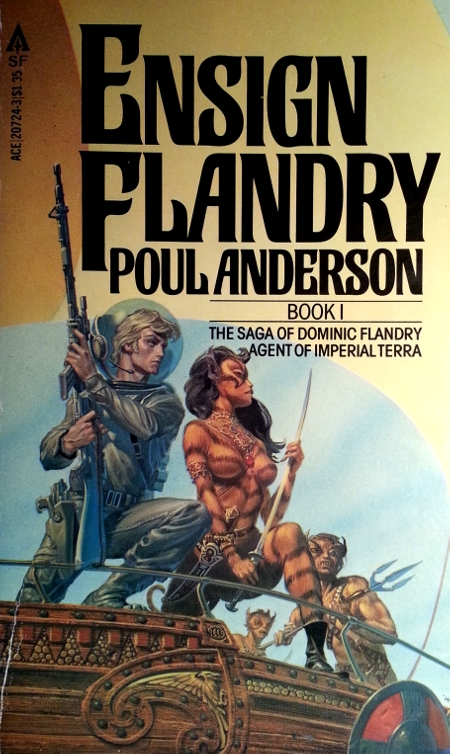
Poul Anderson is one of the authors I chose earlier this year as part of the Grand Master Reading Challenge hosted by Worlds Without End. Anderson was a prolific author whose career spanned many decades and consequently many eras of science fiction so I was unsure exactly where to start. I had toyed with the idea of starting with his Flandry series though the covers of the more recent collected editions tended to make me think these might be like the oversexed wish-fulfillment of Heinlein’s later years. I did not want that. When I saw this Michael Whelan cover for the first novel in the series my hopes rose and I decided to go ahead and snag the book for its cover, hoping that when I got around to reading it I would not be disappointed.
Guess what? I was not disappointed, not by a long shot.
My first foray into one of Poul Anderson’s created universes proved to be one filled with rip-roaring adventure, political intrigue, Bond-style romance and not a little bit of commentary on the soul-blackening compromise of world, or in this case Imperial, government. Ensign Flandry not only provided me with some of the everyman-hero-overcoming-all-odds storytelling I was hoping for but was also full of surprises.
In this half of Anderson’s Technic History, the Terran Empire (that’s us) is beginning to wain but remains a formidable superpower in their part of the galaxy. The Merseians, by contrast, are the up and coming race who would like nothing more than to move in and give the Terran’s a little shove off the proverbial cliff. For reasons unfathomable to the Terran government, the Merseians have gotten themselves involved in a race war on a small, seemingly unimportant planet. Under the guise of protecting the rights of sentient beings the Terrans have retaliated by helping out the other side. Both sides are keeping their involvement in the conflict to a minimum while publicly relating that they are only present to make sure one race doesn’t have the balanced tipped in their favor.
Ensign Dominic Flandry’s superiors suspect there is more going on than meets the eye and when Flandry is shot down over enemy territory wheels are set in motion that will eventually reveal a much greater and more complex situation than the Terran Empire expected.
Ensign Flandry was published in 1966, although Flandry made his first appearance in 1951. I have read enough fiction from this era that I tend to have preconceived ideas of what the story might be like going in. While many of the tropes of mid-century science fiction are present in Anderson’s novel, I was surprised to find very modern sensibilities in the social, political and military arena. Given that I read the bulk of this on the days leading up to the election I couldn’t help but notice that there were parts of the novel which, if written today, would be a very thinly veiled commentary on the world we live in. I don’t know if this in an indication of Anderson’s prescience or is just one more proof that history repeats itself. I suspect there is a little of both.
Socially I found it interesting that one of the alien races that Anderson created has a culture ruled by the female of the species. Though he does not examine this culture too deeply it appeared to me that he did not go the standard route of making the males a weak, resentful sex but crafted then as a respectfully subservient class still fully willing and capable of fighting for their homes. One of the two female protagonists was of this feline race and I give kudos to Anderson for making her a strong and honorable leader and not some dominatrix-style male fantasy.
I am intrigued by Anderson’s approach to storytelling. When I picked up Ensign Flandry I found myself immersed in a fully formed universe. Here was a political system, multiple alien relations, and the impression that there was historical foundation in place, and the reader is pushed right into the fray with no preamble. Additionally Poul Anderson doesn’t short-change the audience in regards to the creativity of his naming of individuals, people groups, planets, etc. This was initially a little disorienting but the presence of those science fictional tropes to lend familiarity to this imagined future made it easy to ascertain the gist of what was unfolding. Each chapter of the novel merges into the next to tell a complete story though the first half of Ensign Flandry felt more like a series of connected short stories than a cohesive whole. Contrast that to the second half of the novel which had a more concise narrative flow. Along with that flow the novel changes from a series of events that establish the character of Dominic Flandry to a more taut, intense story of intrigue and subterfuge leading up to a page-turning climax.
I was reading a review of Ensign Flandry elsewhere online in which the reviewer was chastising the novel for having a lot of talk and very little action. True, much of the action that occurs in Ensign Flandry happens offstage and is revealed in the dialogue of the characters, but that did not make the novel any less “action-packed”. What it does do is lend a smidgeon of authenticity to the otherwise over-the-top nature of any action-oriented heroic tale. Like many young heroes Dominic Flandry tends to have a golden touch and a fair amount of luck, but by placing him in the occasional spot in which he is not in the heart of the action it allows the reader to examine the larger world outside of Flandry’s immediate influence while also making his amazing good fortune palatable. There is an “Aw, shucks” quality to Dominic Flandry that gives him a likeable quality. And although he does tend towards the James Bond mold when it comes to his relationships with women, Poul Anderson handles these scenes with the kind of decorum that makes it a pleasure to read.
I enjoy a good confident protagonist with a dash of chivalry and bravado and enough humility to allow the reader to easily relate to him/her. Poul Anderson has certainly created that. And along with this character he has populated the universe with interesting species who have the kind of conflicting interests that make for engaging storytelling. I liked Ensign Flandry (the book and the man) very much and I will most certainly be back to experience his further adventures.
You mean…
I was NOT disappointed, not by a long shot?
oops, yes, good catch! 🙂
I read Anderson’s Brain Wave last year and it was very good. I should get back to some classic SF and I think I even have this book kicking around on a bookshelf.
That is one of his books that I am aware of although I’m not sure why. Glad to hear it was good, I’ll add it to my list of potential Anderson books to check out.
This one was fun but also had an intelligent aspect to it, if that makes sense. Anderson was highly educated and I think that shows even in this more adventuresome SF tale.
Wow, that’s some cover. This looks really interesting! Sometimes I like more talk than action, if it’s handled right.
I like Michael Whelan’s work as it often reflects the actual story. When he can he reads the story beforehand to get a good feel for the cover. The woman on the cover is spot on from Anderson’s description but for some reason Flandry is blonde when the book describes him as having darker hair, unless I’m misremembering.
As you know, I’m a big fan of Poul Anderson and have been for decades. The Flandry series is a good one, also the Nicolas Van Rijjn stories, which I like even better. Try TRADER TO THE STARS or the contents in THE EARTHBOOK OF STORMGATE.
I thought you were, Richard. From what little I know, from the great fount of knowledge which is Wikipedia, the Van Rijjn stories are from the earlier days of the same Technic History, is that correct?
Trader to the Stars sounds very familiar. I have a few other Anderson books downstairs. I don’t think I have that one but I’ll have to look.
I like the sound of this. I’ll have to try and get a copy for all the forthcoming sci-fi events.
Thanks
Lynn 😀
That would be great! I know it can be found in a collection of the first 3 novels titled Young Flandry that has a very embarrassing cheesecake cover on it that Baen put out in trade and then MMPB recently. The library may have those copies. It is the kind of cover that makes me embarrassed to go buy it from the bookstore.
Well, I had a look in the library – which obviously didn’t have any! Lol. (Actually I do love my local library – I think I’m their best customer). But, had a look on Amazon and can get a used copy pretty reasonable. I can see what you mean about the covers – at first, I thought, ‘oookkkay’, but there was a reviewer on there saying that the cover was almost like a spoof of Bond – which I can sort of see.
Lynn:D
Yes, I definitely think the covers are meant to make the comparison of Flandry to Bond and I can see that, I made the comparison myself, but in other ways I can’t…yet. This book (and this is no spoiler) has Flandry getting involved with the intelligence department and he does strike me as a bit of a ladies man, so I think the covers are correct in the “spirit” of things but are perhaps a bit too overt in their execution.
Poul Anderson wrote wonderful SF for decades. I became a fan early when I read his VAULT OF THE AGES in the 1950s. Rick is right about the Nicolas Van Rijjn stories. The NESFA editions of Anderson’s work are treasures!
I have eyeballed those NESFA editions with envy in the past. I have a few of their collections and they do a nice job. I will definitely be checking out more of Anderson’s work in the future. Not only do I like the guy’s last name, 😉 , but I admired the work too.