(Photo Credit: Dave Neukirch)
After a week off to catch our collective breaths, Kailana and I are back to discuss the next three stories in Charles De Lint’s collection, Tapping the Dream Tree. As I mentioned last time, I will be accompanying each story with a credited Creative Commons License image from Flickr that relates in some way, at least in my mind, to the story. We discuss some general ideas in our short story discussions to give you the opportunity to join in on the discussions too, so please feel free to do so.
And now, this week’s stories.
(Photo Credit: D. Laird)
1. “Many Worlds are Born Tonight” posits the idea of multiple worlds happening at the same time, each birthed out of the decisions we make, or don’t make. How do you think it would affect you to the option to view all those worlds the way Spyboy seems to do at the end?
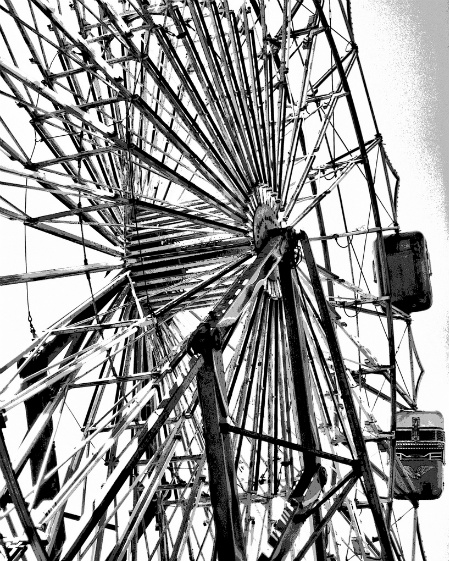
I’ve read various parallel universe stories in the past but don’t recall reading any in which the idea of being able to simultaneously view/perceive all those worlds is put forth. I am not sure I would like it. There is an odd sense about the character selling this idea, especially given that it is presented as a way to escape the vengeance of some very bad people. I doubt it was the intention of the story, but I found the Ferris Wheel to be a sad, melancholy option.
Interestingly this idea of being able to view the worlds created out of one’s decisions made me think about virtual words, particularly those posited in books like Ready Player One or films like Surrogates. In some ways we already have the ability to live in multiple parallel universes through our online identities, at least to varying degrees. I imagine there are some whose online identities are far different than who they are in “real life” and in ways you can chart multiple life paths. If the world becomes more virtual, like in the stories I mentioned, that could become even more the case. That thought path then lead me to the question that lingered in my mind while reading this story: What price escape? And can the price paid for escape from troubles be to high?
(Photo Credit: Susan Williams)
2. In “The Buffalo Man” we see how Jilly sees the world vs. how the Buffalo man sees it, at least at the beginning of the story. What do you think of the ideas Charles de Lint examines through these viewpoints? Can you relate to either or both viewpoints?
In this story the Buffalo Man is overwhelmed by all the negativity in the world. If you are familiar at all with the character of Jilly Coppercorn, then you know that she has a history of being a victim of very violent abuse. Despite that, she embraces life with an openness and curiosity and an optimism not born of ignorance but born of choice. The Buffalo Man can hear the negative thoughts of other people near him, he is overwhelmed by the darkness of the world. He sees the stories of peoples’ lives written on their skin. But as Jilly points out, a person’s focus and what they choose to dwell on plays a big role in how the world is perceived.
I think about that often. I listen to a bit of the news on NPR almost every day and then I’m done. I like to have at least some idea of what is going on in the world, ignorance is not bliss, but I refuse to be inundated with the darkness that is the news, or political talk radio, or the griping and complaining present in those who like to spend their time elbow deep in that muck. It isn’t for me. Like Jilly, I’d rather confront each problem as it comes to me and try to do a bit of good in the process. It may be like tilting at windmills, but I don’t care. Regardless of whether or not you believe we have a higher purpose in this life, years of human existence have demonstrated that the path to a fulfilled and meaningful life is not the one that focuses on the negativity, that seeks vengeance for every wrong suffered, that hides away in a shell to avoid unpleasantness. No, the road to a worthwhile existence is paved with acts of kindness, small and large, with giving of one’s time and energy and finances to help others, to look out at the world not through rose colored glasses, but ones that make an effort to see the good present in the midst of the bad, even when the bad is threatening to be overwhelming.
Each time I read a story about Jilly I become more fond of her. She embraces life, she is open minded about the “magic” in the world, she embraces her passions and she tries to make a difference. Not a bad fictional role model.

(Photo Credit: Angela)
3. In “Second Chances” the narrator states: “There are people that need stories, that can’t exist without them.” What does that statement mean to you?
I think on some level that statement is true for everyone, but the point the narrator is trying to make is that there is a distinction, and I would certainly consider all of us who read to be of that same ilk, that we need stories to survive and to thrive. Others much smarter than me have researched and discussed the importance that story has played in the progress of mankind. At one time the only way to communicate information through the march of time was through stories, told down through generations. Stories that contained the history of a people, stories that helped people make sense of a universe they did not entirely understand, stories that brought people together and passed the time. I don’t believe, as a people, that we are any less dependent on stories now. The only difference is that story is everywhere and we can get multiple stories from multiple inputs all day long.
I don’t believe I could exist without stories. Or if so, what kind of existence would that be. Even if I didn’t have books to read I would be imagining stories in my head. Wouldn’t we all? Our very lives are a story, to some degree, and one that has the potential for twists and turns, cliffhangers and exciting climaxes, low points and high. One of the reasons de Lint’s stories are so powerful is that he “gets” story. He gets how important story is to the fabric of one’s culture and to the structure of a person’s life. His stories reach back into earlier folklore and fairy tales, into early ways that our ancestors learned to reason out and understand their world. It is a skill that I appreciate in his stories and am glad that he is a prolific author as his stories speak to me. I’m glad I don’t have to exist without them.
Beautiful reflection on stories in #3–and that’s a wonderful quote from De Lint!
De Lint explores so many great and timeless themes in his works, including just how important the role of ‘story’ is. I get so much more out of reading his work than just (and I don’t mean this as a slight) the simple joy of reading.