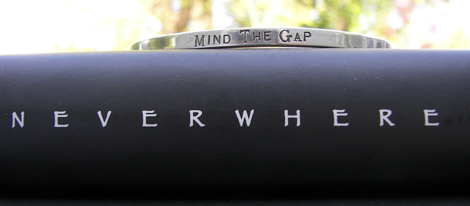
(Photo by me)
What a fun week! Our intrepid band’s journey took a variety of twists and turns and we learned that in spite of our early feelings about villains Croup and Vandemar, they are even worse than we thought!
Oh how I do love this book.
Please remember that spoilers are a given in the following discussion.
1. Chapter 6 begins with Richard chanting the mantra, “I want to go home”. How do you feel about Richard and his reactions at this point to the unexpected adventure he finds himself on?
No matter how many times I’ve read this, each time I find myself having the same reaction to Richard during the first half of the book: I’m disappointed in him. And right off the bat I’ll confess that this is one of the reasons that I applaud what Gaiman does with this book. As the omniscient reader, I can look at Richard’s life in London Above and see just how much it sucks. It is no life. He’s doing a job he hates, engaged to a woman he so obviously doesn’t love, and any tiny spark of individuality that he has is pathetic. That is it. Richard’s life is pathetic. And his reaction to this amazing and frankly unbelievable adventure is pathetic as well. He whines. He complains. He wants to go home. He wants to opt out. And the whole time I’m thinking “open your eyes Richard, this is pretty freaking amazing!”.
And then reality kicks in. Richard picks up a girl off the sidewalk that the thinks is bleeding to death. Within hours of that occurrence his engagement is broken off and he is threatened by two very menacing men. He ends up underground in the sewers and other underground locations. The people and places he is in are dirty. They have to stink. The food is less than kosher to say the least. The threat of death is everywhere.
Why does Richard disappoint me? Because he is having a perfectly reasonable, normal reaction to what is happening to him. Why do I think Gaiman is such a skilled writer? Because Richard doesn’t start off by unrealistically embracing the adventure he is on. Richard acts like I would. And that drives me crazy. The idea of London Below is, for me, a very romantic one. Romantic in the sense of looking at it through rose-colored glasses. In this section of the book in particular we see just how dangerous and scary London Below is. Richard is being sensible in his rejection of it. And yet that doesn’t stop me from wanting to shake him every time to get him to see just how wondrous this all is as well.
I don’t always see myself in the characters of the books I read, but Richard reflects back some of the frustrations I’ve had with myself: the difficulty getting out of my comfort zone, the frequency with which I take the easy path vs. the road less traveled, the ease with which I let fear override a sense of adventure. It is a humbling experience to see less than savory characteristics in a fictional character and realize that your disappointment springs from the fact that you’ve lived with that person before. That you’ve woken up and been that person many times over.
2. The Marquis de Carabas was even more mysterious and cagey during the first part of this week’s reading. What were your reactions to him/thoughts about him as you followed his activities?
Many of us mentioned last week how much we enjoy this character. He is the most enigmatic character in the book and that enigma grows during this section of the book. We see how manipulative and conniving he is. We see that he is one slick and sly character. And at the same time he lives by a code of honor that seems to permeate London Below. The city has its own ethics, its own codes, and de Carabas lives by them while twisting them to suit his needs.
Big Spoiler here:
Did you think he was off to betray Door? I know I did the first time I read the book. I didn’t know what would become of that betrayal, but I felt sick when he ended up in Croup and Vandemar’s lair. Especially since Gaiman ended that chapter with an equally enigmatic statement from de Carabas and then left that scene altogether for another part of the story. Well done.
3. How did you feel about the Ordeal of the Key?
I really enjoyed this section of the book. One of the reasons is that it is a real turning point for Richard. Beyond that, however, I just find that section of the book very exciting, and horrifying in its own way. Think about all the people who have tried to get this key and who have failed. The hints they give about the fate of those searchers is disturbing in the extreme. It is such a great story moment that Richard’s ordeal involves him confronting this new “reality” he finds himself in and the way in which it has crashed headlong into what he thought his reality was. It is also another section of the book where we see Gaiman explore the idea of mental illness in a very interesting fashion. Richard’s sanity hits that breaking point, and all the frankly crazy stuff he has witnessed is born in on him with the idea that he might actually be crazy himself. It is also an interesting section of the book for the reader. If you are one of those readers who always wanted Narnia to be real, for example, the idea that Richard may have just been hallucinating all this is sad in the extreme. By this time we’ve developed some affection for characters in this world and to think that they are all just figments of his imagination is just too sad.
Wow, that makes me think that a really interesting deeper look at that is to compare Richard’s ordeal to being an author and to examine what this section might say about those who can so skillfully make up these worlds in their heads. What must it be like to create beloved characters and incredible worlds and have them be so alive in your imagination and at the same time live with the realization that they are only alive in your mind. I guess we confront that same thing as readers, which is why for me reading is a wonderful experience but can also be a bit melancholy as well. Hmmm….
4. This section of the book is filled with moments. Small, sometimes quite significant, moments that pass within a few pages but stick with you. What are one or two of these that you haven’t discussed yet that stood out to you, or that you particularly enjoyed.
I enjoy the visit to the Earl’s Court. The friend who introduced me to Neil Gaiman’s work via The Sandman did so not long after he moved to New York City. I was very fascinated with the city on my first few visits there, particularly with the subway system. I would see cars sometimes just like Gaiman describes in this book, dark cars that didn’t make any sense. And although they don’t say “mind the gap” in America, there is something similar in the warnings to stay back beyond the marked line so that you don’t fall on the tracks. I love how Gaiman uses real places and commonplace things and weaves them into a fantastical world. “Mind the gap” has been a meaningful phrase to me for years because a friend of mine was hosting a film festival at a World Fantasy Convention many years ago where Gaiman was a guest of honor and this friend graciously took my copy of Neverwhere with him to get Neil’s signature.
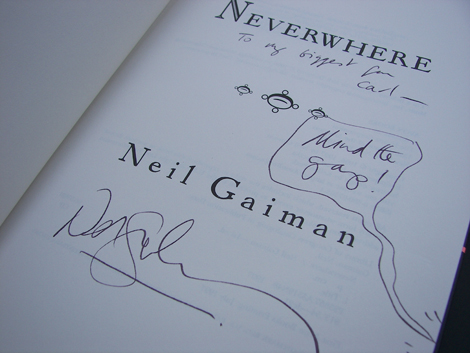
I have since met Neil myself and had a few items personally signed, but this one is special because of the novel’s favored status and because it was the first Neil Gaiman signature I received. Many years later I saw that “Mind the Gap” bracelet (shown in the opening picture) at an art show and Mary bought it for me for my birthday. I don’t wear it often, but when I do Richard and Door and Old Bailey and the rest are with me throughout the day.
5. Any other things/ideas that you want to talk about from this section of the book?
Just this: Croup and Vandemar are scary, arent’ they? We really and truly only saw a glimpse of just how awful they were in the first section of the book. Now we get to see them up close and nasty and it is not a pleasant sight. I applaud the fact that Gaiman doesn’t go into all the gory details about what they are doing. A word here, an image there, and our imaginations fill in the gap, painting a truly evil picture of these two baddies. I like how these chapters reveal just why Croup and Vandemar haven’t been using their full abilities to just take out Door and be done with it.
Oh, and this: Gaiman gives a little more detail about how time works in London Below. Through his characters he describes how pockets of time make their way down to London Below, so you are left with this world that has different sections from different eras in addition to all the forgotten and unused places that have been abandoned to history. It makes me even more fascinated about this world below the world.
Now let’s hear what all of you have to say:
Wonderful pics for today’s post.
I also thought de Carabas was up to no good the first time I read this section. I am glad it gets back to enigmatic as the chapters in this reading progress.
The Earl’s court was such an interesting hodge-podge. I like how Gaiman works in food items here and there – The Earl had Coke and Cadbury bars to offer, Lady Serpentine had foods that some would adore and others would reject whole-heartedly (like eels, pig’s foot, etc.), then London Above with their canapes, and Islington with his magnificent Atlantean wine. Such details make Gaiman an excellent writer.
Thanks, I appreciate that. I pulled them up from a post I did a looooong time ago.
de Carabas is a character you would not want to literally or figuratively turn your back on. I think you would have to find that balance of trusting him but being suspicious of him at the same time.
I hadn’t thought about it, but you are right, there are a lot of mentions of food worked in. Which is nice because people do have to eat. My most favorite book, Dracula, also has a lot of mentions of food and I enjoy those parts of the novel as much as the more exciting parts.
I recently read Dracula – and loved the food descriptions. In fact, I put together a Transylvanian dinner for my man based on the food Harker comes across early in the book. It was really tasty.
“Mind the gap . . .” That was one of my favorite scenes as well. I kinda feel like telling people that now (“Have a good day! Mind the gap!”).
In reflecting back on both your first question about Richard and the Ordeal of the Key, I realize now what makes the Ordeal so extraordinary is that for the first time since he rescued Door, Richard trusts his gut and makes a decision based not on what other people want from him but what he thinks is the right thing to do. I love that what pulls him back is that little bead from Anaesthesia’s necklace and the voice (or the memory of the voice) of this girl who was so terrified of the night on the bridge and who might not have been able to survive the Ordeal herself.
I actually didn’t think that the Marquis was off to betray Door. I actually thought, “That little opportunist! Does he really think he can get Croup and Vandemar in his debt, too?”
I love the signature and the bracelet!
I certainly choose to read a lot into “Mind the Gap”, Emily. I’ve been tempted to use the phrase before too. I find when I watch a lot of British TV that I used a lot of British phrases in my conversation. It is good that I don’t hear “Mind the Gap” or I would be doing that for certain.
You are dead on with your assessment of what happens to Richard during the Ordeal. I too am very pleased that it was that brief moment with Anaesthesia that plays a pivotal role in his salvation.
Thanks. I don’t normally wear a lot of jewelry but this was one simple piece I couldn’t resist.
That’s interesting, I was never disappointed in Richard’s wanting to go home. I thought it was perfectly normal and that is probably how I would have reacted. But I can see why you react that way.
I totally thought that the Marquis was off to betray Door. And then I found out what the two villains are like and I have to wonder if he knew they were that terrible and yet he still tried to get away. I would stay away from them and that is why no books are written about me 🙂
The Mind the Gap part really made me laugh. I remember taking the subway to and from work in Boston and I started to think that the subway trains were a cruel twist on a Disneyland ride. Instead of fun, it would take me to my job and everyone always looked so miserable. People, for the most part, are not happy commuters at 7am.
How cool that he signed the book like that…I love nice people.
It IS perfectly normal, TBM. Probably one of the few books I have read where that is the way the character reacts though. Or at least for a sustained period of time. We see reluctant heroes a lot, but few if any have made me have the same reaction that I do towards Richard. He seems to hold out from embracing what is happening for so long. And I applaud the normality of it all. In the end it really is my own deep identification with the character that gives me the reaction that I have.
I suspect the Marquis knew exactly what he was getting himself into with Croup and Vandemar but had to do it anyway. That honor code thing again, I suspect, and the debt he owes to Door’s father. I praise him all the more for going ahead and trying.
I must say that I found the subway a miserable way to travel too, mostly because it would either be freezing cold or really hot when I was in NYC. The winter was worse and you’d be all bundled up and then the subway would be roasting hot. Much prefer getting into a car.
I was thrilled that he signed the book for me when Jon took it to him. Jon obviously told him how obsessively I talked about Gaiman and Neverwhere in those days, hence the “biggest fan” comment.
Love the bracelet. What a keepsake! I can understand how special it must be to you. I guess we could all use those words as a kind of personal mantra to guard against falling through the cracks!
Thanks, it felt like it was meant for me when I saw it at the art fair. And yes, I like the words as a mantra. It is a good reminder.
My answers seem so lame now compared to yours! 🙁
I agree with TBM in that I have not found Richard disappointing. Instead, I find him refreshingly normal because he is reacting as I would. I always think it is a little lazy for writers to put someone into an extraordinary environment and have them accept it without the slightest problem.
nrlymrtl’s comment about the food reminds me of a question we discussed in the read along of Scott Lynch’s The Lies of Lock Lamora. Adding food and drink to a world helps us to feel more connection to it and increases the sense of reality.
Unfortunately, Emily, no one who works for London Underground is ever going to hope you “Have a nice day!” because they are all so rude and grim: I have only travelled on the Tube a few times and it is a soul-destroying experience even during the quieter periods. I once had to hold people back so that they wouldn’t crush a woman trying to get a pair of young children through the doors! 🙁
Oh not at all. You have to keep in mind that I’ve read this book at least a dozen times over the years, plus watched the miniseries several times. I know the story very well and that makes it easy to have a lot to say about it.
I’m in agreement with you and TBM. My disappointment isn’t with Gaiman at all, it is more of seeing myself in Richard, or seeing all of humanity in Richard, and how easy it is for us to get stuck in ruts. Routine can be a really good thing, but when it is a lifeless, potentially dreadful routine like Richard was getting into that makes it sad and disappointing.
Adding food also makes one hungry. Although less so with this book considering the meal choices many of the characters make, LOL!
I enjoyed these chapters a lot more. I thought the Marquis was there to betray Door as a way to protect himself. Finding out he was there for Door made me like him so much more.
And Croup and Vandemar are scary… deliciously so! lol I love getting more background info on these two. They are just bad and like it that way.
I’ve been having issues with Richard but you make an excellent point. His eventual growth will be more realistic with this slow approach Gaiman has shown from him so far. I’m curious to see what else he has in mind for Richard. If nobody was able to get that key after centuries but Richard was able to, there has to be something more to him.
I’m happy to hear that Sarah. That scene really solidifies my liking of the Marquis as well. He proves to be a stand-up guy in his own twisted, self-involved way.
I’m also glad to hear about the issues you were having with Richard. He is a bit of a milquetoast character at first and (although I love him) I can see how he might turn people off from the book.
I want a “Mind the Gap” bracelet…I’ve been fascinated with that phrase ever since I took a trip to England when I was 16 and it was just…I don’t know, it’s just so British! I LOVED when it figured into Neverwhere.
Once I get to the actual text of your post, there are so many fascinating things in here I don’t even know which way to turn! Well…I love that Richard doesn’t immediately embrace London Below. It’s a scary world down there (exciting, but scary) and I thought his reaction was so believable. I love that he doesn’t arrive ready to be the hero, it’s really over the course of the adventure that he finds his own strengths and abilities.
The Marquis is wonderful, because he’s so complicated. I want another book just about him!
Maybe the need to keep our characters and imaginary worlds alive is one reason we have an instinct to share stories. They get to live in someone else’s mind then too.
All right, those were the main points…but fascinating discussion going on here!
Wish I could remember where I got it from, because I know you could order them online.
His reaction is very, very believable. I think that is why I have such a visceral reaction to his reluctance whenever I read this. It isn’t as strong as the first few times I’ve read it because I’ve grown since then, but it still makes me to a personal inventory every time I read it. Which is a good thing.
I admit to being pretty freaked when the marquis entered the bad guys’ lair. For a moment, I thought the marquis was the mysterious boss who keeps calling.
Carl, I loved the story of the autograph your friend wrangled. I think the story is valuable on another level, too–the connection to your friend. I see the idea of friendship and the importance of human bonding throughout the book. Certainly, the lack of true connection is the worst part of Richard’s former life.
The ordeal section really brought home how frightening it must be to lose your grip on reality. I recently watched the movie Iron Lady, and my heart wept at Meryl Streep’s portrayal of the prime minister.
By the way, am I the only person who loves the British Underground? I lived in London for a year, and I could go places I could never get to in a car, not to mention link up with ferries and trains. Much more inclusive than the BART system where I live.
Me too, the first time I read it, which I thought was really brilliant of Neil. Tricky!
I agree about Richard, his loose, inconsequential connections make his wishy-washy nature make perfect sense.
I can’t say anything at all about the British underground because I’ve never been there! 🙂 I’ll love it vicariously through you and Richard and Lady Door.
I love Croup and Vandemar. They’re both evil and hilarious, and it’s hard to hate a villain who talks with a mouth full of frogs, even if he does participate in the occasional crucifixion. Their indignation about being scarecrows was also quite excellent…
I agree with you completely about Richard being a bit disappointing in the start of the book. He’s a bit too entrenched in the real world and doesn’t have a healthy sense of nonsense. As the book progresses he becomes more imaginative and laid back, to the point that I don’t think he would feel at home in London Above.
I am right there with you. I don’t hate them at all, they are brilliant! A true dastardly duo!
Richard is very much between spaces right now, which will make the rest of the story very interesting. He made a big leap during the Ordeal, and now we get to see how that has an effect on him.
Croup and Vandemar are really great to read. I mean, if you’re going to have a villain you might as well go totally over the top with them and Gaiman so goes over the top here. Mouthful of frogs! I would have loved for Richard to be more enthusiastic but if I’d have been in his shoes I would have been exactly the same and I know it.
Lynn 😀
Dude! I think i should scrub my post and direct everyone to you because your answer to question 1 is almost exactly what i was trying to say! I’m in full agreement on all of it actually, although I didn’t dislike Richard for being a wuss, i cant really blame him.
Mind the gap is a pretty apt catch phrase, shame Richard didn’t mind the gap earlier, and Anathesia too, and all the lost souls pulled into London Below. That phrase has take on so much more meaning after reading your post.
Love the pics too 🙂
Well, thank you, but I want to read your answers! 🙂
Just to be clear, I’ve never at all disliked Richard, not even the first time I read it. Richard Mayhew is one of my literary heroes. But I am always disappointed in how realistically long it takes for him to step up. I’m just too romantic and impractical.
Great post Carl. I particularly enjoyed your answer to No.1 because it had me nodding my head in agreement and funnily enough I didn’t even realise that was how I felt until I read that!! But, yeah, when reading I was wanting Richard to embrace everything and run around like a child in a toy shop but that was because I, as a reader, wanted to do that. I was just so intrigued by this world Gaiman had created that I wanted to go running down tunnels and peeking under things and the only way I could do that was if Richard did so. But, if i’d have been in his shoes. Totally different story I think.
Lynn 😀
It certainly doesn’t cause as big of a reaction in me as it did the first few times I read the book, but I still have that intellectual reaction remembering my more emotional reaction to wanting Richard to “man up”, for lack of a better way to say it.
I am right there with you. I think the idea of exploring all these places sounds very romantic, but if I was smelling it and truly experiencing what Richard was experiencing, it would probably quickly cure me of the romance and spirit of adventure.
You really love this book, don’t you? 🙂
I agree with your first answer, and I hate that I do. Richard frustrated me, even when I knew his reaction was a perfectly normal one and that I probably wouldn’t do better myself. But it seemed almost like he took a little TOO long to come to grips with the situation, like Gaiman wanted it that way just to say “Well, what would you have done differently?”
Love the bracelet. I want one!
Just a tiny bit. 🙂
At this point I don’t actually mind that Richard disappoints me. I do see it as a mark of Gaiman’s skill, even early on in his career, that he was infusing some realism into his fantasy work.
Reading what you had to say about “mind the gap” made me realise that one of the things I love about Neverwhere is that it reminds me of when I used to go back to spend summers in London, starting maybe when I was about 11 (it wasn’t new to me because I lived near London until I was 6). I used to love travelling on the tube, it wasn’t quite as crowded in those days and I fell in love with all the names – I think I could recite whole lines with every station on them – and I really liked all those tiled tunnels, which are still very Victorian and decorative.
“If you are one of those readers who always wanted Narnia to be real…” – oh heavens, yes, it’s so hard to come back to reality sometimes! I’m was sure for years that if I looked hard enough I;d find the right wardrobe.
I’m glad it made you recall those memories, GC. One of these days I’ll be able to visit London and will have some memories of my own to associate with this wonderful book.
The names in London are great! And so much history!
I don’t mind telling you that every time I read this book I look at doors, alleys, etc differently for awhile, hoping to catch a glimpse of Door or the Marquis or Old Bailey.
Oh I wish. I’d be a lot more scared (not to mention disgusted), and probably dead well before this point of the story. That said, I agree completely with your view of Richard’s behavior.
On a completely different note, today my sister shared this link with me, and even though it has nothing to do with the group read, it’s Gaiman-themed, so I thought I’d share it with all of you.
I’m a bit behind in the reading but wanted to comment on your responses. I love love your answer to Question #1. Perfectly said! Richard is such an awesomely written character because he IS so like us — we like and despise him for those reasons. I also was just thinking that w/ the Ordeal of the Key, how interesting that Anaesthesia saved his life pretty much TWICE in the book. But if he hadn’t had that compassion to care about what happened to her, he would never had saved the bead which ended up saving his sanity. Interesting.