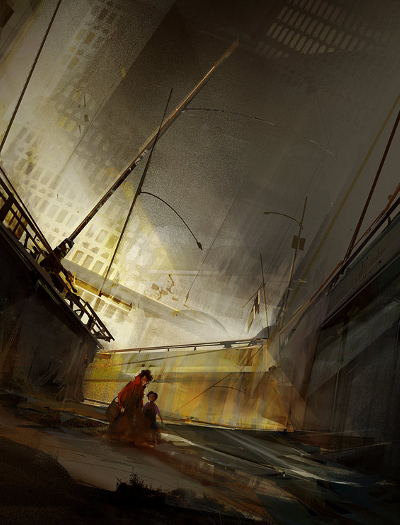
(Image by Richard Anderson)
“When the traders had first crawled out of the sea, a dozen years ago, every memory had been vivid and strong, every page crammed edge to edge with smudged bold urgency.”
In a devastated world where the focus of life has been narrowed to the act of survival, there are those who would trade their memories for the serum, a drug that will help them forget. Morningtown is typical of the havens in which existence is dominated by scavenging and bartering for the necessities to live day by day. Amidst this ruin and destruction there are still rays of hope, people choosing to make a life out of the hand they have been dealt. Lucy is a young lady who does her best to care for the family that took her in long ago. It is her responsibility to make the dangerous trek across the city to procure the serum for the people of Morningtown. Amidst rumors that the traders have been missing serum runs, Lucy sets off for her scheduled rendezvous, a bundle of memories and a sharp knife her companions for the journey.
In “Last Train to Jubilee Bay” author Kali Wallace deftly builds a dystopic world that feels at once familiar and fantastical. It is a story of hope and remembrance and an opportunity for change in a time when the easy route is to forget. It is also a tale that examines the worth of the written word, of memory and story. This short story is a Tor.com original that can be purchased for $.99 for the platform of your choice or read in its entirety for free right here.
Discovering really good short stories can be an agony-inducing pleasure in that the satisfaction of the reading experience may be followed by the ache of wanting to share and discuss it with others. “Last Train to Jubilee Bay” is one such story. Wallace paints a visually arresting landscape and skillfully crafts a character that readers become attached to in a relatively brief amount of time. I am reminded of the way I felt about the original short story “Wool” by Hugh Howey. Wallace’s story is complete in and of itself and yet its world fascinates me and I want to explore more of it, especially to see how the actions of these characters reverberate through their insular world.
Following the jump I am going to dig deeper and discuss spoilers. If you want to comment on what I have written above I suggest bypassing this and going straight to the comments section. It is my hope, however, that some of you will take the opportunity to jump over to the Tor website and read it for yourself, then return to share your own thoughts. It will not take long but it is time well spent.
HEREIN LIE SPOILERS!!! (Seriously, don’t read this if you have any intention of reading this story. And you should intend to. 🙂 )
More and more I am feeling that the words “dystopia” or “dystopic” have become my lazy way to describe stories like this but I am not sure of any better way to quickly convey in a review or discussion this “type” of setting/story. So for the sake of familiarity we will assume that calling “Last Train to Jubilee Bay” a dystopian story is not an insult to its author or a way to marginalize the story by lumping it into a category.
I have to confess that I find beauty in destruction and it is possible that this is a shared trait given the draw that people seem to have to dystopian and post-apocalyptic fiction. While I find the worlds described in stories like “Wool” and “Last Train to Jubilee Bay” frightening in the sense that I would not want to live that reality, I also cannot help but be drawn to the sad beauty I see in old decaying buildings and rusting machines. If anyone is aware of any blog posts or articles that examine the reasoning behind an attraction to this type of aesthetic I would love to know about it. In Jonathan Strahan’s anthology Edge of Infinity there is a story written by Paul McAuley entitled “Macy Minnot’s Last Christmas on Dione, Ring Racing, Fiddler’s Green, the Potter’s Garden”. In it McAuley refers to the “romance of regression” as a reason why people would leave the comforts of a modern society to live what is essentially a pioneer’s existence on unsettled planets. I love that phrase and want to pursue it more as I’ve adopted it as a way to describe stories like this in which circumstance or choice has put the characters in a setting in which they are in more of a survival-mode, living off the land, returning to a simpler way of life or what have you. So as devastating as Wallace’s world is right from the start it also has an allure that instantly pulled me in to the story.
I like Lucy very much. I was pleased with the way Kali Wallace is able to establish her as a strong smart character within a few pages without resorting to telling the reader that Lucy is “strong” and “smart”. It is obvious that she can take care of herself and the fact that she is a fighter and won’t give in to despair is evident in her examination of her own memories and the way she appears to cherish them rather than seeing them as currency with which to buy a means of escape. The mysterious ‘traders’ and their apparent need to exist upon the written lives of others is vampire-like in nature as it is implied that it isn’t just the serum that is making people forget but that the very act of giving over their memories willingly allows the traders to absorb the essence of their existence. Or maybe I am reading too much into it but be that the case it is yet another sign of a successful work of short fiction: you can glean multiple layers of meaning and story from its brief pages.
Because Lucy is a strong character I became invested in her survival and needed to see her bravery amount to something. Wallace delivers in such a satisfying way first with Lucy meeting the young child Belle and allowing her to come along as Lucy follows the tracks to determine why the traders have disappeared and later when Lucy discovers the source of the serum and chooses to destroy it rather than use it as a means for power and wealth. Honestly, stories like this could go either way and remain really good stories if handled correctly but I was very pleased that Wallace had Lucy make the choice to destroy the machine and to have Belle join in on its destruction. In addition to being a nice upbeat ending that gives a sense of hope it also points to a willingness in these young people to not settle for the life that has been given to them but to hope for, and then fight for, something more. There is an authenticity of character demonstrated in their actions. The seeds for Lucy’s choice are there throughout the story and it is in her actions that you begin to look back across this brief journey and see that it would have been disingenuous for her to do anything else.
As I close this discussion I can see that I have found at least one answer to my query above about the attraction of a dystopic story. We live in a world that genuinely feels as if it is on the brink of devastation and that feeling is not new. I grew up in the Cold War era and any brief illusion of “peace” at the fall of the Berlin wall has been eroded by the rise of terrorist organizations, the increasing divide between nations and the world-wide economic crises that are far from over. I believe that we see in these created worlds a familiarity that draws us to them and within the familiar are rays of hope as we are told stories in which characters not only manage to keep on surviving in unwelcome circumstances but also manage to triumph. It would be easy to dismiss dystopic or post-apocalyptic stories as depressing, as something to avoid, and yet they provide not only vicarious thrills and adventure but also reflect what we all hope is true, that we can survive and thrive in whatever circumstances life throws at us.
“Last Train to Jubilee” established Kali Wallace as an author to look out for. I also want to lend my voice to any others that may read this and want to see more of Lucy’s story. I hope we have not seen the last of Lucy, or Belle. It would be a pleasure to witness their world catch fire from the sparks of their actions.
Some of the best short stories are found at Tor.com. I would like to see them gathered in a volume or two with the matching art. Especially with their matching art, since that is another highlight of these stories. I know that some of them were published in an ebook edition, but still, such a physical book would look great. And Kali Wallace’s “Last Train to Jubilee Bay” is yet another example of the Tor.com magic. However, if my dream comes to pass has no importance because I will read constantly the stories they publish on the site.
Excellent review, Carl! 🙂
I agree, and I’ve spent far too little time actually reading them and writing about them. I need to correct that.
I did snag that ebook copy recently when they had it on offer for free (or maybe they still do)…
Quick check, yes they do, you can get it here.
I agree with you wholeheartedly that I would pay for a collection of these with their accompanying art. I’d pay a decent price for it to because it would be well worth it.
Glad you liked Wallace’s story as well. It comes nicely in line with things I have been reading of late but has its own unique touches that excite my imagination.
I want to highlight more the short stories this year too, but sometimes I don’t manage to cover all the things I want. Last year for example, although I read a lot of short fiction I didn’t manage to review them, especially those I loved the most, properly. I’ll try to do so this year and I also want to give more coverage to the Romanian speculative short fiction. It seems that here there is finally a proper time for these particular type of fiction. And this fact is encouraging.
That is encouraging. I had the same issue last year with novels. There were a couple that were among my favorites that I didn’t get around to reviewing and I hate that. Thus far this year I’ve reviewed everything I have read and I plan to keep that up.
I actually downloaded two best of tor.com ebooks a few weeks back. One collects stories from 2011 and the other from 2012.
I think after reading this story I have to come to realize these types of post apocalyptic stories just aren’t for me. You know I love you buddy but this stories “upbeat” ending was just too depressing for me. Sorry man. While I didn’t hate this story to the level I hated the first story in Wool I don’t love this story either. It’s well written and Lucy is a strong main character but the setting just depresses the hell out of me. I couldnt shake the depressing mood of the setting when I read the story. I guess when I want to escape in my fiction I want a brighter world. I’m happy you dig these kinds of stories though my friend. If you’re happy then I’m happy. I’m just going to skip the next dystopic story your recommend though. Sorry. Please forgive me.
No worries, we can’t all like the same stuff. I’m not sure how the ending itself is depressing given that she takes charge of things and ends the means that people are using to essentially drug themselves into oblivion, but I can see how you would see the rest of the setting as depressing. I still think you are missing out on a tremendous story with Wool. Easily one of the best things I’ve ever read. But last I checked you weren’t hurting for books to read. 🙂
I downloaded that Tor collection too and need to make time once in awhile to sample the stories. I’ll need to go back then too and see if I can find the art on their site that corresponded with each story. I’m impressed that they are commissioning stories and art like this that they are giving away for free.
Now I have two collections and the versions I have include the cover art along with each story at the beginning of each story. I did down load them into iBooks though instead of My kindle app so that might make a difference.
Sorry. There is no way I’m ever reading anymore Wool after the author has the main characters die together to end the first story. I’m still pissed. I felt like how my wife felt after reading Cold Equations by Tom Godwin. I know you like the story which why I try not to bring it up because I just had such a different strong reaction to it. We need to focus on all the other stories we both do like and forget about Wool my friend. Think Neil Gaiman, John Scalzi, Robert Heinlein, and Brandon Sanderson thoughts. Not Wool when it comes to our favorite reads.
LOL. We are just going to have to agree to disagree on this stories ending as well. Ok. I just went back and read the ending again just to give it another chance. The last two paragraphs; especially the last line are very dark to me. My gut reaction the minute i finished the last line was not hope for Lucy and Belle as they walked past the skeletons and the author invoked and image of a broken toothed city. I felt as if they were dead women walking. The last word is gray. Not a happy color to me.
That is what I like about stories like this is that they are open to different interpretations. I looked at Lucy as being a fighter as I think that is established throughout the story and her going back after destroying the machine is where I see her, and Belle with her, fighting back against the malaise that has taken those who have given up (vs. those who have not).
Speaking of Tom Godwin I noticed they are reading one of his short stories for the Classic SF book club. I need to go read it as I’ve always been curious to see how some of his other work stacks up to what is probably his best known work.
I noticed earlier that someone had reviewed Sanderson’s new book Steelheart…need to see if I can remember where it is. It was obviously an early review copy as the book isn’t out yet. If I find the link and think it is something you would like I’ll email it to you.
I haven’t looked at mine so maybe the one I have does too. Hmmm…gonna have to check that out.
Man, I need to get to bed. Need to finish up the post linking to SF Signal for the new Clarkesworld review that is now up and go to sleep. G’night my friend. Safe travels back to the flatlands tomorrow.
A review of Steelheart already. It doesn’t even come out until September of this year. It sounds as if its a YA book as well. I’ll look for your Clarkesworld review.
Yes, that was the impression I had too. Will be interesting to see how Sanderson writes to that audience.
He already has written YA with his Alcatrez series I believe.
That tells you how out of the know I am, I have no idea what these books are that you are referring to. 🙂
When I have more time, I’ll jump on over to Tor and check it out. I was editing one of my short stories this morning and I love the art. I wish more collections were available–I don’t want it to disappear. Have a lovely weekend Carl. I’ll see how many dark beers I can find for you in London this weekend 😉
You have a mission for the weekend! I wish you all the best and expect a full report when you come out of your stupor on Monday morning. 🙂
I hope that websites like Tor will continue to put together collections of the short fiction they commission. One of my favorite annual anthologies, Eclipse, is no more (as far as print books go) but they are publishing regular stories online on the Night Shade Books website. I am hoping they will eventually collect all those as well.
I did go and read the story at TOR.com. I am not a short story fan and have not read one in years. So I am not a good judge. I liked the story a lots and it was well written. I got involved in the characters.
It did re-enforce why I don’t get excited about short stories. I want more. I want the story background and follow up. But I am determined to try more short stories. I have a book of Ray Bradbury short stories and a book of mystery short stories (one by Asimov)… and actually quite a few more with mysteries. So I won’t run out. We looked at short story collections of science fiction but could not decide… If you have suggestions that can be bought inexpensively on Kindle or paperback. Or I can always look for used books.
And that is always the thing, Tracy. No matter how good a short story is if you are the kind of person who has to have more(and many are, so please don’t think I’m saying that as a criticsm) then they really never will be as pleasing. I’m not sure when I got bit by the short story bug but I just love ’em.
If you are okay with reading online then Lightspeed Magazine is a great place as they feature new stuff and categorize it by SF or F. Also the Clarkesworld website and Eclipse Online over at Night Shade Books.
As for really good SF collection, the recently reviewed (by me) Edge of Infinity is at the TOP of my list. All SF, almost all GREAT. Really cannot recommend them highly enough. The 4 volumes of the Eclipse anthologies are great for a mix of SF and F. James P. Blaylock has a really good short story collection entitled 13 Phantasms and Other Stories. For more of a fantasy bent the Peter S. Beagle anthology Sleigh of Hand from Tachyon books is amazing.
Thanks for the suggestions. I did see an anthology of novellas that I thought might be just the thing.
Okay, you’ve got me curious, what is it?
I knew you would ask. I did not think I could find it but here is the title (it is at Amazon). The Science Fiction Hall of Fame, Volume Two A: The Greatest Science Fiction Novellas of All Time Chosen by the Members of The Science Fiction Writers of America. There is a volume Two B.
and the link:
http://www.amazon.com/Science-Fiction-Hall-Fame-Volume/dp/0765305356
Ah, yes! I have both of those. I haven’t read all of the stories therein but have been impressed by those I have.
Beautifully written. I agree I want more about these characters. The writing was evocative and painted an amazing view of this world and these characters. Thanks (again) for the review.
‘romance of regression’ I love this term it describes a long time passion (obsession?) of mine. I actually collect books of dystopian fantasy. It started when I read “No Blades of Grass” by John Christopher in the 1970’s. I recommend at if you can get it. Then I also watched the original BBC series “Survivors” in the 70’s and now on DVD, and the excellent novel by Terry Nation.
Probably why I am enjoying watching Revolution and maybe why I enjoyed Lost.
So thanks for the pointer. I was disappointed that the art work was credited but was not in the ebook on iTunes.
It is possible the title of John Christopher’s book is Death of Grass. I think the movie was No Blades of Grass.
This isn’t the first time I’ve read about cover issues with iTunes. They need to get that fixed, it is ridiculous not to be able to make things like this compatible.
Unfortunately she mentioned in a response to me on her website that she doesn’t have any intention to return to these characters or this setting. But you never know. Maybe Lucy and Belle will whisper tales in her ear in the future. Fingers crossed.
Isn’t that a great term? I would like to see SF Signal do a “romance of regression” post where authors would offer up their examples of stories they’ve read and liked that fit this definition.
I’ll keep my eye out for the book and film, Ian. Thanks for the recs.