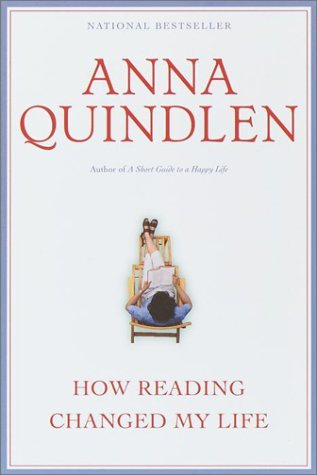
How Reading Changed My Life ~Anna Quindlen
–published 1998
–Ballantine Books
–96 pages
–4.5/5 stars
“How many a man has dated a new era in his life from the reading of a book. The book exists for us perchance which will explain our miracles and reveal new ones.”
~Henry David Thoreau
With the recent taste of a new-to-me Anna Quindlen, I could not resist the urge to return to the book that made me a fan, How Reading Changed My Life. This return to the abode of a kindred spirit was every bit as pleasurable the second time around. This slight book is one of the most wonderful reflections on the love of reading that has ever been written, and it is written not in a dry, stoic, elitist manner–it is written from a place of a passion that was birthed in childhood and remains equally strong today.
This delightful book, championing the great pleasures of the written word, is a book that I think all book lovers should read.
In How Reading Changed My Life, Anna Quindlen touches on a wide variety of reading-related topics, including the fact that there are still many today who view reading, especially reading for pleasure, as a gross waste of time:
“While we pay lip service to the virtues of reading, the truth is that there is still in our culture something that suspects those who read too much, whatever reading too much means, of being lazy, aimless dreamers, people who need to grow up and come outside to where real life is, who think themselves superior in their separateness.”
She shines an intelligent light on the scourge of literary criticism:
“And in circles devoted to literary criticism, among the professors of literature, the editors and authors of fiction, there was sometimes a kind of horrible exclusivity surrounding discussions of reading. There was good reading, and there was bad reading. There was the worthy, and the trivial. This was always couched in terms of taste, but it tasted, smelled, and felt unmistakably like snobbery.”
She addresses both the solitary pleasures and functions of reading as well as the opportunities it opens up to increase socialization:
“It means that reading has as many functions as the human body, and that not all of them are cerebral. One is mere entertainment, the pleasurable whiling away of time; another is more important, not intellectual but serious just the same. ‘She had learned something comforting,’ Roald Dahl wrote in Matilda of his ever-reading protagonist, ‘that we are not alone’. And if readers use words and stories as much, or more, to lessen human isolation as to expand human knowledge, is that somehow unworthy, invalid, unimportant?”
One of the many reasons I was taken with this book the first time is that Anna Quindlen praises the virtues of reading “beach reads” as much as reading “the classics”. This leads to a discussion that many of us have read in many different forums, have taken part in, or have at least thought about over the years, and that is reading assignments in the classroom and how it affects a student’s view on reading.
“In fact one of the most pernicious phenomena in assigned reading is the force-feeding of serious work at an age when the reader will feel pushed away, not from the particular book being assigned, but from an entire class of books, or even books in general.”
It is really interesting to read Quindlen’s thoughts about the disappearance of books in the computer age, especially given the fact that a decade or more has passed since she wrote them and the same pro/con arguments are in existence today.
“Both those in the business of books and those in the business of computer technology realized something that we readers apprehended most deeply in our hearts: that people are attached, not only to what is inside books, but to the object itself, that old familiar form that first took shape four centuries ago.”
How Reading Changed My Life is full of the truisms that we readers have come to embrace, articulated in a manner that makes you feel an instant connection with Anna Quindlen and with all of the other book lovers out there.
“The writers of books do not truly die; their characters, even the ones who throw themselves in front of trains or are killed in battle, come back to life over and over again. Books are the means to immortality: Plato lives forever, as do Dickens, and Dr. Seuss, Soames Forsythe, Jo March, Scrooge, Anna Karenina, and Vronsky. Over and over again Heathcliff wanders the moor searching for his Cathy. Over and over again Ahab fights the whale. Through them all we experience other times, other places, other lives. We manage to become much more than our own selves. The only dead are those who grow sere and shriveled within, unable to step outside their own lives and into those of others. Ignorance is death.”
With charm and the conversational tone of a born storyteller, Anna Quindlen gives voice to the feelings that so many of us share about books, and what they have meant to us in our formative years and what they mean to us now. How Reading Changed My Life is a satisfying excursion into the heart and mind of a book lover who is just like you and me.
__________________________
This book is a selection (my 7th thus far) for the 2010 Support Your Local Library Challenge
As a fellow lover of books about books, clearly I need to get acquainted with Anna Quindlen! I love the excerpts you shared. Sadly, her experience with academic circles mirrors my own, though I realise that not all academics are like that.
most people cannot even tell you why they love to read. I don’t think most realize they might be trying to gloss over the facts of life that hurt them or give them grief of one sort or another. untold comparisons: the vile and ugly make us happy we are better off… the beautiful and likeable we wish we could escape to…as many books as there are..are as many reasons people like to read, don’t you think?
I added Anna Quindlen to my list after your last reveiw of one of her books. I love the sound of this one too. The passages are fabulous and ring so true.
Nymeth: I would have never guessed that you hadn’t already read her work. I certainly think you would enjoy this book. Her other nonfiction book that I really enjoy is Imagined London, a love story to both the city and the books set in that city. It is very good.
Deslily: It is so interesting that you bring this up because she talks about this in the book, reading to escape, to step into someone else’s life, to understand that in our pain we are not alone, that others have experienced the same thing. What makes her thoughts on this interesting to me is that they mirror my own in that I don’t see reading to “escape” as an evil unto itself, I think that motivation, whether conscious or unconscious, can have a real healing effect as reading can really can affect change.
Vivienne: The great thing about her books is that the whole thing is like the passages I quoted. If it wasn’t a library book…and I wasn’t one of those people who would sooner walk over hot coals than write in a book…I could easily highlight every passage!
I love books about books and people who like to read, but I haven’t read Quindlen either. I think I’ve spent my whole life deflecting questions from people asking me why I read just like in the first passage you quoted. I’m definitely getting this!
I read this in December 1998, and gave it a strong rating at the time. I remember liking it enough to reread parts of it as soon as I’d finished the last page. It’s a book that tempts one to underline, highlight or otherwise mark and notate, though I don’t do that to books as a matter of personal rule, and besides I got it at the library, same as you did. Wonderful book!
Richard: As I read your comment and my own I can’t help but think of Anne Fadiman who would definitely chide as both as being the wrong kind of book lovers. She is all about marking and bending books as an act of love towards them. Makes me shudder to think of it! I am tempted to keep an eye out for an older, beat up copy of this book just so that I can pick it up and write in it as I read it.
Sakura: Yes, you definitely need to get this. I think she articulates very eloquently and in a very accessible manner some of the reasons people read and what they get out of reading.
Carl: lol since you cherish books so much, even if you got an old beat up copy could you really make yourself write in it? or mark passages?? lol when you love books as we do that is not easy to do even with an old beat up copy! lol
I do believe that sometimes we KNOW we want an escape and indulge in reading but I believe most of the time we don’t realize what we are looking for when we pick up a book.. escape? find some like myself? find someone I wish I could be like? soooooooo many questions!
Deslily: LOL! I was actually thinking the same thing when I typed that. I am even more tempted to get one just to see if I could actually make myself do it! I’m so weird.
I couldn’t agree more with your thoughts, I suspect that any form of entertainment, but especially reading, works on us on many levels besides what we are just conscious of. I think the same can be said of why we read certain books when we read them, why suddenly this specific book, or type of book, is what we are craving where it is something we wouldn’t have considered picking up last week or last month.
This sounds like a great book. I’ve really enjoyed some of Anna Quindlen’s other books, and although this one sounds different then the others it seems like a book I might enjoy. Thanks for the review!
Love those quotes; maybe I should add this title to my own personal challenge this year, read more non-fiction. I’m doing well so far, I’ve just finished my fifth.
Ohhh I’ve often wondered that! why did I love Drood?? or 13th Tale?? were they just what I needed at a specific time and didn’t realise it?? wow… yes..it is indeed something that can be pondered for a long long time
Carl, I’ve read that Fadiman said that, and I suspect she was allowed to mark her childhood books up with crayons, too. Her father Clifton was supposed to be such a book expert, it amazes me that she doesn’t have a little more respect for the object as well as the contents.
By the way, Enchanted Night just arrived by post. In spite of your rave review, i will have to wait it’s turn on the TBR stack, though I will read it for OUAT.
Carl & deslily – I have, on a few rare occasions, gotten a second copy of a book I wanted to “notate”. Usually a used, sometimes battered copy, but not always. I then TAPE a piece of paper on the front cover and around the spine which reads REFERENCE COPY. Now that the book has been defiled, I proceed to highlight, underline, mark, notate and scribble as I see fit, knowing I’m not damaging a REAL book, just a copy., which I shelve next to the “good” one. I’ve done it only a half dozen times in the last 30-40 years, but it works, with no guilt.
Richard: I think as long as I had a pristine copy I could probably do that too hahahaha
I love Anna Quindlen. Better to me by far than her novels (Black and Blue, which was indeed worthy) are these works of ‘essays’ of hers. I have a copy of Being Perfect, which I love, because too often I’m caught up in that game of perfection as if I could ever achieve it. She reminds me of what is important to focus on in life.
Her work also reminds me a bit of Ann Lemott’s, but Anna is somehow a bit more…spiritual? Reverent? I’m not sure of the word here, but I hope you can gather what I mean.
You’ve made me want to pick up How Reading Changed My Life very badly.
Brilliant post, brilliant sounding book. 🙂
Susan: It is a wonderful book, I highly recommend that all readers pick it up at some point.
Bellezza: I haven’t heard of Being Perfect, but I will be checking it out. I’ve really enjoyed all three of her essay books, and oddly enough have no desire to read any of her fiction.
From what little I’ve read of Anne Lamott, I think your thoughts are right on.
Richard: Fantastic idea! Because if I came across a pristine copy of this book, I would definitely buy it. And NOT write in it. I actually recently read a book a friend loaned me, that his wife did some highlighting in, and he wanted me to do the same. I couldn’t do it. I plan on reading it a second time and I *might* be able to do it then. 🙂
If you read that chapter of her Fadiman’s book she gives a very good argument on her sort of book love (and she got it from her father, he was notoriously hard on his books if I remember what she said right. Her whole family are the kind of book lovers who see it as a duty to really LOVE on a book but not worshiping the physical object but instead having a carnal relationship with it. It really is a funny chapter of that book, although I couldn’t be more opposite of her.
I read half of Enchanted Night aloud to my wife last night and she loves it too. We’ll finish it tonight. I am enjoying it every bit as much a second time around, as I am his short story collection, Dangerous Laughter.
Deslily: I think about that stuff a lot as well, including why, even though my reading abilities have matured, I still love fluff science fiction, like the Stainless Steel Rat books, as much as I do.
Fence: I never used to read much non-fiction, but these essay books I’ve been coming across the last few years have really opened up this avenue of reading to me: Anne Lamott, Anne Fadiman, Anna Quindlen, David Sedaris, Nick Hornby…these have become must read authors to me over the last two years.
Simcha: I suspect if you like her fiction that you’ll enjoy these books a great deal.
I read this book a few years ago and just loved it. Every couple of pages I’d say “Oh I did that same thing!”. In many ways is was like reading about my own history as a reader. It’s such a quick read I may have to put it on my list to re-read soon. I borrowed it from the library the first time I read it, but noted that I wanted to buy a copy. Thanks for reminding me that I still want to do that.
I know just what you mean Suzi, reading this book the first time, and again the second, really made me realize that Anna Quindlen is a kindred spirit.
How did I miss this book! My library must not have it because I was browsing her list the other day and I didn’t see it. I will have to double-check!
Thank you for this review! It inspired me to put this book on my wishlist and to read it. 🙂