As the saying goes, all good things must come to an end. I’m glad that we are ending them together.
It has been a tremendous pleasure to spend the last eight weeks with you fine folk, praising and criticizing, dissecting and devouring the short fiction and poetry of Neil Gaiman.
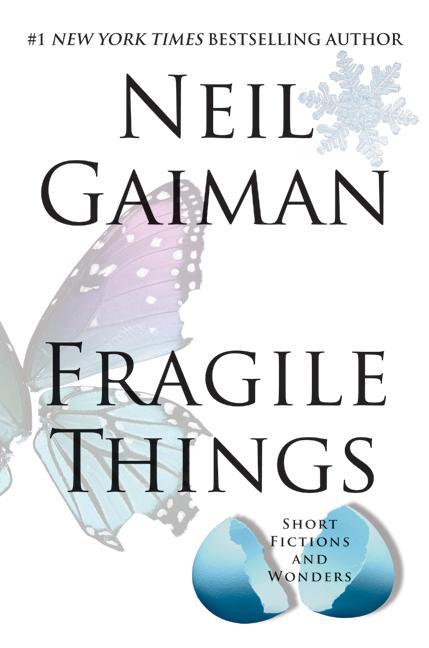
The first time I read and reviewed the Fragile Things collection I wrote:
“Short story collections are something of an enigma. I have read a fair number of short story collections this year, and while some were fantastic from start to finish others contained stories ranging from the very good to the very average. Fragile Things occupies this latter category.”
My opinion of some of the stories in this collection changed in the positive direction when I later purchased the audio version of Fragile Things, but by and large I still agree with my initial assessment of this book. It has some of the very best examples of Neil Gaiman’s tremendous talent in the short story medium. And it contains examples of the things I just don’t care for in Neil’s writing. And there are some that fall squarely in between. There are more stories and poems that I like than those that I don’t and I do find myself coming back to various stories in the collection every few years come autumn.
I do appreciate everyone’s dedicated participation. This extra wrinkle in the R.I.P. Challenge has been so much fun.
And now, let us come to the end.
- The Day the Saucers Came
It is fitting given how much poetry has been in this collection that the final group of four stories would include some poetry. I will start off by doing my imitation of a broken record and state that to hear Neil Gaiman read this is a delight.
I’m very fond of this poem. When I first reviewed it I called it a “fun little weird romantic science fiction nonsensical poem”. And I still feel that way.
The joy of this poem comes in the knowledge that you have these two people, people that I always like to think perhaps had just met and were in that crush phase of their relationship, one of whom is completely oblivious to the unfathomable maelstrom of horror that is being simultaneously unleashed on all of humanity because they are staring at their phone in agony waiting for the other to call. I also like to think that the person telling the story is nearly as oblivious, also staring at their phone and trying to work up the courage to call.
Another win in the poetry column for Neil.
- Sunbird
This is the kind of story that feels as if it could fit perfectly in the American Gods universe. In the introduction Neil mentions that this was his attempt to do an R.A. Lafferty story. And every time I am reminded of that I think that I really need to go track down some Lafferty from the time period Gaiman mentions and I never do. I used to live in Tulsa, OK and was very aware of who R.A. Lafferty was, so I really have no excuse not to have checked out Lafferty.
Lets get this out of the way right from the start: I like “Sunbird”. It is a deliciously, pardon the pun, tale of trickery and deception. I wouldn’t go so far as to say that I am a “foodie”. Perhaps a better analogy is that I am on the outside of the restaurant peering in longingly. If time and income permitted, I could certainly see myself becoming a foodie. As they sit discussing some of the many things they have eaten I find my mouth watering. Not for everything, of course. And it quickly stops when they come to the part about electrocuted Man. Half-fried or no, I would have to say ‘no, thank you’. 🙂
Zebediah T. Crawcrustle is the perfect trickster. From the very start you see him being cagey, dodging questions, using misdirection in his words and playing on everyone’s desire for a new experience. The members of the Epicurean Club often remind me of stories where people live forever and eventually they succumb to behavior that we would abhor because they are bored and tired. They feel as if they have tried everything and done everything and there is nothing left to do but sink into depravity. But this group isn’t quite that way, though they are dissatisfied and looking for something new.
I love how this story is somewhat serious and yet is also wickedly comical. There is an edge to some of the verbal wordplay that I enjoy. I especially like the reactions to the various members of the club as they begin to realize what Crawcrustle has done to them. Even before the club members are aware that they are remembering this story and that it has occurred before we get a small hint where TwoFeathers mentions that he will miss his daughter. Its all very clever and there is more than meets the eye. I get a little something more out of it each time I read it.
I find myself wondering if the members reincarnate to some degree, or if some of them are actually old gods of some sort. Very interesting to think about.
Its a fun story and I’m curious about how you all will feel about it.
- Inventing Alladin
This is another story/poem that I enjoy. Although I haven’t spent much of my reading life with Scheherazade, I’ve always been fascinating by the idea of a woman whose life is spared because she tells such marvelous stories. That story, as well as this poem, exists in one part as a reflection on the importance and life-giving quality of storytelling. Although I enjoy the time period in which I live, part of what feels romantic about pre-technology eras is the idea that people were entertained by sitting around and telling stories. You get the idea that a good wandering minstrel and a really inventive story teller would have been treated like royalty, their creative output like fine gold.
There is an undercurrent of danger in “Inventing Alladin”. Scheherazade knows she won’t live forever. She has a feeling that one day she will fail. But uncertainly still reigns, and her creativity is sparked anew each day.
Again, I see this poem as a metaphor for the writing experience. An author has to keep creating stories in order to “live”, to make a living, and each day the normal activities of living must be done and there is that unspoken concern, “will I come up with something good today”. Although this isn’t my favorite poem of the collection it is one that I still really enjoy in part because there is so much to think about as you look at it on various levels.
“Monarch of the Glen”
Shadow is one of my favorite characters in contemporary literature. I just can’t help but like the guy. When time passes and the urge to either re-read or re-listen to American Gods comes upon me it is always because I want to revisit Shadow, to spend some time with what turns out to be a very complex guy. Although I ache for Neil Gaiman to finish that Neverwhere novella that he refers to in the introduction, I am pleased that we have this additional Shadow story.
Of course it also helps that this novella begins with a quote by Angela Carter from arguably my favorite of her short stories, “The Lady of the House of Love”. (Hmmmm…maybe The Bloody Chamber should be our short story group read for next year’s R.I.P. Challenge.)
One of the reasons I feel Gaiman’s stories, particularly his Sandman comics and the American Gods novel, work so well is that they are built upon the foundation of older myths and stories. They are reworked and crafted with Neil Gaiman’s own unique method of storytelling. In “Monarch of the Glen” it is the story of Grendel and I like the way in which Neil treats this character with respect through Shadow’s actions.
So much to talk about, but I’ll just keep it to some thoughts.
Like the ‘story within a story’ about the hulder. I’ve learned so many pieces of folklore and mythology from stories by Gaiman. Also like (although that isn’t the right word) the Sawney Bean story. Not sure why I am not quite as disgusted by that disgusting story. Perhaps it is just because it, as well as much of what goes on in “Monarch of the Glen” lends a degree of suspicious and weird atmosphere to the story. You feel all the time that something is just not quite right about this place and the people in it.
I enjoyed the brief return of Wednesday in the dream. He was another of my favorite characters from American Gods.
Also enjoy the fact that the “ship of dead-men’s nails” that features in Shadow’s recurring dream is also briefly mentioned in “The Day the Saucers Came”.
I like Jennie. She’s sweet and interesting and a bit sassy.
We get to see Smith and Alice return in this story. I enjoy that, but still could live without the more disgusting elements of “Keepsakes and Treasures”.
For me this is not only a satisfying story but it is a satisfying conclusion to Fragile Things. It is a novella chock-full of references to stories as old as time itself and while on one level it all seems very straight forward you know while you are reading it that there are bits you are just not quite catching, but on subsequent reads you learn more and it becomes an even richer tale. For those who haven’t read American Gods I imagine a great deal of what this story does is lost on you and I highly recommend giving AG a read. Despite its occasional brief forays into Gaiman’s more disturbing type of storytelling, it is a rich and rewarding novel. Shadow is a great character to get to know.
As always, please leave links to your posts below:
Thanks again to each and every one of you for coming along for this experience. I can’t tell you how much I have enjoyed and appreciated it. You have all been so great in your honest assessments of the stories and poems in this collection and I’ve learned so much about you, and about myself and the way that I approach reading and understanding shorter fiction. I hope we can all do it again soon.
Links to the previous week’s discussions:
Week 1
Week 2
Week 3
Week 4
Week 5
Week 6
Week 7
_______________________
This book is a selection for the Peril of the Group Read portion of the 6th annual R.eaders I.mbibing P.eril (R.I.P.) Challenge. To find out more information and/or to sign up to participate, please follow the link. If you are interested in more books or films that are being reviewed as part of this event, please visit the R.I.P. VI Review Site.
Wow, you took far more away from “Inventing Aladdin” than I did! I thought it was cute but I didn’t end up reading too deeply into it.
And I didn’t mention it in my post (not sure why now!), but I thought it was kind of mean that ol’ Crusty let everyone just disintegrate from the phoenix — the fact that he’s the only one left makes me think that the others are probably most sincerely dead. I wonder if that’s necessary, though, if perhaps this phoenix can’t just rise from its own ashes but needs a few more bodies’ worth?
And and, you’re absolutely right about all the fun things in “Monarch of the Glen”! I had to stop a few times when I was reading through it and share the folklore with my husband or sing the “money rolls in” song to him. Amusingly enough, it turns out that my husband had totally heard the song already, from his father who used to sing it often, apparently. I’m not sure I’d sing that in front of my hypothetical children!
I’m so deeply steeped in Gaiman storytelling from so many years of reading and re-reading his stuff that it all comes out when I read a story like Inventing Aladdin. Its the kind of story that I like seeing from a prolific author because I think it speaks so much to the writing experience.
Crusty is, in my mind, an example of one of the trickster gods, kind of like the trickster in Anasasi Boys, and so while it may be mean it is really in his nature to do just that. Obviously Zebediah and the phoenix have developed this relationship over the years where Zebediah gets the thrill of actually eating the bird before it turns to ash and then being able to watch it rise from the ashes. I think they are “dead” in one sense, but I also think the people are also personifications of the gods which is why I see them coming back, even if it is in some other being. That is why I think the references to them knowing about this are in the story, not just because they grow backwards and remember the time when they knew this story from their “parents” but also because I see that spirit coming back from generation to generation.
That’s funny that your husband knew that song already. I don’t think I’d sing it in front of my kids either. LOL! Look forward to your thoughts on American Gods when you read it some day.
I thought the “money rolls in” song was hilarious. Inappropriate, to be sure, but then again most funny things are. 😛
I liked “Monarch of the Glen” a lot, which is interesting considering that I hated the last story that featured Smith and Mr. Alice. I think that this one leaves them as bumbling-yet-not-unlikeable villains, whereas “Keepsakes and Treasures” went a bit too far by zeroing in on things that were best left implied.
Don’t you think it’s rather scary that Smith and Mr Alice are not entirely unlikeable, when we know that actually they are both thoroughly evil? Of course, that rather presupposes an order of writing, and I think Gaiman implies that he wrote Monarch of the Glen first, but it got me thinking…
Very much so. I think that I’d have been inclined to like them if I hadn’t read Keepsakes & Treasures first. It’s interesting to see different facets of Smith & Mr. Alice in different stories, because we can get a greater idea of how they’re perceived by other characters.
I don’t mind them being a dastardly duo, I just wish I could wash their sexual proclivities from my mind.
I loved all these final stories, and I WILL definitely be reading AH soon (as well as reading the rest in the Sandman series. I’ve read the first four collections). I, too, read The Day the Saucers Came as two people in that “mad crush” stage, oblivious to everything going on around them. I love your reference to being outside the restaurant staring longingly in. Yes, The Sunbird is a story to make one hungry! I read Aladdin as being about all humans and our need to tell stories. I, too, am drawn to the romantic notion of sitting around telling stories (like October in the Chair). Monarch wasn’t lost on me – lived it – nut I can see a return to it once I’ve read AG is in order.
I’m assuming you mean AG. 😉
I certainly see that in the Aladdin story as well, the importance of our need to tell and hear stories; the importance that stories play in our lives. Good call referencing October in the Chair.
You will definitely need to re-read Monarch of the Glen once you’ve read American Gods. You’ll want to just to spend some more time with Shadow.
Wasn’t Saucers fun? I hope we can all relate to being that focused on a desired phone call in our lives.
That’s AG, not AH and but not nut. Comments using smart phones are tricky things.
Yes, “smart” phones are not always the most intuitive when it comes to language.
I finally caught up at the end. It was very interesting to read your thoughts after I finished each story. Before this book I had only read The Graveyard Book and Coraline so without your clarifications I would never have understood anything here. You make a great ambassador for Gaiman. I don’t think I would call myself a fan of his yet, I found some of his stories a real turn off here for the reasons you mentioned, but I enjoyed reading the book along with someone who is. You should teach a course in Gaiman’s work.
That is a sweet way to put it Ariel. 🙂 I am admittedly a bit of a Gaiman fanatic, although I think I proved to myself with this read that I have become more objective about assessing his work than I was when I first came to discover his work. Thanks so much for the kind words. One of the things I’ve loved about this group read is that many times I’ve seen stories through different eyes and seen things in them that I had never seen in my readings before.
You’ve done well if your only other Gaiman is The Graveyard Book and Coraline. Both are excellent. I would highly recommend Neverwhere, the book that made me fall in love with Gaiman’s storytelling, and Stardust, which is one of the best fairy tale based stories I have ever read.
Thanks so much for reading along with us Ariel, I appreciate it and am glad that it helped you look at the stories differently.
I’ll keep Stardust in mind for your spring Once Upon a Time challenge :).
I just realized that I had watched the Stardust movie and liked it very much. I didn’t even know that was a Gaiman novel. Now I will have to read the book for sure.
I would have love the Stardust movie if it hadn’t been based on this book. As it was I thought the movie was okay, but the book is so much better.
I enjoyed returning to Shadow’s story for a minute too, though I think my expectations were a bit too high. American Gods kind of sets a high bar. I did really like the Inventing Aladdin story. There was something about surviving based on your own gift for creativity that’s interesting.
Yes it does, but for a shorter story I think Gaiman did a really nice job of revisiting Shadow. I hope one day we get to see what happened when he eventually made his way to Chicago.
I guess I assumed you automatically LOVED anything and everything by Neil Gaiman.
Happy Halloween, Carl. If you happen to be handing out home-baked cinnamon rolls, save one for me, won’t you?
You are out of luck there, just the usual suspects as far as store-bought candy for the Anderson household.
Nope. I love every novel he has written with the exception of the YA novel Interworld which he co-wrote with Michael Reaves.
And for short stories I’m usually about 60-40. There are some I love, others I like, and still others I loathe for whatever reason. I have yet to find any that I feel are poorly written from a skills standpoint but sometimes his subject matter disturbs me and other times the work is too project-specific for me to really enjoy, like his collaborations with Tori Amos.
I think Wife bought the little packets of M&Ms this year. I’m a Snickers guy, so she made a good choice as far as left overs go.
Well, you should have came our way, we had some snickers in amongst our stuff, and som M&Ms too!
Once again I really love reading your insight into these stories. I enjoyed The Day The Saucers Came but just glossed over it so I really liked reading your thoughts on it.
Two big thumbs up to Sunbird and The Monarch of the Glen for me. I’d really love to read more about Zebediah and I liked seeing Shadow again.
When I first read American Gods I enjoyed but it also frustrated me and I think it was my lack of knowledge of Odin and Baldur. I’ve been picking up more and more info over the last year and I think I need to give American Gods a reread. And now I regret passing it on to another reader on GoodReads! Oops! But someone else got the chance to enjoy it so it’s all good.
Yes, The Day the Saucers Came is an easy one to do that with, but I do encourage you to give it another read.
Sunbird and Monarch were great, weren’t they. I’m not sure how much knowledge I had of those gods when I read AG, but I do know I had a little. I give Gaiman credit though because I enjoyed it even with my lack of knowledge. Its been a really long time since I’ve last listened to AG and I really should read it again sometime as I know so much more now and would probably get so much more out of it.
I really liked The Monarch of the Glen too – it was a great end to the collection and now I really want to read American Gods!
And I think that The Bloody Chamber would be a great choice for next year – I’ve wanted to read it for a while and I would definitely sign up for that challenge! Thanks for RIP and this group reads – it was a fun experience even if I didn’t love the collection.