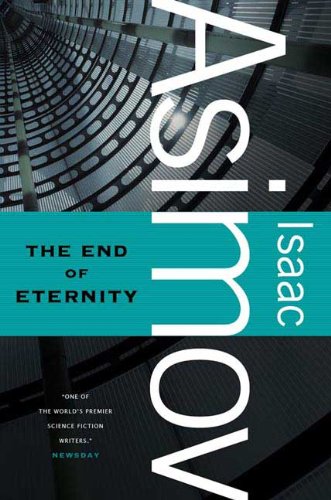
Andrew Harlan, the insular protagonist in what is arguably one of Isaac Asimov’s best works, is a man who lives outside of time. Harlan is an Eternal, a member of a clandestine organization that exists outside of time, an organization that makes “necessary” changes to reality in order to ensure the very best for mankind. In this realm Harlan is one of the elite, a Technician, skilled in the art of making subtle adjustments that nevertheless send ripples through the stream of time. There is a solitary aspect to being a Technician that Andrew Harlan is ideally suited for, until one fateful assignment brings him in contact with Noys Lambent, a woman whose existence in real time calls into question Andrew Harlan’s vocation and the role of Eternity in the lives of humanity. And once Andrew Harlan falls in love, the very nature of time and Eternity may be irrevocably changed.
With more contemporary examples of stories involving the manipulation of time and matter and/or extreme governmental oversight into our lives (movies like Dark City, Gattaca and Minority Report spring to mind) it can be difficult to recommend a book like The End of Eternity. There is an argument to be made that the older work will have a ‘been there, done that’ feel to it and that a more modern work eliminates the dated elements of decades-old storytelling. When it comes to a work as well executed as The End of Eternity, I don’t buy that argument. One can easily posit that it is important to understand the history of science fiction and the foundational novels upon which more current stories are built. I certainly get that out of much of the classic genre fiction that I read and believe it to be a justifiable reason to read older works. But beyond the historical merits there are stories that simply should not be passed up because they are just too good to miss.
The End of Eternity is one such novel.