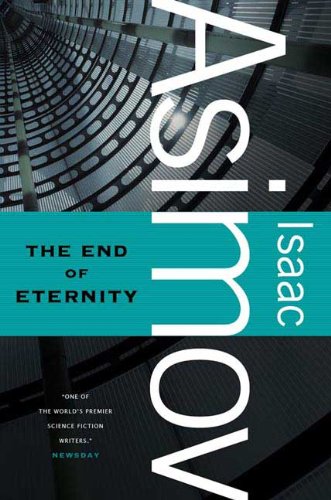
Andrew Harlan, the insular protagonist in what is arguably one of Isaac Asimov’s best works, is a man who lives outside of time. Harlan is an Eternal, a member of a clandestine organization that exists outside of time, an organization that makes “necessary” changes to reality in order to ensure the very best for mankind. In this realm Harlan is one of the elite, a Technician, skilled in the art of making subtle adjustments that nevertheless send ripples through the stream of time. There is a solitary aspect to being a Technician that Andrew Harlan is ideally suited for, until one fateful assignment brings him in contact with Noys Lambent, a woman whose existence in real time calls into question Andrew Harlan’s vocation and the role of Eternity in the lives of humanity. And once Andrew Harlan falls in love, the very nature of time and Eternity may be irrevocably changed.
With more contemporary examples of stories involving the manipulation of time and matter and/or extreme governmental oversight into our lives (movies like Dark City, Gattaca and Minority Report spring to mind) it can be difficult to recommend a book like The End of Eternity. There is an argument to be made that the older work will have a ‘been there, done that’ feel to it and that a more modern work eliminates the dated elements of decades-old storytelling. When it comes to a work as well executed as The End of Eternity, I don’t buy that argument. One can easily posit that it is important to understand the history of science fiction and the foundational novels upon which more current stories are built. I certainly get that out of much of the classic genre fiction that I read and believe it to be a justifiable reason to read older works. But beyond the historical merits there are stories that simply should not be passed up because they are just too good to miss.
The End of Eternity is one such novel.
Andrew Harlan is an interesting character as is the organization to which he belongs. Asimov has created a character that is not instantly likeable, but neither does he put the reader off. He is a character uniquely suited to the position to which he has risen, a position in which social isolation is a desired and necessary factor.
What was it that educator Yarrow had once said: “above all, a Technician must be dispassionate. The Reality Change he initiates may affect the lives of as many as fifty billion people. A million or more of these may be so drastically affected as to be considered new individuals. Under these conditions, and emotional make-up is a distinct handicap”.
While there are many different and equally important roles in Eternity, the job of the Technician carries with it a degree of stigma and fear because of the very power the position wields. Asimov writes the character is such a way that the reader is introduced to the eerily fascinating world of Eternity while warming the reader up slowly to Harlan as Harlan himself becomes gradually more self-aware, gradually more alive.
Occasionally he would lose himself in a world where life was death, death; where a man made his decisions irrevocably; where evil could not be prevented, nor good promoted, and the Battle of Waterloo, having been lost, was really lost for good and all. There was even a scrap of poetry he treasured which stated that a moving finger having once written could never be lured to unwrite.
And then it was difficult, almost a shock, to return his thoughts to Eternity, and to a universe where Reality was something flexible and evanescent, something men such as himself could hold in the palms of their hands and shake into better shape.
Without resorting to being preachy Asimov has written a captivating novel that examines free-will and what control of one’s fate means to the very nature of being human. His Eternity is an efficient, precise organization whose desire for the greater good ignores the needs of the individual and it is that conflict that Asimov fuels to create a gripping page-turner.
Any novel of this age is going to have some dated elements, especially in regards to computers, but I found nothing in the story that derailed the flow of Asimov’s plot and as I read I found myself thinking that this might just be my favorite Asimov story of all that I have read. The tension mounts in the later third of the book toward a climactic end and there are enough twists and turns to keep the suspension building. It is a pleasure to follow Andrew Harlan on his journey and while Noys Lambent exhibits a degree of gender stereotyping she is still an engaging character in her own right. To top that off Asimov’s imagination has created this world that exists outside of the flow of time that will conjure up all manner of fascinating images.
I read this book back in November and as it is one that will be on my Best Of list for 2012, I hated to pass up the opportunity to review it. And with numerous science fiction related reading events on the horizon I also did not want to miss the chance of telling you about a book that must make its way onto your reading list. The End of Eternity is highly effective storytelling that will remind the reader just why Isaac Asimov is considered one of the masters of the genre, and why classic genre fiction can be both entertaining and relevant to the modern reader.
I keep meaning to read this one. I think my dad read it a couple of months ago and really enjoyed it.
It is definitely one to add to your list, John. It is a book I was tempted to nominate and will possibly do so in the future. I’m always torn between nominating something I’ve already read, so I can do a good sales job, and something I haven’t read so that I can get a new experience along with everyone else.
I liked the End of Eternity so much, I named a RPG character after a character in the book (Noys). I liked the exoticism of the name and it stuck in my head. Even with the gender stereotyping
Hey Paul! Thanks for the visit. I can see why you named the character for her. Her name sounded really familiar in my head the entire time I was reading it and I’m thinking it may be because of the “lambent” in the Gears of War games. She is a memorable character and I thought she exhibited some strength too and thus at least wasn’t an entirely one-dimensional stand-in of they typical mode for women in genre fiction of this era.
Hi Carl
Wow, if this is your favourite Asimov and it’s made your ‘best of’ list then it definitely needs to go on the ‘need to be read’. I wouldn’t even know who Asimov was without your readalong and then Positronic Man so excited to read this one.
Ta
Lynn 😀
It isn’t an easy choice as I love a lot of Asimov. This one is just very well done on top of being interesting.
Will add this one to my tbr Carl. Maybe it’s the history nerd in me, but I like to see the evolution of stories. Yes this story may be dated some, but I’m more curious about the foundation and how certain concepts have evolved over the years.
I have become that way myself over the last several years. I am a nostalgia fiend anyway.
I added the audio version to my newly created list at the library.
We started listening to the audio of Fuzzy Nation on the way down to Mary’s parents. It is fun!
That is next on my list after I finish The Graveyard Book.
I’m only on disk 2 of TGB. It’s a lot of fun!
Yes, that one is pretty fantastic.
I agree, an excellent novel. BTW, I have the Signet edition, I’ll send you a small image.
It really is. Great image on that one, Richard. Wow! I’m going to post it here below.
This book sounds amazing! I’ve always wanted to read some Asimov but didn’t know where to start. I’m crossing my fingers that my library has this.
This one or his collaboration with Silverberg, The Positronic Man, are both excellent places to start. I’m also very partial to Currents of Space but I think End of Eternity has nudged past it for me.
Wow, fantastic review! Like Vasilly, I’ve never read Asimov, but he has such a huge list of books I don’t know where to start. It sounds like I got a nudge in the right direction here 🙂
Yes, as I replied to Vasilly this isn’t a bad place to start at all. It is one of his more accessible works while still being firmly a work of science fiction as opposed to an adventure story in space (not that there are anything wrong with those, I love ’em).
For starters with Asimov, I’d recommend:
1. The Currents of Space 1952 (Republic of Trantor)
2. The Stars, Like Dust 1951 (long before the Empire)
3. Pebble in the Sky (early Galactic Empire)
I still have Pebble in the Sky on my shelves to read. I may try The Stars, Like Dust again someday just to see if my opinion has changed but after years of looking for a specific cover image for this one I finally found it in ’05 in Chicago and was then super disappointed when I read it.
The book presents wonderful notion about choices and mankinds desire to resist change, Asimov happen to see it in a grand scale of civilization itself and creates a pageturner with enough scientific mumbo-jumbo to hook a fan of science fiction, all the events tie together in the end and every small event is interpreted in his style of two worlds, really love the book, not in the class of foundation novel because that one is about infinity , this one is eternity and that too is the end of it.