Category Archives: Science Fiction

Homunculus by James Blaylock

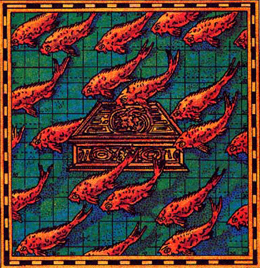
Picture this: The year is 1875, the setting London. A dirigible on a pre-set course helmed by a skeleton sails the night sky and a city full of would-be heroes and thieving scoundrals watch for its inevitable crash landing in the hopes of retrieving the homunculus…the little man in the little box rumored to hold the key to eternal life. Sound bizarre? You haven’t heard the half of it. Enter the world of James P. Blaylock’s Homunculus and you will see this and more.

Scientist Langdon St. Ives and the rest of the amatuer scientists and philosphers of the Trismegistus Club have their work cut out for them as they are slowly but surely drawn into the plot of the homunculus. If they are to keep this powerful being from falling into the wrong hands they will have to out think and outwit a cast of nefarious villians including an insane street evangelist who believes he is the new Messiah, his congregation of corpses reanimated by the hunchback vivisectionist Ignacio Narbando, the alchemist Will Pule who sports a bad complexion and is hell-bent on stealing the heart of an innocent young girl, and many more too numerous to mention. Everyone wants to possess the box, made by a craftsman named Keeble, to use the homunculus’ powers to their own ends. To add to the confusion there isn’t just one Keeble box, and no one knows exactly which box he is in.

Homunculus belongs to the genre of stories known as steampunk. A simplistic definition is that steampunk “concerns works set in the past, or a world resembling the past, in which modern technological advances occurred earlier in history, but were accomplished via the science already present in that time period”. A more detailed dissertation on steampunk can be found on the Wikipedia site here (It is worth reading simply for all the marvelous books, comics, games, etc. that the article references).

Homunculus is a modern treasure of a story in that is an amalgam of plots and settings and characters reflected in the classic works of Jules Verne, H.G. Wells, G. K. Chesterton, Sir Arthur Conan Doyle, Edgar Rice Burroughs, Edgar Allan Poe and P.G. Wodehouse. It also calls to mind the graphic novel work of Alan Moore in his League of Extraordinary Gentlemen volumes. It is a tale that is by turns dark and menancing, and at times absurd and humorous. The heroes are noble and upstanding though some have skeletons in their own closets whose revelation adds to the intricacy of Blaylock’s twisting and turning plot. Homunculus boasts bad guys who are insane, bad guys who are sinister, and bad guys with the vaudevillian traits of Snidley Whiplash and similar villians from the classic melodramas. James P. Blaylock’s writing style in this novel is very reminiscient of Chesterton’s The Man Who Was Thursday and the plot is every bit as deliciously convoluted as that work.

Any book that contains perpetual motion dirigibles, alien space craft, zombies, carp bladders, hunchbacked mad scientists, toy-makers, giant emeralds, kidnappings, suspense, mystery, wild inventions, diabolical schemes, drunken slow-witted philosophers, wet cigars, pea-pots, misdirection, explosions, disguises and the rich atmosphere of 19th century London cannot be anything but enjoyable and I wish I could convey the sheer pleasure I received from reading this book. Its style rewards the careful reader and there is a large enough cast of characters that you do have to pay attention at times to keep everything straight. Reading this novel one can envision how much fun it would be to do as a movie or television show similar to the classic Wild, Wild, West or the more recent Adventures of Brisco County, Jr.

James P. Blaylock has written a sequel of sorts with the same cast of characters entitled Lord Kelvin’s Machine: A Novel that I have ordered from the library and cannot wait to read. I had to utilize the library for Homunculus as well because it has been out long enough to not be readily available in the bookstores. The same characters can also be found in two short stories in the book Thirteen Phantasms and Other Stories which I reviewed back in January.

My only real complaint about the novel is the terrible packaging. As bad as the mass market paperback cover is, the trade paperback is even worse. Lord Kevin’s Machine has a really fun hardback version with a cover that reminds me of Sky Captain and the World of Tomorrow. I hope someday someone with some clout falls in love with this story and republishes it in a worthy format.

If you are in the mood for something outlandishly fun, dripping with atmosphere, somewhat challenging and a reflection of some work of the masters of classic adventure/science fiction and if lines like “Does the night seem uncommonly full of dead men and severed heads to you?” tickle your fancy then I highly recommend that you scour up a copy of Homunculus and give it a good read. It is a wacky, whimsical, farcical science fiction historical mystery that is simply too good to pass up.
The Draco Tavern

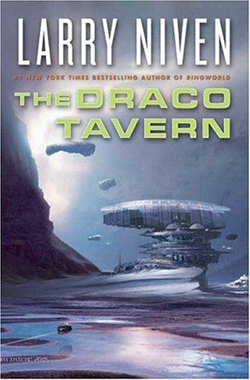
Larry Niven’s latest book, The Draco Tavern, arrested my attention for the same reason most books do…it has a fantastic cover. In this case the cover art is by an artist I have featured on my site previously, Stephan Martiniere. Martiniere’s work has graced a number of science fiction and fantasy book covers lately and his modern techniques remind me so much of the classic science fiction illustrations on books that captured my attention as a child. Each time I see one of his covers I lovingly pick up the book wondering if the story is as good as the cover art. I had less to worry about in the case of Larry Niven. Niven is an award winning author of a series of books centered around a place called Ringworld…and I haven’t read a one. My one and only experience with Larry Niven is an excellent book called A World Out of Time, which has the distiniction of being the first book I ever bought as a kid from a used bookstore and is one I come back to every few years as I enjoy it so much.

The Draco Tavern is a series of short stories, 27 in number, that span the last three decades of Niven’s work. The stories center around, you guessed it, the Draco Tavern. Larry Niven points out in his introduction that the Mos Eisley Spaceport in Star Wars is part of a “hoary old tradition”, one that he felt he could put to use to discuss a number of topics in short story form. The tales told in The Draco Tavern are told by the bartender, Rick Schumann, who built the tavern on Mount Forel in Siberia after the appearance of the first aliens on earth. The stories are set in the 2030’s and Schumann is the only consistent character in each story. The Chirpsithra are a group of aliens who lay claim to having conquered all red dwarf systems in the universe and in discovering Earth they now shuttle various alien entities across the universe to visit this new planet and its race of interesting yet underdeveloped people. Rich Schumann does what any enterprising young man might do, he sets up a bar that serves all comers, maintaining a stock of food and drinkstuffs that defies explanation for an ever-growing number of aliens who defy description.

The Draco Tavern short stories are each individual, self contained tales and yet they build on each other in roughly the same way that episodes of shows like Star Trek: The Next Generation do. There is a definite progression of time and there are things that happen in previous stories that crop up in later tales. Larry Niven is a truly talented writer and this is very evident when you realize that there is almost no deep characterization in these tales and yet you find yourself really liking and connecting with Rick Schumann. As a bartender for the only interspecies tavern on earth Schumann is not only Earth’s ambassador to the alien races but he is the reader’s as well. Through these 27 stories you are allowed to meet any number of interesting alien races seen through the eyes of a man who is very much like you and me. There is not a great deal of action in these stories, they are tales told around the bar, but don’t let the lack of action turn you off, these stories are good. They are also very different. In reading the first two or three stories I was puzzled by how Niven seemed to end each one rather abruptly. I soon got used to this and ended up really enjoying the format, especially as I realized that the connectedness of each story make it read almost like a novel.

If you are a fan of the type of science fiction that does not have to center around explosions and interstellar wars then I really believe you’ll like this set of vignettes into the life of Rich Schumann and his most interesting watering hole. I found myself sadly disappointed when the book ended as I really felt a connection to Schumann and wanted his adventures to continue. Hopefully Larry Niven will revisit this world in future short stories. My only complaint about the book at all is that the last 3 or 4 stories were told out of chronological order (in the order he wrote them instead, I believe) and it felt odd to have them ordered that way as they were the most interconnected of all the short stories. That being said there wasn’t a disappointing story in the bunch and I am so glad that I have finally read my second Larry Niven book. Pull up a chair, order a beverage, and drink in the sights and sounds of the odd, yet somehow familiar, atmosphere of The Draco Tavern.

Thirteen Phantasms and Other Stories

/images/thirteenphantasms.jpg

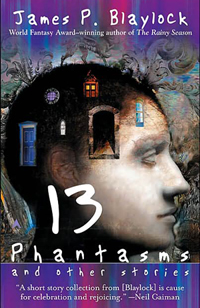
Thirteen Phantasms and Other Stories by James P. Blaylock is a book that jumped out at me last year as I was walking through my local Barnes and Noble bookstore; I recognized the cover art as a work by Greg Spalenka. As I picked up the book to examine the cover I felt like the proverbial fish being caught by the shiny worm…there on the front cover was a quote of recommendation from none other than Neil Gaiman. Flipping the book over was like biting down harder on the hook as there was an even longer quote from Patricia A. McKillip! Needless to say this little unassuming paperback book of short stories ended up coming home with me. And I am so glad that it did.

Patricia A. McKillip’s quote alone makes a perfect review of the book: “[James Blaylock’s] range is quite wonderful…He brings magic into urban fantasy…His characters are people who might occupy the house next door to us; they might be spooky or unkind or even dead, but they are always fully realized. His instinict for the quirky detail is unerring; he takes a clear look at the marvels in his world and makes us remember the marvels in ours.”

Herein Blaylock gives us 16 engrossing tales that find their home in no one set genre: within these pages lie modern fantasy, science fiction, mystery, horror, steampunk, comedy, and suspense. The titular story alone was worth the $6.99 cover price. Like any book of short stories there are some that make more of a connection than others, however each was worth reading at least once and several were so good that I turned around and immediately read them aloud to my wife. Two tales in the later half of the book, Two Views of a Cave Painting and The Idol’s Eye, featured a cast of early 20th century English scientific adventurers that read like a cross between P.G. Wodehouse, G.K. Chesterton, Sir Arthur Conan Doyle and H.G. Wells. Needless to say I was thrilled to later find out that these characters are featured in two Blaylock novels, Homunculus and Lord Kelvin’s Machine: A Novel. Another favorite was the World Fantasy Award winning story, Paper Dragons. The language of Paper Dragons evoked reminiscences of the beautiful language found in Patricia A. McKillip’s work. There is even a story celebrating the wonder of doughnuts.

At the risk of sounding like Forrest Gump, reading a book of short stories is like eating a box of chocolates. If short stories are not to your taste I would venture to say that you have just cracked open too many coconut filled ones. The short stories of Neil Gaiman, Patricia McKillip, Roald Dahl, Gene Wolfe, P.G. Wodehouse (the list could go on and on) and now James P. Blaylock are like sitting down to a large assortment of the best Godiva truffles with each bite better than the last…where each is a favorite to be savored and treasured and the memory shared with friends. Take a bite…you won’t be disappointed.