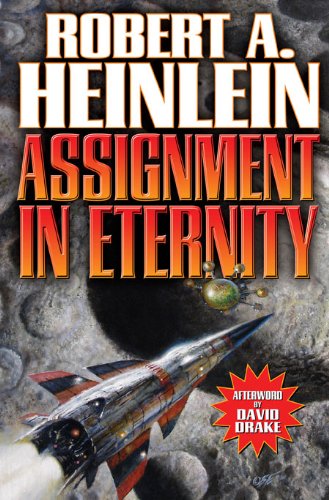
Assignment in Eternity is a collection of four of Heinlein’s early published works. Two of the stories are advertised as “short novels”, or what might be more accurately called in current word count designations as novellas, and two shorter works. All four of these were first published in magazine format in the 1940’s, though two were actually written in 1939.
I first became a fan of Robert A. Heinlein over a decade ago when I read his novel Friday. I went on to read Time Enough for Love and then came a long Heinlein drought, ended because of friends reading and discussing his juveniles–a designation for books published by Scribner’s between 1947 and 1958 that would now be classified as ‘young adult’.
There was something special in both Friday and Time Enough for Love that made it obvious to me while reading them why Heinlein had maintained popularity, but the novels, like others of his later work, are filled with embarrassingly juvenile (here used negatively), taboo-crushing sexual content and diatribes about his beliefs at the time. His juvenile work is wonderful, as are some of the novels published just after the Scribner’s period.
The collection The Green Hills of Earth proved Heinlein’s skill at crafting stories in the short format, so I was very curious when I put this on my Christmas wishlist to venture into some of Heinlein’s early work.
That curiosity resulted in four rewarding journeys into the early imagination of the Dean of Science Fiction, Robert A. Heinlein.
Smarter reviewers than I have discussed these stories, long before the internet was a glint in the imagination of Al Gore’s father’s eye. Science Fiction historians, amateur and professional, who have a greater grasp at Heinlein’s work and his ever-evolving views over the spectrum of his career, could parse these sentences for every nugget of detail.
I’m just a fan of the guy’s work, enough of a fan that I’ve enjoyed reading the occasional fact or opinion about the man and his stories. What I am offering you is my experience with these stories, sprinkled with a bit of knowledge gleaned from the excellent forward and afterward of the collection. For short fiction in particular, mileage may vary.
“Gulf”
This is one of the longer stories in the collection. In it Heinlein posits the idea of a group of “supermen”, men and women of superior intelligence, who cordon themselves off in secrecy, expanding their knowledge base and gathering other like individuals unto themselves with the goal of the creation of a new kind of human. This story of expanded uses of the mind is wrapped up in an entertaining spy story. “Joe”, aka Captain Joseph Gilead–one of many aliases–is a spy recently arrived from the moon. A quick change of personality and the game is afoot. It is also when the paranoia begins.
Robert A. Heinlein does a fantastic job of projecting the mistrust and fear that must needs accompany a life of danger and deception. Of course, it is not paranoia if someone actually is following you, and soon Joe becomes wrapped up in something much greater than his original mission.
Overall “Gulf” was paced like a good spy story. It slows down briefly as Joe gets to know the supermen, yet that part is interesting in the slightly info-dumpy manner of some early science fiction.
There is a point in the story where I was certain it would end with “to be continued”, as the remaining page numbers were decreasing far more rapidly than was seemed reasonable for it to deliver on its promises. The story did wrap up, and surprised me in the way in which it ended, but it does suffer from the “hurry up and end this” feeling that is occasionally present in stories written to a certain word count due to magazine submission guidelines.
“Gulf” acts as a prequel of sorts to Heinlein’s novel Friday in that one of the characters is present in both stories and the protagonist of the novel, Friday Baldwin, is a creation of a number of genetic “parents”, including Joe and Gail in “Gulf”.
“Elsewhen”
A professor explains to a group of five philosophy students how he discovered the ability to use hypnosis and mental power to travel in time. He proceeds to share about parallel universes and the time stream, and his eager students agree to try it for themselves. A little hypnosis and the power of suggestion and “poof”, the students disappear. All except one skeptical student who was only attending the class to be with the girl he loved. What follows is a discussion between the professor and the skeptic, interrupted by the return of students from their many and varied adventures.
It is interesting to read a story written in 1939 that not only has echoes of even earlier stories in its method of travel, but also predates many other famous stories that do the same, including Jack Finney’s Time and Again. The story took an adventuresome turn that I had not expected. Fun!
“Lost Legacy”
Dr. Phillip Huxley and Dr. Ben Coburn, of Western University, and student Joan Freeman, embark upon experiments that prove that there are vast untapped areas of the mind that, if accessed, allow humans to utilize telepathy and telekinesis to do any number of remarkable, super-human, seemingly impossible things–including levitation. Their studies lead them to theorize that the humans of ages past had access to the full powers of the mind, but something occurred which caused mankind to lose these abilities. Their theory begins to take on the characteristics of fact when they get lost during a vacation hike on a snowy mountain and are rescued by author Ambrose Bierce, who disappeared in 1914 and would now be over 100 years old.
“Lost Legacy” is the second novella in the collection and Heinlein uses his word count to great effect. The interplay between the three protagonists is peppered with witty dialogue, the discovery and exploration of latent mental powers is interesting, and the path this takes the story, including the hostile reactions of others who know of these powers and are violently opposed to the knowledge becoming widespread, makes for a first rate novella.
“Jerry Was a Man”
This short does something that I have seen many classic and contemporary short and long works of fiction do: it examines what it means to be human using characters who are not. An extremely wealthy couple travel to a specialize bioengineering facility to procure an exotic, one-of-a-kind pet. While there the wife, Martha van Vogel, source of the family fortune, discovers that the genetically enhanced chimpanzees, modified to perform a variety of work functions, are terminated when they reach the end of their usefulness. When Mrs. Vogel talks to one of the chimps, Jerry, her ire is raised and she begins to use her considerable fortune, and forceful personality, to bring the question of Jerry’s rights to the forefront.
Robert A. Heinlein is a terribly interesting author to read in regards to the portrayal of women in his stories. On occasion he crafts female characters who transcend the time period in which they were written. Martha van Vogel is one such character, at least in some aspects of her character and in the role she plays in the story.
There is a nice thread of humor woven throughout, and Heinlein manages to use an economy of words to impress the overall message on the reader without being overly sentimental in so doing.
I have read many stories with similar themes, including The Positronic Man by Isaac Asimov and Robert Silverberg, and more recently Cassandra Clarke’s novel The Mad Scientist’s Daughter. Even David Brin’s The Uplift War, which I am currently reading, deals with aspects of this idea of what it means to be human and to have rights. I enjoy these stories. Each author does it a little bit differently and I generally find them to be emotionally charged, satisfying stories.
Assignment in Eternity is a first-rate collection of stories. There are thematic similarities in all four stories and yet each is unique and interesting on its own. The seeds of what Robert A. Heinlein was to become are planted in these tales.

Assignment in Eternity was originally published in 1953 by Fantasy Press. It is not uncommon for books to go out of print, even works by well known and much-lauded authors. Baen Books has long worked to keep the stories of Robert A. Heinlein in print and I applaud them for doing so. It is a pleasure to be able to walk into a local bookstore (where they still exist) and find new volumes of Robert A. Heinlein on the shelf, many of them in a nice trade paperback format.
This particular volume has a nice, spoiler-free introduction by William H. Patterson, Jr. and an informative afterward by author David Drake. Both of these enhance the reading experience and are most welcome additions to the collection.

Baen Books has done a nice job of maintaining a consistency of look with the Heinlein volumes by commissioning the work of a single artist, Bob Eggleton. Eggleton is a multiple Hugo and Chesley award winning artist whose work I like. I am particularly fond of his covers for The Green Hills of Earth and Project Moonbase and Other Stories. I like rockets, and Bob Eggleton does a great classic rocket, as he has here on this cover.
His work has a distinct look, there is a texture to his paintings that make them stand out as his work. I like that in an artist. I don’t mean to say that his work is not varied, any more than I feel that way about any other artist with a signature style. I love being able to see a book cover in a store, or on a friend’s shelf, and recognize from a distance who the cover artist is. It is like seeing a long time, beloved friend. It makes me want to pick the book up and interact with it.
My Rating: 8/10 Top-notch early work from one of Science Fiction’s Masters.
I started reading Robert Heinlein’s novels when I was a kid. CITIZEN OF THE GALAXY was my favorite Heinlein novel among his early “juveniles.” I read many of later books but found Heinlein’s works uneven. Of the later books, I liked THE MOON IS A HARSH MISTRESS.
Citizen of the Galaxy is one I have not read. One of these days I will be sad to discover I’ve read all the Heinlein novels (particularly the juveniles and middle period books). Not that I won’t enjoying re-reading some of them. I’ve read and reviewed Star Beast, Starman Jones, The Rolling Stones, Podyane of Mars, The Puppet Masters, The Green Hills of Earth, Starship Troopers, and The Day After Tomorrow (The Sixth Column). I have listened to some of the audio version of The Moon is a Harsh Mistress and like what I’ve heard.
It’s always interesting to read Heinlein’s early work, not only to compare the progression of his thoughts in his later stories, but to see how well he handled words/ideas from the get-go. I confess, I was enormously influenced by his juveniles and I love all his work, though the Lazarus Long stories are my favorites.
I can see why you like the Lazarus Long stories. There was a lot that I enjoyed in Time Enough for Love. There was a lot I could have done without too, but there are story fragments that have stuck with me, and it has been at least a dozen years since I’ve read it.
Heinlein was very facile with words and his writing style never seems to get in the way of the story unless he’s plugging in his “philosophy lectures”. There’s more and more of that as you progress by chronology through his works. I think the fist book I read of his was STARSHIP TROOPERS and at the time (high school) I was oblivious to any secondary themes, moralizing or anything but the straight fast-paced story. I later read MOON IS A HARSH MISTRESS, then started on the books for younger readers. Concurrently I was reading Arthur C. Clarke and Asimov and sometimes they even blend in my mind.
This was a good one, as I recall.
There were small seeds of “philosophy lectures” here, on occasion, but they were really only noticeable because of having seen those be more prevalent in the few later works I’ve read.
I’ve read a good amount of both Asimov and Heinlein, but I believe I’ve only read Clarke once, and that was a short story or novelette.
“Tunnel in the Sky” remains one of my favorite books. I read it in High School (which was a long time ago) and probably why I am fan of shows like “Lost”. Worth a read if you haven’t read it already.
I haven’t read it already, but it is on my list of Heinlein books that I want to read. Thanks, Ian.
Hmmm… I can’t remember if I’ve read the books on your list, although I know I read Heinlein as a child. I do remember enjoying Have Spacesuit, Will Travel (I think that’s the title) so I will have to check out the titles you’ve mentioned.
I know Have Space Suit is a favorite of many. It is one I still need to read.
So many good Heinleins! DOUBLE STAR was a major influence on my own work, I know. And another of my favorites is PUPPET MASTERS–the Donald Sutherland movie version doesn’t even come close. The new Ethan Hawke movie based on Heinlein’s “All You Zombies” looks interesting, though.
Puppet Masters is one of my favorites thus far. The characters remind me to a degree of Jim DiGriz and Anjelina in the Stainless Steel Rat books. I’m curious about the new film as well.
Oddly, I’m working my way through Harrison’s Rat series now. Can’t think how I missed reading them years ago!
I think the Old Man reminded me of Inskipp as well. Again, it is a weak comparison, but I found stuff in Puppet Masters that I liked that was similar to things I like it the Rat books.
Quality posts is the crucial to be a focus for the users to go to see
the web page, that’s what this site is providing.