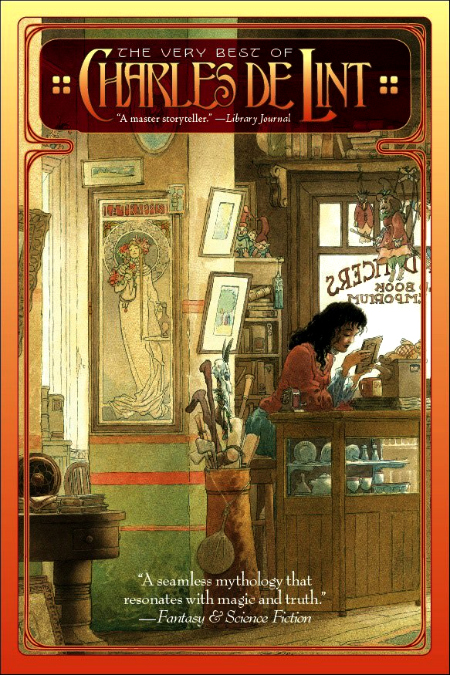
This week Kailana and I tackle 6 more stories from The Very Best of Charles de Lint. The stories we discuss are:
‘In the Pines’
‘Pixel Pixies’
‘Many Worlds are Born Tonight’
‘Sisters’
‘Pal o’ Mine’
That Was Radio Clash’
As in previous posts our discussions generally hit topics that can be weighed in on even if you have not read that particular short story, so please feel welcome to share your thoughts about any or all of the areas we touch on. The first 3 stories were mine to develop questions for, the last three were Kailana’s.
And away we go:
1. “In the Pines” seems to invite trying a different perspective when looking back at one’s life and one’s dreams. What do you think of the message in this story?
This was an interesting story in that I was surprised by what I interpreted the “message” to be, which was that it is okay to dream big but only accomplish small. In the story the protagonist’s life, especially her involvement in music and where it hadn’t taken her, was put in perspective by a spectral visit from the person who inspired her dreams in the first place. My initial reaction was to chafe at the idea of settling for less than your dreams and yet further thought on the subject gave me a slightly different outlook on the story. We all have dreams–or at least I hope we do. We may dream of being writers, artists, musicians, poets, etc. and when we have those dreams I believe the idea of being successful in those pursuits goes hand in hand with that. But few are successful (if you are defining that by fame and/or fortune) in those dreams. Does that mean they should not be pursued? Heavens no. I think there is a fine line between settling for less than one really could be and maturing in one’s definition of success. In this day the internet has allowed for creative people of various types to achieve some level of exposure that may not have happened in the pre-internet days, which is good. I think it also encourages folks to simply pursue their passions, for their own sake, rather than looking at some outward measure to define success. In the end this character stayed involved in the music scene and her unexpected visitor helped put into perspective how doing what you have a love for is in many ways its own reward.
2. “Pixel Pixies” had a couple of wonderful thoughts about books and reading in it, particularly “Wise and clever humans…” on page 303 and the first paragraph on page 315. Pick one (and for the sake of our readers type out that small section, and then discuss it if you would. (I’ll choose whichever one you don’t pick).
This has been one of my favorite stories in the collection, largely because of Dick, the hob who lives in the bookstore and is a true lover of the written word. I would recommend this story to any book lover simply for the way in which Charles de Lint, through this little hob, expresses some of the wonders of books. At one point in the story de Lint writes:
“And he loved the wide and eclectic range of old and new books to be explored in a shop such as Mistress Holly’s, titles that wandered far from the beaten path, or worthy books no longer in print, but nonetheless inspired. The stories he found in them sustained him in a way that nothing else could, for they fed the heart and the spirit.”
Isn’t that wonderful? As I ponder the fate of bookstores and libraries in today’s economy that one small portion of prose speaks volumes about what I love about going into a place that sells, or loans, books and how I feel about the book as a physical object and the magic contained between its pages.
There have been some truly excellent stories in this collection and this is one of the best.
3. “Many Worlds are Born Tonight” has some science fictional elements in the concept of multiple universes being created by our decisions. What do you think of that idea either in general or particularly in light of the protagonist and some of the decisions he did or did not make?
The whole “parallel universe” idea is one I find fascinating, especially given the many interesting science fiction stories that are built around it. As I read this story I couldn’t help thinking about how I would not want to really and truly be aware of my alternate selves in a parallel universe. If the idea that any decision I made or didn’t make had implications on the me and the people around me in another universe was true and I was aware of it I believe it would paralyze me. I would hate to think that some other version of me was suffering in some way because of decisions I made or didn’t make, or on the other hand that there was a version of me having a much better life because he is living in a world where I didn’t make the decision to do thus and such. If you look a little deeper at that concept it really does have some practical application to our actual lives in that it is true that the decisions we make not only have the potential to have lasting and far reaching consequences for us, but that they also affect those around us, whether we know them or not. It isn’t a bad thing to be reminded of that now and then and to spend some time contemplating that.
1. What did you think of the vampire story ‘Sisters’ compared to the popular vampire novels out nowadays?
I have a love/hate relationship with vampire stories. I read Dracula for the first time when I was 11 or 12 and fell hard for the book. I’ve read it many times since then and it remains one of my favorites, if not the favorite, of anything I have ever read. Because of that devotion to the vampire mythology appropriated and crafted by Bram Stoker I tend to shy away from other interpretations of vampires. But occasionally I give stories a try. I enjoyed Colleen Gleason’s Gardella Chronicles novels when I read them a few years ago. Silas, the character in Neil Gaiman’s The Graveyard Book is a favorite character of mine. And Angela Carter’s short story The Lady of the House of Love is one I like to reread every fall. Which brings me to this story and the realization that I am much more tolerant of and apt to enjoy vampires and vampire tropes in a short story format. I actively avoid picking up contemporary books or watching contemporary films with or about vampires, but a short story is something I am more likely to give a shot. I think de Lint is very good at taking familiar story ideas/concepts/archetypes and doing something different with them and I believe he succeeds once again in doing that with ‘Sisters’.
2. This is one of those stories that I am not really sure what specific question to ask, so I will have to just ask what you thought of the story ‘Pal o’ Mine’?
This is a sad story that touches on a number of things, but what I really took from it was looking at creativity and the expectation of others and whether or not one should compromise in order to make one’s art “fit in”. I think it makes for an interesting companion piece to “In the Pines”. The protagonist makes the ultimate choice which is very sad, robbing both her and the world of potential beauty in the form of her music. Certainly commercially there is a great deal of pressure to fit your “art”, whatever that may be, into a homogenized, “acceptable” box. In looking at this story and thinking about the way the internet is functioning today, something I touched on in the first question in this post, I am wondering if the protagonist would in reality find a more accepting and encouraging audience because of the ability to put stuff out there and connect with people who are moved by it, understand it, etc? I’m not sure. Certainly there is every bit as much potential this very day for people to be critical of one’s work and rejecting of both the work and by extension the creator. Some of the things that have fascinated me and spoke to me the most are things that, at least at the time when I discovered them, were outside the norm. Or at least outside my norm. I guess it is naive of me to think that society in general is any more accepting of difference now than it ever was, which makes this story that much more sad because I cannot help but wonder about the real people who are in this same place. Charles de Lint has a very special way of pointing out truth, even ugly and sad truth, and he once again succeeds in doing that with this story.
3. If you had the chance, would you take the opportunity offered to the characters in ‘That Was Radio Clash’?
Like you I had read this one before. I liked it then and I like it now. The idea the story presents, about being able to go back in life and make a different decision than the one that resulted in so much loss and pain, is an interesting one, especially given the fact that things are never that simple. As in the discussion above, every decision has consequences both on the person making it and those around them. I think de Lint does a good job of exploring that in this story. There are a couple of very specific decisions that I made in my life that I wish I had not and the memory of the moment I made those decisions haunts me. Not every day, but when I think about the time the memory is very vivid and I cannot help ruminate about “What if…”. Yet I look at the person I am today because of dealing with the consequences of those decisions and wonder if I would be less of the person I am now if I hadn’t made those mistakes and then built from them? It would be a very slippery slope if we could play God in our own lives that way, wouldn’t it? I would hope that I was satisfied enough with myself and the life I still have ahead of me to not go back and make the change. In the end I am happy to not have the choice.
We only have a couple of more stories left folks and we will be finished with the The Very Best of Charles de Lint. Once again I encourage you to visit Kailana’s site to see her answers to these questions and please feel free to jump in on the general discussion here and over there.
Thanks for reading.
L
Books do indeed feed the heart and spirit…a very nice pick 😀 There are many choices, I believe most people might care to make differently, but at what cost. I wouldn’t be willing to give up the life i’m living now, let alone the wisdom I’ve gained in making those choices, even if poor ones they were. Wow, went a little Yoda there…lol
Kelly: Yes, I can hear the Master’s voice now… 😉
I agree. At this point in my life I feel like I’ve gained a lot of wisdom from my mistakes and am actually applying that wisdom to my life to make it better. A few years ago that might not have been as true and I probably would have jumped at the chance to go back and correct a lot of stupid financial decisions. Actually that part would still be very tempting right now! 🙂