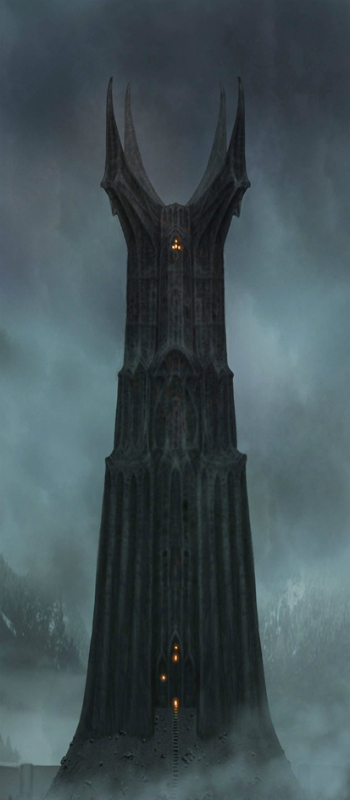
Here the air was still, stagnant, heavy, and sound fell dead. They walked as it were in a black vapour wrought of veritable darkness itself that, as it was breathed, brought blindness not only to the eyes but to the mind, so that even the memory of colours and of forms and of any light faded out of thought. Night always had been, and always would be, and night was all.
And so we leave Sam, a reluctant Ring-bearer, wearing Isildur’s Bane as his much loved Mr. Frodo is carried off, not dead, to an uncertain fate. J.R.R. Tolkien really knew how to end things with suspense, and his publishers picked the perfect place to end this volume of The Lord of the Rings. We the readers now go forth to witness the king’s return as Sam and Frodo are left hanging from this cliff for the next 150 pages or so.
Could anything be more fitting than to read about the darkness and terror of a spider-shaped being of pure malice over Halloween weekend? Shelob is the stuff of nightmares for those readers who imbibe peril.
It is with both sadness and excitement that we come to the end of our group read of The Two Towers. Sad because that means we have a little over 300 pages left (including the MUST READ appendices) of our journeys with the Fellowship. Excitement because the best is yet to come.
Andrea came up with this week’s discussion guides. If you are not familiar with the story presented in The Two Towers you may want to skip the rest of this post, as we will be embracing spoiler-laden discussion.
Faramir strikes me as a noble, intelligent fellow, especially concerning powers beyond his control. Had he gone to Elrond’s Council instead of Boromir, how might the story have changed?
In a concurrent group read we recently read Gaiman’s story The Problem of Susan regarding a character from The Chronicles of Narnia. When I read Tolkien or watch Peter Jackson’s film adaptations, I cannot help but think of “The Problem of Faramir”. Before answering the question, indulge me in this aside. In Tolkien’s work Faramir is presented as a character who wouldn’t pick up the ring if it were laying on the side of the road. He is a noble hero of pure heart and unlike his brother Boromir is not swayed by the tempting voice of the One Ring.
Peter Jackson and company saw this as a problem. They rightly (in my opinion) point out that in setting up the audience to believe in the corrupting power of the Ring, the one tangible representation of the Bad Guy present throughout the story, you strip it of its power when you run across a Man who doesn’t care two figs for it and isn’t even bothered by its tempting influence. You could argue that Aragorn is not either, but Aragorn fears it and fears the failure in his blood line that prevented the Ring from being destroyed many hundreds of years before. It is not a major problem, but it is one that ever so slightly mars this part of the story for me. But Peter Jackson and company marred it for me as well.
In the film adaptations Faramir and his companions are abusive and mean to Gollum. Farmair handles him roughly and allows his men to beat and kick Gollum until he tells Faramir what secret Frodo and Sam are hiding. These scenes always sicken me, the more so because Faramir really is a noble and proud and heroic character. I initially thought Jackson had no literary basis for this behavior. But then my eyes were opened during the reading of The Fellowship of the Ring, where in just a line or two Aragorn admits to being very rough on Gollum to find out what happened to him before he “escaped” from Sauron’s clutches. I’m not sure I would have enjoyed seeing Aragorn do this on the screen.
I understand why Jackson transmitted this part of the story to Faramir. There is much more tension in seeing Gollum beat into revealing that Frodo carries the One Ring than there is in Sam just making a mistake and letting the information slip, then uttering a Homer Simpson style “doh!”. It also sets up the change from the cooperative Smeagol back into the duplicitous Gollum. But to be honest I would rather see a slightly tempted Faramir in the book and not have seen Faramir as a thug in the films.
Back to the question (FINALLY!), If Faramir had been the one at the Council, the Faramir as Tolkien wrote him, it is likely that he would have been given the quest to destroy the One Ring and the story would not have been as rich and varied as is the story of two highly unlikely characters being tasked with the ultimate sacrifice of making their way into the heart of Mordor. Where Tolkien does succeed in pulling off having a character from the race of Men who is not tempted by the Ring is that we don’t meet him until after he knows Boromir is dead and he has his own mission that he must fulfill. At the point in which the reader discovers Faramir he cannot simply say, “Here, let me help you carry that Frodo”. He has a duty and he is honor-bound to fulfill it, just as Frodo and Sam are honor-bound to continue their hopeless journey.
Before I leave this discussion point, let me point out that I love Faramir as a character. On screen and in the pages of the book I find him to be a true hero, despite my niggling issue.
What did you think of Shelob and her lair? Would you willingly go in there? Yes, I know Gollum says “this is the only way”, but Frodo could have demanded they explore and attempt to find another way.
In some ways this ties into earlier questions during The Fellowship of the Ring group read, regarding the hobbits and if we would undertake this journey ourselves. And like I did then I would have to answer that I hope I would “show my quality” and that it would be of the very highest and that yes I would willingly go into that dark, oppressive and stinky tunnel. But I would not have wanted to.
Frodo could have certainly demanded that they explore another way, but they would have soon come upon the Orcs patrolling the area and would have been forced into the tunnels anyway, not that they knew this, but Gollum did. I also gather from the interactions between Frodo, Sam and Gollum to this point that Frodo was able to discern when Gollum was at least being somewhat truthful and that although Gollum’s treachery in the lair was not something he anticipated, he did believe that Gollum was telling the truth in that this was really the only way into Mordor. And despite his understanding with Shelob, I suspect Gollum did know ways to get in and get out of there while avoiding her if his life depended on it.
When Sam saves Frodo from Shelob, he finds himself in the vision he saw in Galadriel’s mirror. Knowing the future isn’t always as helpful as one would think, is it?
No it isn’t, especially because one of the things that Tolkien touches on in The Lord of the Rings is that knowledge of the future is still open to the vagaries of interpretation. When Sam finds himself in that spot and he recalls the vision of Frodo laying there it frustrates him and adds to his sadness and, I believe, in some way helps to convince him that Frodo is indeed dead.
We also know from Saruman’s use of the Palantir that seeing things doesn’t mean that one is interpreting those things accurately. Visions of the present and visions of the future can be manipulated and twisted to serve ones own ends and can also be easily misinterpreted simply because a person doesn’t have the full breadth of knowledge.
I wonder if part of what Tolkien is demonstrating is that knowledge of future events is not ultimately very helpful, and that we are better served in preparing ourselves to meet life’s challenges whatever they may be. While it is important to recognize the signs of what is going on around us, to “see the writing on the wall” so to speak, it is less helpful to have a certain knowledge of what is going to happen to you personally.
Having always been a sidekick/helper of sorts, Sam reluctantly realizes he may have to become the Ringbearer. What do you think Sam will do with the Ring of Power? If you were the sidekick of the hero, and suddenly had the opportunity to become the hero, to finish the quest, what would you do with the Ring of Power?
Every time I partake of The Lord of the Rings, through the medium of the books or the films, Sam is one of the characters who inspires me. He makes me want to be a better person. He makes me want to appreciate the “simple” things, like a good meal, honest labor, and loyal friendship. He inspires me to not be too clever and not to try to see all ends but to do my best at whatever task I take on. I know what Sam will do because of my exposure to the stories, but I would like to think that even if I did not I would recognize that Sam is unlikely to ever completely embrace the hero’s journey, or if he does he does so not as the principal hero but one of the important but supporting characters who in the end rises to the top because of his humility and perseverance.
Having gone through all that they have gone through, none of which has been glamorous or particularly enjoyable, I don’t see Sam feeling in any way satisfied at being thrust into the leadership role. Of course Sam has always maintained enough of an optimistic spirit that he hopes, even in the midst of these troubles, that songs will be sung about him. I like that in Sam. It doesn’t feel arrogant or self-serving with Sam. It reflects on his child-like faith and hope that things will work out in the end. So while he is reluctant, Sam is also the type of person who, once embracing the challenge, will do so to whatever end.
The conversation between the two Orcs at the end was highly amusing for me. Yes, it serves to educate Sam on Frodo’s condition, and Tolkien could have just left it at that, but he didn’t. The Orc’s commiserating could have been any soldiers in any war. To me, it felt like Tolkien was humanizing the enemy, instead of the traditional dehumanizing of the enemy that you usually see in war stories. What do you think?
I have mentioned before that there are examples throughout these volumes that indicate that a) Tolkien’s work is deeper than some critics want to give him credit for and b) fantasy is more than just fantastical characters experiencing stock adventure stories as fantasy allows us to examine important issues in a nonjudgmental way. One of these areas is the way in which Tolkien treats the “bad” characters in The Lord of the Rings. Many of the enemies in Middle-earth are characters who have been “corrupted” by evil influence. They weren’t born bad, but they became that way over time. The orcs and Uruks are perversions of the elves at the hands of Sauron’s first master, Morgoth. The men who follow Sauron are not necessarily evil in and of themselves but they have been manipulated or conned into joining forces with him, either out of their animosity towards those races who ally themselves against Sauron or because of fear of what Sauron’s armies might do to them if they were to rise against him. Gollum is corrupted by the ring. Saruman is corrupted by years of gazing into the plans of the enemy through the palantir. I find that idea very interesting and it adds to the overall bittersweet aura of Tolkien’s books.
There is joy in triumphing over the enemy, but that joy is tempered by the sad reality that in order to do what you felt was right and in order to protect those you love you had to take the lives of others. I think Tolkien demonstrates his feelings about this so well in Sam’s ponderings, which are given to Faramir in the films:
It was Sam’s first view of a battle of Men against Men, and he did not like it much. He was glad that he could not see the dead face. He wondered what the man’s name was and where he came from; and if he was really evil of heart, or what lies or threats had led him on the long march from his home; and if he would not really rather have stayed there in peace…”
That sentiment gets me every time. While I believe that in the world that we live in there are times when war is a necessity, I also believe that the average joe who populates the army of any country would rather, given the choice, be out working in fields or factories, would rather come home at the end of the day to a simple, modest, satisfying life rather than go out to take the life from an “enemy”.
The book ends on a cliffhanger. Are you excited to finish up the trilogy and see how it all turns out?
Very much so, and my excitement is not at all tempered because of knowing where the road ahead is taking us. Part of my excitement rests on the fact that I’ve only been down this road of Tolkien’s books once before. There is much that I have forgotten and I have been pleased and surprised with each book thus far as the story becomes more richly detailed and more profound as I am reminded of things forgotten. And there are details that I recall from my first reading of The Return of the King that I am franky aching to experience again. I long to once again see the journey that each of the members of the Fellowship take on, in particular Aragorn, and given where we leave Sam and Frodo I am and will be anxious to return to their sides as soon as possible.
I would like to thank Andrea and Clint for allowing me to take part in the development of discussion questions for The Two Towers. I will be returning to that duty during week two of The Return of the King. Be sure to visit either of their sites for links to the posts of the other participants.
I also want to thank all of you who take the time to read my blatherings about these books, which mean so very much to me. I have enjoyed and will continue to enjoy your insights into these stories.
The Two Towers was every bit as exciting of a read as it was the first time I opened its pages. It was so fun to pull this book down from the shelf again, to gaze at its fantastic Alan Lee cover illustration of a flooded Isengard, with Orthanc dominating the background. Feeling the weight of this book in my hand, smelling the ink and the paper, added immensely to the thrill of reading this book, as did many days of autumnal weather. As I sit here typing this I feel a palpable glow of satisfaction in time spent reading and writing about such an incredible work of fiction. And we are not finished yet. 🙂
_________________
Additional Two Towers discussion posts:
Hi Carl
Love your comments – as usual so articulate and well thought out not to mention thought provoking. I’ve really enjoyed this read along – I think it’s great to find out the differences between the book and the film – which frankly I’d totally forgotten! I loved Faramir in the book – not so much so in the film but it was interesting to read in your comments the reason why this was changed because I wasn’t aware of that. I also think Sam is great – he does play a supporting role – but frankly, I don’t think Frodo would have succeeded without him and his optimism and funny stories. ‘Good old Samwise – I want to hear more about him.
The road goes ever on and on…
Thanks
Lynn 😀
Thanks Lynn. As I’ve mentioned before, it is easy for me to “wax eloquent” (in other words have a case of verbal diarrhea) when it comes to talking about The Lord of the Rings. 😉
I love a great deal about Faramir in the film and actually prefer him being initially tempted by the Ring, but I don’t like the cruelty towards Gollum, even if it was an accurate part of the book just done by Aragorn. I’d rather not see that part. I do like the actor playing Faramir though. I think he conveys the emotion of his conflictual feelings about everything very, very well.
And yes, I’ve watched the extras so many times and read so much about the films that I am well versed at the reasons given for why some things were changed in the films. Good ol’ trivial knowledge. LOL!
I think one of many points Tolkien was trying to make in this story is that we cannot do anything on our own. That there are no solitary heroes. Frodo could not have done this at all without Sam, and Sam would not have done this at all without Frodo. Their interdependent relationship is wonderful to see.
I just glad that I am able to experience my first reading of LOTR series.it is much like how you read Dune. I was wondering will you be reading more of the the Dune books?
I think you are correct Faramir question. That would have been something if Faramir would have been on the quest with Frodo to help him out.Very interesting indeed.
I think that so many people in the world today should at least learn about Samwise and his attitude towards life. If they did, I think that the place would be a much better place.
I don’t know why I didn’t remember that this is your first time through the books. Fun, isn’t it? Especially doing it with a group like this.
I am definitely interested in reading the next Dune book. Everything I’ve heard about it makes me want to pick it up and see how Paul’s story continues.
I also think the world would be much better if we all had a bit of the Gamgee attitude about us.
Hi, just wanted to tell you, I enjoyed this post. It was inspiring. Keep on posting!