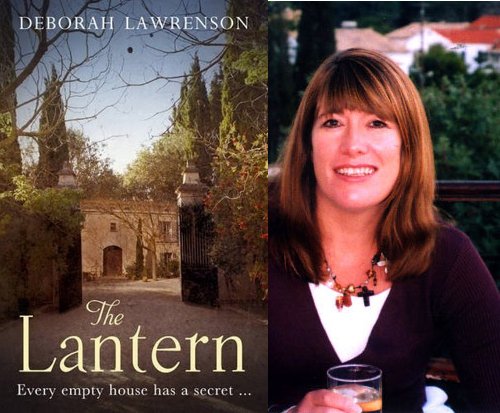
Over the past three weeks I have had the distinct pleasure of discussing an engaging new contemporary gothic novel with a group of astute and passionate readers. That novel is The Lantern by Deborah Lawrenson and it has generated a wide variety of opinions not just about the overall book but about various elements within the story. The fun thing about putting your thoughts out there on the World Wide Web is that you never know who is watching. In this case, it was the author herself.
Deborah Lawrenson sent a very nice, insightful email to me the other day and in the ensuing discussion I asked if I could share that email with all of you. With a great deal of courtesy Ms. Lawrenson wished to see if she could have the opportunity to share thoughts that were inspired by all of our commentary regarding her novel. And since I really enjoyed what she had to say in the email there was no way I wanted to just keep it to myself.
So I would like to invite those of you who participated in the group read of The Lantern, those who did not but have already read the book, and then of course all of the rest of you, to take part in some further discussion of the novel with the author herself.
I have asked Deborah Lawrenson to feel free to respond to comments, questions, etc. I hope you’ll join in.
Here is Deborah Lawrenson’s email:
Dear Carl,
I don’t know how many authors whose books you discuss follow your readalongs, but I certainly have, and been gripped by all the diverse views. Thank you very much indeed for choosing The Lantern and leading such a great discussion – I really appreciate it, and also your stalwart insight into the book.
There are a few points I would very much like to throw into the ring, but I want to do so in the same spirit of generosity you have all shown, and certainly not in a combative way. I didn’t want simply to put down a link and take up the discussion without approaching you first, under the wire.
The first addition to the discussion I would like to make concerns what you quite rightly term the “blueprint” of Rebecca. So many times the discussion came very close to covering why this should be so, but then shied away. The Lantern is a novel, on one level, about reading and writing, and narrative and expectation. So, (just as you say) the pattern of that book leads the reader to certain expectations about the plot.
Rebecca was itself a modern retelling of Jane Eyre. When it was published, there was plenty of criticism that it was a pale imitation of a classic. If I might quote from Margaret Forster’s brilliant biography of Daphne du Maurier: “…the reviews were often sarcastic. Comparisons [in the US] with Jane Eyre were even more numerous than they had been in the British press, usually to the detriment of Rebecca.” (p.140, Arrow edition, UK)
The Lantern also contains several echoes of Jane Eyre, across the time frames: the discovery that André is already married, like Mr Rochester; Rochester’s suggestion to Jane that they live together, unmarried, in the South of France; the overt comparison of the story to the Bluebeard legend by Jane as she edges closer to the truth at Thornfield Hall. But unlike the paragraph where Eve admits she is re-reading Rebecca (which some critics say was like “hitting the reader over the head with a stick”), the connections to Jane Eyre are alluded to only in one vague sentence about her reading the Brontës as autumn darkens around her. Clearly, it’s a case, for the author, of “Damned if you do, damned if you don’t.”
All the discussion about unreliable narrators is spot on: each tells what they believe to be the truth, based on the knowledge they have at that moment, their own experience, and their own blind spots, real and psychological.
It follows that readers read with the same recourse to their own experiences and preconceptions – perhaps even preconceptions that have grown from previous reading of gothic literature.
The novel is full of stories, from the tales told about the house, to the Provençal tales in Bénédicte’s lost book and the disturbing way they confound expectation, to the published and half-written articles by Rachel and the detailed but untrue yarn she spins Sabine about the perfect French village. The sighted version of the lavender fields that Bénédicte tells Marthe. The evil lies Pierre tells. Even the story Dom tells Eve about what happened to Rachel. And Eve is writing – and translating Bénédicte’s words on tape – with the influence of the gothic books she is reading ringing in her head.
I’m going to leave you the link to a post on my blog where I try to set out what I was trying to achieve with The Lantern. I don’t want to go on and on, to the point where you’re wondering if this author is as mad as Bertha Mason in the attic!
PS. Personally, I think you and all the others are absolutely right that different fonts for the different narrators would have been better. As a matter of fact I wrote the whole manuscript with different fonts, but the publishers decided it made for a more subtle read all in one typeface, allowing the different stories to merge together dreamily in places. I have asked them to reconsider for the paperback edition.
All good wishes – and thanks again.
~Deborah Lawrenson
Okay gang, let’s chat!
How great to have the author join in the discussion, thanks Deborah!
I didn’t see the Jane Eyre links at all, but I suppose I should have, because now that it has been pointed out it is obvious! Of course I have huge issues with Jane Eyre as a novel because I kinda studied it at college and so can’t think about it without thinking about sexual inadequacies and Rochester having to be made impotent in order to get together with Jane. Not that I agree with that interpretation but my lecturer went on and on about it!
Thank YOU – all – for discussing my book with such care and honesty! It’s been a real privilege to have the insight.
Now Mr Rochester’s unadequacy, that’s a thought that I didn’t have when I was weaving in the echoes of Jane Eyre! If anything it was in bed where Eve and Dom did their best communicating. And no such problem for Andre. But now that you mention the subject, Pierre never got anyone to marry him, so perhaps…
On your blog, on another tack, I thought you had Sabine just right when you said she told various truths at various times in order to provoke a response. Exactly so. As was your summary of Dom’s eejit-cy, though in my mind he was more of a repressed Englishman, depressed to boot.
Thank you for being willing to join in the conversation, Deborah. It is much appreciated and very exciting.
Sabine was an interesting character to be sure. I often saw her as the Mrs. Davers character in your story and am curious if she was in any way inspired by her or if that is just me reading too much of “Rebecca” into “The Lantern”.
Well I think that most repressed Englishmen have a bit of eejitry to them 🙂
And yes, depressed and caught up in his own past. Which is understandable.
Thank YOU – all of you – for your spirited discussion. It really has been a privilege to be able to read all your insights and honest reactions in such detail.
Now I really didn’t consider Mr Rochester’s inadequacies when I was weaving in the nods to Jane Eyre! Certainly, Eve and Dom do their most effective communicating in bed, so there are no worries there. Neither does Andre have a problem. Pierre, though, now there’s an idea that might explain a few things! And he never marries…
Sorry about the dual reply – was trying to get it to post!
Thanks for joining the discussion! It’s exciting!
I can definitely see the Jane Eyre similarities now that you pointed them out. I’m one of the people who hadn’t read Rebecca, so I had no real preconceived notions about the plot or tone of the book. I think that in a way it actually enhanced my reading of the novel.
The fact that Eve is a bookworm was her redeeming point, to me. Normally I’d be upset at a female character who stuck with a guy despite major gut reactions telling her not to trust him. The fact that she demonstrates that she is a reader to me sets her as one of those people who is very book-smart, but a bit socially challenged. I know people like that, so it gave her a bit more depth.
Hello! That was the whole premise of the novel: Eve is a bookworm. She’s also shy and damaged by her upbringing, wary of relationships after seeing her parents’ marriage dissolve acrimoniously, without ever feeling that anywhere was really home to run to. She seems to have formed her ideas of a romantic hero from books, which is bound to lead to heartbreak. She’s book-wise but not life-wise.
The discussions about Eve’s drippy nature have been really interesting to me. When I was writing her, I was focused on her lack of self-esteem and the way she used books and words as a protective shield from the wild world outside. The reason she continually lets Dom off the hook is that in every other way he is lovely to her, even when he is working on his music alone. When she writes her version of events she is largely picking out the bad parts to examine. She frets over them, in her isolation. But the bigger picture is that they have both bought into their isolation as living a dream life, and Eve simply does not want to rock the boat. She wants the dream to be true.
I thought the discussion about the conventions of gothic literature and the fine line between credibility and farce – or plain annoyance! – was fascinating. Is it even possible to write a modern gothic novel, when the heroine runs the risk of having to be too wet for sympathy? Of course, if she is a feisty one, there would be no place for the languorous melancholy that I wanted to write. She’d have done exactly what most of us would – but then there wouldn’t have been a story. I think, with Eve, it may just be a case of having to accept that this is her character: naïve, over-imaginative and for once trying to grasp the nettle of life.
I agree with you about the ways in which a female protagonist “must” behave for a novel to work in the moody atmosphere of gothic literature, be it a product of its time period or a contemporary version. I think a novel like “The Lantern” really brings out what we as readers bring to it. I was less annoyed by Eve because I the parts where she was talking about her and Dom that were good really jumped out to me. As a reader I was clinging to the hope that she was not inflating her memories of their “dream” moments and that in the end they really would both have a romantic loving part of their lives to fall back on.
Both characters were annoying at times, but “annoying” doesn’t necessarily have to mean “bad”. Just like in scary movies you want to yell at the characters to “run”, but at the same time there would be no story if all the characters were making rational decisions. In the end I think the characters have to be somewhat realistic and I think you managed to walk that fine line between then being too realistic and not realistic enough to find themselves in the drama of a gothic work of fiction.
I like that Eve was a bookworm and would even have liked to see more emphasis on that aspect of her character simply because I love books about people who read.
I did think that Eve was very realistic, and when I got annoyed with her, it was for the same reasons that I get annoyed at friends for dating specific types of guys who are very much the alpha-male but aren’t necessarily the nicest people out there. That’s how I felt about Dom at first, until his own insecurities started coming out. By the end of the book, I did understand his position a lot more. I was hoping the whole time that I was reading that he hadn’t done something too terrible, but morally ambiguous instead. Overall, I was quite happy to see their relationship remain as it did at the end of the novel.
You really do never know who’s reading – thanks for the letter, Deborah! I’m feeling a bit like slapping myself around with my copy of The Lantern for completely missing out on the Jane Eyre allusions (as well as the fact that I had no idea Rebecca was a reinterpretation of Jane Eyre! I’ve been remiss!). I feel like these pop up the most in the relationship with Andre, which the group never really discussed too deeply.
I do love the idea of interpreting shifty narrators more as storytellers in their own right, rather than intentionally trying to be deceptive or manipulative. I mean, don’t get me wrong – I think Pierre is shifty and deceptive and manipulative regardless of what he says. However, I also think that many of the characters didn’t necessarily set out to be unreliable narrators, simply becoming so as their stories came to light against other stories. It’s such a cool way to tie in the importance of language (Benedicte and Marthe) and words (Eve) in the book as a whole.
If there is ever a petition to call or a publisher to gripe at, consider me on board – a different font is almost necessary, at least at the beginning part. I can’t even tell you how many times I didn’t have ANY idea who was speaking until about part II. Thanks again for such a great conversation these past few weeks, Carl!
It’s astonishing, isn’t it, how easy it is to connect these days!
Yes, they are all storytellers in their way. Actually, this is quite a good place to mention something I didn’t put into my letter because I didn’t want to make it too long. In Part V, when Eve reveals what Dom has told her about Rachel’s death, she doesn’t – as many here have noticed – go into detail about it. We don’t even know what kind of cancer she had.
The reason for this is that she is trying to protect Dom. I think it may have been cut in the editing, but in my manuscript that whole reveal is prefaced by something like: “I won’t give you details, nor put words into Dom’s mouth, for obvious reasons.” What I meant by that was that Eve wanted to give nothing but the crucial details in case any published account might be used in evidence against Dom. In Britain there have been quite a few cases like this where the relatives have been charged with murder, even though it was committed in Swiss clinics. They have been acquitted but had to suffer all the trauma of a court case on top of their grief.
It occurs to me that if I was going to have Eve “nameless”, then here would have been a good place to make that point – and say that “Dom” was a pseudonym too! Too late.
The question of whether Dom was telling Eve the whole truth, I will leave to your imagination.
I hadn’t even considered that some details might be left out of the narrative because of the idea of it not being used as evidence against Dom. Interesting! I also wonder if I would have been more cognizant of that if I lived in England. Probably not as I’m not one who generally pays an overt amount of attention to the news, but it is interesting to contemplate.
And I’m with you Chelsea! I know that when I’ve read books with narrators from two different time periods, that some difference in font always psychologically puts me back into that earlier time period. While I would make the case with others that I would have liked to have seen this in The Lantern, I do also know that part of what made me think that Benedicte was a ghost (before finding out she wasn’t when she was narrating but then was) is that the same font made me unsure of just when exactly she was relating this story.
That’s a very good point – and exactly one of grounds the publishers decided on one font. Separate fonts would give away the final twist.
That is true and I do actually see the point of it. And in the end it didn’t take too long to get past that initial confusion to figure out from then on who was talking.
This is great! Considering I read Jane Eyre earlier this year, I should have made the connections, but I did not. I suppose it is because so much attention was brought on it being re-telling of Rebecca. Now that you point out the similarities they are rather obvious!
Thanks for taking the time to join in the discussion! I also have to agree that the font should be changed for the paperback. The use of the same font throughout is jarring in the first little while because you have to pause and get your mind around who is talking. I am reading another book right now where it is the same thing. I personally think it takes away from the flow of the story, but obviously it is a popular publishing method.
It’s always hard to know how obvious to be – the answer must be that you can’t please everyone all the time! (I loved your question about the lantern, by the way – thank you.)
I suppose the broad theme of the book was haunting in its many guises – and that includes the way some classic books have a haunting quality that inspires and influences all the stories that come after. It’s a tribute to the power of the Brontes and the brilliant way Daphne du Maurier captured that same essence that any new books in the same vein will always suffer in comparison. What was trying to do was be upfront about that, through the eyes of a shy bookworm, and all the other stories swirling around her.
As far as the fonts go, I can only say that I agree with you!
Yes, the whole Rebecca connection was in some ways, but not entirely, a red-herring in keeping some of us from seeing the Jane Eyre connections. I haven’t read Jane Eyre, but I did watch the latest film adaptation just a few weeks back and I still didn’t make this connection in any way.
“the broad theme of the book was haunting in its many guises – and that includes the way some classic books have a haunting quality that inspires and influences all the stories that come after.” – What a great quote! I think that this is an important point to keep in mind if we’re going to try and apply some of the things that The Lantern ‘teaches’ us to ourselves/stories outside The Lantern. I mean, not all of us can ex-pat with an angsty lover and have our lives caught up in a gothic murder mystery. But we tell ourselves and each other stories all the time, and it’s those stories that lead to the stories those people tell to others…it becomes a rather mind-boggling web after a while!
Yes, once you start thinking sbout all the stories and versions of the truth (most of them absolutely well-intentioned)that we all hear every day, the world can shift on its axis! I’m really fascinated by this aspect of life, and it extends to the way we all see the same events and experiences but can interpret them differently.
And books fit this category too – which is why I can completely understand that some readers will like a book and others won’t. That’s how it is because we’re all individuals.
I think that aspect of the narratives of our own lives and the way that we can all see and relate things differently makes discussing books like The Lantern, with its unreliable narrators, so very interesting. I’ve mentioned before that I have been very, very surprised by the depth and degree of discussion that has risen from this group read. I am so glad that we all had and brought different experiences to this book.
When it comes to the similarities to Rebecca, some people are going to like it because of that and some are going to dislike it for the same reason. Some will enjoy The Lantern despite those similarities. I ended up loving The Lantern because of the gothic elements of the story and the story beyond the Rebecca connection.
Thank you very much, Chris. In fact, your lovely review was sent to me by my publishers when it appeared on your blog, and I was thrilled. Just to show that publishers read blogs too!
I did try very hard to make The Lantern stand on its own beyond the Rebecca/Gothic background, while playing on it at the same time.
I had said before that I like what I define as “homage” books when they are well written, and I like them for many reasons, not the least of which that they make me want to re-read the books that inspired the homage in the first place. I also like them because while I don’t believe that every book or story should beget copycats, I do want to read “similar” stories to those that I love, and I think modern gothic stories like The Lantern are far too few and that we need more of them. So I am thrilled that Jane Eyre and Rebecca were influences on The Lantern. They allow me to read it in a way that I would not if I weren’t familiar with those stories and for me personally those comparisons enhanced the read.
I really did enjoy The Lantern. I caught the Jane Eyre aspect of it because I had just watched the film on DVD. The homage to both Rebecca and Jane Eyre was very nicely done I thought. My problem was with Eve always letting Dom off the hook with respect to the discussions concerning his ex wife. The reason why the ex wife was kept so secretive in Jane Eyre and Rebecca was because of the stigma attached to mental illness at the time. Now it’s more widely understood and there is medication and therapies so I don’t think people would be as inhibited today. That is why I especially enjoyed Deborah’s point of view on that topic. The way Eve acted is not the way I would have. My husband has an ex wife and I knew everything about her, their relationship, and why she was the ex before I ever said yes to the ring. I get the point that it might be difficult to write a modern Gothic story and have the characters act modern. In the end I accepted Eve for the way she was portrayed, even though it bothered me, and moved on to enjoy the story. I am so glad to read Deborah’s thoughts here. They have greatly added to my enjoyment of the story.
I’m glad about that! I think there’s a really interesting discussion to be had about the female characters in the Gothic tradition, and whether it’s possible to write a credible modern heroine to fit the mould. I suspect that the answer is yes, but that I didn’t quite manage it with Eve.
I bet some of you would have some good ideas. I should have found you while I was working on the drafts! 🙂
You are much wiser than I am Ariel in regards to seeing the Jane Eyre connections. I just watched and reviewed and had extensive conversation about the latest Jane Eyre film and not once did I make any connection, LOL!
Hi, Deborah, I’m so happy to have your clarification on many things. I’ve had difficulty reading “The Lantern” for some of the reasons I outlined on my blog, and I’ve just gone back to reading it to finish it. My intention is to write a review completing the circle once I do finish the book.
You are a wise and thoughtful author to recognize that your characters and the prose have taken some explaining to your readers. We’ve all learned so much from your being willing to communicate. Loving you for this!! I think “The Lantern” may take a couple of readings to appreciate, actually.
Deborah/TheBookishDame
Thank you, Deborah, that’s very kind. I should say right here, that I am very comfortable with the fact that not everyone will like my book. Not because I don’t care, obviously, but because part of the magic of reading is finding the books that really speak to us, and by definition that can’t be every one of them! I don’t like every book I read, so why should anyone else?
I think the criticisms of The Lantern, especially in the readalong have been very fair. Sometimes I’ve thought, well perhaps X didn’t see what I was trying to do, but an objective reaction is a very good thing for an author to receive. Apart from anything else it points to what might be improved.
Other issues, such as Dom’s character, I wonder might be put down partly (I stress partly) to cultural differences. To me, who has been familiar with this breed of British man all my life, he doesn’t seem that peculiar. They don’t want to discuss their emotions, they bottle everything up, and are very good at appearing to skate across the surface of life pretending everything is just tickety-boo. Frankly they should thank their lucky stars there’s also a certain type of British, or British-raised woman willing to take them on!!
I hadn’t thought about the cultural aspect. The British man you described, is an apt description of men in general, at least the ones I have known. American woman are exposed to a lot of Dr. Phil and Oprah who instruct us to talk about our feelings with our partners sometimes ad nauseam so maybe we emote more about our feelings. The British are viewed as having that stiff upper lip while Americans are perceived as more expressive emotionally. If you examine Eve and Dom in the traditional British way then their actions make more sense to me. P.S. I have never heard tickety-boo before but it’s my new favorite word.
Until this discussion came up I hadn’t thought much about cultural differences either. While I did say that I sometimes wished Dom would “be a man”, I also knew that it didn’t serve the story at all to have Dom be open and upfront about everything. He had to be moody and secretive or it wouldn’t have been much of a gothic mystery!
I love the word “tickety-boo”. I think I’ve heard it on episodes of All Creatures Great and Small, but given that my wife and I are obsessed with British mysteries it could have been on any number of them.
I like it too. It’s certainly old-fashioned, and we use it here to flag up tongue-in-cheek comments, especially when talking about stiff upper lipped characters (if that’s not an impossibly tortuous image). Overtones of P.G. Wodehouse!
I bet it was the Stephen Fry/Hugh Laurie adaptations of Wodehouse that I heard this. Love those, as I do Wodehouse’s stories themselves.
Thank you so much to Deborah for joining in on the conversation. It is always awesome to have an author who is willing to discuss, but also very refreshingly to take any criticism in such a gracious way!
I completely missed the Jane Eyre references but I am not surprised because I haven’t either read the book or seen a movie. I know…living under a rock!
I loved the word that you used in a response earlier – dreamily. For me, that word sums up the tone of the book, especially when you add in the sensousness of the descriptions of smell and sight and taste! it fed my hunger to visit France again soon.
I loved what you said earlier about Eve focusing on the bad thing that happened and reexamining every word and event that happened in retrospect! This is definitely something that people do when they are having issues!
Yes, they do – especially where there is a strong emotional investment, like picking at scars. What heightens this for Eve is her isolation, which is the first uncomfortable truth of her paradise dream world in Provence. There is no one to confide in, so she turns inward to putting more words on a page. Small things loom large and where there are no answers, the imagination will not let go.
The detailed descriptions of the house and landscape are part of this aspect too. What I was trying to do was to capture the sense of slowing down, a feeling that time was hanging heavily on Eve when she was left so much to her own devices. There’s time for her to examine every leaf and crack in the wall – more small things magnified. (And the downside of that, I recognise, is the slowing down of the reader’s experience.) Same with the scents, for some they will feel a bit suffocating at first but the idea was to create that slight feeling of being trapped by something that should be lovely.
Thanks for the kind words about my joining the discussion. It’s I who should be thanking you all for the chance to engage with you with the book in this way!
I think you did a good job with that too, capturing that mood that would occur if you were left with a lot of time on your hands and fewer distractions and even fewer people to interact with.
hello Deborah, as you may, or may not know, I was one of those who had a huge problem with the Eve-Dom story. To be fair I must admit that I dated a guy a few years back and that almost got me killed… It’s a crazy story and way scarier than anything anyone could invent. Funny enough this makes me less tolerant of women who choose badly. In books and in real life.
I’m sorry to hear about your experience – of course anything like that will affect the way you react now. In a way (and I hope this doesn’t sound too trite in relation to what you went through, I certainly don’t mean it to) the way in which you read the book is entirely relevant to what it’s about: that we all read and react and make decisions in life according to our own knowledge and history.
Sometimes we all find it hard to understand other people, even when we really want to, because there is a part of their experience that will always be closed to us. (I’m thinking Eve and Dom here.) There’s also a big difference between knowing about an issue intellectually, and really knowing it, emotionally, from experience – and there’s many a misunderstanding that arises from that gray area.
I’m sorry to hear about that Caroline, but glad that the story had a “happy ending” in that you are not in it anymore. After a few decades working with people with mental illness and substance abuse I too sometimes struggle with my tolerance of people who make poor decisions. You find as you work with people that there are some who are really in need of help and others who repeatedly choose poorly and that at some point you feel that since they have “made their bed” that they should “lie in it”. I try hard to not be that way, but it isn’t always easy.
I think that is why I found it odd that some people got so frustrated with Eve and Dom because I see people act that way all the time. Heck, I’ve acted that way in my own marriage, where I’ve had things I really needed to just talk about and instead I’ve brooded on them and fretted about them to the point where the idea of not talking about them became bigger than the actual issue itself.
So why it did annoy me at times that they weren’t communicating, I found that to be one of the pleasurable things about the story as it fit the kind of story that was being told.
It’s interesting to see how we always read with our own history in mind. I just think once you know the pattern of toxic relationship, it seesm so obvious and that makes you less toreant of others, be it in books or real. Maybe like those who gave up smoking. I never did smoke and am far more tolerant of smokers than someone who gave up.
In any case, it was nice “talking” to Deborah and I would alos like to take the opportunity to thank you, Carl for hosting it.
I enjoyed it a lot.
It was my pleasure.
I agree that it is much harder to be tolerant of others in the areas where a person has either come out of something themselves or at least thinks they have. I liken it to being a parent, once we see and correct our own mistakes we get frustrated with our children as we see them making those same mistakes all over again. And the end results that seem so obvious to us just don’t to them and it is so frustrating. I often pray for patience in these instances, not just with my child but with employees, etc. because I don’t want to come off as self-righteous or judgmental. I try my best to remember where I was when I was having my own struggles with various issues and that helps some. Still, it is not always easy.