“The first week of August hangs at the very top of summer, the top of the live-long year, like the highest seat of a Ferris wheel when it pauses in its turning.”
Yesterday it was Bridge to Terabithia, today it is Tuck Everlasting. My journey through some of the classics of children’s literature continues.
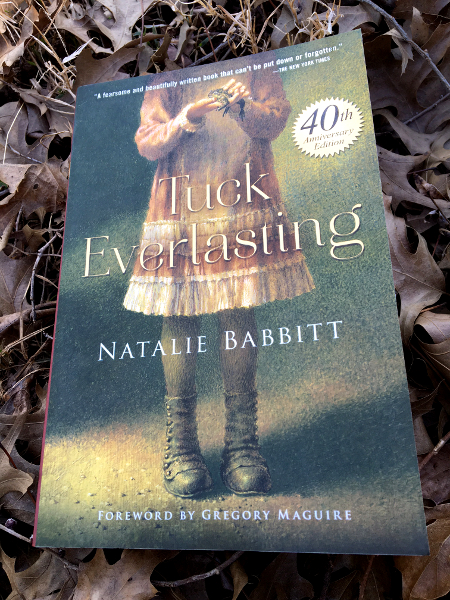
Tuck Everlasting is a story I am familiar with because of its film adaptation, and though I had thought of reading it more than once in the years since the film’s release, that idea never stuck around long enough to take root. I’m happy I did not give the inspiration a chance to fade away this time. Natalie Babbitt wrote something very special 41 years ago, so it is not surprising that the copy I found on the shelf at Barnes and Noble yesterday was a nice 40th anniversary edition, complete with extras.
Tuck Everlasting asks that age-old question: If you could drink from the proverbial Fountain of Youth and live forever, would you do so? Babbit’s examination of this question through the eyes of eleven-year-old Winnie Foster, and the family who claims to be immortal and unchanging, makes for a compelling read.
Can a book truly be timeless? I suspect that the quality of being “timeless” is in the eyes of the beholder. Having spent the formative years of my childhood in something of a pre-technological age (in terms of personal computing, smart phones, social media), the introduction of young Winnie Foster and her non-air-conditioned, small town childhood elicits a feeling of kinship. As she sits in her yard on a hot August day, chaffing at parental authority and making bold claims of running away to an unimpressed toad, I cannot help but remember so many days longing for something exciting to happen, longing for a change. At the risk of sounding like the older generation that just doesn’t understand kids today, there is an appeal to books like Tuck Everlasting that the author could not have foreseen four decades ago: the people that inhabit these author-invented worlds do not have their faces glued to their electronic, web-connected devices.
Yes, I’m a hypocrite, sitting here typing this review on a laptop; a review I will then upload on social media. But there you have it. As much as I love technology and embrace it for its many good qualities, it does not take much for the nostalgia for the “good old days” of my youth to come rising to the surface.
Winnie Foster is an interesting child, right on the cusp of adolescence. She is not whiny or annoying. Though it is apparent that she comes from privilege, as a reader you are not subjected to a period of getting to know Winnie so that you can then identify with her plight. Babbitt makes her instantly accessible, and through that quick kinship, the reader wants to see her make good on her promise to run away. She lives right next door to a wood, after all, and one that her family owns.
It is when Winnie Foster steps outside of the gate, and makes her way into the wood, that she first sees the large tree, and the handsome young man drinking out of what looks like a hidden spring at the base of the tree. Her thirst leads her to ask for a drink, and young Jesse’s refusal sets off a series of events in which Winnie Foster finds herself an overnight guest of the Tuck family.
Natalie Babbitt approaches the fantastical elements of this story, those relating to a spring that grants everlasting life, in such a matter of fact way that even Winnie’s feeble doubts seem unwarranted. Of course the Tuck’s are telling the truth. And they are desperate for Winnie to keep their secret, though perhaps not for the reasons you would initially think.
Natalie Babbitt presents a story whose true sadness and melancholy, while not shied away from in the story, lie their under the surface in a way that the adult reader cannot help but ignore. The true horror of the Tuck’s existence is there for us to see, and we cannot help but see the wisdom of keeping this water of life a secret from the world.
Secrets are difficult to keep, especially when there are unscrupulous people who suspect the truth and will doggedly search to uncover it. Natalie Babbitt has created an antagonist so subtle in his sinister nature, that it wasn’t until it was later pointed out that I realized he is never given a proper name.
Natalie Babbitt examines the idea of eternal life (not in the heavenly realm, but here on old Terra Firma) in a non-judgmental fashion, using the various members of the Tuck family, and ultimately Winnie Foster herself, to spotlight various opinions on the idea.
Tuck Everlasting is a masterful story, told with an appreciation for the power of words that is apparent on every page.
The 40th Anniversary edition has a really nice forward by author Gregory Maguire, one in which he acknowledges that risk of story spoiling inherent in forewords, and encourages the reader to stop and read the story first, though he by no means spoils the story in his brief musings. Instead Maguire speaks to the way stories speak to us when we read and re-read them at various times in our lives. Given this sudden desire to read these novels, it felt as if Maguire had looked into the future and knew that I would benefit from his wisdom about the pleasures of reading.
This edition also contains a brief interview with the author, brief, but very satisfying. In it she speaks of her love of words and her refusal to write down to children:
“Some time in the last forty years, people have decided that children can’t understand any words that have more than four or five letters. That’s just plain crazy. When I was in grammar school, my friends and I were no smarter than children are now. But our books did not fudge on vocabulary…There’s no other way to enlarge our vocabularies. The more words you have at your disposal, the easier it is to say what you want to say, specifically. Should we wait until high school to teach children words of more than one syllable? No, no, no.”
She also reveals that she likes to use words in naming her characters that have more than one meaning, that a reader doesn’t even have to know. Imagine how surprised I was to read that she found the word “tuck” in an old dictionary when looking for a word that meant “life”. Makes the book’s title that much more interesting.
Despite remembering many of the details of the story, I did not feel cheated in any way to experience the story as Babbitt herself wrote it. On the contrary, the experience was more richly rewarding than I had expected it to be. In over four decades of reading I have not ceased to be impressed when reading the work of an author whose skills with the tools of language are noteworthy. It is a revelation of the power of words each and every time it occurs.
I enjoyed my time, albeit brief, with the characters and descriptions in Tuck Everlasting.
I have never read this. I really should at some point!
I was so thrilled with the way that she wrote. She mentions in the interview that she loves writing descriptions, and that was very apparent throughout the story, in the very best of ways.
I haven’t ever read it either, but it sounds like something I’d enjoy.
You probably would, it is an interesting take on the idea of living forever.
Carl – this is definitely one for me I think. I loved your review and feel totally drawn to this now! It has to go on the list right now.
Thanks 😀
Lynn
I hope you enjoy it when you get a chance to read it. I was surprised by how much I got into it even knowing how the whole thing was going to resolve itself.
I’ve been meaning to reread this one ever since I saw the movie. I think I probably read it about the same time I read Bridge to Terebithia, as my memories of the book itself are about as distant. I appreciate Babbit’s refusal to “dumb down” her writing, as I am quite certain that I learned much of my vocabulary from reading, not vocab lessons.
It is a wonderful book. My daughter and I read it before seeing the movie. I prefer the book, she the movie. It is a story that sticks with you for a long time.