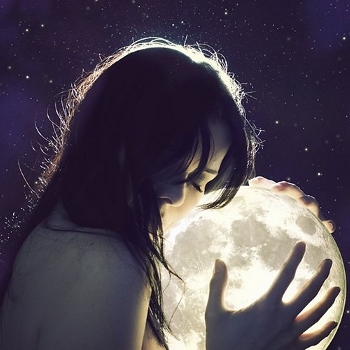
This week’s story, “The Woman Who Married the Man in the Moon”, is one of the several Peter S. Beagle short stories most recently collected by Tachyon Press in their lovely collection, Sleight of Hand. Over the many years of reading short story collections and anthologies I have come across some MUST READS and were I to have the means to purchase all of my short story loving friends a box of books that I feel contain the very essence of what story is all about, Sleight of Hand would be one of the first books I purchased.
“The Woman Who Married the Man in the Moon” is a story about stories. It is also about the stories we tell ourselves, be they true or embellished, to make sense of our lives. Eleven year old Mourra and her younger brother Findros are lost and becoming more so when a tall, gangling man with a pointy hat falls from a tree in front of them. The man turns out to be the magician, Schmendrick, who for some unapparent reason puts them at ease. The children are unsure of what kind of magician he is, however he does know their names without being told and he promises to get them home.
Beagle’s short story is about their journey home and the stories that are told on the way and after they arrive. What at first may seem like a sleight story contains surprising depths and in addition to the magic there is an underlying sadness, not unlike what happens in this adventure that we call life. It is not a particularly long story. If you would like to participate in this week’s discussion, please go read it and then join us below.
As I begin this week’s story I must make a confession: I’ve never read any of Peter S. Beagle’s novels, only several of his shorter works. I say this because “The Woman Who Married the Man in the Moon” features Schmendrick, a character from The Last Unicorn. I do realize I’m missing out on some special stories and need to right that wrong at some point.
In the past I’ve come across various authors who tell these short stories about a character, or characters, who inhabit a larger work. When done right they make me want to read the bigger work. I recall a short story featuring Kvothe that I read that compelled me to want to read Patrick Rothfuss’ novels. This story does so as well, in large part because Schmendrick is a complex character. More on that soon.
We experience the story through the eyes, but also the ears (I find that very creative) of Mourra. I think Beagle does a really nice job at writing a young girl in between childhood and adolescence. Her moodiness, her efforts to act above her age and her frustrations with her brother’s “baby” behaviors ring so incredibly true of a child that age. She is as aware as her brother that they are lost but she stubbornly refuses to admit it, a stubbornness arising in part because of her brother’s panic. That stubbornness makes her want to not avail herself of Schmendrick’s help when he falls from the tree. In truth it later appeared she was right to have doubts when Schmendrick gets them even more lost.
Very early on we are given a clue that this may not be the light, airy fantasy that you would expect with two young children and a magician silly enough to fall from a tree when the children begin to speak of their father’s death. They tell Schmendrick how their father died in bravery, attacking a dragon, and I think Beagle does a brilliant job of hinting to the reader that this may be more of a story than reality through Schmendrick’s mumbled questioning about the kind of dragon and his own knowledge that dragons, of any nature, normally are not seen in this part of the world. I also like the way Beagle reveals that the magician himself may be troubled because his “tricks” appear to be just that, but Beagle also points to something else truly magical there, as the children have not revealed their names and yet Schmendrick knows them. It is hear that Beagle points out the importance of keeping one’s name a secret which is one of the mysterious plot elements in fairy tales and fantasy that I find intriguing. In fantasy sometimes more than in other genres I think we see the importance of names, truly even just of words, and how they can have layers and layers of meaning depending on both the author’s skill at imbuing them with meaning and with the knowledge and experience the reader brings to the story.
The children’s mother, Sairey, is another interesting character. We glean some knowledge of her even before meeting her with the knowledge that she is a widow and is presumably bringing up her children on her own since they mention no other father besides their deceased one. She appears to be a loving if exhausted mom (aren’t all moms with young children that way? Raising kids isn’t easy). We get yet another story when Schmendrick and the children arrive as they sit over a meal and Schmendrick tells of the reason the dogs howl at the moon. Being a dog-lover I found it a sweet, silly tale and I could not help imagining all kinds of interesting ideas of dogs reading. It too is ultimately a very sad story…I mean, imagine being separated from one’s books? The horror! I would howl in misery as well, and go on howling.
I mentioned Schmendrick being a complex character and I see this in that he is largely presented, or presents himself, as an ineffectual magician. He seems both confused and resigned. And yet he has some magic. His ability to know people’s true names, the thing with the flower for Mourra and again at the end of the story. The knowledge that he inhabits other Peter S. Beagle stories also leads me to believe he has a significant history. And yet it is also revealed that at the time he was found by the children, dropping in on them as it were, he had been trying to kill himself. He was trying to find a branch that would take his weight but also alluded to it needing to be a particular kind of tree/branch because of the kind of person he is. It is a shocking and sad admission to find out that this man was…is…at the point of wanting to end it all and I want to know more about what would bring him to that place.
As Schmendrick leaves we again see and even more hear the story through the sleepy haze of an eavesdropping Mourra. I must digress here for a minute: when you were a kid did you lay in bed at night looking and/or listening out the window? I had the top bunk in our room thus was right at window level. On spring and cool summer nights I loved to feel the breeze come in the window and on stormy nights there was nothing more pleasurable than watching the lightning and listening to the thunder and rain. We also had the pleasure of listening to our neighbor lady yell at her husband and children. It was very sad, but as kids we did get a kick out of hearing the profanity that the woman used. She was an equally opportunity swearer and she used all the words liberally.
At any rate, Schmendrick is leaving and it is obvious that Sairey is trying to delay him at least for a time, and so she tells the titular story about a rather plain woman who fell in love with a rather plain man who said he was the man in the moon. It is interesting how Beagle plays with the conventions of fairy tales in that he has Sairey telling this obviously thinly-veiled story about herself that may have its own magic too it while Schmendrick expresses all the real-world outrage of how this cad took advantage of a naive and trusting woman. Sairey says a very beautiful line here that stood out to me as I read it:
“…and as time passed people began to say that she walked in moonlight, such was the radiance of her joy”
I love that line.
And this last story brings another dimension into the tale. Is Sairey the woman who fell in love with the man in the moon? Did her husband really fall into a sink hole and Sairey’s story is just her fairy tale version of what happened, something more substantial to cling to the same way her children cling to the story of their father being a brave dragon fighter? Or are we meant to understand that Sairey’s story is real? Then again there are indications near the end that Sairey is telling someone else’s story, not her own. But I’m not sure. I like the way that Beagle acknowledges the potential for stories to teach truths by having Schmendrick rather haughtily point out that he gets the message Sairey is trying to give to him when in fact, as she points out, he is missing it altogether. The point of this story (or one of them), as it is with Sairey’s love story, is about belief and the need to believe in ones self–something Schmendrick has stopped doing.
In the end we are left with a magician on a continuing journey, possibly to an ignominious end but hopefully to a good one in a far distant future. And Sairey has her children who still believe in magic in one way or another, as does she, and the reader is left…or at least I was left…with a hopeful feeling that there is a lot of adventure, and love, in the days to come for all of them.
“Stories never end. We end. If we could but live long enough, we would see how all tales go on and on past the telling.”
____________________________________________________________
Next week we are doing another first run story, meaning I haven’t read it and will be experiencing it along with you for the first time. Ken Liu has been featured here before. He is fast becoming a well-known and hot short story author. Last year his story “Paper Menagerie” was the first ever short story to win the Hugo, the Nebula and the World Fantasy Award. I hope you will take the time to read it this week and come back next Sunday for our discussion. Until then, have a wonderful week everyone!
(Image Credit for woman hugging the moon)
wow I am shocked that you (of all people) has never read any by Beagle before! I read Tamsin and A Fine and Private PLace by him. (A Fine and Private Place is good for RIP.. fyi)
you write such great reviews.. have you never tried to write a story ??? just wondering.
Just short stories, Deslily. But I’ve loved them. Do need to get around to reading him. Here is where I have to admit that the title “The Last Unicorn” has always made me think of Strawberry Shortcake and Care Bears and other light, fluffy fare which is why I’ve never bothered even looking at it. Stupid, I know.
I haven’t tried writing any stories since I was a kid. I imagine it is much easier to putter around trying to figure out what an author meant in a story rather than doing one yourself. You would know much better than I, having done so! 🙂
Yes, I also associated The Last Unicorn with Care Bears, etc. perhaps because we had the movie that my children watched incessantly. In reading descriptions of the novel, however, I came away with the belief that the book is way more. Readers speak of philosophy and metafiction…Anyhow, I just purchased the book and am anxious for its arrival.
The Woman Who Married…is so beautiful and dreamy. Thanks for bringing it to our attention. It’s interesting what you said about the changing of names and the connection to fairy tales. I hadn’t thought of that before, but my fairy tale selection for OUaT is Messenger, in which name changing/finding one’s true name is a prominent motif.
I’m glad I’m not the only one with that reaction, wrong as it may be for me to have it. I have liked his work enough that I really should give this well known novel of his a try. It is probably well past time.
I have read Beagle’s The Last Unicorn and now, knowing that Schmendrick is a part of this short story, I want to go pick up this collection. He is a complex character and I believe him to be one of Beagle’s better, more fully developed characters too.
The Schmendrick connection makes me want to read The Last Unicorn now.
If it’s Peter Beagle, a light, airy fantasy is the LAST thing I’d expect.
I’ve come to see that from his short stories, Richard. And this collection is amazing and full of depth.
I noticed and appreciate, too, how Beagle has us questioning the veracity of each character’s stories–and not in a angry way, but in a way that we do understand there are good reasons why we fool ourselves into seeing or knowing something a certain way.
He does capture the children beautifully.
I think another early clue that this was not going to be a straightforward, lyrical sort of fairytale is all those complex sentences in that first paragraph. We waded through punctuation marks to get to that last line that is also a more typical (these days anyhow) hook.
I’ve only seen the film of The Last Unicorn, and Schmendrick struggles with his limitations (whether real or perceived). He was very much a young man trying to play magician, a bit clumsy, not yet grown into that ferocity his nose hints at.
I was really struck by how much and often human insecurity got in the way of magical possibility. and the hint that character’s have limited themselves (and in some fashions limited another). It was a marvelous moment when the woman said that it was her belief in herself that would rescue her from loneliness, not the appearance of a man (that was a mere consequence). The girl who began to consider the possibility of a woman garbed in spider-spun clothing began to see more magic around her. but a child is allowed to look a bit foolish, right? it is the adults who struggle to hold onto/believe in the magic among the ordinary and the depressed who have the added burden of being “adults.” The girl is that bridge, showing us when and how we lose fancifulness–and in effect, lose our way.
–enjoying these stories you’ve selected for us, Carl. thanks.
You are exactly right. There is nothing about the story that makes us feel like the author, or the characters, are trying to fool us with their stories. They are just laying them out there for us to experience and interpret.
Great thoughts as always, L. I do think that the comparison between Findros, who is young and thus is considered “okay” to believe in magic and Mourra who is in the middle and desperately wants to believe but also wants to be grown up, and Sairey who has every reason not to believe but also appears to be trying to nurture belief in her life is so interesting to see. And Schmendrick’s insecurity and self-doubt is an ever present companion to him in this story and you wonder how much of that is a result of experiences and how much is a self-fulfilling prophecy.
That is the first story, short or otherwise, by Beagle that I have read. And I really liked it. I loved the meandering style, the light-hearted beginning and the hints at something deeper and darker. And stories about stories as always interesting to me.
You really should track down the Sleight of Hand collection from Tachyon. It is chock full of really excellent stories, and the variety is amazing. My favorites are a couple that feel as if they tap into 1950’s nostalgia and have a great magical/fantastical vibe.
:O I highly recommend “The Last Unicorn”, especially if you’ve enjoyed this tale. If you decide to read “The Last Unicorn”, I hope you’ll reread this soon after to see how it affects your perception of this tale. It’ll give you a bit more of Schmendrick’s background and it broke my heart the first time I read this story. (Bear in mind that this is set before TLU; it’s just that the novel gives us more insight into Schmendrick’s past before this point.)
You’ll see some recurring themes as well, I think. I… should hush before I quote half the book at you, though. I love “The Last Unicorn” so much. I was introduced to it through the movie and it was years before I read the book, but I have so, so much love.
I should reread it, really. And rewatch it. And reread this. And “Two Hearts”. Reread that too. *plots* I think, if I knew the first thing about read-alongs, I would attempt to organise one… It could be fun!
Thanks Lynn, I really do need to read it. I had actually special ordered a copy of it a long time ago and that version was never released…something about financial issues with the company. Lost out on that money, which I don’t mind so much, but wish I could have gotten the book. I’d like to see the film as well.
Organizing read-alongs isn’t hard, trust me, or I wouldn’t be doing them myself. I encourage you to go for it, and if you have any questions I would be happy to answer them.
T_T I’m sorry to hear that! The film is remarkably close to the book. It’s probably one of the best adaptations I’ve ever seen, and that’s even accounting for how much of the B-plot they cut. (You don’t really miss it in the movie, I don’t think, but it does add more depth to the story.)
I’ve never even joined a read-along, to be honest. They always look like a lot of fun, though, and “The Last Unicorn” is a fantastic book. ^-^ Still, I could poke at it and see if I can get one organised for over the summer when I shouldn’t be quite as swamped. *ponders and plots*
There are parts of the movie I like, and I’ll talk about that, but I can well remember the parts that they got wrong, and unlike many of the complaints about the Lord of the Rings adaptations, which can be put down to choices that had to be made to make an adaptation work, there were some really poor choices in Stardust that were just that, poor choices, which take away from the beauty of the story and have nothing to do with the change of medium. Can’t wait to talk about it.
I’ll come on board if you do the read-along.
*tilts head* How did we get from “The Last Unicorn” to “Stardust”? Though I’d love to hear your thoughts on it, so I can’t wait to read your post on it! I don’t remember being very fond of “Stardust” as an adaptation, but I did enjoy watching it as a film.
It probably won’t be until at least July, but I’d love to have you along if I don’t chicken out of the idea before then. ^-^
I ordered Sleight of Hand.