“We’re all made of stories. When they finally put us underground, the stories are what will go on. Not forever, perhaps, but for a time. It’s a kind of immortality, I suppose, bounded by limits, it’s true, but then so’s everything.”
— Charles de Lint
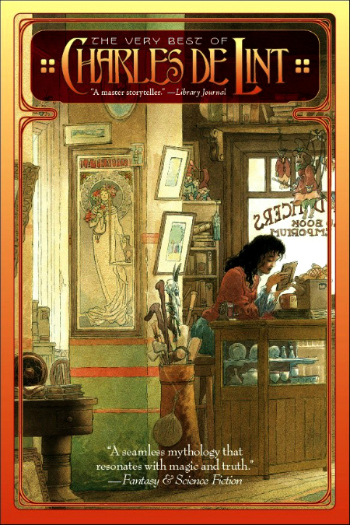
Those of you following along over the course of the last few months will recall that Kailana and I were conducting a buddy read of The Very Best of Charles de Lint. We discussed the stories contained within it in groups of threes on our respective sites by taking turns asking and answering questions about the stories. Now that we’ve come to the end we have decided to do an overall review of the book and this experience by asking a series of back and forth questions. The first 5 questions are answered on Kailana’s site. I would ask that you start over there before continuing on with these questions and answers, and we would both love to have your comments for the various parts of the discussion on our respective sites.
As always, thanks for your input and please jump in on the conversation.
6. Do you relate to the integration of art and music in Charles de Lint’s stories and if so, how?
C: I’ll go ahead and answer this first so you don’t feel obligated to throw the question right back and me. 🙂
One of the reasons I think the stories of Charles de Lint resonate so strongly with readers in general is that he combines so many great things into them: real and imagined folklore and mythology; real-world issues and concerns, sometimes very dark ones, shown in a light of hope; a vast and interesting mix of human and folklore characters, and the integration of various kinds of art and music. I am a big fan of art and have showcased a great deal of it here on this site over the years. In addition to book illustrators I am very drawn to folk art, found art, and mythic art. It is those later kind that I think de Lint’s work points to. He also features characters who are painters and writers. I think creative expression is such an important part of life, and music falls in here as well. Over the years, thanks entirely to the internet, I have gravitated more and more towards folk music, celtic music, English/Irish/Scottish singer-songwriters and when I read de Lint I hear that music in my head.
As I mentioned, creative expression is an important part of life and has become an important part of my own life through my blog. It is a very little thing, but I find outlet for my creativity even when simply writing about a book I enjoyed. I am more drawn to and interested in creative people and many of Charles de Lint’s characters are just that. One on level Newford is a city filled with the detritus of the worst humanity can do to each other, but on the other it is a magical place simply because of the arts community. When I read the works of Charles de Lint they make me want to discover more music, to spend more time admiring art, and they make me want to be creative myself.
K: I forgot about Christopher Dennison [referring back to question 5. Get over there and read the first part! LOL]. There are several social workers mentioned in de Lint’s stories and books. I also appreciate the character of the Grasso Street Angel. I think that she was she is called, anyway.
When people ask me about things like music and art, my usual response is that I read. That’s not to say that I don’t like music, art, and other creative endeavours. It is just my way of saying that I tend to concentrate on reading so much that I don’t have the need to pay as much attention to other things. It started with the fact that I have no artistic or musical abilities of my own, so I dedicated myself to something that I felt I could appreciate. Nowadays, I can look at a painting and think it is great, but I am not the sort to go to an art gallery or browse the internet for great paintings or pictures. That being said, I do enjoy the fact that characters such as Jilly are painters in these books. I think by reading about them, it makes me pay a bit more attention the artistic world when the chance presents itself. As to music, I listen to it all the time, but I don’t live for it in quite the way that other people do. I am always clueless about who musicians are and have listened to basically the same things since I was younger. That’s also not to say that I don’t appreciate musical characters in books. I enjoy reading about all their experiences in de Lint’s books and stories. So, let me see here. I guess what I am saying is that I don’t entirely relate to their inclusion, but I appreciate it.
7. I know we have mentioned it briefly in previous posts, but what do you think the message of de Lint’s books are? What do you think he is trying to accomplish by including characters that have seen rock bottom and are trying to get back on their feet?
C: Oh, the Grasso Street Angel! Forgot about her, good inclusion. She is indeed a wonderful social worker character. One of my roles at my company is the Director of Youth Services. We work with the kind of kids de Lint’s characters come across. I should encourage my staff to read the Newford series.
Okay, on to your question. The predominant message I take from the work of Charles de Lint is that of hope. Charles de Lint is most assuredly not the first person to feature broken, authentic people in stories with a fantastical bent, but I do believe he is one of the best based solely on my feelings about them. I do not seek out, and often purposefully avoid, those books (particularly YA ones) that look to feature characters who have been through abuse, neglect, substance use/abuse, etc. In large part that is because some of those novels are more depressing than they are hopeful and on the other I work with that every day so bringing it into my entertainment is something I avoid. I NEVER feel that way about Charles de Lint’s stories. That is in part because he strikes a balance. There are desperate, broken characters at various levels of the healing process and there are recovered individuals who offer a beacon of hope and there are characters who by all we see have lived pretty standard “normal” lives and then there are fantastical creatures and they are strewn throughout his stories with a balanced hand so that you as a reader are never overwhelmed with dark stuff nor put in diabetic shock with a saccharine overload.
I think Charles de Lint’s books are on one level just really good stories but on another level are all about healing and relationships and…hope. I think that is also why music and art play such a large part because they are traditionally mediums in which some people go to work out their issues and also provide solace for those seeking healing from the hurts of life. And as I ponder these things and in turn write about them I find myself falling back on my standard response which is to not let this description of de Lint’s work keep you from reading it. There are some sad stories in his short story collections and not every character “magically” gets better. Some make bad choices and some meet tragic ends, but overall the stories really are lovely and inspiring and entertaining.
Your thoughts on his message?
And:
8. What do you think of the idea of words/stories as instruments of healing, self-improvement, etc and do you feel that happens in Charles de Lint’s stories?
K: I agree with you! There is always hope in de Lint’s stories. It might not always seem that way, but at the end of the day things play out like they should. I also am not a huge fan of YA that is rather hopeless in nature and I cringe away from most ‘coming of age’ literature, but I find there is more to de Lint than that. He writes believable stories, but he also infuses some magic in there. It makes for an enjoyable experience. There are moments when I am sad with one of his stories, or feel bad for a character, but you don’t get bogged down with it. One thing I enjoy about de Lint is that he is very crafty at inserting lighter moments in a tasteful manner when things might get a bit too depressing. I appreciate that about his books and maintain that everyone should read him!
hm, before I answer your question, I am going to do a clarification-type question: Do you mean for the reader or for the character themselves?
C: I was leaning more towards ‘for the reader’.
K: I assumed, but it could easily be for both because writing is another creative outlet showcased in this series. Christy and the Professor, just to name a couple, are main characters that have written many books. I like to think of them as the characterized versions of Charles de Lint.
To answer your question, though, I can see that. There are characters in de Lint’s books that I can relate to and I think that is part of my personal appeal with the series. I read the books and it often makes me think about the issues I can relate to. I would like to think that once in a while I can think of them differently after seeing someone in a worse situation, but that is my own perspective of myself. I am afraid that your question is one of those questions that strike a cord with me, but I am really struggling to put my thoughts into words… All I can say is yes!
What do you think?
C: I certainly believe in the power of words to bring about healing and change in a person’s life. I also believe the written word can inspire deep and lasting change for those open to it, and the wonderful thing about books, fiction and nonfiction, is that the most unlikely of books can be inspirational to the right person in the right frame of mind. I see de Lint’s stories as particularly powerful and possibly untapped tools in the area of healing, etc. for those who have experienced the kinds of hurts his characters have went through. At the very least they may be a first step to get people to look at their own lives and perhaps get a glimmer of hope and maybe seek the help that they have not been open to in the past. They also are the kind of stories that inspire me to be a better and more creative person in my work with people with mental illness. In that manner these books are more than merely entertaining stories and I give kudos to Charles de Lint for that.
9. Do you have any final thoughts on Charles de Lint’s books as a whole or the specific short story collection that we read?
C: As much as we have both been honest about our difficulties with this collection, I don’t want people to think that I am not recommending it. I think it is a beautifully packaged collection that has some wonderful stories in it that offer a wide range of samples of the style of Charles de Lint. My issues are with some of the story selections and with the order in which some of the stories were placed. This would be an absolute must-buy edition had a few changes been made to it. As it stands I see it as a worthwhile book with flaws that is not in my estimation the ‘very best’ of Charles de Lint. It is some of the very best, to be sure. Then again, I cannot imagine any group of fans agreeing in totality on what is the author’s best work. I do firmly believe that Charles de Lint is a ‘must read’ author for anyone who is a fan of this genre.
It has been a great pleasure to slowly read this collection with you and I’ve really enjoyed it. I’m not sure I’ve ever analyzed a book in this fashion and I did enjoy it. I hope we can find another short story collection to read together next spring, if not sooner.
Your final thoughts?
K: I agree. I do recommend this collection! I am very happy that I bought the collection instead of going through the library. It is a perfect collection because of its randomness to satisfy a need to read something by Charles de Lint. I was disappointed, yes, but maybe there is too much pressure when you call a collection ‘your very best’. I second you, though, Charles de Lint is a ‘must read’ author for most people.
I also enjoyed reading this collection over the last little while, too. I look forward to another short story collection explored in a similar fashion.
Thanks for doing another buddy read with me, Carl. I had a lot of fun reading it and discussing it in such depth! I look forward to our next buddy read. 🙂
Me too, especially because its going to be Enchanted Night, a book I adore! Hope yours comes in the mail soon so that we can get a date scheduled for it.
I wouldn’t hold my breath. The mail is flowing, but apparently it is VERY slow…
Now you tell me, long after I’ve turned blue!
and i’ve STILL not gotten around to reading my copy yet. 🙁
so many books piled up around the house, so little time.
but, with work being slow I may just start reading at my desk. Reading Judith Tarr’s “Kingdom of the Grail” at the moment. Being a Merlin/King Arthur fanatic I don’t know HOW I managed to miss this one when it originally came out. Quite possibly there “IS” a copy already extant somewhere in the house that i’ve just forgotten about/mis-placed.
being a collection of short stories I think the Best of Charles DeLint is gonna get bumped to the top of the pile…
sgist: Well when you do so if I can be so bold I would suggest reading those three specific stories (mentioned in the Q&A on Kailana’s site) in the order I suggest because you will enjoy them more that way.
Look forward to your assessment of the various stories in comparison to what Kailana and I thought about them.
Great post! I’m a big fan of Charles de Lint, mostly because, as you pointed out, his writing is always hopeful. He’s also a fantastic writer, which helps a lot. Sometimes I think that he uses too many artists and musicians in his work. Even though I love artists and musicians, I get the impression that Newford is a small-ish city and that having too many artsy characters can be a bit unbelievable, just because you wouldn’t find that large a percentage of artsy people in one place in real life. Either that or the East coast is a really boring place 😛
Thanks Grace!
I initially thought Newford was smallish too but then when he talks about the ruined part of the city, the Tombs, and the city under the city and all of that and you start factoring in details I think Newford is a lot bigger than it initially seems. And since most of the artists and musicians seem to know each other I suspect we are seeing just a small circle of people in a much larger group, At least that is my impression on it after what I’ve read.
That was kind of my thought until I read “Forests of the Heart,” which introduces a completely different art collective in the city that the other characters hadn’t associated with. At the same time, I do like artsy characters.
If Wikipedia is to be believed (Big IF), de Lint’s hometown of Ottawa may have been the initial inspiration. At around 800,000 residents it isn’t that surprising though that you would find a vibrant art communities.
Ultimately it doesn’t matter, it is just that I don’t see it as that implausible, especially given what you tend to see on the internet if you follow artists, authors, etc. They seem to surrounded themselves with other artistic people. Even with all the books/stories he has written there is still only a relatively small amount of steady characters and not all of them are artists and musicians.