The rocket lay on the launching field, blowing out pink clouds of fire and oven heat. The rocket stood in the cold winter morning, making summer with every breath of its mighty exhausts. The rocket made climates, and summer lay for a brief moment upon the land….
Ray Bradbury’s classic story of Earth’s progressive colonization of Mars, and the devastating effects that has on the native population, is a series of chronological vignettes, some of which were previously published as short stories in a variety of magazine publications prior to 1950. The stories are told from both human and Martian points of view over a period of months and years beginning in the then future of 1999 through late 2026.
A firing rocket brings early summer to a wintery Ohio countryside; a Martian wife in a dissatisfied marriage tells her husband of her recurrent dream of a man from Earth coming soon to their planet, prompting her husband to make a decision that will forever effect both humans and Martians; an expedition of men from Earth land to discover a familiar small town and the presence of friends and relatives long dead; a colonist of a later expedition takes exception to the behavior of his fellow crew members to their new home and reacts in the only way that makes sense to him…a way that ends in blood…
Ray Bradbury uses the mysteries of the red planet to shine a mirror at humanity, reflecting our hopes, dreams and propensity for destruction in a series of interconnected tales written with the graceful nostalgia that made him a much-celebrated and beloved author.
Like many of us who gaze into the night sky and wonder what it would be like to travel to other planets, Mars has long cast a spell over my imagination. The fourth planet in our solar system has been the setting for printed stories beginning a hundred years ago or more, some of which approach Mars from a scientific standpoint and others that play upon the romantic notions of ancient alien inhabitants and an atmosphere that would allow mankind to survive and thrive on its red sands. The Martian Chronicles leans towards the later, though Ray Bradbury’s refined story technique makes the implausible so palatable that you cannot help but believe that surely this must the way of things up there.
In a recent online book club conversation, blogger James Wallace Harris described The Martian Chronicles as “elegant”, and that word rang in my ears as I turned the pages, grasping almost instinctively what he was referring to. I had not read Raymond Bradbury since 2010, and that absence has certainly made the heart grow fonder as I recalled everything that I loved about Dandelion Wine–another series of short stories with an overarching theme–while reading The Martian Chronicles. Though he wrote these stories not long after the end of World War II, Ray Bradbury’s fiction is ingrained with the heady nostalgia for that time period that many of us have experienced all these decades later, even if, as in my case, we were not yet born at that time. How he was able to capture that spirit and sentimentality for a time in which he was presently living is one of the great mysteries that makes his fiction so readable today.
The Martian Chronicles strikes me as a collection in which readers could find any number of themes on which to grab hold. It has that quality of “applicability” that Tolkien wrote about. I cannot help but see it as being informed by the horrors that mankind afflicted upon one another in two great twentieth century wars and the rapid boom in industrialization, urbanization and consumerism that arose, in America in particular, after the end of World War II.
While there is a sense of wonder present which makes science fiction such an appealing genre, there is a greater thread of sadness and inevitability woven throughout, beginning with the first time we meet a native Martian. Though Bradbury describes a place and people that are somewhat alien to humankind, the sadness of a marriage gone cold and the longing created in this Martian wife as her dreams become filled with the impending arrival of a man in a rocket from far-off Earth, are so familiar and heart-breaking that readers form an instant connection with this people and their home. As we begin to detect her husband’s intentions, we long to step into the book and bring them together, begging them to sit down and discuss their hurts and desires and the hope that they surely must have had in the beginning for their marriage. In this one couple, and the decisions they make, Ray Bradbury brilliantly demonstrates the consequences of a lack of communication and the causes and effects of those decisions.
Ray Bradbury accomplishes what many others seemingly cannot do with the short fiction format in that he writes in such a way that readers form a bond with characters that may only be present for a brief period of time. He does so, I believe, by taking readers straight to the emotional heart of the story. I could not help but feel a connection to Jeff Spender, whose desire for the first night on Mars to be one of quiet reverence is juxtaposed against the men who want to whoop and holler and drink and celebrate. It is in this story that we learn of the fate of the aboriginal Martians since the arrival of the first men and Spender’s initial reaction to this news is what we hope ours would be. As he sees the men of his crew begin to litter a Martian canal with empty bottles something clicks in Spender. Any of us who have felt saddened, and frankly disgusted, by historic landmarks defaced with graffiti or beautiful spaces of nature spoiled by litter and waste will immediately understand what Spender felt. That kinship of sentiment makes for an interesting conflict of emotion when we see Spender’s reaction to this all-too-human tendency to be disrespectful and destructive.
Lest you think The Martian Chronicles is some depressing, moralizing story, please let me disabuse you of that impression. The Martian Chronicles is brilliant and accessible and remains relevant because of the way it reflects the way we have treated both our planet and our fellow human beings over thousands of years, but it is also an intriguing, imaginative journey of mankind stepping out from Earth into the great unknown. It is exciting and mysterious and engages you from the first page. The fact that these vignettes are so closely interrelated gives The Martian Chronicles the structure of a novel. This too is a testament to Bradbury’s storytelling skills. Though Ray Bradbury was envisioning a future (now our present) in which we have not tamed our inclinations for violence, there remains a spark of hope in the life of each and every person, and alien, we meet in The Martian Chronicles.
Ray Bradbury’s vision of Mars is fascinating. The Martian culture is interesting and inventive, the science fictional tropes that we are used to seeing all these years later feel visionary because of the rhythm of Bradbury’s writing, and his imagined future is at once solemn, terrifying and hopeful.
My Rating: 10/10 A fine example of the art of storytelling

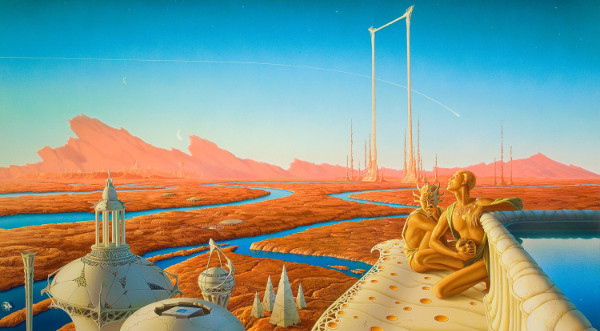
The wrap-around cover for this Grand Master Edition Bantam paperback is the work of one of my favorites, Michael Whelan. Michael Whelan’s art is always attention-grabbing, but I feel an extra connection when the cover reflects aspects of the story and the spirit of the world the author describes. That is certainly the case with his painting for The Martian Chronicles. I found myself looking at the cover several times while reading about Mars’ bone cities. That is a Mars I would love to explore.
Fine review, Carl. Certainly Bradbury is unlike any there SF author, both in the way he uses themes and in his method of casting descriptive passage that stick inside the reader’s mind, if that makes any sense. I prefer THE ILLUSTRATED MAN to this collection, though I’m not sure why, I just remember liking it better, for some reason. It’s been decades since I read either of them.
In reading about The Martian Chronicles I learned that The Illustrated Man is laid out in a similar structure, so that raised it up on my list of books I want to read. My next Bradbury will be Fahrenheit 451, as, believe it or not, I haven’t read it. I ordered the Folio Society version of it as I like Sam Weber’s art and I’m expecting to like the story. I’ll be reading it soon as part of a 1950’s SF challenge I am taking part in over on Worlds Without End.
darn auto correct. That should have been “unlike any other SF author,”
What an excellent review! In fact, you make me want to go out and read this collection as soon as possible. Bradbury has always been conspicuously absent on my list of authors I’ve read. It sounds like it is time to remedy that.
Thanks Michelle. When I was a kid I read Something Wicked This Way Comes, but barely remember it. Back in 2009 I picked up Bradbury for the first time as an adult and read Dandelion Wine. It was a special experience. It reminded me of my childhood, of why I love reading, etc. Such a good book. I was disappointed with the later written sequel of short stories, though.
I wish I could have expressed my fondness for The Martian Chronicles as well as you have here Carl. There is something to that book that I can’t put my finger on, but I think you have gotten much closer to pointing to its essence than I ever have.
Maybe I could say it this way: Imagine when America didn’t know about science fiction, and The Martian Chronicles was its introduction. It was an excellent introduction.
I’m so glad you posted your thoughts about it over on the book club site, as it really sparked my interest in reading it right away. And I’m glad I finally did as I connected with it in a big way, obviously. Thanks for the nice words. I suspect I am still far off base in really getting all that this was about, and I know I didn’t quite get down all that I felt about it, but overall I think I hit the high points for me without writing a book-length review. 🙂
It is fun to imagine that time period, Jim. It is one of the things I enjoy about older science fiction.
Be sure and post a link to this review over at Worlds Without End. We need to get some discussion going.
I did…or I guess I should say I posted the whole review over there on the site.
The Martian Chronicles are the only Bradbury I’ve ever read. I really really enjoyed them and meant to read more by him. But somehow I just haven’t gotten around to it yet 🙁
And I think that elegant is a perfect description for The Martian Chronicles.
I agree, I’m glad Jim wrote it.
I would certainly recommend Dandelion Wine, and Jim above recommended The Illustrated Man. I’m looking forward to reading Fahrenheit 451 here soon. I feel like my schooling was somehow suspect given that we didn’t read this in any of our classes.
I am glad you reviewed this and reminded me to read it again. I read it decades ago, and I had forgotten the structure.
Thanks Tracy, I’m glad I finally got around to reading it for the first time. It was obviously long overdue.
One of my intro authors into SF/F/H. First read it as a teenager in the early 60’s. Highly recommend The October Country-mostly horror stories, A Medicine for Melancholy and The Golden Apples of the Sun. Too bad his best work was behind him by the early 60’s. Always had one problem with Dandelion Wine-that the main characters seemed much younger than their ages. But still beautifully written
Not many SF/F writers wrote like this pre 1960. Theodore Sturgeon was one exception. If you haven’t read it try More Than Human.
Hello Steve! I picked up an ebook copy of The October Country last year as I’ve had several people echo your recommendation. I need to put it on my list to read this fall.
It has been awhile since I’ve read Dandelion Wine, but I don’t recall having that impression. I thought the boy was around twelve, and it was set in a simpler time when kids still played and had an imagination at that age as they weren’t bombarded by adult content on the tv and internet from the time they are born. (I’m getting a bit crotchety!) Even when I was twelve I was still playing with toys and having make believe adventures while also exploring new feelings about girls and growing up.
I haven’t read Sturgeon, but would like to. I’ll keep an eye out for that one.
I enjoyed reading The Martian Chronicles and loved it for its vignette style storytelling and the magic that Bradbury created through this. I felt it was a timeless SciFi classic and wish this was remade into a movie.
It would be interesting to see a film version of this, or maybe a television miniseries with each of the vignettes being an episode.
There was a mini-series based on The Martian Chronicles, with Rock Hudson no less. But it’s not easily available. It’s $82 at Amazon. There’s a 360p version at YouTube. I saw it when it came out, but I’ve forgotten if it’s any good.
By my recollection, it’s not.
Thanks Jim and Richard.
The Martian Chronicles was an assignment for my reading group in the 5th grade. It blew my mind. And then the reading group was canceled and we never got to finish it and the lady in charge of the group (some Junior Achievement volunteer) never really explained it, so I went the rest of my childhood life trying to recapture the feeling I got from that book. I didn’t know that it belonged to this bigger subgroup called “science fiction.”
That was a fun assignment! I certainly don’t begrudge the things I read in school, as my mind was opened to appreciate authors like Poe and Shakespeare. But I wish we would have read some science fiction too.
Sorry to hear that it got canceled before it was over. Don’t you wish you could somehow track that lady down and find out just what happened? How odd and mysterious.
Maybe the Martians got to her?
The odd thing about Ray Bradbury is that his major work was done in the 1950s and early 1960s. Yes, he continued writing for decades after that, but his best known work–THE MARTIAN CHRONICLES and FAHRENHEIT 451–came early.
I don’t really recall much later fiction either, now that you mention it George. I’m not sure when the stories for the Dandelion Wine follow up, Summer Morning, Summer Night were written, but I thought the collection was less cohesive and the later half of the collection had a lot of weak stories in it.
I admit that so far I just have not figured out Bradbury. 451 didn’t catch me and I found Something Wicked sadly simple. I will try again though. Someday.
I cannot speak to either story, Nathan, as I’ve not read 451 and I don’t remember anything about Something Wicked beyond the movie, as I read it back when that came out. If you like short stories I would certainly recommend this collection.
This was a lovely review! As much as I love Ray Bradbury, I have to admit that I didn’t expect to love this book. Oh, but it’s so wonderful to be proven wrong sometimes! 🙂
Thanks Debi. I certainly didn’t expect going into it that I would have had as strong a connection to it as I did with Dandelion Wine. I saw myself in the boy in Dandelion Wine. I saw myself as part of humanity as a whole in The Martian Chronicles.
This is one of my favorite short story collections of all time. I usually struggle with that medium, but Bradbury is just the master! The October Country is another great collection from him. Also, last year I discovered my city (Indianapolis) has a Ray Bradbury Center! Of course I had to visit… http://avidreader25.blogspot.com/2013/12/center-for-ray-bradbury-studies.html
I’m looking forward to reading October Country at some point, hopefully later this year.
Fun that there is a Ray Bradbury center there. I would visit too!
Well, I’m only a newbie to Bradbury but I’m starting to work through his books – Dandelion Wine is next.
Lovely review and I LOVE the cover!
Lynn 😀
Thanks Lynn, I hope you enjoy Dandelion Wine. I look forward to your thoughts, one way or another.
I read this one a few years ago (possibly for the Sci Fi Experience!) I found it really fascinating as classic sci fi that has set so many cultural ideas about Mars, and about a certain kind of Mars story. Loved your reflections on the themes and emotions of the book!
I read The Martian Chronicles in high school and Fahrenheit 451 in college. I didn’t pick him up again until I read these and Illustrated Man,The Toynbee Convector, Something Wicked This Way Comes, and A Graveyard for Lunatics about 3 years ago. Needless to say, I ended up reading everything by him in the house. While I enjoy his novels, I think he is a master of the short story. They often have such amazing twists.
There’s so much classic science-fiction like this I need to catch up on. Beautifully written review.