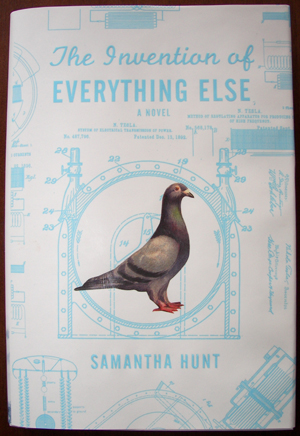
The Invention of Everything Else ~Samantha Hunt
–published 2008
–251 pages, Houghton Mifflin
–3.75/5 stars
Where does one begin to describe what results from Samantha Hunt’s sophomore novel? Though it feels like cheating I think the most efficient way to introduce you to Hunt’s creation is to show you exactly what inspired me to lay aside the books I was currently reading and begin this immediately upon arriving home with it from the bookstore:
A wondrous imagining of an unlikely friendship between the eccentric inventor Nikola Tesla and a young chambermaid in the Hotel New Yorker where Tesla lives out his last days
From the moment she first catches sight of the Hotel New Yorker’s most famous resident on New Year’s Day 1943, Louisa — obsessed with radio dramas and the secret lives of the guests — is determined to befriend this strange man. As Louisa discovers their shared affinity for pigeons, she also begins to piece together Tesla’s extraordinary story of life as an immigrant, a genius, and a halfhearted capitalist. Meanwhile, Louisa—faced with her father’s imminent departure in a time machine to reunite with his late wife, and pleasantly unsettled by the arrival in her life of a mysterious mechanic (perhaps from the future) named Arthur — begins to suspect that she has understood something about the relationship of love and invention that Tesla, for all his brilliance, never did.
The Invention of Everything Else luminously resurrects one of the greatest scientists of all time, Nikola Tesla, while magically transporting us — Ã la Steven Millhauser and Michael Chabon — to an early twentieth-century New York City thrumming with energy, wonder, and possibility.
I must confess to not having read the aforementioned authors, Millhauser and Chabon, however I could not help but compare this book to an old favorite: Time and Again by Jack Finney. While both books have major differences both in their subject matter and in their delivery, there is a kinship of type, of genre, that these two novels share. Both books by all rights could be shelved in the science fiction section of any bookstore and be readily at home there. Both books contain the kind of science fiction underpinnings that books like The Time Traveler’s Wife share. Perhaps it is the historical aspects and romanticized early 20th century sensibilities of these two books that cause them to be classified as literature rather than science fiction. I believe that fans of either type of fiction would find something to enjoy in Hunt’s novel.
I have to admit that other than the knowledge gleaned from David Bowie’s portrayal of Nikola Telsa in the film, The Prestige, I knew little about the famous inventor going in to this story. It turns out Ms. Hunt was in the same boat. On a website interview she shares that she left a museum determined to look up an inventor whose name she had come across. She looked up the wrong inventor, Tesla, and became so intrigued by his history that it became the genesis of this novel.
It is hard to pinpoint just what Invention is all about. While the book’s synopsis gives a good overview, there is so much going on here that one could discuss. In addition to learning many interesting things about this inventor, including the fact that his ideas and patents were behind many of the inventions that are credited to other more well-known inventors (why can’t more history books read like this?), the reader is taken to a time when the world seemed more innocent; a time when inventors wrongfully assumed that the world’s one great war was over and that inventing powerful machines of destruction would show man the folly of warfare and the wisdom of peace. By setting Invention in 1943, two years prior to the unleashing of the most deadly weapon to date, the atomic bomb, Hunt allows us a glimpse of a man who believed in invention for invention’s sake who was coming up against the reality of what the world was becoming.
Hunt adds a sympathetic human element to the plot by introducing Louisa, a hotel chambermaid, into the life of Nikola Tesla. Louisa brings her own relationship with her father and a newly developing relationship with a man named Arthur into the tale and as she does so she becomes the window through which the reader is allowed to discover Nikola Tesla. Louisa, more than Tesla, serves to represent the everyman that the reader relates to. Her character not only introduces human romance into the plot, but she along with Tesla and several other minor characters, both historical and fictional, paint a portrait of an idealized and romanticized New York City. One of the most interesting characters in Hunt’s tale turns out to be a building in the city.
The Invention of Everything Else is a delightfully whimsical story that served to make me as curious about the structure and history of The Hotel New Yorker as Time and Again did with the Dakota. In reading up a bit about this book and its author I discovered that Samantha Hunt was allowed to tour some of the fascinating below-ground facilities that used to provide guests of the hotel with everything from barber shops to a direct tunnel like to Penn Station. My only disappointment as relates to the hotel as character was that I wish actual photographs of the hotel from that time had been included in the book like those of the Dakota, and New York City itself, were in Time and Again.
Early on in Invention it is apparent that Hunt can write. She weaves an imaginative tale that served to make sure that I never had the book far from me despite the many other activities I had going on this past weekend. It is a wonderfully told story that is well worth reading and yet it does have its imperfections. For one Hunt occasionally drops in story elements that feel as if they were added simply to share an interesting fact about one of the several historical characters who show up in the book. One such example is Edison’s contributions to the electric chair. Also, it takes a skilled craftsman to weave charming and quirky elements into an otherwise serious story and there were times when I wondered just whether or not the sum total of various character’s eccentricities would add up to something magical. Unfortunately the conclusion left some loose ends that I would rather have seen tied up. Which leads me to what I felt like was the biggest imperfection of the novel and that was the partially unsatisfying conclusion.
As a novel with a subtext of the loss of innocence and the ushering in of a more deadly and dangerous time the melancholic end notes fit well. And yet there were elements that I felt Hunt introduced, such as those surrounding the time travel theme, that at the very least were not handled the way I as a reader wanted them to be handled. If Hunt had given me a better clue as to what she was trying to say with those characters then perhaps I would have been satisfied despite the ending not being exactly what I wanted. However I found myself frantically reading the last several pages, very aware that I was coming to the end of the book, hoping that what I had just read wasn’t going to be the end of certain character’s story arcs. While there is certainly a hopeful romantic ending on some levels, I was left with a melancholy confusion mixed with hope, wondering just how I was supposed to feel about certain plot lines. The ending isn’t the kind that I feel the need to add a “warning: don’t blame me if you don’t like this book” label to like I did with The Brief History of the Dead,, however the optimism and magic I felt throughout 95% of the book certainly took a punch to the gut in the end.
3.75 out of 5 stars isn’t a bad rating. This book is a treasure on many levels. But an uneven ending and some cryptic loose ends makes what all along felt like a 5 out of 5 star novel feel a bit tainted. I certainly will be interested to see where Samantha Hunt’s career goes from here as she has all the makings of a phenomenal force in the fictional world.
I’m not sure that I’ll ever actually get around to reading this one, but it definitely sounds fascinating enough to warrant writing down for the future. And as always, your review was delightful to read!
I love reading your reviews. I’ll have to keep this one in mind. Though I know I won’t have time to squeeze this one into the sci-fi experience.
Some books have endings like that though. It’s frustrating at times. Old Twentieth, my last one read for this challenge, had an ending that left some feeling that way. But oddly enough, it worked for me.
I felt the same way about Old Twentieth, but after it simmered for a day or so I found that I really liked it. I enjoyed The Accidental Time Machine more, but OT was a good read.
As this one sits I certainly find that I liked parts of the end but still wish for some closure, or some different closure, with a few of the characters. I’ll have to keep my eye out for more interviews with her as maybe she will discuss some of what she intended with characters like Louisa’s dad and Azor (the ‘best friend’ I refer to in the review).
well.. it certainly has an interesting title! lol.. and if anyone could make me read something outside of my “norm” it would be from one of your reviews…
But I am standing FIRM. I will NOT budge! Because I know your Fantasy Challenge is right around the corner and my wish list is already sooooooooooooooooooo loooooooong I can’t hardly stand to go to Amazon anymore!!! I highly expect it to grow in leaps in bounds once that challenge begins.. so I am letting NO ONE make me shift gears right now! grrrrrrrrrrrrrrr lol…
Really weird that you should post this review…I just read an article in the New York Times Book Review of Millhauser (mentioned in your review) which got me thinking of The Illusionist (he wrote the short story), which got me thinking of The Prestige…and here’s a book review of a book having to do with Tesla! I’ve always wanted to know more about Tesla as well and this sounds like a fascinating way to learn more about him. I love stories like this. While adding this to my wishlist, I discovered her other book, The Sea, which looks like it might be a good one for the Once Upon a Time Challenge!
The Sea does sound interesting Chris and I certainly agree that this was an incredible way to learn about Tesla. I left the experience fascinated by him and by the history of that hotel…both of which I’d like to learn more about.
Deslily: It will be here before you know it! Get that pile ready.
What an excellent review!
Despite the imperfections this sounds like a worthwhile book, and like something I’d definitely enjoy. I love that it’s set in early twentieth century New York – I find the city in that period so fascinating.
I don’t know much about Tesla, but he sounds like someone worth reading about.
I thought the name Tesla sounded vaguely familiar-thanks for pointing out Chris, I know his name from The Prestige!
Anyhow, this sounds like an interesting read!!
I read a book a couple of years ago in which Tesla was a secondary character (and by far the most interesting part of the book, then came The Prestige, then a tv show about science that featured Tesla, now this. thanks, Carl, I’ll be looking for this one.
Yes, I had a similar problem with the ending: there was something unsatisfying about it. I’m usually okay with loose strings, but there’s an aspect that seems a little off key from the rest of the book.
It’s also different reading it in 2013 when the mythologized Telsa is more prominent. I’d say that in 2008, I knew that David Bowie as Telsa was only slightly less cool than Tesla coils.
Yes, I just remember being so frustrated at a book that I was really into ending with such a whimper. This ended up being another of many examples that proves, to me, that coming up with a satisfying ending is not an easy task even for obviously talented writers.