The Dying Earth ~Jack Vance
–originally published 1950
–Orb Books
–130 pages
–4/5 stars
Jack Vance has been on my radar for several years, beginning when I purchased the Subterranean Press collection, The Jack Vance Treasury. I read a handful of stories out of that collection and really enjoyed them yet I hadn’t gotten back to reading any of his work in the past two years or more. Recently Tor Books sent me a copy of the Jack Vance tribute collection, Songs of the Dying Earth. This volume is filled with wonderful illustrations by Tom Kidd and many stories written by authors whose works I have enjoyed. Although I suspect one could jump right in and enjoy these tales, I decided I would take the time to read the book that inspired the tribute in the first place. This was one of my good decisions.
The Dying Earth is actually a series of 6 short stories, loosely linked by the world in which they occur. Jack Vance’s Dying Earth novels take place at an undisclosed time in the far distant future of Earth, a time in which the sun is burning itself out. As you immerse yourself in the stories you begin to understand that in large part humanity has reverted to less technologically advanced state. Large cities do exist, but these are mostly in ruins, with people living a more simplified life and suspiciously avoiding what to 21st century humans would be advanced technology and mechanization. This dying Earth is populated by wizards, who practice arts that are hinted to be a melding of magic and science, made indistinguishable by the fact that no one truly understands science anymore.
I did not realize before beginning this book that the Dying Earth series was more fantasy than science fiction, although both are present. Vance employs an interesting magic system whereby the wizards have to memorize complicated formulas in order to cast spells, and once cast they are immediately forgotten and have to essentially be reloaded, through memorization, to be used again. This makes for an interesting plot device in several of the stories as the wizards have to plan for any eventualities that might occur as they can only memorize a certain amount of magic depending on their skill level and the difficulty of the spell. The short tales that make up this novel are:
Turjan of Miir: Wherein we meet the wizard Turjan who undertakes a perlious journey to learn the secrets of creating life. Two female characters, T’sain and T’sais are introduced in this story and will crop up in later tales.
Mazirian the Magician: In this story Turjan finds himself on the losing end of a battle between wizards. T’sain features prominently in this story and proves that she can hold her own.
T’sais: The reader learns a great deal about T’sais in the first story in this novel, particularly about her flaws in regards to understanding and seeing beauty. Her search for understanding continues here and it is one of the more satisfying stories in the novel. I liked both women a great deal, but T’sais is a more complex character and is thus the more interesting of the two.
These first three stories are woven together with overlapping characters and form something of a loose, ongoing story. I enjoyed each of them separately and taken as a whole they are an engaging introduction to this greater world Jack Vance was creating. The remaining three are not so closely interconnected.
Liane the Wayfarer: I had actually read this story in The Jack Vance Treasury but had forgotten much of it, so while it felt vaguely familiar this was essentially a fresh reading. We meet Liane briefly in the previous story and it is safe to say that he is far from a likable character. Liane the Wayfarer is a darkly satisfying tale that taps into the vein from which the Brothers Grimm mined their stories. This one can be read and enjoyed on its own, independent of any knowledge of Vance’s created universe. Although it does pack a bit more punch after meeting Liane in T’sais.
Ulan Dhor: This is far and away my favorite story in the novel, no doubt influenced by the fact that I read it thinking that Larry Niven must have been inspired by it for parts of his novel, A World Out of Time, one of my long-time favorites. This story has some of the elements of a classic adventure tale: the hero’s quest, a damsel in distress, overwhelming odds, and an evil villain. Despite the presence of these now-familiar tropes, it is as much evident in this as in the other stories that Jack Vance has a particular deftness at fantastical storytelling. Ulan Dhor has more science fictional elements in it than the rest of the tales in this novel. Because it tapped into several positive memories of lifelong reading experiences, I found myself completely immersed in and absorbed by this story.
Guyal of Sfere: This was the only story in the novel that I was not impressed with, largely because I felt the end was unsatisfying. There was nothing particularly wrong with the character Guyal, but his quest and its ultimate end did not engage me the way the rest of the novel had, which is unfortunate given that it is the last story in the novel.
The Dying Earth as a whole has given me a much greater appreciation for the talent of Jack Vance. It is a testament to his skill that he can craft stories around some of the more strange character and place names that I have ever read and yet they are in no way distracting, because the story itself is so good. There is an ambiguity to many of the characters in The Dying Earth that made reading the stories an interesting process. While great depth of character is seldom achieved in the short story format, this blurring between “good” and “evil” did at least provide a semblance of depth to many of the characters introduced in The Dying Earth. I find the dying Earth concept, with its ruins of a far distant future, to be fascinating. This kind of story telling, where the “present” is built upon the foundations of earlier civilizations, stirs the imagination. Authors before and after Vance, from Robert E. Howard to J.R.R. Tolkien and beyond, have handled this concept with consummate skill and I look forward to immersing myself in the other Dying Earth novels to learn more about this world birthed from the imaginings of Jack Vance.
_______________________________
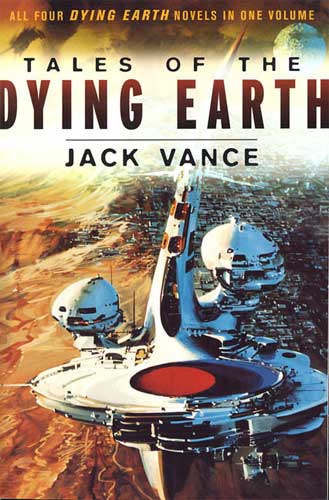
The cover image accompanying this review is from the collection, Tales of the Dying Earth, which features all four complete novels in Jack Vance’s Dying Earth series. This is the book I picked up, with its beautiful John Berkey cover illustration. I mention this merely to point out that I have not read the entire 741 volume, just the 130 pages that make up the novel, The Dying Earth. However, I am mid-way through the second novel and if it is anything to go by, all four novels in this trade edition make it a great, and gorgeous value.
I’m guessing you never played the role playing game Dungeons and Dragons as a kid because the magic system you described is exactly how magic users had to handle spells. They had to memorize them and after using them rest and memorize them again. How funny. I would bet anything that this Jack Vance series influenced Gary Gyax and friends.
Glad you really enjoyed these stories. I’m very interested in reading them as well now myself. Thanks for the review!!!
I’m glad that you enjoyed the collection so much. It’s on my wishlist so fingers crossed that I’ll be reading it soon after Christmas along with Songs of the Dying Earth.
Peta: I’ll cross my fingers with you. I read Dean Koontz’s intro and Jack Vance’s part of Songs of the Dying Earth which also strongly influenced my decision to go ahead and read The Dying Earth first.
Jeff S: No I didn’t. I think I would have really enjoyed that, but no one I knew was into that at all. It is funny to hear you say that because Jerry and I were talking about this last Wednesday night at the shop and he also mentioned that Jack Vance influenced a lot of what came after him.
I would never have guessed that the stories would play out that way just from looking at the cover artwork. From the covers i would have thought hard sci-fi.
Sgist: You are right. What I liked about the cover was that the science fictional elements in the stories are so subtle and seen somewhat in hindsight after getting farther into the work that the image helped me keep in my mind’s eye that these stories were taking place in the future. When they talked of ‘castles’, etc. it helped me keep in mind that some of what they were describing were not ruined medieval castles but instead the ruins of advanced civilization, like Berkey’s image represents.
Not that I don’t like hard sci-fi, as I’ve enjoyed what little I have read of it, but I was actually pleasantly surprised by the fantasy/sf blend in these stories.
sgist – The cover made me think it was a Scifi story collection as well.
Carl – You do realize that I have to read this book as well now that you given it such a good review before I go back and read anymore of the tribute book. Damn you ! 🙂
Jeff S: Well, at least it is only 130 pages. And to be honest I think you could read the first 5 stories, which is only 88 pages in this collection, to get a real solid idea of what Jack Vance was doing.
Of course you might also want to skip my reviews of the other stories IF I end up liking them as much as this one. 😉
I was recently introduced to Vance through “The Dragon Masters,” which just like the book you described, was full of all kinds of out their names and creatures, but thoroughly readable and entertaining.
Subsequently I picked up “The Demon Prince” and read the first one. I think you’d like those. They are fun action/ adventure stories like the “Stainless Steel Rat.”
John, I read The Dragon Masters in the Jack Vance Treasury book and I liked it as well. I saw the Demon Prince novels in my local BN the other day when I was hunting around. I’ll keep those in mind after finishing these. I also have a couple of other Vance paperbacks that a friend gave me. I’m going to have to check in the basement and see just what those stories are.
I have this one, and it’s somewhere in a box. It was on the nightstand, high on the TBR…oh well. I did think it was more than 130 pages, though. Trick of the mind. Dragon Masters was the first Vance I read, many years ago, and it’s still a favorite. Vance is a really talented writer, and he always surprises and satisfies, or mostly he satisfies. Sometimes I have to be in the right mood for Vance.
Richard: LOL, that’s pretty much true of everything right now, isn’t it?!?! Ah, hopefully soon you’ll have your shelves built and all your books where they rightfully belong, in a permanent home. The book itself is 700+ pages, but the first novel is only 130. I can understand the mood thing, pretty much about every author I like. The Dragon Masters was my first Vance as well, purely because it is the first story in the Treasury book that I have, which was my first ever experience with his work. I can see why you consider it a favorite, I enjoyed it quite a lot.
Vance has been on my radar for a while too, I really need to make finding his stuff a priority. I like the SF/F blend, and most of my favorite authors say Jack Vance influenced them in some way.
redhead: I’ve had some memorable reading journeys that I went on simply to check out authors who influenced favorites of mine. Robert Sheckley is one who springs to mind, whose short stories were touted by Gaiman, among others, many years ago.
I love Jack Vance’s THE DYING EARTH. Every home should have a copy.
George Kelley: I couldn’t agree more! 🙂