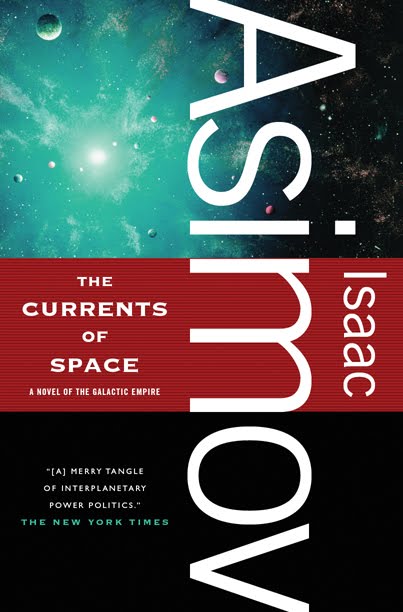
The Currents of Space ~Isaac Asimov
–published 1952, first Tor trade edition, 2010
–Tor Books
–238 pages
–4.25/5 stars
In a region of space not-yet entirely swallowed by galactic empire, the independent world of Sark holds dominion over the planet Florina, whose peasant class citizenry work the fields of kryt, a cellulose-based fiber craved all over the universe. When a lone spatio-analyst arrives feverishly predicted the planet’s destruction, his mind is wiped clean and he is found later by members of the laboring class, naked and enfeebled on the side of a road. This stranger, thereafter named Rik, is taken in by a peasant woman, Valona March, who nurses him back to health and finds work for him in the mill. After a year of child-like existence, Rik suddenly begins to recover snatches of memory. He knows what he used to be, and he knows that they are all in great danger.
The Currents of Space is the second (by internal chronology) of the three book Galactic Empire series. It takes place as Trantor is expanding rapidly, well on the way to forming the Galactic Empire, an empire which is found to be in decline many centuries later in the era in which the Foundation Trilogy is set. Although I have read the first of these novels (The Stars, Like Dust), they each are set so far apart that they are essentially stand alone novels. I have to admit that although I requested this as a review copy from Tor Books, my disappointment with The Stars, Like Dust left me with mixed feelings as to how to proceed. Over the past couple of years I have read the Robot short stories and the three Foundation novels and consider them superior works of classic science fiction. I was afraid to do anything that might tarnish Asimov’s idol status. After a nearly non-stop cover-to-cover read I am pleased to admit that my anxiety was unfounded. The Currents of Space is an interesting, suspenseful, page-turning science fiction tale full of mystery and political intrigue and enough science fictional elements to leave me wistfully gazing at the night sky.
Chapters follow Rik and Lona but also various other characters who one way or another are wrapped up in the events that rapidly unfold once Rik’s memories begin to emerge. Leaders from the Trantor, from the Great Squires who make up the ruling class of Sark, and a member of the Interstellar Spatio-analytic Bureau, who has been looking for Rik since his disappearance a year earlier, make up a but a few of the characters that give the reader a glimpse of the various factions and interests whose story threads are deftly woven together by one of the Masters of science fiction. Though the “currents of space” have a specific scientific meaning as laid out in the book, I was also aware of the currents that pulled Rik and Lona this way and that before depositing them at the climactic end to their tale. I felt pulled along as if I was riding the raging rapids while reading The Currents of Space.
Making my way through this novel I was keenly aware of the decades of my life that elapsed before I finally plucked up the courage to give Asimov a try. Like the three books of the Foundation series, The Currents of Space once again proved to me just how accessible are the works of Isaac Asimov. That statement is not meant in any way to denigrate the skill of Isaac Asimov or to minimize his importance in the genre. Instead I mean to convey sincere admiration for a book that can be picked up 58 years after its initial release and enjoyed as if it was a rollicking contemporary work of speculative fiction. The Currents of Space feels relevant and is not saddled with many of the dated references or descriptions one often finds in classic science fiction. Despite this being a grand, edge-of-your seat adventure, there is an interesting social commentary here as well, reflecting on America’s past during the years of slavery. I will not pretend that I caught on to that, but once it was pointed out to me it was very obvious. Considering the time period in which this was written and released, I imagine it felt very relevant then as well.
The Currents of Space was great fun and it is yet another work that solidifies Isaac Asimov’s position as one of the science fiction authors I will go to time and time again to fuel my passion for the genre.
I’m glad to hear that you had a better experience with this book. The “Good Doctor” remains one of my favorite writers. Will you continue with the third book in the Galactic Empire series? My next Asimov to review will probably be “The Naked Sun”. I enjoyed re-reading and reviewing “The Caves of Steel” earlier this year.
Yes I will Jim. I have a nice old copy of Pebble in the Sky on my shelves already. I also have the two you mention that I want to get to at some point. Not sure if that will be before or after I re-read I, Robot and the Foundation trilogy. I’ve been aching to re-read those lately.
Cool cover. I’m not as big of fan of Asmiov as you are but I definitely respect his work and contributions to the field.
Jeff: He’s certainly becoming a big favorite. Not quite up to the way I feel about Heinlein, but close. In some ways this felt very similar to some of the Heinlein stories I’ve read recently, most notably The Puppet Masters.
I came back to your review to see if you felt like I did that George Lucas must be a big Asimov fan – but you didn’t bring that up.
I didn’t notice that, though I do know Lucas took inspiration in many things. In what ways did you see a connection between this story and Lucas’ movies?