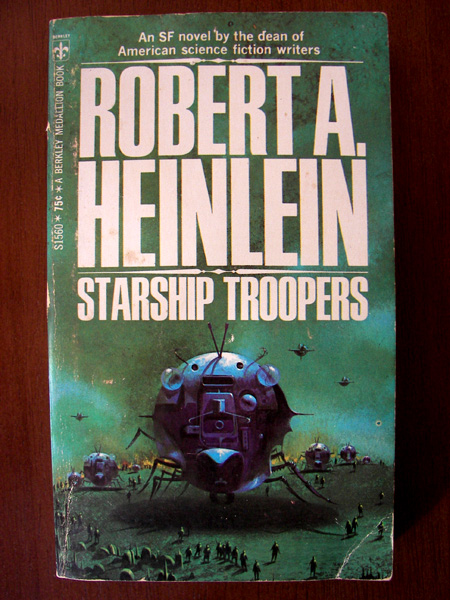
Starship Troopers ~Robert A. Heinlein
–published 1959
–G. P. Putnam’s Sons (this version, Berkley Medallion Books)
–208 pages
–Hugo Award for Best Novel, 1960
–4.75/5 stars
A wise man once said, “Never judge a book by its movie”. For years I have done just that. I left the theater in 1997 after seeing Paul Verhoeven’s interpretation of Heinlein’s novel feeling that I had just pissed away the price of two movie tickets and precious hours of my life. To be fair to those who enjoyed Starship Troopers: the movie, I can only vaguely recall the events that frustrated me so. I was certainly expecting a different movie than I received, and I determined that there was no way that I was going to ever read the book.
Age and experience have taught me the the truth of those wise words, and my recently kindled desire to read Heinlein’s earlier and more famous works, coupled with the positive review of a good friend, made me cast aside my former prejudice. I have now read Starship Troopers, and I liked it. I liked it a lot!
It is the 22nd century and humanity is at war, not with itself, but with a hive-mind arachnoid race un-affectionately known as the “Bugs”. Starship Troopers tells the story of one young recruit, Johnnie Rico, as he experiences basic training, combat, and promotion in the Mobile Infantry (M.I.). For a novel that is largely about one man’s experience in military training, Heinlein knows how to get the blood flowing, putting the reader in the hands of the young narrator as he prepares to drop into battle. The initial pages are pulse-quickening and do an excellent job of getting the reader up to speed with ground warfare in the 22nd century. But this is just the hook to reel you in. What follows is a retrospective look at what brought Johnnie Rico to this place, a bird’s eye view of what military training and war is like for a young man looking for his purpose in life.
Starship Troopers is not your typical space adventure novel filled with non-stop action. Instead it reads more like a biography of what it is like for Rico to go through basic training, experience battle, and eventually go through officer candidate school. On this journey the reader gets to know Johnnie Rico as he matures. We see through his eyes and our understanding of military life, of the world as it exists then, and of war grows as he grows. It is a surprisingly engaging journey. As I read Starship Troopers I couldn’t help but compare it to my experience reading Master and Commander, the first of Patrick O’Brian’s Aubrey-Maturin novels. Both books have an attention to detail that, if described very literally, might just make the average reader say “thanks but no thanks”. Details of equipment and routine and shipboard life could be very dry in the wrong hands, but, like O’Brian, Heinlein makes this detail interesting by couching it in a good story. Heinlein’s description of future military life has so much texture that you cannot help but think that it is real. It is that rich detail that gives the story a hefty, tangible quality.
While most of Starship Troopers‘ characters are peripheral, the reader feels an emotional reaction to them because of Rico’s connection to them. The interactions with characters might be brief, but their presence is no less real. When characters die, you cannot help but feel a twinge of sadness. When Johnnie does something that earns him praise from his commanding officer, you cannot help but feel a bit proud. His interactions with his mother and father, though brief, strike an emotional cord.
It wasn’t until I was well into the book that I saw a more recent copy of Starship Troopers at the bookstore proclaiming it to be a “controversial work”. I was not finding it controversial in the least, so after finishing it I took a quick glance at the Starship Troopers Wiki page. It reveals a detailed list of allegations, all of which are fascinating even if I feel they were off base for my personal experience with the story.
The one accusation I could somewhat understand was that of the story being pro-military. It certainly is that. Without delving deeply into personal politics, I am very much in support of our military and found it to be refreshing in its presentation of military life. Looking back on the time period it was released, not long after the Korean War and near the start of the Vietnam War, I can certainly see how it might have generated controversy in the years following its release. It is fascinating to think about how it might have been viewed differently had it been released during the WWII era.
Another accusation leveled at Starship Troopers is that it is merely a vehicle for Heinlein’s political views. I will not presume to know if this is true or not, given my limited knowledge of Heinlein’s political ideals, but there were a few moments in the story where political theory was parceled out info-dump style. For the most part I found it very interesting and felt that it worked within the story. The last incident of this, in the later part of the story, did go on a bit long and slowed down the story somewhat. That is reflected in my 4.75 rating, as other than that one minor complaint I found this a perfect reading experience.
Now that I have the benefit of having read the novel, I can certainly see how it would be difficult to effectively adapt this faithfully to the big screen and I can perhaps judge the film a little less harshly. Heck, I might even enjoy it now, knowing both what to expect and being able to watch it while overlaying the actual story as Heinlein imagined it. But maybe not.
I believe it takes a very talented author to take a story about war that has less to do with actual combat and more to do with the day to day grind of military life and make it page-turning. Although intellectually I know that the action sequences are brief, the intensity of my experience with the novel tells me something much different. This is my favorite Heinlein to date, and I have really enjoyed everything of his that I have read.
Starship Troopers was nothing like I expected while being everything that I wanted the story to be. As I closed the final page I found myself wanting to hug my dad and play Gears of War 2. While I couldn’t do either at that moment, I did manage to do both the next day.
______________________________________
This book is a selection for:
Mind Voyages (for the Moon Voyage and Mercury Voyage)
The 2010 42 Challenge
The 2010 Reading Challenge (for the Older Than You category).
My son read this one & The Forever War and wrote a paper contrasting them for extra credit in his honors english class. He says they’re great read back-to-back because they take such different views.
Carl,
Like you I came to the book after the film, and like you, I had a similar experience. If you’re interested you can find my review here:
http://tinyurl.com/y9hs6oc
Stuart
Great write up and I look forward to reading the book.
Robin: I’ll look forward to your experience with it.
Stuart: Great review, you touched on several parts that I thought about writing about but my review was already too long! 🙂
Caitlin: I got the impression that reading this and Forever War back-to-back might be really interesting, especially as it reportedly is more about Haldeman’s own personal Vietnam experiences.
__________________________
Forgot to mention in my review that I went out of my way to get this specific copy of the book because of the fun cover by Paul Lehr. Although not specifically representative of the ships in the book, it is a fun take on the idea of ‘bugs’.
Glad you enjoyed it and as of right now it is my favorite Heinlein read. Of course I read it many years ago after the movie came out and I don’t remember much about it now except that I loved it. I hate to do many reread’s but I may make an exception for this one some day. I also didn’t pick up on all the so called ” messages ” that Heinlein is accused of putting throughout the book. I found it a kick ass militaristic Scifi tale which is still what I remember about it not some Pro whatever agenda book.
I saw the movie first before reading the book back in the late 90’s. I LOVED the movie and didn’t mind pissing my money away on it myself. 🙂 Of course I also LOVE to the this day the Flash Gordon movie which came out in the late 80’s as well. They are fun adventure movies with a ” camp ” style that hit’s me just right. That being said after reading the original material for Starship Troopers I can see where someone who loved the book might hate the movie. ( I know I felt this way about the Stardust movie that came out a few years ago now. ) I actually saw after reading the book where the movie took a lot of things from the book but twisted them 180 degrees from what the book detailed. It’s kind of like the Starship Troopers movie is like the 4th copy of the character Michael Keaton played in that movie Multiplicity.
I’m grinning just thinking back to fun scenes from the Starship Troopers movie now; like the ” news stories ” and the way the girls would say Johnny Ricco’s name. Of course I also fondly remember the Flash Gordon movie with it’s ” Go, Flash, Go ” cheering and ” What do you mean Flash Gordon approaching ?!!! ” lines. Just to let you know what other bad films I like please count me among those who loved The Phantom with Billy Zane and Time Bandits. So if you love those films as well I think maybe you can see how I would love the Starship Troopers movie if viewed in that light. Much like I enjoyed Joss Whedon’s equally cheesy Dr. Horrible web film from a few years ago. Neil Patrick Harris being the common denominator. 🙂
I hated the book. I’m no longer as much of a fan of Heinlein as I was, but I suspect I never would have liked Starship Troopers. I wrote about it on my blog here. The movie, OTOH, is great.
Like all thing Heinlein, I was predisposed to like this book. I have yet to read one of his books that I couldn’t find something I liked.. even if just the dialogue. I read this book many years ago, long before the movie. When the movie came out I was excited, then disappointed. I could see only a very small link between the book and the movie. OTOH, if I watch the movie -without- thinking about the book, I find I can enjoy it. I especially like the Neil Patrick Harrison character, even though he gets very limited screen time….
Now that’s an awesome book. I have that exact same cover on mine, too.
Alex J: It really is a fun book cover, isn’t it?
Astaryth: Since Verhoeven admittedly didn’t bother to finish the book, I don’t find it surprising at all that they don’t resemble each other in the slightest. This certainly isn’t the first case where this has been done. Whether a person adapts a work as faithfully as possible or goes the route of subverting it, or lampooning it, or using it as a springboard for a new idea I think there should be some universal law that an adapter must read the work he/she is adapting in its entirety. Some day I’ll watch this again without my preconceived ideas, knowing that it is much more tongue-in-cheek, and I might just enjoy it for that.
Ian: Because you always lay out really good arguments in your reviews I definitely respect your opinions on the classics even though 9.9 times out of 10 we do not agree at all. LOL!
Jeff: I’m sure some day I’ll watch the film in a very different light. I am definitely a fan of camp and silly science fiction (I do after all love the Stainless Steel Rat books). And after Dr. Horrible and How I Met Your Mother (and Undercover Brother come to think of it) I appreciate Neil Patrick Harris’ comic delivery much, much more than I did back when the movie came out. As I said in the review, what I remember most of all at that time was expecting something, or wanting something, different in a sci fi film than what Starship Troopers delivered.
Glad you enjoyed the book when you read it.
I read the book in the mid 1960s, when I was about 15. I missed the political stuff completely and loved the book. I always thought that there should have been more action sequences and more bugs until I saw the movie where there was too much action and not enough of Heinlein’s digressions.
I reread all of Heinlein’s juveniles every few years (Heinlein wrote Starship Troopers as a young adult book). I still read it with a 15 year old’s appreciation.
My experience is similar to Keith’s, I read it as a teenager when I was ploughing through all the Heinlein I could lay my hands on. I think this was the fourth or fifth of his books I read, but only the second novel, having read short story collections before it.
Having read it many years before the film, and not having any of the preconceptions of SF films or specifically the one of this book, for me it was about the adventure, and the excitement. Great stuff.
I’m glad to see you’re continuing to read through Heinlein’s books. What’s next?
I’ve only read Heinlein’s Once & Forever War, which I enjoyed. But I saw the film version of this, and I have to say it is one of my favourite films. But if I had been expecting a straight action sci-fi it might not have met the mark.
I have heard that the book is in many way the opposite of the film, and your review seems to suggest that too. I’ll have to pick it up at some point.
Fence: I’m not sure I’ve heard of that and can’t find a reference for it online. Joe Haldeman wrote, The Forever War. Can you point me to a link?
Richard: I’m not sure what is next in my Heinlein adventures. I am thinking it might be Red Planet but to be honest I am just not sure. Maybe I should read the juveniles in the order in which he wrote them just for the fun of it. As for what I am reading next in general, Starship Troopers inspired me to re-read a favorite which I will post about tomorrow and I’m reading Gateway by Frederick Pohl right now.
Keith Graham: I still read books like this with a teenager’s appreciation for them, hence my ability to enjoy the Stainless Steel Rat books now every bit as much as I did when I read them the first time in my pre-teen/teen years. I am sure there are novels that I would read that the political stuff would put me off, they exist, no doubt, but I haven’t found that to be the case with any classic science fiction that I have read. In part I read them with an eye on when they were written, which makes their viewpoint a little more fascinating to me. Also, I am just not wired to read a great deal of political stuff into books, I too easily get caught up in the story, whatever that may be, and if that works for me then I am pleased.
Plus I find Heinlein’s politics, what little I know of them, pretty interesting, especially when contrasted against other SF writers of the time.
Read Door Into Summer, my favorite Heinlein. Sometimes I think The Moon is A Harsh Mistress is better.
Of the juveniles, I like the later ones; Tunnel in the Sky, 1955, Time for the Stars, 1956, Citizen of the Galaxy, 1957, and Have Space Suit—Will Travel, 1958
I’ve read Starship Troopers many times, starting back in the 1960s. I actually liked the movie version. I was terribly disappointed that it didn’t feature the powered suits, but I don’t expect movies to be faithful to their books. To me, every movie based on a book is an interpretation – but then every reader creates an intepretation. I hope Starship Troopers gets remade in the future. Great books deserve many movie versions.
Many people hated the book because it suggested that a political system could be based on something other than 100% democratic participation. I don’t think I’d support one where volunteer military service was the only critia for citizenship, but I could accept the idea that a period of volunteer service in a variety of areas could be the price of voting rights.
Jim: I certainly agree that every reader creates an interpretation, that is a fact that is well born out in the various conversations about books that crop up all over the internet. I also agree that some movies are interpretations of books…but others are just travesties. 🙂
I thought the citizenship and voting concepts were very interesting. I don’t think I would want that to be the reality, but it was an interesting interpretation of what life might be like in the future.
Keith: Jeff read Have Space Suit to his kids last year and really enjoyed it. And its one of Jim’s favorites and I owe it to them both to get back to it. I started reading it last year and it was simply a timing issue. I wasn’t in the mood for it at the time and I kept getting distracted. All those you mention are one my list of books of his that I want to read. And at some point I want to reread Friday and Time Enough For Love, since those are the books that initially hooked me on Heinlein.
Hi, Carl! Sorry to come in on the comments here, but I just wanted to make sure you received the email I sent about the book blogger convention? 🙂
I’m so sad…I’ve yet to read my first sci-fi book of the year. Not to mention how behind I am on my blog reading! I just haven’t been getting much read at all except for school. Anyway, you must have one awesome collection of these old sci-fi books. I just love the pictures you’ve been posting of them. 🙂
Seems like forever since we’ve touched base…been missing you! Hope everything is going wonderfully thus far this 2010!
Debi: No worries, the year is young! 🙂 I was just thinking the same thing about you yesterday, that I needed to send you a big ol’ email to catch up. Being a parent with more than one kid and doing schooling yourself is a BIG job, you shouldn’t feel bad at all when those more important things get in the way of blogging. You are investing your time and energy where it is needed most, and we all give you kudos for that.
Trish: Yes I did and I will shoot you an email back.
Am reading – if this isn’t off topic – James White at the moment. I picked up the first omnibus volume of his Sector General series, about a deep space hospital catering to humans and aliens of all types. Good 1960s style hard SF, uncomplicated, easy to read. I’ll be posting soon, but this to say that two more SF reads so far this month.
Richard R.: Anything about reading is NEVER off topic here! As much as it might paint me in an ignorant light, I’m not sure that I’ve ever heard of James White. I’ll be looking that up though. And now I’m back from looking them up. I can tell you right off the bat that one volume with a Jon Harris cover and one with a John Berkey cover has me frothing at the mouth!!! I can’t quite tell, are they short stories or novellas or novels? The basic premise sounds very interesting. Makes me think of Draco Tavern, the short story collection by Larry Niven where all the stories take place in or around the tavern involving the same main character and several peripheral characters. It is a collection that I really enjoyed and it is high past time for a reread.
So Carl, which Heinlein are you going to read next? You should create a poll for your readers to vote for their favorite Heinlein books, and then you read and review them.
Carl, the James White Omnibus #1 (Beginning Operations) is comprised of the first three Sector General novels. Those novels, in turn were original published as short stories or novellas and then edited together for paperback publication. The editing is good, you can’t tell that much where they are joined and they each read like an episodic novel.
I’ll be doing a detailed post as soon as I finish the third novel, which will be in a day or two.
I’m in a hurry just now, I’ll comment on your Scalzi post tomorrow.
Richard: Look forward to your Scalzi comments, and thanks for the direction on James White.
Jim: You, my friend, are the stats king! Only you could do a poll and give it any justice. Of course I have a feeling that there are only about 5 of you who have read Heinlein and would actually vote on the poll! 🙂
Scalzi is working the same side of the street as Heinlein: scary aliens, human warriors, bureaucracy and government musings. Great war scenes in both books!
I agree George, I agree. And it is a fun side of the street to read from, in my opinion.
This excellent review is funny to read, mostly because I just finished “Starship Troopers” last week and also found myself thinking these same thoughts. I know exactly what you mean about the “controversial” thing – I didn’t feel like the book was too allegorical or heavy with metaphors. It felt complete enough as is, upfront. I honestly liked that it wasn’t too “action-packed” and went instead for things like a deeper analysis of basic training (often too glossed over…). I did start to feel the story dragged a little by the end, but I ultimately think it’s rewarding.
Biblibio: It certainly sounds like we had the same rewarding experience with Starship Troopers. I liked the deeper analysis myself and the action was perfectly placed to enhance but not overwhelm the story.
Glad that you got to read this classic from the ‘golden era’ of the genre. Anyone who is serious about Science fiction should read some Heinlein (as well as Frank Herbert) – a truly gifted writer. Have you picked up ‘The Moon is a Harsh Mistress’ yet? If not, you should – just excellent. I hope many others follow your lead here. Regards from England.
Very late reply, Howard, but thanks! All these years later I’ve finally read Herbert. I have Moon is a Harsh Mistress on my shelves but haven’t read it yet.
It’s interesting to see some of the issues that this book brought up, but the strangest thing from the wiki you linked to (at least to me) was that the director of the movie never finished reading the book. You’d think that would be helpful if you’re directing a movie based upon the book.
That is odd, but sadly not surprising. I’ve seen that happen far too often with adaptations. And usually the results are less than stellar.