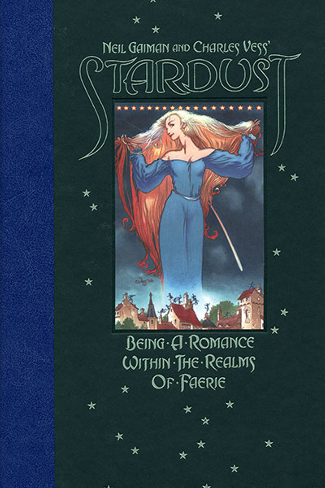
For those of you who are taking part, and those who may still like to, this is the first of two discussion posts for the group reading of Neil Gaiman’s wonderful fairy tale, Stardust. I cannot recall the exact year I first read this book though I do know it was not long after it came out in paperback form. Over the years I have read it many times, including aloud to my wife, and have listened to the audio version many times over. If you haven’t tracked down a copy of Gaiman reading this story it is something I highly recommend. The story itself is magical, Neil reading it makes it more so.
For this read-along I decided to forgo the audio version and do it old school and it has been a tremendous pleasure to journey through the pages again, allowing Neil’s words to ignite my imagination and memories of Charles Vess’ illustration in the original version to inform the visions in my head.
For this read through I am reading the small slip-cased signed Gift Edition that I purchased from Subterranean Press. It is my first time reading this particular copy of the novel and I am loving the size of it. In the Introduction Neil points out that he asked his editor if they could make the book look like a “much loved book from 1922” and they have, and it is lovely.
I hope that all of you participating are enjoying the story, but I look forward to hearing from you even if that is not the case. Following the jump there will be a spoiler-filled discussion of the first five chapters of the book. Anyone who would like is welcome to participate in the conversation, even if you are not reading along with us at this time. I only ask that you limit the conversation to the first five chapters so as not to spoil anything for those reading Stardust for the first time.
Below are the questions I came up with to guide the discussion. As I told everyone in the email, these can be dismissed entirely in favor of sharing what you want about the first five chapters of the novel, can be used in part or used in entirety. Those of you who don’t have blogs, or don’t want to post about this on your site, please feel free to answer any or all of the questions in the comments section of this post.
1. We have spent a little time with Tristran and even less time with the star. What are your initial thoughts/impressions of our two protagonists?
Tristran is an easy character to fall in step with. We learn of his origins before he does and thus upon meeting him we already have some expectations that this seemingly ordinary boy in a seemingly-but-not-quite-ordinary village is bound to have adventure in his future, and make no mistake. The Tristran we meet early on is not complicated and I like that fact. He is a likeable character with the annoying habit of being attracted to someone who seems to be toying with his affections, not unlike the experience many a young man goes through.
It was curious for me as this is the first time I have ever read Stardust and found myself thinking of Tristran and comparing him to Richard Mayhew from Neverwhere. Richard had the sometimes annoying tendency of wanting to get back to Jessica, who did not ever seem right for him, and Tristran makes repeated mentions of Victoria Forester even though the reader has been given little indication that Miss Forester is worth pining over.
I remember the first time I read the story how surprised, and pleased, I was to discover that the star was a person. I love how Gaiman introduces her with an exclamation and an expletive. So very Neil Gaiman and so perfect for the story. I won’t share much about her now because we barely spend any time with her in this part of the book. I will have much more to say in next week’s discussion.
2. There are some very interesting potential villains introduced in this first half of the book. Do any of them particularly stand out to you? If so why or why not?
All the brothers from Stormhold are great. I like that we are given a sense of history, of time having passed, by the fact that four of the brothers are already dead and yet their ghosts remain to watch the proceedings. I also like the intimation that the living brothers can see them and yet do what they can to ignore their presence. As would I were I to have to look at siblings that I had taken part in dispatching to the next life. Despite the numerous times I have read this book I never fail to get tense and on alert whenever any of the living brothers are together, wondering who may do who in at any time. As they approach the window to answer their father’s question about what they see I always get that eerie feeling in the pit of my stomach that you do when nearing an edge at a great height, knowing for sure that this time one will give another a shove.
The Lilim are fantastic! There is SO much being said and artfully not-said in Gaiman’s description of the three crones and the three beautiful women who inhabit the world reflected in their mirror. I want to know so much more about them than we are given and I delight in that kind of storytelling. Again I am loathe to say much more until we get to part two, other than to say that I look forward to re-experiencing their actions as the story progresses.
3. In Chapter Three, just after the section with the brothers in Stormhold, Neil Gaiman gives us a description of Faerie that includes “each land that has been forced off the map by explorers and the brave going out and proving it wasn’t there…”. What imaginary lands do you then hope are a part of Faerie?
I love that description, and again it reminds me of Gaiman’s description of London Below in Neverwhere in that there pockets of time and history have been swallowed up and are part of that world, an urban Faerie, if you will. I certainly cannot help but think of the maps Gaiman mentions in this part of the book, those old ones that had monstrous sea creatures and the words “here there be monsters” or some such statement. There is something comforting and yet terribly disappointing about growing up to discover there are no enormous kraken in the sea, nor sea-serpents or leviathan. I imagine those places, with those creatures, exist in this realm.
And I cannot help but imagine some Lovecraftian gothic horrors exist here too. Gee, I’m in a dark mood! Must be two consecutive nights of thunderstorms and lost sleep. 🙂
4. We do not get to spend a great deal of time in the market but while there we are given a number of interesting descriptions of the wares being bartered or sold. Which if any of them caught your eye, either as items you would like to possess or ones you would most certainly hope to avoid.
I imagine I won’t be the only one who would like to have a storm-filled eggshell and given that Neil Gaiman has only revisited this world once (in a short story) to my recollection, I would love to pay money to hear that town-crier tell me all of the stories that he shouts out headlines for. I could spend many a night listening to those.
The market is one of those places that lovers of this kind of literature cannot help but want to visit and I couldn’t imagine living in Wall and only being able to attend it once every nine years. I cannot imagine ever wanting to go back through the Gap once I passed through to see all the wonders.
5. If you have read much of Gaiman’s work, particularly his short fiction, then you have come across some rather graphic and disturbing portrayals of sex. Gaiman offers up something very different in the way of a sex scene early on in Stardust. What are your feelings of the scene either in general or as a contrast to other Gaiman-penned scenes involving sex?
I debated about asking this question at all, thinking “do I really want to talk about sex?”. The answer turned out to be “Yes, I do!”. The reason being isn’t so much in contrast to other stories Gaiman has written, although it does make for an interesting discussion, but because of the scene itself.
I’ve written in the past my dislike for Neil’s short stories, or at least the majority of them, that have a darker and more disturbing view/usage of sex. They are not stories that I enjoy and I recommend the collections they are in with the caveat that my recommendation is because of the presence of other great stories. It is nice to see Neil Gaiman write about sex in a way that isn’t disturbing or deviant.
I really like the scene between Dunstan Thorn and the bird/woman. You can certainly look at it one way and believe that she enchanted him or seduced him but she herself mentions this is not so and I am always torn between what the reality in the story is. What I do know is that I find the scene itself one of the more beautiful descriptions of sex I have ever read in a novel. It is passionate and lovely and describes the act in a way that reflects just how beautiful and wonderful sex can actually be. And so really the whole idea of this question is my own need to just say “Well done Neil Gaiman!”.
6. I suspect Neil Gaiman is influenced by a number of fairy and folk tales in Stardust. Are there any elements of the story that made a particular impression and/or reminded you of other fairy stories you have read or are familiar with?
I have mentioned Neverwhere several times (refraining from doing so yet again in the Faerie Market question), but that isn’t exactly what I meant. I certainly think the Lilim are inspired by old tales about the Fates, and in thinking about that the witches in Macbeth come to mind. I also see them as something similar to the Fate characters in Neil Gaiman’s Sandman series.
The serewood reminds me a lot of Fangorn Forest from J.R.R. Tolkien’s The Lord of the Rings, although the serewood seems much more pro-actively aggressive whereas Fangorn appears to me to be more of a wood that will enact vengeance but will leave peaceful passersby be.
7. And finally, which of the many side characters introduce have caught your eye and why? Or what else about the story thus far is of interest to you?
I am so attached to the little…man?…that we first encounter in a dark barn with Dunstan Thorn and who later meets, briefly travels with, and helps Tristran. He is such an interesting little creature and the way he talks tickles me. His going on about the ‘mushrumps’ and use of the word “skellingtons’ alone makes me want to pack him along for the entire journey. I like that he has a bit of Old Bailey (again, Neverwhere) about him with perhaps some of the cunning of the Marquis de Carabas. We learn so much about Faerie through him and in the course learn much more about Tristran that he is as yet unaware of. And he generally seems like a nice creature who would make for an interesting travel companion. I would go on a journey with him. And I guess, in a way, I already have. 🙂
Please share with us the links to your discussion posts below. I look forward to joining in the discussion myself later this evening.
Thanks for organising this read along. Stardust has been on my to read list for a while and this pushed it to the top. I absolutely loved this story. It contains so many of my favourite elements. I agree with what you said about wanting to know more about the Lilim. I had that feeling about many bits of this book, even little details that seemed thrown in just for the heck of it. The bit with the mouse that was enchanted and needed to eat the nut but got eaten by the enchanted hawk (owl?) who needed to eat a mouse who had eaten the nut… I want to read a book just about that!
You are welcome, Lauren. I’m happy to see anyone read this for the first time and am so thrilled by your enthusiastic reaction to it.
You are so right in pointing out all the details that make you want to follow them along the path to see where they lead. I love that bit with the mouse and the nut too. So much fun.
I am loving all the Neverwhere comparisons…I definitely didn’t pick up on that the last time I read this book. Which may or may not have been before I read Neverwhere, I can’t remember anymore. I thought of the Market as well, and I love your point comparing Tristran and Richard. They definitely resemble each other (and a fairy tale archetype) as the ordinary (?) guy thrust into an adventure. Although Tristran seems to be taking it all much more calmly than Richard did!
Re: the market, I did think Dunstan lacked imagination when he couldn’t think of any need for a storm-filled eggshell…
I am too and I thought of a bunch more when driving to work after posting this. I don’t know if he consciously used a similar framework for both stories or not but I am enjoying contemplating the ways in which both stories mirror one another.
Yes, Tristran is much more calm and appears more happy about the adventure than Richard did. I wonder how much of that has to do with the difference in the time period in which each character lived, if you were to psychoanalyze it. Certainly Tristran lived in a time with fewer opportunities and fewer distractions where an adventure of this kind would only be dreamed of whereas Richard lives in our time when so much is at your fingertips and it is easy to get complacent about and perhaps even shy away from anything outside of routine.
And yes, who wouldn’t want to at least possess a storm-filled eggshell, at least for a little while?
Very interesting observations about the difference in time period… I also think Tristran and Richard’s reactions are different because their expectations are so different. Tristran, after all, lives in a town that encounters denizens (and products) of Faerie every nine years. Although it’s not delved into much and Wall seems like a perfectly ordinary town, that has to change things. If nothing else, there must be a tangible acceptance of the magical as real–if only on the other side of the wall.
Richard, on the other hand, lives in our modern, technology-driven, science-oriented world. An encounter with the fantastical is a complete shock to him, because he never believed any of this could exist.
I don’t know that it makes Tristran any more capable of dealing with anything in practical ways…but he does at least come at it without Richard’s stumbling block of shock and denial!
It’s very true that Gaiman manages to say a lot by what he leaves out. Reading between the lines on a Gaiman novel really gives the reader an added depth to his works.
Yes, I forgot to mention the lillim and the Fates in my post, but you are so right. I can’t help but equate the 2 stories in my head while reading this book.
Sometimes I feel like we know Tristran a bit better than he does himself because we got to know his origins, and for the first years of his life he doesn’t have this knowledge.
OK, that doesn’t make any logical sense (saying a lot by what he leaves out) but I know exactly what you mean! It is like he gives us just enough of a tiny hint at something that our imaginations can extrapolate a huge amount from it without us realizing. How cool is that?
I think it is the nature of this kind of fairy tale to have lines to read between anyway, and Gaiman does a masterful job of it.
I too think we know Tristran better, as we did with Richard, because the viewpoint of the story allows the reader to see more of the context. Makes it kind of fun to be going along with him, wondering just if or when more will be revealed to him.
Now I’m really going to read Neverwhere! There is no better advertisement than comparing it to Stardust 🙂
It is quite a lot darker, but very enjoyable. It was my first exposure to Mr Gaiman’s work and I have been a fan ever since.
It was also my first experience of Gaiman and I can’t recommend it enough. Please read it!
Lynn 😀
Ah, wonderful!!! Neverwhere is one of my favorites, being the first Gaiman novel that I ever read.
In reference to your answer for #1: This is a little weird but I keep thinking of Tristan like I did the little boy from The Little Prince. As you say, Tristan doesn’t understand his origins or himself too much until he visits all these strange people and places. It’s a tenuous connection and maybe some of that is just a similarity in tone between the two books, but it is a comparison I can’t help myself making nonetheless.
Thanks for hosting a great read-along so far!
I *think* I’ve read The Little Prince but am not sure. I know I own a nice copy someone got me as a gift. Now I’m wanting to read it to check out the connection you are making between the two.
Whew I’m so glad I got this one just in time. I was starting to think I would miss out on the fun. And this is a fun read. Like you I’ve been comparing it a lot to Neverwhere. Tristran reminds me a little of Richard. And the villains yet again, are villainy. They freak me out and I love it. Thanks for hosting this read.
Thank goodness we don’t have villains like the Messers in this book though, they were seriously creepy.
They were creepy, but pretty funny as well.
I’m so happy you aren’t missing out on the fun, particularly because it involves this book which I adore so much.
I’m holding off on reading the rest so it’s fresh in my mind for discussion next week. It’s killing me.
1. Now that you mention it, he does seem to share Richard’s incomprehensible obsession with a woman who isn’t worthy of his devotion. I have to admit to actively disliking Victoria because she is actively toying with the poor boy.
I laughed out loud when we first met the star: it was a such a perfectly understandable way to react to her situation, but so totally unexpected.
2. I agree with you about the wonderful sense of history that we are given for these characters: we get enough to be able to perceive the depth and yet are left wanting to know much more. I like the idea that the brothers come from a family where sibling rivalry is so very lethal: it is a wonderfully simple idea, but absurd at the same time.
3. It’s a good thing that you are pointing out all these obvious parallels to Neverwhere because they sailed right past me! 😀
5. While I agree with you about the actual description being rather beautiful in its simplicity, I did feel it was out of place in the amount of detail that we were given. I find it strange that I felt like this because I don’t have a problem with sex scenes in general. Now I feel like a prude! 🙁
7. I also liked the little furry man, and I loved his use of language. His silly word mangling reminds me a lot of my father, who is also known to talk about skelingtons from time to time. I have no idea where this tradition of silliness comes from, but I enjoy using it with my pets . . . who seem to tolerate it rather well.
I think the comparison between the two markets is a great observation. Also the Lillim – they’re really excellent to read about and I think it’s the fact that there are three – very Macbeth!
In terms of the brother – I really enjoyed the way in the film that they were in black and white.
A great book.
Lynn D:
Thank you for those interesting questions. This is my second Neil Gaiman book and I’m definitely interested in reading more.
I have a copy of Neverwhere on audiobook and I’m thinking about replacing my current listening with it now; I wish I could take part in the interesting discussion about the comparisons between the heroes (and other characters). Reading multiple works by one author adds immeasurably to discussions of their fiction I think. Nonetheless, I enjoyed Stardust on its own terms. I really liked that little (?) man too: I would have liked to have had him along on more of the plotlines, if only for the good cookin’.