“Adventures are all very well in their place”, he thought, “but there’s a lot to be said for regular meals and freedom from pain”.
And thus we come to the end of our journey, our travels with Tristran Thorn and his fallen star come to an all-too-soon end. But as my own experience attests, there is great joy in a return trip. Neil Gaiman’s fairy tale does go by quickly, but its pages are packed with imagination. It is a sweet, satisfying adventure found through a gap, outside a wall.
It has been a great pleasure both re-reading this book and doing so with a group of others who are either exploring the land outside of Wall for the first time or are returning for another go. It is fascinating to see a story you love through the eyes of other people as it causes you to look at the story with differently and reveals new facets despite your familiarity with the tale.
Thank all of you who participated in the reading and/or the discussions. I am anxious for your thoughts on the second half of the book. For those who have not read it, there are spoilers to follow.
1. In the first part we saw a naive, wool-headed and self-involved Tristran. What are your thoughts about Tristran and his personal journey now that the book has ended?
One of the primary things that Stardust tackles is the passage of Tristran Thorn from boyhood to manhood. Wall is a quaint, small and isolated village and Tristran’s life experiences have been very limited up until the point where we meet him and discover that he has an unrequited attraction to the local beauty, Victoria Forester. The readers can see right away that the feelings are not mutual but Tristran is naive and what courage he has is born aloft by his youthful passions and not common sense. When he leaves Wall to retrieve the fallen star to win Victoria’s hand we know that he will not return the same.
Tristran took a bit of a beating in last week’s discussions because of his cold, disinterested response to meeting the star and her broken leg. I write that off to the character being an adolescent with little but the standard self-interest that many (especially boys) at his age have. I do like that he begins to grow up and mature and does so fairly quickly. He initially chains Yvaine (I had SUCH a hard time not using her name in last week’s discussions since it hadn’t been revealed yet) but soon releases her, naively trusting her, and that act combined with his selfless efforts to save her when she is drawn into the witch’s lair binds her to him with obligation rather than chain.
I think Tristran does a great deal of changing in the months that he is gone in Faerie. In some ways he does become a man; at the very least he comes into his own, finally being back among his people. But mercifully he doesn’t make such an enormous change that we can’t see the original boy who stepped through the gap to find a star.
2. The star, who we now know as Yvaine, also experienced a transformation of her own. So I ask the same question, what are your thoughts about Yvaine and the journey she took?
We talked last week how we are introduced to Yvaine, and the fact that she is a young woman and not a hunk of space debris, with a curse word, a brilliant way to play on the shock of our discovery of her. She too grows in this story but her transformation is a different one. She is separated from her family by the act of another rather than by choice, like Tristran, and so we initially see a sad and bitter young lady who has to grow to embrace the world she now lives in and has to take the enormous step of putting her trust in another.
I enjoy the way in which she comes to realize her feelings for Tristran and that she remains a very strong and independent character even while doing so.
3. The villains of the story came to interesting ends, but not necessarily expected ones. How do you feel about Neil Gaiman’s handling of the Stormhold brothers (who had remained at the end of Part 1) and the two witches, the one Lilim and Ditchwater Sal?
The first time I read this I remember being surprised by the reveal that the chained bird was Lady Una. In retrospect I should not have been surprised as Gaiman gives it away right at the beginning when we meet the dying Lord of Stormhold as it is mentioned in that section that he has a daughter. Still, I liked the reveal and though the brothers were not typical villains in the sense that they were bad through and through (they were largely only seen as traitorous to one another), it did not pain me to see their ends. I thought it was interesting the way Gaiman ends up taking the various parties who are after the star for less than honorable reasons and pits them against one another, so we see the witch and brother essentially defeat one another, with him being killed and she using most of the last of her strength in the process.
I also found it to be a very creative twist in that Morwanneg’s cursing of Ditchwater Sal ends up backfiring on her by setting up the situation where Yvaine is right at hand but Sal cannot reveal it because she doesn’t know.
In the end I thought the handling of Morwanneg was wonderful. I’m glad that she didn’t die, if she even could, and found that the way Yvaine treated her, not with contempt or vengeance but with pity and a parting kiss, was a fantastic and again surprising element of the story. That one gesture reveals so much about Yvaine that if you weren’t cheering for her before you would be then.
4. Were there any descriptions, characters, settings, plot threads that stood out to you personally during this second half of the book?
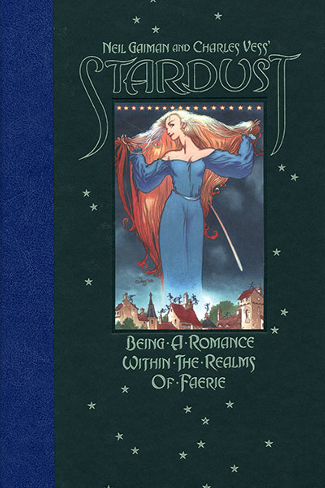
I love the big harbor tree. That illustration by Charles Vess is one of my favorites in the illustrated version of the story. It would be incredible to see a tree that was so large that it took three days of walking away from it before it disappeared from your site. Wow!
I really like the time on the lighting ship and will talk about it more in a few weeks when we do the Movie vs. Book discussion.
5. At the very end of the book we see that Tristran and Yvaine’s relationship and fate echoes that of Aragorn and Arwen from The Lord of the Rings. If this question makes any sense to you (lol), what comparisons and/or contrasts do you see, especially in the fates of Yvaine and Arwen?
I’m not sure how obvious this will be to people who are not as obsessed (yes, I admit it) with The Lord of the Rings as I am. In LOTR we see that Arwen makes a choice to give up her chance to go to the undying lands with the rest of her kin to marry a mortal man. Arwen knows that this will eventually end in bitter grief as Aragorn will die and she will live for a long, long time alone after that. With Tristran and Yvaine we have a similarity and a difference. Yvaine’s choice is made for her. When the Lord of Stormhold knocks her from the sky she is permanently separated from her people. Yet she also chooses to love a mortal man and in the epilogue see that Tristran too eventually passes away and it is a very bittersweet, melancholy scene to see Yvaine go to the deserted uppermost part of their castle to gaze longingly at the stars and moon above.
There is something very sad about the fates of both of these women, a sadness that resonates with us because we know that either we or our spouses will likely experience that feeling of separation and loss when one member of the marriage dies some day. Some have already experienced that. Again, I won’t go into how the film addresses this end here, but I will say that as sad as that is I love that Neil Gaiman writes this the way he does. It gives a great deal of depth to the relationship and to the story itself.
6. What are your overall impressions of the story now that it is done?
Well, this is easy for me. I love it. I haven’t lessened my affections for the story no matter how many times I’ve read it or listened to it on audio. If you can get the audio, read it again that way. Man, is it a delight! If I hadn’t read Neverwhere first I would have a hard time not considering this my favorite Gaiman story because I think it is so lovely and he accomplishes so much in the way of effective storytelling without the book being some monstrous thing.
7. If Gaiman were to return to Wall/Faerie, would you take another journey there? If so, are there any adventures hinted at in Stardust that you would like to see Neil expand on?
I would be there in a heartbeat. In this new version of Stardust I read there is the original opening chapter to what would have been a story about wall and a character named Jenny. I enjoyed reading it but it didn’t grab me like the beginning of the finished novel did and rather than a story about her, if I had my choice, I would rather return and read the more lengthy descriptions of all the adventures that Tristran and Yvaine had when they traveled around after the realization of their love and the revelation of who Tristran actually was. They are so much fun together and I would love to spend more time with them.
Thanks again everyone for participating. Please leave your links below. I would like to give all those who want to some time to track down the movie and watch it, so how about we set the date for Sunday, April 28th to post about our Movie vs. Book discussion posts? Check your library as well as the local video shops. It has been out a long time and I know cheap copies exist all over the place. Looking forward to it, as I am your thoughts on this part of Stardust. You are great! Thanks again!
I was very glad when Tristran gave up the chain, but then saved Yvaine’s life. Now the two were bound by an act of kindness instead of one of personal greed/accomplishment.
It was very clever of Gaiman how he arranged for all of Yvaine’s/Tristran’s enemies to be pitted against one another. While the Stormhold Boys may be brother-cidal, they still have this honor code that requires them to off anyone who harms the family. I especially enjoyed all the ideas Septimus came up with for taking out the witch – boulder, poisoned pie (can you see Septimus baking?), and finally fire.
For some reason, I thought Yvaine returned to the stars, perhaps only in spirit, after Tristran’s death. But perhaps that is my brain manufacturing that end or making assumptions based on how Gaiman leaves it. And that is one of the fun things about returning to a Gaiman book – he leaves some things up to interpretation by the reader.
Looking forward to the movie-book tie in discussion on the 28th!
Carl, once again, thank you so much for hosting an awesome read along.
I do love it when an author uses such clever ideas to tie his characters into self-fulfilling knots, so that they are responsible for their own fates.
That is such a great scene where Yvaine realizes that she is bound by a much more secure and lasting tie because of Tristran’s self-sacrifice to save her. Beautiful.
Septimus was a real piece of work, even in that family! 🙂 I too enjoy the whole convoluted mess the enemies find themselves in where they are essentially eliminating one another, or at least occupying one another’s time.
I don’t know. When the book ends Yvaine is still alive and ruling and goes off on her own to gaze at the stars. I think the painful beauty of the story is that she cannot return to that place.
I’m looking forward to doing the book/movie discussion too. Need to track down a copy. Thought it would be on Netflix instant but is not.
Thank you for participating! That is what makes it all so fun.
Loved reading your thoughts on this book. Beautiful analysis on the characters. And I think it’s fascinating how people can read the same book and have such different experiences! You make a very good case for the villains’ ending, and why it turned out that way…but personally, I felt rather disappointed that we didn’t get a (admittedly more conventional) confrontation at the end.
It’s a lovely adventure in many ways, though, and since I was already planning to get the DVD from Netflix, I’ll definitely join in for that discussion too!
Thank you! Its a fun book to talk about, especially as I’ve taken this adventure with these characters many times, and yet after awhile away it feels fresh to go back to it.
I can see there being some disappointment with the non-conventional ending. I liked that it wasn’t that way myself. I liked the idea that even some of the questionable characters lived to see another day. It would be fun to see them and Tristran and Yvaine cross paths again.
Please ignore the ‘Dreams and Shadows’ bit on my link *eyes it*… Anyhow right now I’m battling a cold so my answers weren’t as thoughtfully thoughtful as I wanted, but I had fun with this!
Hope you are feeling better now, Lisa! There has been a lot of that going around and it is a miserable time of year to have a cold. Not that any time is particularly wonderful.
I wonder how many times you’ve read this book? Five? Ten?
I have five different physical copies of the book and have read each at least once, so I’d say I had physically read it at least 10 times and I’ve listened to it on audio at least another three or four.
1. I really enjoyed the way that we spent quite some time in Faerie without being given too much detail. This gave the characters, especially Tristran, the time needed for them to change in a realistic way, which I really appreciated.
2. It is strange how Yvaine has so much to adapt to, and yet she remains relatively calm throughout. I was particularly touched by her determination to follow Tristran to Wall even though it would mean her certain ‘death’.
3. The self-defeating villains were quite sad, in a way, and I liked the way that Tristran and Yvaine are mostly untouched by their attempts to get her.
5. There is something beautifully sad, but ultimately satisfying about stories that don’t shy away from showing these difficult aspects of life. I have the utmost respect for authors who are willing to take their readers through these pains rather than taking the easy way out and providing a happy ending. This reminds me of the ending of Philip Pullman’s His Dark Materials trilogy, where his ending is totally heartbreaking, but essential to maintaining the integrity of his world.
I watched the film some time ago, after my indoctrination to the wonders of Mr Gaiman’s works last year. It was interesting to see what decisions the writers had made in their adaptation, especially as some where more successful than others (*cough Robert De Niro *cough).
You are right about the timing, there was a good long time for growth.
Yvaine did have a pretty calm presence and I wonder how much of that came from all the years she spent watching humanity and realizing how silly, and sometimes very petty, we are. Her years of being truly ‘above it all’ may have given her a very different perspective on everything.
I don’t mind there being a bit of melancholy and pain in a story. I don’t generally like it when they dwell on that and most of the story is that way, but a dose of realism in fantasy is a welcome thing.
I’m looking forward to the film vs. book discussion…much more than I am actually having to watch the film again. 😉
I hadn’t thought of it before, but maybe Yvaine’s fate is even more melancholy than Arwens. Yvaine, as you mention, can stare at the fate she passed up EVERY NIGHT… that’s depressing!
I can’t wait to watch and discuss the movie!
It is, I agree.
Wow I totally dropped the ball on this one and didn’t manage to get a post up for discussion. I have to say that I really enjoyed this book. It’s such a simple fairy tale. I loved that he said that Tristran and Yvaine had adventures but didn’t go into detail. I feel a lot of writers would have overdone this aspect and ruined the special factor of the story: how charming and simple it is. And I loved the end of the brothers–very fitting end and not overly complicated. The ending, while sad, is oh so beautiful. I can picture her staring at the stars each night. I have loved and lost a few people in my life and I’m glad I had a chance to know them and can cherish their memories. That’s how I see her.
It is simple, deceptively so I think. There is a lot going on under the surface, off stage, etc. I agree with you about not going into detail. It seems we are certainly in the minority there, and I understand that, but I do like a story like this now and then that can hint at things and let your imagination do the rest. It works very well for the kind of fairy tale this story is trying to emulate.
“Charming” is a fantastic description!
It is a very melancholy, bittersweet end and I like that in the same way I like The Lord of the Rings as there is a lot of hope there but also a lot of the bittersweet feeling that comes from a life well lived.
It’s funny, part of what makes me sad about the ending is that they couldn’t have children. And I think they would have been good parents. Additionally, children would have given Yvaine a longer time with loved ones–sort of the mortal’s form of immortality. There is a definite sadness in immortality, that you must watch the mortals in your life grow old and die.
This dedication to true love is part of what makes this a fairy tale for me. Yvaine with her biblical allusion “Where thou goest” and Tristran giving up family life to spend all his days with her. Uber romantic!