Well, this week it was my turn to ask the questions.
Confused?
Check out Part I (click here) and the clouds will be parted.
The ‘Very Best’ collection kicked it up a notch with this week’s stories, tales 4, 5, and 6 from the collection. I verbally wished for more stories about the character Meran from last week’s installment and was rewarded with two more Meran stories this week–both very good, as was the story about Merlin and a tree.
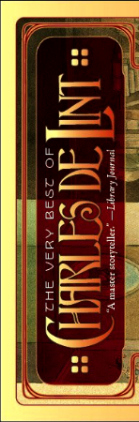
If you will recall, Kailana is answering the questions over on her site, here, and I am answering them after the break. If you would like to track down a copy of The Very Best of Charles de Lint and join us, we would love it. We can put you on the email list for the weekly stories and questions or you can just grab them here or at Kailana’s and answer them in the comments section. The stories for this week’s reading (and next week’s questions) are listed at the end of this post.
The three stories we read this week were:
“The Badger in the Bag”
“And the Rafters were Ringing”
“Merlin Dreams in the Moondream
1. Naming and the power of naming is a really big aspect of “The Badger in the Bag”. Did you ever name an inanimate object, like a musical instrument, bicycle, vehicle?
I certainly have never named something inanimate (other than stuffed animals) with any degree of thought and “rightness” as occurs with the naming of musical instruments in this story. I have called my pickup truck “Red” on occasion, for the obvious reasons and used to have this old, strange looking riding lawnmower that I thought of as the “Millennium Falcon” because every time I looked at it I could hear Luke’s incredulous voice in my head…“What a piece of junk!” I talked about how engaging I find Flavia de Luce’s naming of her bicycle, Gladys, in Alan Bradley’s novels and I mentioned recently that if I actually start riding my bike again this year I will feel a very strong temptation to find out what its name is and will brand it accordingly.
What attracts me to this concept in the story is the same thing that makes Tolkien’s work so thought-provoking, albeit on a larger scale–the importance of names. This is a biblical concept, of course, and I see parallels in Tolkien’s work (particularly The Silmarillion) and the early books of the Bible when it comes to names and their meanings. There is a bit of a difference here in the magical connotations associated with names, and of course the magical things that happen once an instrument is named. Readers know deep down that words are important, and I think we also understand that names are as well. Characters and places we love are partially so because of what they are named, and we just know they couldn’t be called something else. A rose wouldn’t smell as sweet by any other name…not really.
Finally, I enjoyed the way this story gave life to inanimate objects. I’m sure many among us were sure growing up, and perhaps still are, that our stuffed animals and toys had lives of their own when we were fast asleep or were gone for the day. Haven’t we daydreamed about the characters in books the same way? Films like the Toy Story series and Jasper Fforde’s Thursday Next series are built on this shared concept.
2. Like the previous Meran stories in this collection, “And the Rafters were Ringing” is set in a time of belief in spirits, both good and evil, (and mischievous). In many ways we are better off living a less superstitious (for lack of a better word) life. What, if anything, do you feel we have lost as a people in not being as open to “magical” things?
I have been a Christian the majority of my life. I believe in a real God, a real Jesus, a real Holy Spirit. But I also grew up believing in Santa Claus, the Tooth Fairy, the Easter Bunny, and all sorts of other “magical” things, be it Pooh’s adventures or fairies or life on other planets. I guess I have been fortunate in that the revelation of the parental involvement in many of those beings has never affected my belief in God.
My wife did not want to raise our daughter to believe in Santa, the Tooth Fairy or the Easter Bunny, but did want to go ahead and still play pretend with her. Our daughter wasn’t told these characters were real, but we still played (and still do play even though she is 19) the ‘make believe’ game. We both believe in the importance and power of the imagination.
I say all that as preface to my answer, which is that I do feel there is the loss of something when we choose to explain everything away with science or reason, or when we get so hard nosed about something that we refuse to allow ourselves to imagine. I think our kids lose something if we don’t tell them stories about their teddy bears or about fairy godmothers or kind fat men who love to give gifts once a year. I enjoy reading stories steeped in old lore, in the folklore of earlier times, in long held mythology. To whatever degree folks actually believed these things, I think it helped them understand their world but also allowed them to exercise their imaginations. Would I really want there to be mischievous imps who I had to be careful to not annoy or they would make my life miserable? Not at all. But that doesn’t stop part of me from wishing they existed, that they could be a positive part of a life experience, as they are in some of de Lint’s stories. I find that same desire to believe when I read, for example, H.P. Lovecraft. The idea that there are hidden caches of long buried evil books, etc. is thrilling and exciting. Curses, things that go bump in the night. Again, wouldn’t truly want them, but part of me still wishes. Heck, the alternatives (real murderers, rapists, child abductions, genocide, etc.) are so much worse.
Many readers keep this hold on childlike belief in “magic” by getting lost in the pages of books. Not all do, but some. While I wouldn’t want to give up my air conditioning or my Xbox 360, I do envy the days, be they real or fictional, when folks gathered at the local inn for a night of dancing and kept their eyes open for the wee folk.
3. “Merlin Dreams in the Mondream Wood” has a big emphasis on trees. Or one tree in particular. Actually these past 4 stories (with Meran’s life tree) have acknowledged an important bond to trees. In what ways have trees played a significant part in your life, imagination, etc.?
I’m thinking there was another de Lint short story, or a portion of a novel, that dealt with a person and their bond with a tree? Cannot recall which, but I enjoyed that as well as this one. Gaiman had a tree that was instrumental in helping young Tristran Thorn in his adventures in Stardust. One of my favorite YA books, Ida B., featured a young girl who talked to trees. And of course one of the most famous novels with a tree presence was The Lord of the Rings. Be they in fiction or in real life, I do love trees!
And I have always had a love of trees. Some of my favorite childhood memories are of climbing and sitting in trees (something that horrified me as a parent when I thought of my daughter doing the same thing). 🙂 We bought our first home based in large part of the wonderful trees that were in the yard. Trees are so beautiful, whatever the time of year, and to me are one of the most amazing and magical things in existence. I like nothing more than to take walks in the woods, and would never want to live in a city and be devoid of the presence of trees in my daily life. I have several “back road” drives that I can take to work, all chosen because of their wooded landscape. In fact, it pains me because some of these roads are undergoing “development”, wherein the trees are all removed so that cookie cutter houses can be built. It is sad to see such beautiful trees, that could be incorporated into the design, bulldozed over without a thought. Trees are, and will continue to be, very important in both my fiction and in my life.
Speaking of naming, I’m thinking of naming the newly planted trees outside of my office window. Hmmm…
What about you? I would love to hear your answers to these questions, many of which you can answer without having read these stories at all.
And, if you want to join us, next week’s stories are:
“The Stone Drum”
“Timeskip”
“Freewheeling”
Interesting Q & A, I was struck by the things you chose to ask about, and the phrasing of the questions to focus on Kailana as much as the stories, perhaps more, while I thought her questions focused on the stories and your reactions to them.
As for trees, I’m having one removed tomorrow, a medium to large Birch. It’s intruding on the space it’s in and he roots are causing problems. I hate taking out trees, and here in Oregon there is a one-for-one law, remove a tree, plant a tree (off their list). I’m planting a Canadian White Hemlock (not in the same location) which is a much better choice. I’m also having a dead pine removed (which does not require the 1-for-1, though I have also planted a maple) as over-pruning by the previous person killed it. The pride of the property is the stand of 300 ft. + Douglas Fir trees. They are magnificent.
RkR: I know we both, Kailana and I, want to try to stay away from this being a weekly: did you like this story or didn’t you? questions, especially since we will probably do some kind of more story-related review at the end of the book. It so happened that all three of these stories had some very obvious (to me) universal questions that could be asked which would allow our readers to enter into the conversation without having to have read the stories. And I hope it will still encourage others to read the stories if these topics are of interest.
I mentioned on my comments on Kailana’s site that we had to have our favorite tree removed last year. Could no longer live with the fear of it falling and killing the little older lady who lives in the house it was precariously leaning towards. I miss it a lot. It was a good 75, 80 feet tall, a tulip tree, and it was enormous and beautiful.
That 1:1 rules sounds interesting. I’m sure it is a good or bad thing depending on the circumstances, but as on overall plan I think it sounds good. Your trees sound wonderful, and what I remember of your pictures of your view, I have no doubt they are.
This is a lot of fun so far. 🙂
We are in a discussion of sorts about one of our trees. It’s a weeping willow and their roots get into everything. I want to keep it, but the guy is more practical and wants to cut it down. I imagine we will… discuss… for a couple years before either really wins. 🙂
I am looking forward to our questions next week. My bought copy of this book arrived today, so I am happy I didn’t buy it and it arrive after I had finished the book. I just wasn’t sure how long I could keep it from the library and I would want to own it anyway. 🙂
Kailana: Yes, I’m enjoying it as well.
I understand your not wanting to cut the tree down. I’ve been thinking about root issues myself as I make some plans about possibly planting a few more trees in my yard. Don’t want to plant something only to have roots break through my water pipes or basement walls sometime in the far future.
i am enjoying listening in on the q&a. I am becoming more and more intrigued by the stories.
i wonder if magical thinking can every truly diminish into nothingness for a person. i’m sure its forms vary, but the impulse seems inevitable, e.g. in the naming and attachment to inanimate forms; though trees are animate, something steady and soulful, more accessible than a mountain and yet a greatness in nature (and potentially long-lasting). rambling…but comforted by the fact that whimsy is ever available us
~L
L: Thanks, and ramble away, that is what we love to see. I too am comforted that whimsy still exists if we want it. And I, for one, do. I don’t imagine I’ll ever let go of magical and magical thinking. I get too much pleasure from it, and it just seems to be a natural part of my life.