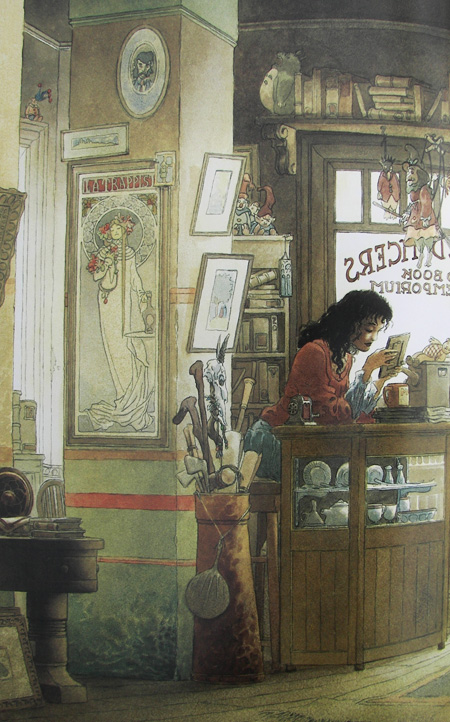
I dropped the ball over the last couple of weeks, missing my post last week and am now two days late for this week’s. But now I’m back on track, having secured Kailana’s forgiveness for dropping the ball, and am more than ready to discuss some more of the offerings of the talented Charles de Lint.
After the jump I’ll tackle this week’s questions (which it was my turn to come up with) and will follow that with my answers to Kailana’s questions from the week before.
Kailana’s answers to this week’s questions can be found here.
1. Did you see the end coming in “A Wish Named Arnold”, and, perhaps more importantly, if you saw it did it in any way effect your interaction with the story?
I loved the opening line of this story:
“Marguerite kept a wish in a brass egg and its name was Arnold”
There is something so fun about that one line. It sparked an air of expectation and I wasn’t disappointed. Marguerite’s story is the age old one of wishes granted, only in this case instead of three wishes she only had one. As wishing stories go the choice that Marguerite made wasn’t necessarily unexpected, but despite seeing the end coming I really and truly found this to be a special story. De Lint drops in a reference to wish granting fishes in this one and oddly enough I had recently heard a similar version of this story on This American Life a few weeks back.
It is often the case with fairy tales that we’ve heard them, or versions of them, before and given that I think it takes a really special talent to breath life into them. De Lint does this well more often than not and had I been a voter this is one story I would have picked for this collection.
2. One of the ideas explored in “Into the Green” is the idea of stepping over into another world. Although this wasn’t necessarily an option presented to the protagonist, if the door opened, would you step into the green?
It is funny, because even thought this is a question I came up with I find myself wanting to waffle on the answer. The protagonist in our story is a musician, a loner, and a witch. I love music but cannot play anything, enjoy my alone time but am definitely a social animal, and I prefer to keep mum here about my magical powers! That being said, if I can step inside the world of make believe to imagine that I was on my own, I think the temptation to step across the veil would be nearly overwhelming. If I could step through the looking glass, dig deep into the wardrobe, or head off into London Below I think the adventurous part of me would be very, very tempted to go for it. In some of these stories you get the best of both worlds in that you can go have your adventure and then return to the exact moment you left (Chronicles of Narnia). In others (Neverwhere), once you go in you can come out, but you and your world will never be the same. Regardless of the risk, I would imagine there are times in all of our lives that we would be willing to step into the green.
3. I felt myself surrounded by a lot of different images from other stories, films, etc. when reading “The Graceless Child”. How about you, did you see other influences there, and if so, what?
It was funny but I could not get Shrek out of my head as I read this story about a young girl who was a mix of human and troll blood. I didn’t entirely effect my enjoyment of the story, but I doubt that I saw this in the light in which Charles de Lint meant this rather serious story to be taken. At any moment I wondered if a talking donkey would arrive! I also saw some reflections of Neil Gaiman’s Sandman series in the references to the dream world and the ruler of that world, which was fun. I wasn’t entirely sure how I felt about the end and the choice the main character made. Faced with a life of persecution I’m not sure I wouldn’t have made a similar choice (have I whet your appetite?), but still I have some mixed feelings about it.
__________________________________
Now, travel back in time with me if you will and pretend that I actually answered these questions last week! 🙂 Kailana’s responses to these questions can be found here.
1. What did you think of the mythical creatures included in ‘The Stone Drum’?
I have read all three of today’s stories before, but this was one that I had forgotten much about, at least the second part of the story. First off, almost any story with Jilly Coppercorn in it is a winner for me. I just love that girl. The qualifying “almost” will make more sense when you read my answer to question #3. Like the snippet of a story that started this collection, “The Stone Drum” is de Lint masterfully revealing to the reader just how his world works through a very sweet character who is learning to open herself up to the enchanted realm that intermingles with our own. There are some darker, more potentially sinister characters revealed in this story and I actually like them and the ‘city under the city’ elements of this story. I often find myself comparing what I like about de Lint with what I like about Neil Gaiman and this is yet another story where I feel they do similar things, but de Lint of course has his own unique and lively voice. This may just be the story I would point Newford newbies to in order to introduce them to this universe de Lint has created.
2. ‘Timeskip’ was about time travel. Did you find the story believable?
This is an unconventional time travel story and I did find it very plausible, for a story with a science fictional concept, of course. This is a rainy day story, literally, and de Lint infuses it with just a bit of that melancholy that a rainy day can bring and that added an element of emotion to the story that I found really special. As Kailana mentions on her site, saying much about this story at all will ruin it, so I’ll stop here. I would recommend you tracking this one down (it is in the Dreams Underfoot collection as well as this one) as it is well worth a read.
3. Could you picture the images mentioned in the story ‘Freewheeling’?
“Freewheeling”, a story about magical bicycles, is one I had read before and I was unsure about it then and still am. This story features my favorite de Lint character, Jilly Coppercorn, and because of that I think I judge the story much more harshly than I would have had it been a story that was set outside of de Lint’s Newford universe. I don’t have problems anthropomorphizing objects at all, and as silly as it sounds to describe a story about bicycles being set free to roam, there is something very charming about it and yes, I can actually picture the images of it.
For anyone who grew up and saw ET in the theater, I think the image of the kids flying on their bikes would come to mind while reading this even though the imagery is very different. I know I thought of that.
Bicycles have featured pretty prominently in my reading lately, be it in stories like this one and Alan Bradley’s Flavia de Luce stories or be it on blogs, where spring is sparking conversations about bikes and riding. It is safe to say that it has been a couple of years since I’ve been on a bike, but my desire to start riding again is growing stronger by the minute.
Again, I think I would have really enjoyed this story so much more if it wasn’t fitted into the Newford collection and was instead a stand alone story. Having it mixed in with magical stories that are treated more as serious stories made this one feel extra silly to me, I’m sorry to say.
____________________
Well, thanks for joining us in this week’s short story reviews. I hope you’ll join us next week, where I attempt to actually post a Monday review on Monday!!!
well, even though I am not a short story fan the book is still worth the cover lol..sheesh..
hey i totally liked Name of the Wind and am reading Wise Mans Fear now (which will take me most of the month to read!) he’s a fantastic writer!
It is one of my favorite Charles Vess images. I’m so used to seeing John Jude Palencar covers on de Lint books (which are generally great) and it was a nice surprise to see Vess chosen by this publishing company for this collection.
I’m so glad you are enjoying Rothfus’ books. It doesn’t surprise me at all, given your love of fantasy, and your willingness to tackle the chunksters. You are much more courageous in that respect than I am.