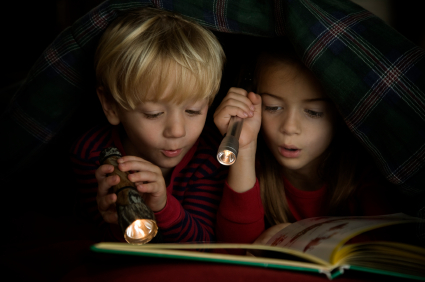
Critics who treat adult as a term of approval, instead of as a merely descriptive term, cannot be adult themselves. To be concerned about being grown up, to admire the grown up because it is grown up, to blush at the suspicion of being childish; these things are the marks of childhood and adolescence. And in childhood and adolescence they are, in moderation, healthy symptoms. Young things ought to want to grow. But to carry on into middle life or even into early manhood this concern about being adult is a mark of really arrested development. When I was ten, I read fairy tales in secret and would have been ashamed if I had been found doing so. Now that I am fifty I read them openly. When I became a man I put away childish things, including the fear of childishness and the desire to be very grown up.
– C.S. Lewis, “On Three Ways of Writing for Children” (1952)
Welcome to the second of two participation topics loosely linked to our group read of Neil Gaiman’s, The Graveyard Book. The first had a graveyard theme in keeping with the location of young Nobody Owens’ adventures and this second revolves around the idea of growing up, or coming of age, as that thread is woven throughout Gaiman’s young adult novel. In my particular instance I am coming at this topic as it relates to story, in film and in print form.
As a lifelong voracious reader and movie watcher it probably goes without saying that I devoured story in my childhood and young adulthood that covered a wide area of topics, the idea of the transition of growing up being one of those topics. But as I’ve made that transition from childhood to adulthood (some would argue “exactly when did you make that transition, hmmm???) I have found that my attachment to coming of age stories, as defined by me to mean stories that have something to do with the bittersweet agony of leaving things behind, have not ceased to attract my interest. If anything that interest has become more acute.
The reason for this isn’t as simple as a longing to return to childhood. If anything is true the complete opposite is true. I love where I am at in my life. At nearly age 44 I have 23 years of marriage to a wonderful companion and friend in my past. I have an adult daughter who is a source of pride and joy. I feel secure in the choices I’ve made in my career and every day I’m finding more and more pleasure in the simple joys of life. No, I don’t want to go back.
I also don’t have Peter Pan syndrome, even if my predilection for video gaming belies that fact. I have grown up. And I want to grow up. I still have many areas in my life where I long for even greater maturity and wisdom. I don’t want to be a kid again. But the flip side of that coin is that I am also the kind of person who never entirely left that part of me behind. The whole “inner child” phenomenon was interesting to me because until then I always assumed that everyone still embraced the magic of an active imagination. I assumed everyone at least tried to keep a childlike enthusiasm for things that either a) they cared about in childhood or b) made them feel like a kid again. I guess not everyone does that.
I think that is why I feel a kinship with these stories still. I am very much a ‘kid at heart’ and I also have a very strong attachment to nostalgia, be it the nostalgia generated from things written or filmed long before my presence was thrust upon the world or things from my very own past. I use the terms “melancholy” and “bittersweet” on a regular basis and often pair them with words like “beautiful” and “delicious”. When I say something gives me a sense of “delicious melancholy”, I mean it. Growing up in Nebraska the most melancholy time of year was the fall and winter, but so many of my favorite activities happened in fall and winter: Halloween, my birthday, Christmas and New Years, and of course all those activities associated with school: plays, hanging out with friends, dances, etc. Fun has always been paired with those melancholy times and I have also always had an acute awareness of that sad bit that comes from endings. And all things end.
When it comes to “growing up” or “coming of age” stories, I think the film Labyrinth is probably the most perfect personal example of what that means to me. It matters not that the protagonist in the film is a female. It never did. From the moment I first saw the film up through every subsequent viewing I have felt a kinship with the story Jim Henson set out to tell, a story that is in large part about the inevitable journey to adulthood and the sad reality that, as in any journey, some things are left behind. They are gone, if not forgotten. Where Labyrinth becomes something of a personal statement for me is the way in which it ends, when a liberated Sarah comes to the realization that although she may be shifting her focus away from herself and her own youthful fantasies towards a wider world, that she still needs to embrace those things that made her what she is.
“I don’t know why, but every now and again in my life – for no reason at all – I need you. All of you.”
It is such a wonderful moment in the film, a “deliciously melancholy” moment, if I may once again overuse one of my favorite phrases.
So when I watch and re-watch films like Labyrinth or Mirrormask or read stories like the Anne of Green Gables books or Ray Bradbury’s Dandelion Wine or Neil Gaiman’s The Graveyard Book one of the reasons I return to them again and again is the poignancy for me personally of that sad, sweet idea of saying goodbye, of growing up. I find that same hard-to-explain delight in newer works I’ve read like the semi-autobiographical work Dead End in Norvelt or Bill Bryson’s The Life and Time of the Thunderbolt Kid. To a somewhat lesser extent I get a nostalgic vibe from all those angst-laden but fun John Hughes films that were popular when I was a teenager. I wouldn’t want to relive the time in reality, but boy is it fun to visit on a trip down memory lane.
So that is a somewhat rambling and possibly quite incoherent start to a conversation about why you will find me, year after year, raving about some film or some young adult novel here on Stainless Steel Droppings that may seem outside the norm of what I usually like or perhaps may be something that did not touch you in nearly the same way. A good “coming of age” thread in a story can cover a multitude of other flaws for me when it comes to a book or film. I thank you for allowing me to babble. C.S. Lewis really said it all, and said it best, but it felt good to do a brief examination of this myself. At some point I would like to do something much deeper and more studied, but that is certainly not in the cards for today.
If you participated, or would like to participate, in this exercise, please leave a link to your post below. I’ll be doing a prize drawing over the weekend randomly from this list. Look forward to your thoughts here and on your posts.
There may be something in the universal consciousness theory… 🙂 I love that we both ended up at C. S. Lewis for this topic! Thanks for your great reflections on so many sides of the question. I hadn’t thought so much about the matter of leaving things behind; also very interesting. I love the way these group-examinations of a topic (or a book) spark off new thoughts!
Yes, and all three of us so far, including L, have mentioned Peter Pan. Which may not be that big of a leap, but still I find it interesting.
Leaving things behind is a big deal for me and always has been. You would think I had somehow been abandoned as a child, lol! I’ve always been very attached, be it to people or things. My mom likes to bring up how all through childhood I would always go to sleep with whatever gifts I was given for any reason, be they clothes or toys or what have you. I had to sleep with them. I had to have them close. I am no different now. If I buy new things or get gifts I always leave them out somewhere where I can see them, for a time I keep them close. I feel that way about friendships too and that push-pull relationship between holding on to things and being willing to let them go is something that attracts me because I get a deeply personal meaning out of it.
For me, I guess the draw is that knife-edge we walk on our journey from child to adult. I think of Bod when he ventures out to do a kindness for the witch. He’s right, of course, but that doesn’t lessen our terror for him. I think of Scout, still the child, whose innocence faces down a mob and then later, after she matures, how she can out-Atticus Atticus with moral logic.
Great examples Deb. And it is a knife-edge journey and one that studies are showing goes on longer than was traditionally thought. Our brains continue to grow and mature much later into life, well past adolescence, and some of the ‘coming of age’ continues to happen into and through the 20’s.
this was a great post!
“I always assumed that everyone still embraced the magic of an active imagination.” me, too. I was shocked to find out that this was not so.
I wonder if we mislabel things as childish when it is actually a part of being a human, a part of who we are throughout the span of our lives.
I like “delicious melancholy.”
I so agree with you about not wanting to go back, enjoying the people and things that come with growing-up, but the ability for us to remember and find venues that suit our taste for the bittersweet…I am grateful for those things as well. I feel all the fuller for it.
Thanks. It is shocking to find out that some people lose that connection to the magic of childhood, to the sense of wonder. I never want to lose that.
And I think you are right, I think there is a lot of mislabeling, a lot of mistaking things that are child-like (not a derision) with child-ish (definitely derisive).
Hi Carl
What a great piece. I’m glad I’ve not grown up so much that I no longer want to read fantasy and make believe. I love it – and what a great film choice with The Labyrinth. I adore that film and have watched it many times. How could you possibly want to deny yourself enjoyment such as can be had by watching or reading this type of film/book. I do recall reading a written piece by somebody (and I’m sorry but I can’t remember who but think it was a journalist) who was basically saying in so many words that all the adults ‘out there’ reading Harry Potter should be ashamed of themselves and grow up! How about no to that. It’s strange how some people equate growing up with the stifling of imagination.
On a separate note, and although I wouldn’t want to roll back the years and become a teenager again, I sometimes can’t help thinking it would be fun to go back and spend a day then knowing what you know now!
Thanks
Lynn 😀
Thanks Lynn, I feel the same way. I’ve read similar articles and posts about different books that are perceived as only worth reading if you are a child and I just shake my head because those folks just don’t get it, and I feel sad for them.
I wouldn’t mind going back at all if I could take all this knowledge with me. 🙂
Carl,
Your description of Labyrinth sounds like something I would enjoy watching with my daughter when she comes over this weekend. I’d never heard of it before.
It’s funny, when I first read your post, I was thinking Pan’s Labyrinth, which also has some coming of age elements although more in the line of you don’t give up all childish things in order to mature. Though the protagonist of Pan’s Labyrinth is young, she comes to an adult understanding. Have you seen Pan’s Labyrinth? For me, it was one of those movies where I just sat in the theater after the closing credits until the lights came down and the security detail started sweeping up.
You should give it a try, it is a sweet movie, one of Jim Henson’s best. If you have any fondness for the Muppets it is fun from a nostalgic point of view. And I love David Bowie’s music in the film. It has its painfully goofy moments, but I’ve always been really fond of the story.
Pan’s Labyrinth is a great film and does touch on some of the same themes in a much more serious manner. I saw it twice in the theater and bought it the moment it came out on DVD. If you were that in to the film it is worth watching all the extras on the special edition DVD or on the blu ray. Del Toro shares some fascinating things about story and symbolism in the film. There is also an excellent show with three film makers, including del Toro, being interviewed by Charlie Rose that is on the extras. Wow, is it good!
That special edition DVD sounds fantastic! I am fascinated by symbolism.
It’s not often I have that speechless, deer-in-the-headlights moment in a theater, but I sure had one that day.
Today could be a good day for the other Labyrinth, too.
It is a worthwhile buy, for sure.
Funny that you mention today being a good day for Labyrinth. My daughter and her fiance are in the living room watching it right now. It is the random movie they decided to pick out to watch. I’m in here watching the ball game and heard just a few notes of music and knew right away what they were watching. Yes, I’ve seen it a few times, lol!