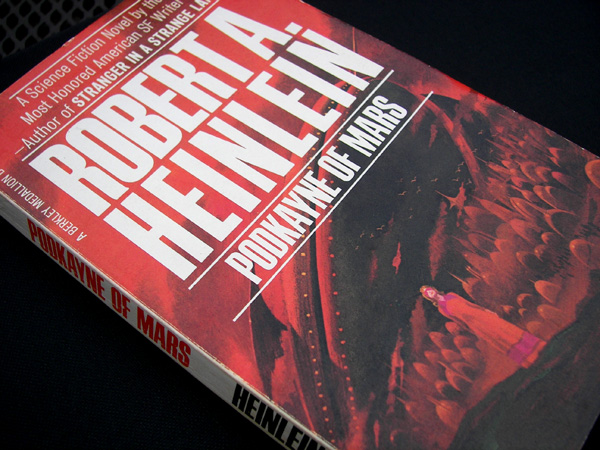
Podkayne of Mars ~Robert A. Heinlein
–originally published in novel form in 1963, my version 1970
–176 pages, Berkley Books
–3.75/5 stars
Robert Heinlein was and remains one of America’s most celebrated science fiction authors. Although Heinlein wrote a number of short stories for various magazines on any variety of themes, his first published work in novel form, and several of his novels thereafter, were classified as “juveniles”, what would be defined as YA (Young Adult) today. His later works took on more decidedly adult themes and were definitely not for a younger audience. The two books that seem to fit in between these two styles were Starship Troopers and Podkayne of Mars. According to Wiki, “both books were written for a publisher expecting to market a juvenile science fiction novel, and both raised serious objections from the publisher.” More on that later.
I picked up a used copy, pictured above, on a birthday celebration/Christmas gift visit to Half Price Books last week for a whopping two dollars. Something about the cover and the size of the book and my previous positive experiences with Heinlein, and an ever-growing urge to immerse myself in science fiction, made me want to get right to this novel. And that is just what I did, reading it over the course of a day or two this holiday weekend. I’m glad I did. While not my favorite Heinlein story to date, it was a very engaging tale with an interesting history to it.
I will be foregoing my standard “tell nothing” review policy to talk a little more about the story itself and thus there may be some spoilers. I will also be discussing the ending of the book but will make sure there is a big SPOILER ALERT warning posted before that occurs.
Podkayne of Mars is the story of a teenage girl, Podkayne Fries, “Poddy” for short, and her slightly younger brother Clark. The story is told in journal entries by Poddy, with occasional interludes where Clark puts his two cents in. The story opens with Poddy excited about a much-anticipated trip to Earth, the place rumored to be the birthplace of human kind, though Poddy has her doubts. When a mistake that results in the thawing out of her three ‘waiting to be born’ siblings cancels the trip (a truly interesting take on reproduction in the future), a distraught Poddy is rescued from her growing disappointment by her Uncle Tom, a Senator, who volunteers to take her and her brother on the journey.
The story unfolds with a slightly pretentious but extremely likable Poddy sharing her most confidential thoughts in her diary about the trip preparation, her dreams to become a starship pilot, and her concerns about her antisocial brother and her thoughts on the people she meets onboard the ship. The majority of this very short novel is spent experiencing what Poddy experiences, which is little more than her first space flight. Not to say that this is in any way boring, Poddy is a very entertaining narrator and her view on things certainly moves the story along. She is a charming narrator with an engaging sense of humor. Other than a couple of info dumps, which are themselves interesting largely because we can now look back and examine Heinlein’s predictions of the time, there is nothing particularly science-heavy in the book. Intermingled with Poddy’s “adventures” is a growing suspicion that her brother is up to no good, a suspicion that grows even more strongly in the reader when Clark hides entries in her journal giving the reader some insight into his character.
Two thirds of the way into the story the ship arrives at its first destination, Venus, a planet where the strict social morays of Mars are not in evidence. A place where reportedly ‘anything goes’. It is here that Clark, and one of Poddy’s older ship friends, Girdie, appear to get themselves into trouble. Trouble that causes the disappearance of Clark, her uncle Tom and eventually Poddy.
SPOILER ALERT!!!
As mentioned in the Wiki quote, the publishers had some problems with this book, most notably the ending. Clark and Poddy and Tom are kidnapped for political reasons, to pressure Tom into choosing a certain side at a conference he will be attending in his role as a Senator when he arrives on Earth. This a particularly page-turning section of the book as the kidnapper is quite sinister in her treatment of her prisoners. Poddy is locked in a room guarded by what are locally known as “fairies”, a winged humanoid creature that bites and will hurt anyone trying to leave the room. This particular fairy is nursing her newborn and Poddy befriends the “baby” during her captivity. As zero hour approaches and Uncle Tom is about to be sent on the ship leaving for Earth, Clark devises a plan of escape which involves he and Poddy splitting up so that at least one of them will be able to get help. Clark sets a bomb that he had smuggled onto the ship (part of his early storyline that gives some insight into the type of character he is) to go off at a certain point after they leave. This is where the publisher’s interference came to bear.
This after part of the story is told in “postlude” by Clark. Heinlein’s intention was to kill Podkayne. In the story Clark kills the mother fairy but leaves the baby alive. They both leave. Later, after he is found, Poddy’s dead body is found near the blast site. She went back for the baby and forgot about the bomb being set to detonate. The publishers put a halt to that and Heinlein begrudgingly wrote an ending wherein Poddy is just injured. In Heinlein’s original ending, this was a turning point for Clark as he realizes that his actions caused his sister’s death. He is seen at the end choosing to raise the baby fairy because that is what his sister would have done. The changed ending leaves Podkayne severly injured with the idea that she will recover in time. Clark’s character still admits to some fault but the ending is certainly less powerful than it could have been.
Now I’m all for happy endings. Generally I prefer them. And I’m not sure that I don’t prefer that Poddy lived. But it isn’t until the very last page that you realize she hasn’t died. The ending is written up to that point as if she had and it turned what was an interesting and fun but not necessarily “powerful” story into one that was very powerful. I felt a real sock in the gut thinking that she had died and it makes Clark’s indication of being changed something much more real. The publishers changed ending isn’t horrible, the story is still very entertaining to read, but it does lack the weight that Heinlein’s original ending had. Evidently there is a 1995 version published by Baen books that includes both endings and some people’s comments on both endings. I’m going to have to try to track down a copy of that book.
SPOILERS ENDED!!!
Even though this may not technically be one of Heinlein’s ‘juveniles’, it is a relatively tame story by today’s standards, especially compared with the more provocative works he published in later years. I wouldn’t recommend it for younger children as there are some “teenage” themes in the book. I also don’t believe it has the same rollicking adventure of the Heinlein juveniles that continues to make them popular reading today. It is not often in this ‘classic’ science fiction that you find a teenage female protagonist written by a male. My first experience with Heinlein doing this was in the very excellent short story, The Menace from Earth (you can read it here). Never having been a teenage girl myself, I cannot with 100% authority proclaim that he does a good job in representing the teenage female. I can say that, as a reader, it is very convincing to me. With Podkayne, as with Menace, the voice feels right and does not feel forced. Podkayne was a very real character to me. I consider this one of Robert A. Heinlein’s many gifts.
The Menace from Earth is a must-read in my opinion. It is a very entertaining short story that actually does have a distinct arc to it. It is a very satisfying read. Podkayne of Mars is also very entertaining and is worth reading, but I wouldn’t consider it a must-read. If, like me, you would eventually like to read all of Heinlein’s work, this is one book that will be a pleasurable read. If you are looking for a different kind of science fiction story featuring a female protagonist, this also is a book that is worth picking up. I enjoyed it, I really did. Had it had Heinlein’s original ending I would no doubt have rated it a 4 to 4.25 out of 5 stars. As it is the 3.75 is indicative of this being a really solid read. I’m happy to have found the copy and am glad I decided to dive right in. Heinlein is a particularly fascinating author to me and this book just adds to his estimation in my eyes.
To close, I am often fascinated by the “time” factor of stories. This story was written and published 5-6 years before I was born. And the copy of the novel that I now own was published in January of 1970, 14 months after I was born. I couldn’t help but wonder about the history of the story itself and about the journey that my book has been on over the past 39+ years. How many people owned it? Who read it? What did they think? Ah, if only these books could talk and tell their specific story, not just the story imprinted between their covers. As I held this book in my hands I was again reminded why the ebook is not for me. Until the day I am forced to read novels electronically I will continue to opt for this experience. It gives life to these tales that would come through in no other way. I know I am just a sentimental (growing older) fool, but I like my old paperback copy of Podkayne Fries’ adventure. I wouldn’t have wanted her to tell her story to me in any other way.
Sorry to read that the tale was just good but not great although even just good Heinlein is far better than most writers. 🙂
You implied you would have given it a higher rating if it had the original ending. Did you then find it and read it online or something? If not I have a copy of the original ending I could lend you in my copy of Grumbles from the Grave. Just let me know if you would like to borrow it. It’s only about 4 or 5 pages long.
Hopefully I will get to this book during the Scifi experience coming up soon as I have it on my TBR pile. I skipped over all your spoilers above for now. Additionally I love the huge space ship on the cover above.
As for ” The Menace from Earth ” I will second it as a must read Heinlein short story. You can find it in a recent Baen Books short story collection entitled ” The World Turned Upside Down “. I’ve only read a few stories out the book so far but they have all been very good. Overall, I have seen very favorable reviews for the book. I’m almost certain I saw it reviewed on the SF Signal website during the past 12 months.
Jeff: I think you may be right about SF Signal reviewing that collection. We both need to read more of it during the Sci Fi Experience.
I read about the original ending online, but not the actual ending itself. The changed ending could have been a very good one, but I think Heinlein would have needed to alter it even more than he did to make it feel satisfying as a new ending. It wasn’t bad, and had I not known about the controversy I probably would’ve liked the ending just fine. Knowing it was not what Heinlein wanted sort of colored my view of it once I got to that part.
Still, this is one I think you should read sometime. For now though I know you have a whole pile of Heinlein yet to get to. 🙂
COMMENT CONTAINS ENDING SPOILERS!!!
I’ve always felt that Heinlein was well reigned in by his editors at Charles Scribners, but I prefer the ending with Poddy dying. The double ending reminds me of the double ending of Great Expectatins by Charles Dickens. Sometimes the happy ending isn’t the right ending. Another Heinlein juvenile that was altered and recent editions have the cut parts returned is Red Planet. Heinlein wanted to emphasize how skimpy the colonists dressed and that was cut out in the original, and a lot of boring political arguments were cut out to by the editors. The idea that colonists wore skimpy shorts inside but had to have thermal suits outside didn’t make sense, and the political stuff slowed the story, so I preferred the editors cut version. I think Heinlein must have been a nudist because he loved having characters run around in the buff, and that was a little weird for his juveniles.
I like Heinlein’s Podkayne of Mars ending though. Carl, you should listen to the audio edition of the story, Poddy really comes off well as a teenage girl because having a girl reader narrate it gives it a ring of truth to the written narrative. The lines sound right coming from a girls voice.
But I can also understand the editors not wanting Poddy to die. First person narrators never die unless there’s a trick, and having the brother write in the diary is a trick.
There’s a great book about Heinlein’s juveniles called Heinlein’s Children: The Juveniles by Joseph T. Major. He considers Starship Troopers and Podkayne of Mars to be the 13th and 14th books of the series.
COMMENT CONTAINS ENDING SPOILERS!!!
Jim: I thought I read somewhere that Heinlein was actually a nudist. He certainly had a utopian ideal of the future being filled with people with very open ideas about sex and very strong appetites for it, at least as is evidenced by the non-juvenile books of his that I’ve read.
I believe that most if not all authors benefit from editing. A good editor can point out and help trim the fat, leaving a lean and well cut story. Situations like this one, where it is a minor and at the same time major change give me pause, however. I guess it all depends again on how you want the story to end. I thought Heinlein set up Clark’s telling of the end well by having him sneakily reading Poddy’s journals. It may not have been the best sleight of hand, but it works out alright. It would have worked much better had Clark done so more often, giving the reader a bit more insight into his character as well. The book would have been more well rounded in that respect.
I do really like it though, and like I said in reality I prefer having Poddy live because I liked the character so much. I just think it taints the power of the story, especially when you realize that it wasn’t what Heinlein intended. It reminds me of Tom Godwin’s short story, Cold Equations. It wouldn’t be nearly as memorable and powerful if Godwin had found some way to save the girl.
I’d actually really enjoy listening to this one on audio. I’ll have to keep an eye out for it and check my local library.
Thanks for coming over and sharing your thoughts. You are one of the few people I knew who I figured had read this story and I appreciate your insight.
You know, I’ve yet to read any Heinlein. Good thing another Sci-Fi Experience is right around the corner 😉 What would you recommend I start with?
The only work of Heinlein’s that I’ve read is The Moon Is a Harsh Mistress. Remember a thousand years ago when I first started blogging? It was a great read, and it showed me where my father got the saying, “There’s no such thing as a free lunch.” Which he said all my life, even though I doubt very much he’s ever read any science fiction. It just goes to show what a powerful writer Heinlein must be.
You open my eyes to this genre, Carl, which I must admit is no easy task.
Bellezza: Thanks, I’m glad to be an eye opener! 🙂 I started, but haven’t finished, The Moon is a Harsh Mistress. I suspect that although some similarities in style exist, that Podkayne is probably quite different being that it features children, teenagers in this instance, and is probably closer to his juveniles than his adult work. Heinlein definitely was fond of sayings. In Time Enough for Love, one of the main characters has all kinds of rules and sayings that he is fond of. I believe he uses the free lunch one there as well.
Nymeth: Jeff, what do you think. You’ve read more of the juveniles than I have. Where should she start?
Carl: I will try my best. Jim Harris,if you’re out there I would love to hear what you would advise as well.
Nymeth: As for the juvenile novels. I think I’ve only read 5 and half of them so far( The Rolling Stones, Farmer in the Sky, Red Planet, Starship Troopers, Have Space Suit, Will Travel and I’m half way through Space Cadet ) of I believe 12 or 14 of them ( depending on how you classify the book Carl reviewed above and Starship Troopers ).
Of those that I have read listed above I would rank Starship Troopers as my favorite. If you’ve never seen the 1997 movie adaptation of it then count yourself lucky. If you have seen it then remove it completely from your mind and enjoy this Hugo award winning classic all on its own merits. Now it’s more on the serious side. A close second to it I would have to rank is Have Space Suit, Will Travel. Some of the dialogue is quite dated in this one but the sense of wonder and adventure is not. Lastly, if you’re a fan of audiobooks then I would recommend The Rolling Stones. It was my first Heinlein juvenile so it shares a special place in my heart. Also, I didn’t read it but only listened to the audio and it was done with a full cast. It’s by no means a great story but it’s a wonderful funny family story and the actors they got to do the voices are great especially the grandmother. It still brings a smile to my face thinking about it. I even was able to find a cheap copy and bought it this year so I can share it with my family in the future. I’m just waiting for the right long out of time drive because I think it’s about 8 hours long on audio.
I hope that helps Nymeth. What do you think Jim?
Well my absolute favorites are:
Have Space Suit-Will Travel
Tunnel in the Sky
The Rolling Stones
Time for the Stars
Starman Jones
The Door into Summer
Starship Troopers
The Moon is a Harsh Mistress
and many short stories in
The Menace from Earth
Assignment in Eternity
The Unpleasant Profession of Jonathan Hoag
I love many more, but these I think are my very favorites.
Jim
Jeff and Jim: Thanks for your ideas. It looks like I’m going to need to move Starship Troopers onto my list (the encouragement to forget about the movie while watching it is probably good advice for me personally).
Jim, are those the order that you would recommend them in, read Have Space Suit first?
Yes, they are pretty much in order by my favorites. You know, I thought you had started Have Space Suit-Will Travel a long time ago. Starship Troopers is very patriotic, and exciting, but if you pay attention it’s pretty much one guy just telling his story, like Podkayne. Listening to it is like hearing a one man show on stage. There’s great audio editions of many of those novels, especially for Have Space Suit-Will Travel and The Rolling Stones. Of course they are geared for kids and might sound cheesy to an adult, but I found them charming.
Nymeth, I’d be interested in reading about your reactions. I love Heinlein because I grew up with him and discovered his stories back in the 1960s. But I don’t know if they are as wonderful to read today for new readers.
Thank you so much for the recommendations, Jeff and Jim! Heinlein is an author I’ve been meaning to try for a long while, but a lot of sci-fi classics intimidate me slightly for some reason – which is completely silly, I know. It’s great to have a concrete idea of where to begin. And no, fortunately I haven’t watched the movie adaptation of Starship Troopers 😛
Nymeth: Glad to help. I’m curious to hear what you think when you’ve had a chance to read one of his books.
Jim: I will have to say they are to read today. I had never read any Heinlein up until 5 years ago when I turned 35. Since then I have read about 10 of his books and/or short stories both adult and juvenile tales and enjoyed them each thoroughly. While some of the dialogue and gender roles are outdated for today I would say for the most part the stories and ideas are timeless and just as fun for me to read today. I have also been sharing the juvenile stories with my two kids over the last two years. We’ve read four stories now together and they love them. My daughter was 11 when we started reading them and my son was 8. I read them aloud to them before bed once or twice a week so it takes us a while before finishing them but the kids really do love them. We read Red Planet, Have Space Suit – Will Travel, The Menace from Earth, Farmer in the Sky and now we are in the middle of Space Cadet. I have already picked up others to read as well. Plus I have The Rolling Stones and The Star Beast full cast audio book recordings for us to listen to in the future together as a family.
I just love talking Heinlein. Thanks again for doing this review Carl!
I’m enjoying the conversation as well.
Jim, I did start reading Have Space Suit last year during the tail end of the Sci Fi Experience and although I was seeing the appeal of it, the story wasn’t clicking for me at the moment. After reading the Cordwainer Smith, Asimov, and Niven stuff that I read I was too much in that frame of mind and the more young adult nature of Have Space Suit (which I normally really enjoy) wasn’t what I was in the mood to read. After reading Podkayne, though, I am definitely in the mood for more of his juvenile fiction and I do plan on getting back to that. I knew it was one of your most favorite if not the favorite Heinlein and I’d love to talk to you more about it after I’ve read it. I’m sure Jeff would get in on that conversation as well since he and his children really enjoyed it.
Nymeth: Don’t feel bad about the intimidation. I didn’t read Asimov, Heinlein, or Niven’s more well known work until the last few years because I was intimidated by the idea that these bigger named people would be writing stuff that I just didn’t understand. The truth is that it is not that way at all. There is an accessibility to their better known work and, as Jeff said, a timeless quality to the story, even when the trappings of the story seem a bit dated compared to what things are like now.
I plan on reading Menace from Earth aloud to the family during this year’s Sci Fi Experience and will be reading some more Heinlein as well. At least that is the plan.
I always tell people that Heinlein imprinted on me like ducklings with their mother. Reading most of Heinlein within a two year period from age 13-15 was very intense. My parents were alcoholics and I chose Heinlein as a father figure, and science fiction was my escape. I also read lots of other science fiction in 1964 and 1965, but it was the Heinlein books that were the brightest and most remembered.
For the rest of my life I’ve gone back every few years and reread many of my favorite Heinlein books to rekindle that excitement. This is why I wonder how other people react to Heinlein – do they find the magic I did. But that’s hard to tell and convey.
It wasn’t until I started listening to audio books in 2002 and branched out into new kinds of novels that I found a reading Renaissance equal to that 1964-65 period. I’ve gotten into literary novels, both classic and contemporary and see a great difference in writing from my childhood favorites. Right now I’m listening to The Good Soldier by Ford Maddox Ford. It reminds me of Starship Troopers because it’s a one man narration too, but it is full of lovely writing and insights about the first decades of the 20th century. It isn’t imprinting on me like Heinlein, but I realize it’s far better written with so much more to say about the human condition.
I know Heinlein is a very good writer within the context of the science fiction genre, but not necessarily a good writer in the world of literature at large. Does that make sense?
Forty plus years older, I’m reevaluating the science fiction I read from 1963-1969 to see how it fits in a bigger reality. Could Heinlein be the Charles Dickens of 20th century science fiction? Or will he be Sir Walter Scott, a best selling writer in his times, but little read today.
Jim: I certainly understand the imprinted part. Though I’m not lumping them anywhere close to the same category, Harrison and Daley were both imprinted on me during my childhood, and even though I can read something like Ian Sales’ reasonable arguments as to why The Stainless Steel Rat sucks, in my heart it just doesn’t compute.
I have read a handful of Heinlein’s later works and not much of his juveniles, but from what little I’ve read I think there is definitely an accessibility still there, if only by the example of Jeff and his family getting into them so much and my attraction to what little I’ve read. Will an author like him stand up the way someone like Dickens has?
It is really hard to say. There is a lot of lamentation about disrespect of science fiction, but I cannot help but wonder if the passage of time will lessen that and works like Heinlein’s might be considered more worthwhile and worth of remembrance as the decades wear on. Who really knows. Only time will tell, though I’d love to be able to glance into that crystal ball and look into the future and see.
Despite being 41 I have yet to truly re-evaluate the things I loved as a child and young man. I have such a strong emotional attachment to them that it is very, very…very rare that I read or watch or listen to something that I loved then and find a problem with it now. I cannot help but still see it through those eyes. Perhaps it is a failing of mine, but I have never been one to compare the latest to the past stuff in a head-to-head type of evaluation process. For me it continues to be about entertainment and connection.
I have connected to the Heinlein I’ve read (with the weird exception of Have Space Suit which I know was just a timing thing) and I have no doubt I will continue to connect with other works of his. And hopefully with us talking about it, creating some minor exposure and people like Jeff getting his kids turned on to it, it will continue to be viewed as the worthwhile literature that I truly believe it is.
Will Heinlein be like Dickens in the future or Scott. That is an interesting question. I guess if I was a betting man I would say most likely Scott just because their is so little rhyme or reason to what stories survive through time. I’d like to think Heinlein would be like Dickens though in 50 years.
I think more authors works though will survive and thrive in the future because of how much more available everyone’s work are with the advent of the internet. So many works are out there free online and so easily accessible to so many people around the globe that I hope and believe many authors will still be read in the future just because their work will be at so many people’s fingers tips or a click away.
I think Asimov, Heinlein, Norton, Harrison, Leiber and so many more will still be read for decades to come for both their ideas and sense of adventure.
I think the real question is what authors from just the last 10 to 20 years will be poplar in 50 years. I think the giants from the last 50 years are already established but whom from now will still be read in 50 years from the popular circle of current Scifi. Will it be Orson Scott Card, John Scalzi, David Weber, David Drake, Elizabeth Moon or someone else?
I do tend to agree that the internet will definitely help keep authors on people’s radar, despite the seemingly endless amount of distracting information out there. Now I’m not naive enough to believe that the blogging phenomenon will last forever, but I do believe as long as there is an internet, or something like that, people will be talking, and those that are readers will be talking about the books we read.
I think that gives authors perhaps an even better chance of surviving and remaining in folks’ minds.
And I too am interested to see which of the contemporary authors are popular in the next few decades and beyond.
Ok. I’m really in a Scifi reading mood now. Damn you guys. 🙂
Me too. I just finished two non-sci fi books (which I’m about to review) and even though I have a couple more non-sci fi books that I want to finish (trying to not carry a bunch of partly finished books into the new year), I have been craving sci fi BIG TIME. I have Vanguard sitting on my bedside table, because I’m loving seeing the cover, and it (along with other sci fi books) are mocking me!
Carl, I agree that there are some books we first read as teens (or younger) and even as adults we’re resistant to their faults. Van Vogt’s The Undercover Aliens is one such sf novel for me. But rereading some of these books has proven quite an eye-opener to me – it’s not just how accepting as a reader I was when younger, but how accepting the genre was as a whole. The flaws which spoiled The Stainless Steel Rat for me are not ones I could ever accuse of Heinlein of including in his novels. Incidentally, I’ll be reading and blogging about Stranger in a Strange Land this month.
What? No mention of “Stranger in a Strange Land”, hmmm has anyone out there read it?
Cyn
Opps, I take it back. Last comment mentions it. I read this book a hundred years ago or at least 3 lifetimes ago or so it seems. It was always my favorite sci fi book back when I was in that mode.
I’m guilty to have not read Stranger in a Strange Land. I did give it a try once but I only read a little bit of the beginning. It came off very hippiesh and at the time I wasn’t interested in reading a book like that. I do want to try it again one day as it’s one of Heinlein’s most famous works. It’s seems silly of me after awhile to not have read it when I’ve read so many other books of his.
Jeff: I have not either and the reason for staying away from it is that my perception of it is the same as what you mention. It seemed too 1970s to me. I’m sure I will give it a try at some point, but I want to read more of these juveniles first.
Cynthia: I sincerely doubt it was 100 years ago! 😉 What about it made it your favorite sci fi book?
Ian: I look forward to your review of Stranger. I plead guilty as charged when it comes to being resistant of the faults of things that I love. Heck, that is just as true of current stuff as it is the stuff I grew up with. If a story grabs me then it just grabs me and the flaws end up not having the same weight as the enjoyment I get out of the story. By the same token, I’ve read stuff where my perception of the flaws didn’t allow me to enjoy it at all when other people rave about it. That is what makes the world go round, I guess.
Yo guys, I was a hippie. That’s what we did, we read this stuff, talked about it, got into it and read everything he wrote after that and than life got in the way. I read Heinlein, Asmov, E.E. doc Smith, fantasy, became a Scientologist, had Jennifer, mortgage payments, etc. I guess just went into a different phase of life. Haven’t gone back to sci fi since those days. sigh! (ps. no longer a scientologist that ended around 1983) i feel old.
Cynthia: I certainly understand feeling old! Having a senior in high school does that to ya! I think its time to re-embrace those sci fi roots!
I had forgotten I had written this blog post until it showed up in the stats today: http://jameswharris.wordpress.com/2008/01/23/what-was-heinlein%e2%80%99s-most-loved-story/
I use Google’s search numbers to rank which are Heinlein’s best loved stories. The stats were collected almost two years ago, but I think they are probably still valid.
I think the real test of Heinlein’s popularity will remain the stories themselves. Dickens is famous today for many of his novels, but especially because he wrote A Christmas Carol, an unforgettable plot. But I also think Dickens hit a major home run with Great Expectations – a deeply psychological story about the battle of the sexes. For Heinlein to succeed as a classic writer one hundred years from now, at least a few of his novels will have to strike a universal chord with readers. Are Starship Troopers and Stranger in a Strange Land, the top stories in the study, really unforgettable?
Thanks so much for the link James. I went over there and read it and commented on it there as well.
As I mentioned before, I do think it will be interesting to see what stories and authors still resound with the public in the future. I often wonder how the plethora of available books today effects an author’s long-term staying power. Although there were many authors alive and working during Dickens time, there were far many more during Heinlein’s and even more now. As time moves on chronologically but the available books one is aware of grows exponentially, it makes me wonder just what a book has to do today to remain popular fifty to a hundred years from now.
I’ve been thinking about this one for awhile and this is what I’ve finally came up with. The long term staying power of an author is his or her works ability to be successfully adapted to other mediums ( ie. play’s, tv series and/or films ) AND the author’s story connecting with masses in a PG to PG13 level. I’m not saying this fair and/or just it’s just what I see as the bottom line.
Jim brings up Dickens and A Christmas Carol. I think this story is still read today because of the plays and movies it was adapted into. Let’s face it most people don’t read books. We are in a huge minority of the country that actually reads for pleasure. I think what keeps most classic authors relevant and/or talked about is plays, tv, and film keeping their work alive to the masses ( Austen, Dickens, Dumas ). This drives a small amount of people to actually go back and seek out the original work that the plays, tv and or books were based on. I would say that Great Expectations is much lesser known because of the lack of successful adaptions into other media. A Christmas Carol also has a plot that is family message friendly which is big deal with mass appeal.
I think Peter Jackson’s movie adaptations have now cemented JRR Tolkien’s Lord of the Rings work in people’s minds for the next 25 to 50 years before the Tolkien estate will need those tales ” re imagined ” for a new generation to keep Toliken still alive and relevant in literature.
In reviewing Heinlein and author Scifi authors to see who will still be talked about in 50 to 100 years and it’s hard to see any real sure fire hit. Most author’s in the Scifi book field have suffered from having poor adaptions of their work. I mean poor in the fact that they didn’t perform well at the box office. Also most of the Scifi stories that have been adapted haven’t been family friendly to the masses. The Starship Troopers movie fails on many levels to connect with an audience that will make it timeless and I don’t think Stranger in a Strange Land would fair any better in that regard. No Scifi authors really jump out to me with stories that might have that right message and appeal to the masses. Not Phillip K Dick. Maybe Asimov but not really I, Robot and I’m afriad Roland Emmerich can’t do the Foundation series justice. Bradbury says he not a Science Fiction writer. So who?
I’m hoping a Scifi author might have that story that some director will develop that touch’s the human core and makes a big enough splash to get enough people to go back and find the original works to read. Maybe Neil Gaiman will be that author but more honestly it more likely people will look back 50 years from now and it most likely that people will still be reading Michael Crichton and/or Stephen King and considering them the giants of the time.
I agree with Jeff about the media and the part it has played in keeping literature alive. At least it has people reading again.
I got away from Sci Fi when I had kids. It was just not my realty and maybe in this stage of my life I can now go back and explore.
I agree with Jeff too. Over at my Classics of Science Fiction site, I came up with many theories about what makes a classic, and having media editions is one of them. See
http://classics.jameswallaceharris.com/Essays/Classics_of_SF.html
That’s why Dune is the most famous science fiction novel in the general public’s eye. It’s had two filmed versions. I did another study trying to find out which SF novels of the 20th are the most famous to non science fiction fans and came up with this post:
http://jameswharris.wordpress.com/2008/03/25/the-greatest-science-fiction-novels-of-the-20th-century/
Other famous SF books with the public are Ender’s Game and Stranger in a Strange Land, two books that people keep trying to make into a movie and can’t for some reason.
Would Pride and Prejudice be as famous as it is now without all the TV and movie versions?
I certainly cannot argue with that logic. Certainly on a personal level many of the classic authors I have read have been due to a strong connections with the film versions. All but one of Jane Austen’s works that I have read are because I enjoyed film versions.
I also think, and these could be closely tied together, I think ‘classics’ remain ‘classics’ because they continue to be taught in schools as such. I believe many schools are branching out today and having a wider reading curriculum, but for a great deal of the twentieth century there was a stable of classics from which teachers regularly drew and many of us were exposed to those books because of school. I read my first Dickens, my first Shakespeare, Hemmingway, Steinbeck, Poe, Dafoe, and many others because of school. Whether one enjoyed them or not the knowledge of those books stick with all of us who were taught them in school. I wonder if at some point genre fiction will find more of a place in the classroom and what authors would break that barrier in a significant enough manner to have their works remain in the public consciousness for decades to come.
First off let me say, WOW! Jim those are some great essays of Science Fiction. That must have took you a ton of time to put together. Thank you for doing that because they were very interesting to me. I realize yet again I have a lot of reading to do it because there are way to many books on those lists that I want to read and haven’t yet. I love that Being Human cover as well.
In reviewing your data one thing that sticks out to me the most is how dominate the 50’s, 60’s and 70’s are in the numbers of classic science fiction novels. I wonder, if that is because for most of the compilers of the lists which you gathered the data from, if these books were the books they grow up reading as young adults so they had a greater impact on them or with the country in the ” space race ” at the time was science fiction so much more on people’s mind so it written about more. I think one thing that has made science fiction suffer so much in the last 20 years is that the country is not focused on any kind of interstellar goals like it was back when the ” space race ” was going on. If it wasn’t for Star Trek and Star Wars I wonder if most people would think of space and/or science fiction at all.
It concerns me that so little science fiction books are making an impact on the public and readers today. Since 1980 it seems only Ender’s Game by Orson Scott Card has made any big impact on even science fiction readers themselves. This concerns me a lot. The big books from the 80’s on seem to be fantasy series for exapmple by Robert Jordan, George RR Martin, and JK Rowling. Scifi and Fantasy are often lumped in together which makes me wonder if they kind of mirror each other in that when one is popular the other wanes and vice verse.
I like what Carl says about classics being tied into the classroom as well. I think that is a valid point as well. Staying in print is also huge as well so a book can be discovered by readers. I see both educators and tv/film as playing that crucial role in keeping works in the public’s mind so they stay in print.
I guess my hope is that educator’s evolve those classics lists over time in the future that we see more Scifi authors make their ways on those lists. Here’s my concern about getting Scifi on those lists and the what I think is a huge hurdle for the genre. It’s modern day authors using sex and curse words in their books. Educators don’t push books with sex and bad language in them because they know parents will freak out about it. It seems parents are ok with any kind of violence but when it comes to sex it like no way unless sex is portrayed in a bad way. You can get away with a curse word or two but not much more. Educators and parents like to think when they hand a classic to their young adult it is ok. It can be filled with ideas but not sex. I hope I’m making sense. I think this is one thing that hurts Neil Gaiman a lot. He throws in just a little sex and it’s hard to recommend his books to young people. The Graveyard Book is finally one that he didn’t do that in where he did so in American Gods and Stardust. Classic authors we all know like Dickens, Shakespeare, Austen and more I think are helped because in their time it just wasn’t acceptable to write about sex in literature so educators feel safe assigning their work now days. Modern day authors have a lot more freedom to write whatever they like but it is a double edged sword for them if they ever want to be considered classic authors because I don’t see parents ever changing their views on sex in the American culture.
Sorry for going off on a seemingly tangent subject but I think it does dove tail back to what Science Fiction authors will be still popular in the next 50 to 100 years. I think the perception of Heinlein because of Stranger in a Strange Land will hurt him with educators and becoming a classic author in the long run. I think Asimov has a better chance of his works surviving and becoming classics due to the lack of sex in his most famous works.
Great discussion everyone! Cynthia I hope you do find some science fiction you can enjoy now. I know when my wife and I had younger kids it was hard to find any time to read at all. 🙂
Jeff, I’d love to update my database with newer lists but I haven’t had the time, and I haven’t really seen any major polls from recent years, or new critic’s lists. I’ve updated the list three times now, and each time it shifts the timespan of the overall list. Older books fall off the list and newer books get added, with the core classics getting more validation.
It’s fun to see what new books get on the list, but it’s also sad to see which ones fall off. Jules Verne almost got left off the last list.
Carl, books being taught in school is another one of my indicators for identifying a classic novel. But actually, I think being made into a movie or TV show over and over again is probably one of the best indicators.
Jeff: Good points all. James has wrote often of his own personal frustrations with where the space program is at and I think we would both agree that the world is unfortunately not captivated by it the way it was back when these were new discoveries AND there was a general fear and awe about what the Soviets were doing, which spurred America on to its greatness.
I also think you make good points about how various science fiction books do not have a prayer of making it into public school reading curricula because of the controversial subject matter.
James: I also agree that over the last several decades the books made into television and film have had the most impact in revitalizing the author’s work for a new generation. Much more than school reading does. I do think both though have the opportunity to make a difference in what is popular years from now and I unfortunately don’t see that changing a lot, at least as far as school goes, because I cannot envision anything in the science fiction genre right now suddenly being in widespread circulation in school reading programs.
Jeff and I were talking tonight as well about how movie adaptations can sometimes harm as well as help books. I certainly think Robert E. Howard’s Conan works, at least some of them, are literature. But because of the Arny movies the character has such a dumbed down persona. This isn’t a recent example, of course, but is I think one of the explanations why the works of Jules Verne and H.G. Wells have had some exposure in classrooms over the years and I doubt Howard has had much of any (again, different genres, but I think the example is valid). I think Peter Jackson’s treatment of Lord of the Rings did and will continue to do a lot to keep Tolkien, already well-known, in the public eye for decades to come. I wish that science fiction books could get that same kind of respectful, high quality treatment.
Your review really brought memories of this book rushing back! I remember reading this as an early teen and being SO relieved at the end of the book. It is a shame that the publisher forced him to rewrite against his wishes, but that teenager sure was happy about the ending! And I agree that the book had a greater impact because of the way the ending is revealed.
Darla: I can certainly see why you liked this ending, and I did too. I just think the other ending would have been more powerful. A very fun read though.
It’s funny reading back on this review now as I mention trying to to get to this book soon on my TBR pile. Well… only three short years later I got around to reading it!!!
I enjoyed the book. It’s not great but Podkayne is a spunky loveable character you can’t help but adore. I could just picture my own sixteen year old daughter as her often in the book. I’m glad my son is not like Clark though. Clark gives any parent the shivers.
As for the story it’s a weak one for Heinlein. He’s getting a lot more preachy in this book while cutting way back on the action. You sure can see his transition taking place from writing juvenile fiction to adult fiction. I read a letter from Heinlein where he considers this novel an adutl novel himself but I would classify it as YA now days but 50 years ago I think I would have agreed with him.
I will say I had a lot of problems with how Heinlein writes in what were the view’s on women’s roles during that time period. It’s a hard read though when you get to those negative statements on women’s roles. I could not hand this book to my sixteen year old daughter and she would take great offense to how Pody handles herself as a woman in numerous situations. She’s much too liberated for that kind of literature.
I did find numerous scenes a joy to read though. I think Carl’s rating is spot on for me as well.
As for the ending. I really was ok with the revised edition. I think it would have been too sad of an ending for me to swallow if I lost Pody without her getting to continue her journey especially if Clark gets to live and not her.
As fast as time flies, we can say that it was sort of “soon”. 🙂
Clark is definitely every parents’ nightmare. I thought Heinlein did a really nice job making him a very distrustful, unlikeable character.
I’m glad Poddy lived and much prefer that ending in that sense, it just didn’t have the impact that it would have had in its original format. Still, I remember feeling really tense reading through those last pages.
Like I said in an earlier email conversation, even in these later novels where Heinlein starts drifting into a very open sexuality and women are seen much more as shared sex objects he still manages to do some things that are forward thinking. In both Podkayne and Menace from Earth he has female characters who have at least some ambitions towards being involved in space flight in what most novels of the time would consider traditionally male roles. So even when he gets it wrong there is a bit of getting it right too and that is one of the reasons why I think his novels remain popular today.
I remember in Rolling Stones where you have the dad and boys relying on the women to do all the cooking and at the same time mom is a doctor and grandma is a strong, take no guff female character. I often wonder what was going through his head and if he was genuinely trying to imagine a future where women didn’t entirely fit into gender roles but where it was also okay if they cooked or had aspirations of matrimony.
I’m so glad you got around to reading this and that you enjoyed it for what it was. It is far removed from my favorite Heinlein, and yet here I am 3 years later with very strong affection for Poddy herself. In that sense Heinlein has succeeded with this book, he created a truly memorable character.