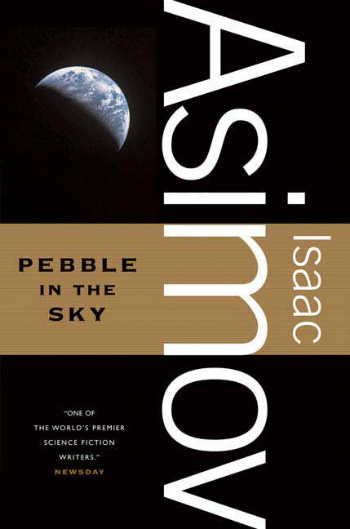
“To the rest of the Galaxy, if they are aware of us at all, Earth is but a pebble in the sky. To us it is home, and all the home we know.”
Sixty-two year old Joseph Schwartz, a retired tailor, is walking down the streets of Chicago in 1949 when, with a single step, he finds himself transported in time to a far distant future in which Earth is no longer recognizable. When he stumbles upon a local farmhouse he discovers that the people who answer the door are speaking a language that he does not understand, soon after that he discovers that this world, no longer his world, is a very dangerous place.
Isaac Asimov’s first published novel, set in the same universe as the later-published Foundation series, is a suspenseful page-turner, filled with a number of what are now considered science fiction tropes.
Conspiracy, prejudice, fear, suspicion, plots of galaxy-wide destruction, euthanasia and mind-control stand side-by-side with romance, adventure, scientific theory and an historic game of chess in the novel that started the Galactic Empire.
If you are a fan of Asimov’s Foundation novels, this is a must-read look at a time long before Hari Seldon posited his psychohistory. If you are unfamiliar with Asimov’s Foundation stories, Pebble in the Sky would be a great place to get acquainted.
My Rating: 9/10 stars. I couldn’t put it down.
Mary purchased Pebble in the Sky as a gift for my birthday a few weeks back, and I could no longer wait until Andrea’s Vintage SF Month to give it a read. I first read Asimov in January 2008, when I finally worked up the courage to give Foundation a try. I was smitten from the start. I’m not sure why I tend to take such long breaks between feasting on Asimov’s work, as there is something about the way that he writes which reaches down into that place in my childhood where I first became hooked on science fiction.
Pebble in the Sky begins with the introduction of Joseph Schwartz, but along the way we meet an archaeologist bent on proving that the vast and sprawling citizenry of the Galactic Empire had its birth on the now backward, radioactive planet Earth. We also meet: an Earth scientist who is testing a machine said to be capable of vastly increasing the learning capacity of the human mind, his lovely daughter, and a handful of government officials who alternately annoy and generate fear as the various threats of Asimov’s plot unwind.
The novel presents a one-way version of time travel, a take on mental telepathy, and the kind of back and forth power games and fears of conspiracy that remain popular in contemporary storytelling. While veteran readers may see elements of the plot coming a mile away, Asimov continues to play some cards close to the vest and is able to surprise with the twists and turns of the story. It is so brilliant that Isaac Asimov includes a blow-by-blow conversation over a chess match (itself lifted from an actual match that took place in Moscow in 1924), because much of what occurs throughout the novel is a mental chess match between various individuals and political/social forces.
At 255 pages in the trade paperback format, Pebble in the Sky sure packs a wallop. It is a story that rings with sensations of nostalgia that accompany Golden Age science fiction, while at the same time engaging the interests of the modern age reader. The characters may arguably be “types”, but Asimov writes them well and is able to elicit emotional reactions from the readers in their regard. It is an interesting novel to read while keeping in mind the post-WWII/Cold War climate of the time period as the more science-fictional fears and concerns mirror those of people living in that era.
I started the novel a few days ago and found myself unable to resist returning to it at every opportune moment, even if it was just to advance my reading by a paragraph or two.
Pebble in the Sky is yet another Isaac Asimov novel that I highly recommend.
For additional reviews I have written featuring work by Isaac Asimov, see:
Foundation
Foundation and Earth
Second Foundation
I, Robot
The Currents of Space
The Positronic Man (written with Robert Silverberg)
The End of Eternity
And if you didn’t read Asimov at all… which first?
(I don’t remember if I read his books or no).
I think The End of Eternity would be the one I would recommend. It is a stand-alone novel and deals with time travel, among other things. It is a very interesting take on what is now a well-worn trope.
Thx for suggestion. 🙂
You are welcome. I reviewed it here if you are interested:
http://www.stainlesssteeldroppings.com/the-end-of-eternity-isaac-asimov
I haven’t read anything by Asimov in many years. This sounds wonderful — I’m adding it to my list. Thanks for bringing it to my attention. 🙂
This is not a bad place to jump back in. This novel, The End of Eternity and Currents of Space are all truly excellent stand alone novels.
Read most Asimov back in the sixties when I was a teenager. Tried rereading some a few years ago and couldn’t get past the poor writing. Asimov had no ear for dialogue. Just found myself cringing.
I think it is just a matter of taste, Steve, as the dialogue works fine for me.
I remember reading all those Asimov novels when I was a kid. Not long ago, I read Gregory Benford’s FOUNDATION’S FEAR–the first book in the SECOND FOUNDATION trilogy. The style was far from Asimov’s as was the unsatisfying plot. Trying to do what Asimov did is probably impossible for most writers.
I’m a ways from being tempted to read those books as I still have some of the later Foundation books to read, but I’ve heard similar things, George, and am unlikely to give them a try because of that.
Imagine reading this in the early Sixties, when these weren’t tropes, they were The Latest Thing in SF. I loved it then and still do when I occasionally reread one of them. Glad you read and liked it. I wish more SF fans would go back to these.
That honestly is part of the thrill I get out of reading older science fiction, Richard. Trying to imagine what it was like to be reading this type of fiction in the time period, sometimes as a first time for something that is now considered cliched. That sense of history adds something special to the reading experience.
Hi Carl
‘Must read’ and ‘couldn’t put it down’ – oh dear was that the sound of one of my stacks of books crashing to the ground because I just added another title! – why yes, it was!
Thanks – you never steer me wrong.
This one can go on the wish list as I did love Foundation and Positronic Man.
Lynn 😀
As I wrote, there is something about Asimov that just gets to me. I connect with him so strongly.
If you liked those books, I think you’ll enjoy this and would enjoy The Currents of Space and The End of Eternity as well.
I haven’t reread Asimov for fear of the suck fairy, but I think I’ll try this and Foundation and see if they hold up.
It is always a risk, that’s for sure. I re-read the Foundation trilogy as part of a group read a few years ago and while it didn’t floor me like it had in 2008, I still enjoyed it. I, Robot is the one I would like to re-read.
I read this a few years ago, after I had read the Foundation trilogy. So I didn’t find it quite as polished. It still was a gem and I really liked the idea of Archaeologists arguing over a theory that Earth was the birthplace of man.
While I have thoroughly enjoyed every Asimov I have laid eyes to, I often see that the female roles are rather limited. But I have to take into account what publishers were willing to publish at the time. Because there is so much awesomeness in Asimov’s work, i can often ignore this fault.
It is true, his female roles are limited. Though I did really like Arkady in Second Foundation. I’m sure publishers had something to do with it, but I’m not sure Asimov had a very healthy idea of/relationship with women (based on rumors/accusations), so maybe that had something to do with it as well.