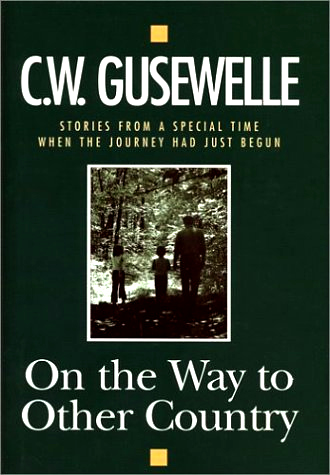
On the Way to Other Country ~C.W. Gusewelle
–published 2001
–Kansas City Star Books
–355 pages
–9/10
I doubt that there are many people alive who have not been overtaken, on certain gray days of the spirit, by a sense of the futility of words.
~C.W. Gusewelle
The steady blinking of the cursor on open white space is keeping perfect rhythm with the steady beat in my head–“I don’t know what to write. I don’t know what to write.”… C.W. Gusewelle is ever so right. On some days it feels like an exercise in futility to put fingers to keyboard in order to get the words out. I don’t make it a habit of reviewing everything I read. My intentions are good, but there are days when I am weighed down with too much to do and others in which I cannot drum up enough inspiration to do a book review justice (either for good or ill) regardless of my feelings after closing that final page. Yet there are some books that just cry out to be reviewed, especially a decade after they are published when they are perhaps more forgotten than they should be. On the Way to Other Country is one such book and so I will press on, endeavoring to inject my words with some of the emotions sparked by reading this book, both to myself and at times aloud to my wife and child.
If you are unfamiliar with C.W. Gusewelle, rest easy. You have a much better excuse at unfamiliarity than I have. C.W. Gusewelle has been a columnist at the Kansas City Star since 1979. The name on the spine of the book awaiting my discovery on the library shelf sparked a faint glimmer of recognition and then it was gone. I had to rely on the jacket flap to tell me that he was a regular part of my local newspaper. The fact that I don’t read the paper seemed somehow an inadequate defense.
In my ignorance of nonfiction classification I would describe C.W. Gusewelle’s work to be in the same family as Anne Fadiman’s “familiar essay”. Though Gusewelle’s work is much shorter due to the limitations of space in a newspaper column, they contain that same mixture of personal insight and universal truth that I admire in the work of Anne Fadiman and other essay writers I’ve read of late. On the Way to Other Country could be called a ‘best of’ collection of sorts, though it doesn’t read like the culmination of a life’s work. Collected here are over 100 brief but powerful essays categorized into seasons and steps along the journey of life. With an economy of words and a lyrical style Gusewelle shares thoughts on youth, parenthood, solitary walks in the woods, growing old, the deep connection we feel with the land, and with our pets and so very much more. What sets Gusewelle apart is that his writing is really and truly beautiful. Not flowery, not given to long-winded exposition. Instead he sets out to share an insight or two and takes the reader on a journey that is rapid in the telling but can lead to a great deal of thought and discussion afterwards.
I read this book over the course of the last month, savoring it one moment, devouring it the next, all the while wondering how I had missed out for so long on reading his remarkable work. These vignettes traverse the whole spectrum of human emotion. There were times, reading aloud to my wife, that I had to take a deep and steadying breath so that I could read the final paragraph of an essay without choking on tears. There were moments when I laughed out loud while reading quietly to myself. And more often than not there were moments when I became acutely aware of how much common ground we all have, simply because we are part of the human race.
From what little I’ve read about C.W. Gusewelle since finishing this book I know that I don’t necessarily agree with his political views nor with the way he sometimes expresses them in his column. And I have no doubt there are many other areas in which we would not see eye to eye. The beauty of On the Way to Other Country is that it does not stray into politics, religion, race, etc. There are no dates on when these columns first appeared, nor any indication if these all were ever in print. From some you can gauge a sense of when they might have been written, but at their core they are timeless and they feel so when you read them.
If you are looking for something to read that is at once encouraging and thought-provoking, something that will spark a sense of belonging and make you look at even the mundane moments of life as something to be savored, I strongly recommend that you track down a copy. In trying to describe it I feel overwhelmed and inadequate, mostly because there is so much there. It is a testament of sorts to how much I was affected by this book that I wrote yesterday’s post, Aging Gracefully, heavily under the influence of C.W. Gusewelle. Moments after reading the last 10 or so essays to my wife I sat down to craft a “Happy Birthday” to my daughter. A short series of essays about autumnal walks in the woods was written in a style that I found flowing out of my fingers, truly without conscious thought. Afterwards my wife read it and mentioned that I sounded like C.W. Gusewelle. Not that my writing was in any way comparable to his, more’s the pity. No, but she could tell that I was under Gusewelle’s spell when I sat down and those words came out unbidden. I love it when writers affect me in such a way that my very thought patterns and internal dialogue channel them unconsciously.
Words are powerful, especially when wielded by someone of consummate skill. Sincerest thanks to Dewey and his decimal system. Had I not been in the specific section of the library where I knew they shelved Anne Fadiman’s books, I might never have discovered this gem.
Sounds inspirational. Do you think if you had known of your unshared views before you read the book, it would have affected you in the same way? Are you able to separate your feelings like that? I only ask because as i read your review, I found myself wondering If the difference in views would taint it in some way for me…even a little in the back of my mind 😀
I don’t know, its really hard to tell. I still think I would have given him a try because the book looked and sounded so darn good. That and the fact that I know that there is a very large portion of the authors I enjoy who feel differently about politics, religion, etc. that I do would probably have leaned towards me going ahead and reading it. I like this kind of book and there are too few that I’ve found with that employ this level of skill. I’ve found several “similar” books in that same section of the library and after reading a few pages decided they were not for me because the author had a good idea but was just not executing it in a way that engaged me.
My favorite familiar essay writer is still Anne Fadiman, but Gusewelle is now a close second. I also recommend Sloane Crosley and David Sedaris, who if anything are the antithesis to Fadiman and Gusewelle in their irreverence yet still capture the beauties and challenges of life in such a way that they can really speak to you.
Great question. Personally I wouldn’t let it stop you from reading this book. As I said, politics and religion and stuff like that really don’t creep through in these essays, and we agree on the really important stuff, like how to treat your fellow man, how important family is, and how it is that pets can become such an ingrained part of your family, just to name a few.
Nice facelift – much better!
Regards,
DANNY
Thanks Danny, I appreciate it. 🙂
Sounds like a really good read and a perfect book for me to enjoying while sitting on my deck. Thanks!
Yes, I think you would enjoy this one, TBM. I believe the overall theme of the book shares elements with where your blog, and life, are focused and I think you’d find it a nice companion, especially outdoors. I read a great portion of it outdoors myself. It just felt ‘right’ to do so.
if yesterday’s post was the influence of this man, I should hunt down an essay or two at the very least—loveliness.
~L (omphaloskepsis)
L: Aw, thanks! I’m curious if you, or anyone else for that matter, finds themselves doing this? I notice when I watch a lot of British TV I find myself doing the same thing–very unconsciously thinking in British terms and often using them as well. Perhaps I’m just too easily influenced. 🙂
This happens to me, I catch myself using words that I would not have if not for a book I just finished reading. When I finished reading Pride & Prejudice for the first time, I found myself speaking Austen talk…to my patients, co-workers, family…no one was immune. LOL
What mostly happens, after reading historical fiction, I view life matters in light of what time-period I just finished reading; what they lacked.
Hi Carl. You talked me into it, however, my library doesn’t have a copy. However, they have Far From Any Coast by him. I’ll start with that while I find On the Way to Other Country. Thanks again!
I plan on checking out some of his other books as well, and I’m going to be buying a copy of this. I’m actually hoping on my next used bookstore run that I can snag some copies of this. Being that it is a local press I’m hoping that this will be something I can find as I’d love to give some copies as gifts.
Your entire post sold me on this one, but nothing more than this line: “And more often than not there were moments when I became acutely aware of how much common ground we all have, simply because we are part of the human race.” Yep, that one thought alone makes me really want to get my hands on this book. Unfortunately, our library doesn’t have it (yes, I already had to go check) but Amazon has several very inexpensive used copies so I see this one falling into my hands one day in the not too distant future. Thank you.
I just checked Amazon a couple of days ago myself and I’ll also be snagging a used copy from them soon. I have no doubt you’ll enjoy this one Debi, and an extra bonus is that at 2-4 pages each, this is a book that is easy to read in stolen moments of busy days and I’m convinced even those few pages will leave you refreshed.
This is one of my very favorite genres of writing…and I can’t wait to get my hands on this one. Have you ever read Anne Lamott’s “Traveling Mercies”? Your review brought to mind many of the emotions that I have concerning that book.
Jessica: No I haven’t, but I’ve read (part of) her book Bird by Bird and really like her writing. I have heard really good things about Traveling Mercies and really should have grabbed it from my library right now. If you enjoy this kind of writing I cannot recommend Anne Fadiman enough. “Ex Libris” and “At Small At Large” are both wonderful collections. I also read a book recently called “Idyll Banter” which was a collection of small town paper columns from author Chris Bohjalian. I need to review that book. It wouldn’t put it on the same par with this book by Gusewelle, but it was very sweet and made me think of home and growing up and of good neighbors.
I do not read much in way of non-fiction, but this book sounds like one that would be an interesting read. Besides that it sounds like a good read, if it was any influence at all over your writing then I think I really need to read it. 😀 I really like how you write to begin with, but your Happy Birthday post was absolutely beautiful; poetic. I would love to emulate.
Thanks! I like those moments when I feel the muse and can actually write without thinking much about it. Usually when that happens the words pour out faster than I can type. The trick to becoming a “real” writer (and why I am not one) is that you aren’t supposed to follow that muse, you are supposed to actually set time aside every day and just write. Good, bad, crappy, magical, it doesn’t matter. I have yet to conquer the lethargy of the flesh to the point that I practice any craft daily like that.
I asked to have tis one added to Patti Abbot’s Friday Forgotten Books posting list, and it is now up. Hope it brings some new readers to this top-notch blog. It’s a fine review.
Thanks Richard, and thanks again for suggesting it to Patti. I’ve visited a few of the Friday Forgotten Books posts today, link here:
http://pattinase.blogspot.com/2011/06/fridays-forgotten-books-june-3-2011.html
and plan on checking out some more over the weekend. Fun stuff there.
I hope more people go find Gusewelle’s work and expose themselves to it, it is very good.
you can always tell when a book or article etc inspires you..it’s a great feeling and as I sit here and think on it ..it makes you wonder why more “words” don’t do this when injected into a story or essay or novel.
I was just talking about something similar to this on Little Red Reviewer’s latest post (about a Harrison novel). It would be interesting to be able to step behind the scenes to see just how and why certain combinations of words affect us in certain ways at specific moments in time. Of equal interest would be to see and understand why some books can be read over and over without them losing much if any of that magical connection we felt with them upon the first reading and how other books blow us away but then seem like so much less if we read them again, or vice versa. Fascinating stuff.