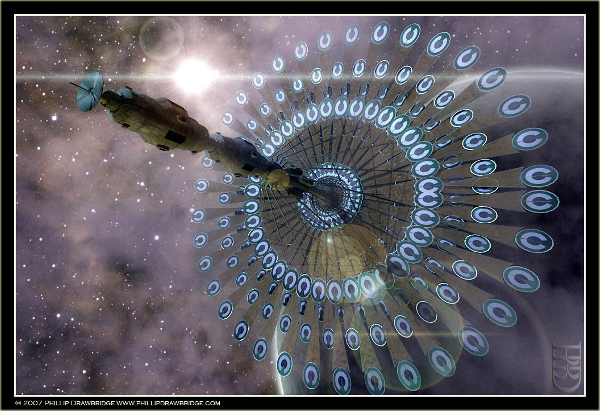
In previous short fiction posts I have mentioned that there was one story in particular that I was longing to share with you, a story that had not yet made its way to a free online venue. That story was “Mono no aware” by Ken Liu and was recently released this week in the current issue of Lightspeed magazine. Liu is a short-fiction magician, a wizard with words whose work has been featured all over the place over the last few years. This is one of Liu’s more accessible stories, exploring the concept of an individual’s importance in relation to those around them.
“Mono no aware” tells the story of Hiroto, a twenty-five-year-old Japanese youth aboard the generation ship Hopeful, bound for a new star, a place for humanity to rise from the disaster that befell Earth. Liu’s story alternates between Hiroto’s present timeline his childhood, when the Earth was in the course of impending doom and Hiroto and his family were waiting to board one of the Japanese starships.
What follows is a spoiler-filled discussion of the story. I recommend taking the time to read this before following the rest of the post or reading any of the comments. The emotional impact of the story comes from a fresh reading, unspoiled by details. Follow the link here to read the story and then come share your thoughts.
“Mono no aware” is a concept that the author defines as “an empathy for the inevitable passing of all things” and that theme is woven throughout the story. It is a concept that I don’t find all that far removed from Tolkien’s philosophy in the history of Middle-earth. The melancholy beauty in the idea that everything is but for a season.
It first comes into play early on when we see the situation on Earth through young Hiroto’s eyes. An asteroid, dubbed “The Hammer”, is headed towards Earth and is predicted to destroy all life. In response, the various nations of the world have built ships to travel to a star called 61 Virginis in order to ensure that humanity does not become extinct.
We have seen and heard, in our media and in our entertainment, the idea of an asteroid being the cause of humanity’s destruction. It has been predicted that this is what destroyed the dinosaurs so long ago. I think it is interesting that rather than choosing one of many other options for our destruction, Liu chose one that truly does feel like one of those situations that could be called “inevitable” if you believe it happened once before.
When I read the story for the very first time, in the anthology The Future is Japanese, one of the immediate things that struck me was the Japanese nationalism and the portrayal of America. It would be easy to look at those early situations and find fault with them (as some have in the criticisms I’ve read). But I didn’t see them that way. First off, the places in the story where we see Japan portrayed as this ideal, stoic, take-things-as-they-come society is the part of the story seen through a child. He is remembering things his father said. He is remembering images glimpsed on television (and we know how balanced the media is…*wink*) about how America and other unnamed nations went to war with one another rather than being a part of a global initiative to save the human race.
On another note, I would expect a story told from the viewpoint of a Japanese boy to be one that included a lot of national/cultural pride, especially when that boy turns out to be the only Japanese person left alive, the last of his race. And finally, the scenario painted in regards to America is not far out of line. While I love my country and believe that were the situation to play out the way Liu has written it we too would have our brave souls, we are also a country that is often at war and is not afraid to fight for what we feel are our rights and privileges.
All that being said, I personally don’t get a big political vibe off this story. What I see is a boy who feels the weight of preserving his culture and I feel very strongly about people honoring and carrying on their cultural heritage.
I am a big fan of “generation ship” stories, those stories in which it will take hundreds of years to reach a destination. These stories have a combination of adventure and sadness to them, knowing that many generations of people will be born, live, and die solely in service of keeping the ship on course and running well so that future generations may find a new home to thrive in. So right away this was a story that was going to be right up my alley. In Liu’s story we do not get much in the way of the ship itself and how life works, which is fine in the context of this short work. The focus is more on the characters, particularly Hiroto. We do get an idea that life goes on in relatively the same way it does here on Earth in that Hiroto has a job, is in a relationship, and interacts with friends.
I am impressed by the way in which Liu uses the flashbacks of Hiroto’s past to build this character. We see who Hiroto was through his parents as much as through his own words and actions. The idea reinforces what little I know of Japanese culture, which includes the importance of the greater family. It also establishes the idea that Liu promotes through this story that:
“We are defined by the places we hold in the web of others’ lives.”
This becomes painfully obvious when the sail of Hopeful becomes torn and Hiroto must make a choice to sacrifice himself, his future happiness, and even more sadly the future of the Japanese race in order to ensure that the remnants of humanity remain on course. The sacrificial nature of this story makes it sad, especially given the fact that Liu has only allowed the reader to get an intimate picture of Hiroto, and perhaps his mother and father through his recollections of past events. It is a beautiful story too and I would hope that as you read it you would see why I find it to be so. This second reading was the first time it dawned on me that with Hiroto’s sacrifice comes the sacrifice of the Japanese culture. It would be interesting to know what Ken Liu’s thought-process was behind this and if there is some deeper meaning. It certainly reflects what has been a reality with many cultures down through the years and it is depressing to think how much cultural identity has been lost first because of invasion and forced assimilation and in today’s world because of a global tendency to see so much identity being tied up in technology and other pursuits.
There is a classic short story by Tom Godwin entitled “Cold Equations” that is a must read story. “Mono no aware” could be considered a companion piece to Godwin’s story, a kindred spirit separated by decades of storytelling. It is a profound piece of fiction and I won’t share any more about it as it too must be experienced sans spoilers. You can find it here. I like these stories because they manage to encapsulate all the whizz-bang wonder of science fiction–the technology and wisdom that allows mankind to travel amongst the stars–while also incorporating a strong emotional thread, a beating heart to pair with the lifeless machinery. “Mono no aware” doesn’t shy away from the cold realities of what it means to be a pioneer. Ken Liu doesn’t shy away from the dangers that come along with breaking free of Earth’s gravity and traveling outward. His story manages to weave the romanticism of space travel with its realities, which gives “Mono no aware” a weight, a dimension, that makes it memorable. It is not surprising to me that the story is nominated for both a Hugo and Locus award this year.
I would love to talk more about this story and to know your thoughts. Feel free to share anything that you would like in the comments below.
_______________________________________________
For our next short story I have chosen “The Urashima Effect” by E. Lily Yu. It can be found here on the Clarkesworld website. You can read it for free or listen to an audio podcast of the story. In some ways it too shares a kinship with “Mono no aware” and it has and ending left me wishing I had someone to talk to about it. Thus I’m recruiting you! I know everyone is very busy, as am I, so this story discussion will not be posted until Sunday, June 29th. Look forward to sharing it with you.
I am so glad you put this story on my radar, and that I actually read it. What a fabulous short story. It felt complete; very complete.
I am with you as I did not get a big political vibe. I also was quite fine with the Japanese nationalism and the American portrayal. The story is based on a Japanese man’s memories and situation. The nationalism completely makes sense to me. Japanese society is different than ours and so I didn’t take any offense as to how Americans were portrayed, and furthermore, it didn’t enter my mind that I should be offended.
For me, the entire story was incredibly written. It moved smoothly as it weaved back and forth with Hiroto’s past and present. It also was filled with emotion from start to finish. I felt connected to Hiroto and was very intrigued with the building of his character; his parents’ influence made a huge impact.
The ending was very sad to me. Far more sad than I would have ever anticipated for a short story. I think that speaks volumes for how deeply engaged I was with the story. Hiroto’s decision makes sense, but I greatly wish he did not have to decide to sacrifice himself. I wish he was able to go forward in life. And because I tend to be a bit morbid, I couldn’t help but wonder if he would have suffered in the end. The story makes me feel as if he peacefully left life, but I don’t think so….not when he started to gasp for breath. (Here I am, wondering about a character as if he were real and really experienced this ending).
Another part of the ending that struck me was when Hiroto was talking about heroes.
As to how each person was a hero because if they did not play their role well then the next part could not play out in life. Very interesting way to look at it, and I agree. I am not a big fan of calling a person a hero to begin with so Hiroto’s thoughts on it gel with mine.
This brings me to the following quotes which made me pause, really pause and ponder… “Individual stones are not heroes, but all the stones together are heroic.” AND
“We are defined by the places we hold in the web of others’ lives.” It was neat to see you place that quote in your post.
I was impressed as to how deeply this short story impacted me in way of engaged reading, and emotions on my part towards Hiroto, and the society. (I am not huge short story fan, but I think I am becoming one). This is definitly a story that I do not want to leave, and would love to reread.
(Is Mono No Aware an exception or are many of the stories featured in Lightspeed written with this same level of quality? I would love to read more stories of this caliber)
It is wonderfully complete, isn’t it? That alone is one of the reasons it was one of my favorite reads last year and would easily sit in the upper tier of my favorite short stories.
You hit it right on the head, I didn’t find anything “offensive” about the portrayal of America nor of that of Japan in comparison. I don’t think it was the author’s intent to offend and I think that comes out clearly in the story.
I thought about his death as well. Since Liu set it up that he was so exhausted and barely conscious half of the time, would he have just fallen asleep and not woken up? Would the lack of oxygen wake him up in a fit of gasping for air? It is kind of horrible to think about. There aren’t many truly romantic deaths, despite the way entertainment may want to paint it.
I wasn’t expecting him to die the first time I read it and even though I’ve read stories with similar outcomes it was a surprise to me. A sad one. Not unpleasant, just sad.
I haven’t played “Go” but could picture the game as it was described and thought it was brilliant the way Liu wove this into the story and how it was used to demonstrate Hiroto’s definition of heroes and heroism. I’m with you in that I felt this story really lays out a better idea of what I feel about being a hero. True heroes serve. They are willing to lay down their lives (which sometimes simply means their own agendas) for others. They work with those around them for a greater purpose. They don’t set out to be heroes.
Not all short stories work this way, and of course not all are meant to so it would be unfair to judge them as such, but this is one of those short stories that I think I could point non-short-story-readers to as one that, again as you point out, feels complete and does a good job of making the reader care about the characters and the plot.
Ken Liu is an exceptional writer, in my opinion. But both Lightspeed and Clarkesworld (and Asimov’s to some degree) feature high quality storytellers. But they always have those in the mix that you won’t quite gel with. I would highly recommend both the Tom Godwin story I mentioned and the next discussion story, The Urashima Effect, for a similarity in quality.
I would imagine that not all short stories are alike just as it is with novels. I am definitely intrigued with Lightspeed and am going to continue to look around over there. Clarkesworld I will check into starting with “The Urashima Effect” . I will also look into the Tom Godwin story. Thanks for the suggestions.
You are most welcome, Deanna. I hope you enjoy the stories. “The Urashima Effect” is also available on audio podcast over there if you are in more of a listening than reading mood.
The way of thinking of the narrator in this novel is totally of Chinese, not of Japanese. As a Japanese, I don’t want you think that it’s a story about Japanese culture. It’s definitely different from what he wrote, even though he is a great writer.
I loved this short story. It’s so very Ken Liu, too, that it’s about one thing, or a few things, and at the same time, about everything.
It does have a sad ending, but with Hiroto’s father’s voice in the background, I couldn’t help but think that everything was just as it should be.
I didn’t get any political vibes out of it, just more knowledge about how Japanese culture is so very different from American culture. We’re so into heroism here, so into individualtiy, everyone wants to do something different, everyone wants to be special, everyone wants to forge their own way, and be remembered for something. It’s not that Japanese culture doesn’t have those things (they do), it’s that they view it differently. To be a hero there, is to help your family, to help your community, to be with everyone else, instead of apart from them. That’s what really struck me in the story and i found it absolutely beautiful.
Also so very happy to hear this available from Lightspeed. They’re my favorite ‘zine these days, i love their short story podcasts!
It is a sad, but hopeful (pardon the pun), ending in that his sacrifice actually meant something.
It is interesting seeing the differences in cultures, especially Asian cultures, to our own here in America. I do like learning more about cultures that look beyond individualism and focus more on family and community. I think there are pockets of people in America trying to do that and I desperately wish it would become a true part of our cultural identity and/or our national identity.
I agree with what you point out regarding heroism in the story and I too find it beautiful. It is the kind of short story that makes you want to strive for something better in your life/with your life.
I was thrilled that it finally came out online. I haven’t listened to any of the Lightspeed or Clarkesworld podcasts but really should do so.
I’m with you on Ken Liu. The guy is a word magician!
He is, isn’t he? Wow!
This is quite the endorsement: a wizard with words
He is one of my more recent favorites, a rockstar short story teller. What I’ve read has some real nice variety to it too, so every new story is a surprise.
This story is just astonishing. It’s good that Ken left a good story that people can enjoy reading. Really liked it!!