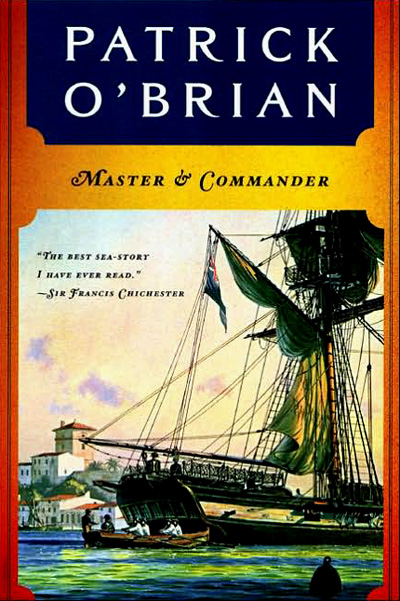
Master and Commander ~Patrick O’Brian
–1970, W.W. Norton and Company
–458 pages
–4.5/5 stars
Upon seeing Master and Commander: The Far Side of the World for the first time last year and listening to various people on the DVD extras discuss the books and the relationship between Captain Jack Aubrey and Dr. Stephen Maturin, I most ardently wished to read these books. After watching the film again this past Thursday, and sharing it with my daughter for the first time, the mood struck again and this time there was no recourse. I had to give Patrick O’Brian a try and I had to do it now. Several libraries and two bookstores later, I procured my very own copy. I shipped off yesterday morning and have just now returned from a most satisfying voyage into Patrick O’Brian’s imaginings of the Age of Sail. Most satisfying.
Through 20 novels (and a 21st, partially finished work), Patrick O’Brian painted a portrait of early nineteenth century naval life during the time of the Napoleonic Wars and in so doing created one of the more memorable friendships in modern literature. I can certainly recall hearing of the Aubrey-Maturin novels long before I knew what they actually were. Though it is well out of the range of my expertise to judge, critics appear to be fairly unanimous in their praise of O’Brian’s accuracy with the time period, nautical terminology, and dialogue. He reportedly used factual historical events as settings within these novels as well as the framework around which he built some of Jack Aubrey and Stephan Maturin’s adventures. The rumors of this attention to detail caused me to enter Master and Commander with a degree of trepidation. It is all well and good for Sir Francis Chichester to proclaim on the front of the cover, “The best sea-story I have ever read.”, but not knowing who Sir Francis Chichester is made me a little reluctant to accept his assessment on faith. It turns out I had no reason to doubt.
To be sure, Master and Commander, and I suspect the whole series, is one that is full of talk of sails and riggings and ranks and maneuvers and many other turn-of-the-century naval terms that are truly gibberish to me. W.W. Norton and Company are kind enough to include an illustration that shows all 21 sails that can be referred to if need be during the course of reading the book. While the accuracy of this discourse was lost on me, it was readily apparent that Patrick O’Brian went to painstaking lengths to make Master and Commander an authentic experience. That he also manages to create such memorable characters and tell the kind of story that keeps one turning the pages is credit to his skill as an author. I could not, did not want, to stop reading this book and I find that this is one of those rare occasions for me that I am glad that I have many, many more books in which to spend time with these characters.
What attracted me to Patrick O’Brian’s books in the first place was DVD commentary that indicated just how much these novels focused on the friendship of these two individuals and that the first novel really established this friendship. Casting Russell Crowe and Paul Bettany in these roles was a stroke of casting brilliance in my opinion. Seeing them interact on screen in a way that established that they had a long relationship between them made me want to see how this relationship formed and that is exactly what Master and Commander delivers. The reader sees things through the eyes of both Captain Jack Aubrey and Dr. Stephan Maturin and, on a few occasions, from other characters. In so doing, the reader is rewarded with an intimacy with these two characters that gives insight into their growing friendship. And, not surprisingly, one learns a great deal about the time period and about life aboard a naval vessel. It is fascinating stuff. I have mentioned in a recent post or two how important I feel it is for men to have avenues with which to acknowledge the importance of cherished relationships with other men. There is an intimacy that can form between men, the importance of which is sometimes ignored or is lost during the late teen and early twentysomething years, which grows more apparent as one grows older. Men need these relationships, in my opinion, and seeing these kind of relationships in book and film acknowledged in a way that is respectful and admirable makes me appreciative of writers like Patrick O’Brian.
In the end I just could not put this book down. The book certainly has its share of white-knuckle adventure, but it takes its time building to that point and even when these ‘adventures’ begin, O’Brian continues to concentrate on the many and varied relationships that form between men confined together on a relatively small ship in the vastness of the ocean. Interestingly enough, only a small portion of material was taken from this volume for the movie. As such, I found myself wondering what was going to happen next as it was obvious that these adventures were not where the film was focused.
It is a wholly satisfying experience to pick up a novel that I had trepidation about, in a genre that I have very little active interest in, only to find myself swept away in the grandeur of it all. Master and Commander, and Patrick O’Brian himself, is well worth taking a chance on, in my opinion. I will certainly be reading more.
well, it sure sounds like you enjoyed this book ! I’ve seen the movie, but originally I watched it because Billy Boyd was in it and I wanted to see how he did when he wasn’t playing a Hobbit, lol. It was a good movie, good to hear the movie did fairly good for the book
I haven’t seen the movie -or- read the books, but my dad has several of them and he seems to really enjoy them. They’ve been on my to read list for a couple of years now. Guess i need to move them closer to the top. Thanks Carl!
I’ve heard that the books only get better from hereon in; most fans consider this the worst of the lot. Isn’t that a great thought?
Memory: That is a wonderful thought! Makes me want to read the next one even more than I already do. I was site-hopping last night and caugt a review of the fifth book in which the reviewer said the same thing, that that was her favorite thus far and each had gotten better.
SG: I highly recommend the film, it is a beautiful and exciting and, by all accounts very historically accurate, film. And the book was, of course, a real pleasure.
Deslily: I had forgotten that Billy Boyd was in it until we popped it in the other day. My daughter piped right up with, “Hey, there’s a Hobbit on the ship!”. 😉
’twas Pippin!!! a Hobbit on a ship is quite rare.. they can’t swim you know! lol lol
These books saw me through 8 months of unemployment 5 years ago and had finished the series before the film was released. I recommend these books to everyone who asks me for something good to read!
Some great comments about a truly great series of books! I picked up M&C on a whim some years ago and was hooked instantly. I liked them so much I made my mother put down her romance novels and read O’Brien instead. I was already into book 5 but she soon caught up with me and proceeded to dog my heals the rest of the way through the series.
After O’Brien I found Forrester’s Hornblower series, made short work of those, then Bernard Cornwell’s Richard Sharpe series which took the battle against Napoleon to dry land. I know you’ve got 20+ books ahead of you already but you’ve got to try Hornblower and Sharpe!
I quite enjoyed the Master and Commander film though I was a bit cheesed that they combined elements from so many of the books. I would rather they had made book 1 then given us room for many a sequel! They stayed true to the spirit of the books and I forgave them the editing 10 minutes into the film. Too bad they didn’t make any more.
I envy you the new journey you’ve embarked on!
Dave: Thanks, I certainly look forward to the journey. It is a shame that they didn’t make any more of these films and yet I have the feeling they knew this was going to be a one-chance affair and decided to at least combine enough of the elements of some of the books to make it a good film. I’ve always wondered about Forrester’s books. Very cool that your mom took your advice and ended up liking these as well.
Kathy: I’m sorry you had to go through the period of unemployment, but you certainly chose well when you chose Patrick O’Brian to keep you company during that time!
Deslily: 🙂
As you know I loved the movie as well and I whole heartedily agree on your comments on the importance of male friendships.
I’m so glad to hear you enjoyed the book. As I told you before I listened to the first disc on audio and I had a real problem with following all the terminology. It sounds as if I really need to try to this series again one day in written form. My TBR pile is just too massive right now but one day I will give this novel a second chance. Thanks for the review!
Jeff: I was thinking about that the other day and I’m not sure I could listen to this on audio either. The reader would have to be absolutely excellent, I think. Seeing the words on paper made it easier to get the idea of what they were doing when they were doing things with the sails, etc. (and you could always refer to the picture, though I didn’t much). On audio I’m not sure this would work.
I’ve read a few of these books, because of the film, and loved them all. They really are great. Glad you enjoyed this one
I loved the movie, read the first one, and then promptly went out and found the guides – the dictionary of nautical terms, and the historical atlas and guide… and then never read any of the subsequent books, even though I have 2-4 on the shelves. I’ll get back to them… one of these days!
These books are more like one enormous multi-volume epic. The careers and relationships of Aubrey and Maturin as they travel the world make them some of the most fascinating characters in literature.
I was a little disappointed that the movie totally ignored Maturin’s secret life as an intelligence agent. I think there is certainly plenty of material for more movies.
My history with O’Brian began with the movie’s release. A friend had read the series and recommended it as well. I chain-read the twenty books in 4 months. It was the most fun I’ve had reading, except for the time when I re-read them this year. Having read all of Hornblower in between, Under Enemy Colors by S. Thomas Russell, a biography about Cochrane and the Billy Ruffian (HMS Bellerophon) both by David Cordingly, and the Longman critical edition of Moby Dick, the second read of O’Brian was much easier and just as enjoyable, if not more, as the first read. The second time through was more leisurely and took twice the time because I savored it, dreading it coming to an end. I see myself reading the series again.
Russell Crowe is the perfect Jack Aubrey. Paul Bettany is not the perfect Stephen Maturin. O’Brian’s Stephen dresses like slob and could not care less about his appearance. Had he been a 20th Century man, he would dress and drive a car like Peter Falk’s TV Columbo. Bettany is too tall and handsome. As has been noted, the movie was not able to fully develop the secret agent side of Stephen. In the books he is cunning, ruthless and unequaled in spycraft. This side of Stephen sharply contrasted with his ineptitude at sea, other than his roles as surgeon and naturalist. As a Surpriseophile, I still give a “thumbs” up to the movie.
The arcane jargon does give folks trouble. It is worth deciphering. There is a published glossary of terms for this era. A few keystrokes in Google is usually enough to get meaning,. However, it should be noted that O’Brian in an interview, confessed that some of it was “made-up” by him. In contrast, the Longman edition of Moby Dick contains a glossary of terms at the bottom of each page where the word or phrase appears.
If I had to pick 3 books out of the 20, it would be the first 3. Fortunately, there is no such limitation. The Reverse of the Medal contains my favorite scene of the series. It is not a swash-buckling, cutting-out expedition or boarding of an enemy ship. It is when Jack is serving his sentence of pillory in a London square after being disgraced by conviction of trumped-up charges by his enemies. Being pilloried in stocks in a public square for a few hours was more than just humiliation. Bystanders were permitted to throw rocks and rotten fruit, etc., at the unprotected head of the defendant, often maiming the victim. Hundreds of his former shipmates, present and former, of all ranks, without regard to the possible effect on their careers, showed up in uniform to surround and protect Jack from the rock-throwing gang who showed up to inflict grave injury. After driving off the thugs, his friends turned towards him and removed their hats in salute until he completed the sentence. These few pages of print summed up the charisma of Jack Aubrey and the loyalty of his friends and shipmates better than all of the print contained in the remaining books.
I share all the enthusiasm and affection for the books and characters of the original writer and those commenting. I venture to suggest, however, as a fan long before the movie was proposed, that although Russell Crowe does, in fact, do a good job with the role, the Aubrey-Maturin relationship, and the two characters, are much, much better, deeper, and more interesting in the books than in the movie, which subjects them to Hollywood stereotyping.
Actually, the mainspring of the books is not Aubrey, but Maturin. Unlike the screen version, Maturin in the books is rather plain (if not ugly), frequently repellent, certainly more than a bit eccentric if not downright odd. But he is also courageous and a bit of a super-hero: a remarkable swordsman in a duel (who would have thought it); physically able to toss off the effects of personal torture (not to mention laudanum addiction); capable of wooing and winning the most beautiful and dashing woman in the series of novels, and incidentally, in the end, fantastically rich as well as being a polyglot, a Renaissance man, a world figure in his scientific discipline, and personally acquainted with most of the royalty and aristocracy of the time through family connections or his prowess as a physician (not to mention his true vocation as Britain’s most important and successful intelligence agent). His craggy temper and humanly pedestrian sense of humor, as well as his devotion to Aubrey (who is merely a Nelson-class seaman, original astronomer, and mathematician, as well as a savage fighting captain), make him as easy to like as Aubrey. But here is what he is not: an Art Garfunkel-like tree hugging wimpy scientist, which, in my opinion, is what Hollywood made of him. And Crowe, for all his charisma, doesn’t look like the Olympian English “type” (Fitzroy Maclean) of rangy, powerful fighter-charmer that the books envision. And it didn’t help to make Bonden a Hobbit! Those British seaman were supposed to be powerful fellows, looking like NFL lineman, not little small friendly folk.
The movie was good despite these weaknesses. And the books, for all their humor and good writing, suffer from a lack of larger purpose or theme: in a way, I’m sorry to say, it’s the Hardy boys for well-educated grownups. That said, there are few 20-volume tales that are so well worth re-reading and treasuring. Next to so much of what passes for entertainment, the books and the movie are more than just the lesser of two weevils.
Just read that Crowe is negotiating with the owner of the book rights to do another O’Brian book-flic. “Reverse of the Medal”. http://www.kansascity.com/402/story/1330794.html
Mates, run like smoke and oakum to the nearest stay and start scratchin’!
That is exciting! I hope that happens!
I beg to differ, but I thought the movie was a crushing disappointment. The casting was mediocre, although to be sure all involved are fine actors. The movie portrayed Aubrey as a “Popularity Dick”, the rousing speech was not true to character. The relationship with Aubrey and Maturin was only close to true in the last minutes of the film, as they shared the roisen and played out the ending images. Boyd as Bonden was a horrible choice, Bonden was an oak beam, not a deal partition. I can only hope that in the fullness of time, someone in Hollywood or elsewhere will take the time to read all these books and realize they’ve got a franchise for the ages. I was rather a fan of the Hornblower treatments from A&E. That would certainly be a far better tribute to Mr. O’Brian’s monumental opus than the half baked sea pie we were served.
But to close positive, I echo an earlier posting and envy you the opportunity to read these novels for the first time. When I started, POB was still alive and I had hopes for the 21st novel.