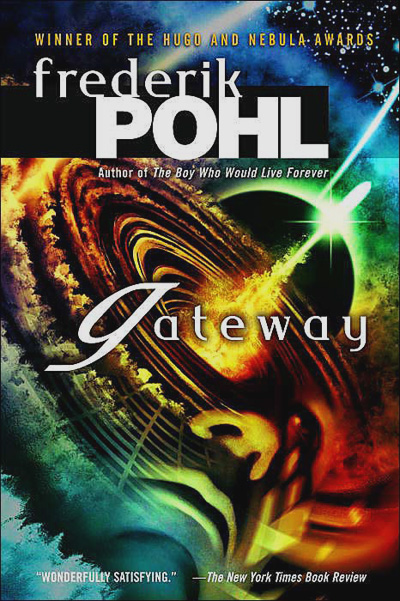
Gateway ~Frederik Pohl
–published 1977
–Del Rey Books
–278 pages
–1977 Nebula Award Winner, 1978 Hugo, Locus and John W. Campbell Award Winner
–3.25/5 stars
Frederik Pohl’s much-lauded novel is my latest foray into the books that have won speculative fiction’s biggest awards, in this case, the Hugo and the Nebula (and the Locus and the Campbell!). Pohl was up against some big names that year, George R.R. Martin (Dying of the Light), Marion Zimmer Bradley (The Forbidden Tower), Larry Niven and Jerry Pournelle (Lucifer’s Hammer) and Gordon R. Dickson (Time Storm) and while I can not legitimately have an opinion about whether it was the best of that group, having not ready any of these other novels, I can see, upon reading it, why it captured the imagination of the voters.
It captured my imagination as well, and there was much about it during the reading, and in retrospect, that I enjoyed. There were other parts of the story that bothered me, and I will attempt in this review to touch briefly on both.
While I make an effort in this review to not point out major plot spoilers, I do end up talking around various parts of the plot in ways that are not typical for one of my book reviews. I thought it fair to warn you ahead of time.
In his novel, Pohl has created a future in which humanity has discovered a hollowed-out asteroid (called Gateway) filled with a number of one, three, and five man space vessels created by a mysterious race that has long since vanished, the Heechee. Gateway, and its companion asteroid, Gateway Two, are ruled by a multinational corporation. The ships housed on Gateway follow a prescribed course, taking the daring to various points in space that were, for reasons unknown, important to the Heechee. Some of these destinations contain amazing scientific wonders, others house technology and other objects left behind by the Heechee, but for every successful destination there are several missions that end in nothing, or worse, injury and/or death. The adventurous come to Gateway to become prospectors, hoping to make that big score that will set them up for life. One such adventurer Robinette (Bob) Broadhead begins his journey thanks to a lottery win that gives him just enough money to get a start.
The reader follows Broadhead’s story, which alternates between the present, where he is under psychiatric consultation from a mechanized shrink, and the past, wherein his experiences at Gateway lead to his need to seek help. The back and forth nature of the chapters in this book help to maintain the interest in both story lines by increasingly ratcheting up the tension of the dual mysteries: who/where are the Heechee, and what exactly is Bob Broadhead’s great secret. Inserted within the story are various one-page items of interest: reports on successful and unsuccessful missions, documents about Gateway and the Heechee, advertisements of a varied nature, and more. The culmination of these elements results in a created future that feels “lived in”. Frederik Pohl “shows” more often than he “tells”, doing his world building in a way that gives the reader a story rather than a lecture.
I was endlessly fascinated with the Heechee elements of the story. The pictures painted of the cramped living spaces on Gateway and the even more cramped Heechee vessels felt like the kind of not-too-far-removed-from-reality science fiction that I have been reading lately from Heinlein and others. The danger felt very real and the many failed missions shown and alluded to in the book made the story feel plausible rather than pollyannaish. I was also fascinated with the psychiatric process as viewed in Broadhead’s sessions with his A.I. doctor. I work in the psychiatric field which certainly added to the fascination, especially seeing 1970’s ideas of psychiatry played out in a futuristic setting vs. the way things are done today. Broadhead’s frequent attempts to control the sessions, to deflect issues onto the machine when the conversation got too close to a raw nerve, and his inability to make more than miniscule progress all were very, very familiar. I also liked a lot of the humor Pohl injected into these chapters, a dry, less obvious humor…or at least a sense of humor that felt natural and not forced.
Which leads me to a few of the things that bothered me about Gateway. Many of the novels that science fiction holds up today as “classics” have dated material. How could they not? It is the rare story that feels truly “timeless”. And, I assume, we all have generations that we are not particularly fond of. I was a teenager in the 80’s, so I was rebelling against the 70’s, a decade whose popular culture, in many ways, I do not enjoy. I say all that to say that what I find charming in fiction written in the 1950’s, I find less so in fiction written in the 1970’s. The frequent references to “tapes”, the silly names of the various levels on Gateway, like “Level Babe” for example, and the uncomfortably dated attitudes about sexuality were a few of the things that bothered me, perhaps somewhat unfairly to Pohl and the time period he was writing in. The level names especially threw me out of the story a bit whenever I read them. If the book was meant to be more tongue-in-cheek, like Bill, the Galactic Hero, then I wouldn’t have minded at all. But by and large Gateway felt like a serious examination of both the idea of “life out there” and a serious look at humanity in the person of Robinette Broadhead and the flower-power-ish references, though few, did not serve the story.
And so we come to Robinette Broadhead himself. There are many books that tell the story of unlikable characters–Gully Foyle in The Stars My Destination, Ben Reich in The Demolished Man, and more recently Ramon Espejo in Hunter’s Run–characters who by their very nature are not good guys. In all those examples I personally like the protagonist in spite of their flaws. I am not sure I can pinpoint why, exactly, but I do. I had a much harder time liking Bob, in large part because his day-to-day self was too close to normal human foibles to be comfortable. Much of Bob’s time on Gateway was spent wrestling with his fears, putting off making hard choices, wasting time…all things that are all too real. I’m not sure I liked seeing myself in Bob Broadhead. Then later in the story, when he does something that I find deplorable (but strangely enough, something that Gully Foyle also does and didn’t bother me as much), I lost even more sympathy for the character. And finally there is the homosexual thing, and by that I mean a portrayal of homosexuality in a way that I can only imagine would make people in the homosexual community absolutely cringe. I hesitate to talk any more about that here because it is a big spoiler, but I will do so in the comments, with a SPOILER warning, if anyone is interested.
The above complaints, in the grand scheme of the novel, are actually small ones. They take up almost no space in the story and yet had enough of an impact on me personally that I rate the story the way I do. The majority of the story was intriguing and page-turning and showed a glimpse into a very fascinating idea of alien technology that allows me to feel that it deserves its recognition. I am certainly pleased that I read it, though I do not imagine re-reading it anytime in the future. It might then surprise you to know that despite my issues with Broadhead, I am actually interested in reading Gateway‘s sequels: Beyond the Blue Event Horizon, Heechee Rendezvous, and The Boy Who Would Live Forever, specifically. The reason being, unless I am convinced that these are horrible novels, that I think Pohl really has something fascinating here with the Heechee themselves and I would like to learn more about them.
So there you have it, my brief (ha, ha) thoughts on Gateway. I know for a fact that there are some of you out there who love this novel, and I have no doubt there are others who do not. I would love to know your thoughts/opinions on it. This was merely my experience.
______________________________
This book is a selection for:
Mind Voyages (for the Moon Voyage and Sling Shot Back to Earth Voyage)
and the
The 2010 42 Challenge
I have read this one, but The Forbidden Tower is one of my favorites of Marion Zimmer Bradley’s Darkover books – maybe because it’s the first one of hers that I read (at the recommendation of my father). If you haven’t read any of them I highly recommend. They’re a lot of fun and blend elements of fantasy (a vaguely medieval setting combined with a very modern space port) and more typical science fiction in a cool way. She does lots of exploration of the tension between the two societies, of gender roles, and politics, religion, and just plain adventure. She and Joan Vinge (The Snow Queen) are two of my faves from that general timeframe of sci-fi writing.
I read this, and the following book, Beyond the Blue Event Horizon (1980) shortly after they each were published in paperback. I don’t remember being put off by anything in them the way you were, but I was reading in the time, and so was probably just able to assume the views of the day, projected into the plot and characters. Fredrick Pohl has never been one of my top favorite SF authors, it has always seemed to me he works overly hard to push his characters onto the reader, as if real-seeming characters would make us accept some iffy plot devices and weak storytelling. As if by making us relate to the protagonist (perhaps by reminding us of ourselves) he moves us to accept the entire premise of the novel. It seems you felt a little of this when reading Gateway
The following book, which I had hoped would answer all the questions left unanswered only deepened the confusion and made it clear Pohl was in the process of writing a series. By 1080 series were not in the least uncommon, of course, but I would have had to like the first two books more than I did to continue on. The mysterious Heechee do appear in the third book, but by then I’d given up on the series, and the author. I don’t think I read another book or short story by Pohl.
Oops, that should have been “by 1980 series were not in the least uncommon…”
Also, I’ll add that by the time these books came out I would much rather read Niven.
Interesting take on the book, Richard, and on Pohl’s writing. I haven’t read enough to form a big opinion yet. I did really enjoy the short story, The Hated, which I couldn’t help but think of while I read part of Gateway, because after being stuck in a small ship with people for many months I think I’d want to kill them too!!! 😉
SPOILERS FROM THIS POINT ON IN THIS COMMENT:
The two things that bothered me the most about Bob is that his ever-present guilt turned out to be because of him beating the crap out of his great love, in a fit of pure weakness, and that the character was revealed to have bisexual tendencies (which didn’t bother me in and of themselves) but that his desires for a certain male crew member stemmed from his mother taking his temperature rectally.That was the only time she touched him so he equated love with anal sex. This is the kind of dime store psychology that I find ridiculous, even more so having to read through an entire novel to get to this great ‘revelation’, and if I was a homosexual reading this I would be offended by the inferences made.
Carl,
That was a great review – and all of your points, especially your complaints, were quite valid. I read this book back in 1999 and I remember not liking Robinette very much either. However, the idea of the Heechee and their spacecraft was so interesting that I often find myself thinking about them even today, 11 years after reading it. I also enjoyed the psychiatric part of the story – especially after finding out what Robinette’s big secret was.
Anyway, I am glad that you read it and enjoyed it – or at least most of it. I myself was also a teenager during the ’80’s and I had to laugh at (and agree with) your views of the ’70’s! Ha! Well said, and that is exactly how I feel.
So, kudos on the great review – and here’s hoping you read and review more of Pohl’s Heechee novels. I never read any of them, so I would be very interested in what you thought of them.
Rusty: so glad that you enjoyed the review and came over to share your thoughts. I know this is a book that you really enjoyed and I suspected it was because of the same things that I liked about the book and thought worked well. Have you been following Pohl’s blog posts about Isaac Asimov? They are interesting and I highly recommend them. He has done a couple thus far and plans to do more.
Carl, the things you mention in the spoiler alert were things that made me not like the writer, not the character. Pohl had no need to put any of that crap in the novel, there are dozens of ways he could have written to the same ends without it. He was (my opinion here) just showing off that he could put it a book and get away with it. But He does a lot of that kind of thing, and the “science” in the books is pretty rag-tag too. Compare these books to Poul Anderson, Larry Niven, Jerry Pournelle, Ben Bova, Arthur C. Clarke, Isaac Asimov, James Blish… etc. and Fredrick Pohl comes out as the lesser writer.
Pohl was a fine editor, that was his strength.
SPOILER AGAIN!!!!
Richard: I felt it was all pretty unnecessary as well. It appeared to me to be the kind of writing, in regards to the sexual stuff, that didn’t serve anyone. It wouldn’t please people who do not want homosexuality in their fiction, by its mere presence, and it wouldn’t please anyone who is a homosexual because it was such a cheap, parlor-trick way to handle the subject that I couldn’t help but find it offensive and a bit ridiculous. And again, in my opinion, those attitude date the story more than things I see written in the 50’s and early 60’s.
Okay, showing my age again here. I have read all of the books that you’ve got listed that were up for awards that year. Of them all, the only ones that i can remember really, really enjoying were Marion Zimmer Bradley’s “The Forbidden Tower” and Gordon R. Dickenson’s “Time Storm” so i’d recommend both for further reading.
and, as per usual these were all my brother’s books that i wasn’t supposed to be touching ^_^.
I loved the mystery of the Heechee and their constructs and the concept of getting into one of the HeeChee vessels and playing Russian roulette with your life. But, that was pretty much the limit of the enjoyment and i was disappointed in the followups for the very same reasons that Richard comments on.
Marion Zimmer Bradley’s Darkover novels are fantastic! and much more indicative of what i liked/like to read than the hard-sci-fi (at the time) of Niven and Pohl. I likes my fantastic worlds & adventures with less hard tech and more psyche stuff i guess. ^_^
Right at the moment i only have vague recollections of Time Storm, but I do remember i purchased my “own” copy to escape further thumps from the brother and read it multiple times. May need to go home and find it and reread.
Thanks for bringing these back to the forefront of my admittedly scattered brain.
(by the by, brother “does” have Scalzi’s “Old Man’s War” and if heartily refusing to let me borrow it at this time. I’ll get around him eventually. (Cue evil laugh and exit right)
SGist: I can understand the desire to guard OMW! Good luck wearing him down, it is great fun. It was interesting when I was doing the review to go back and look what Gateway was up against that year. It didn’t surprise me that I hadn’t read any of the books. I didn’t read a great deal of science fiction in those days unless my uncle had it on his bookshelves, and Pohl is not an author I recall being there. I’ve enjoyed everything I’ve read by Niven thus far. Haven’t read anything by Bradley or Dickson that I can recall.
I was reading up on Fred Pohl last night in Clute’s fine SCIENCE FICTION, The Illustrated Encyclopedia (which you have, of course, yes?) and was reminded that he was considered very cutting sdge in the decade before this book was published. I’m guessing that putting the things in that bother us today was an attempt to either shock us, show how different the future will be or just pull our leg as he told his story.
The concept of the Gateways is the central and important thing in the book, and how they figure into the over-all scheme of things as revealed in books 3 and 4. Remember, Heinlein couldn’t seem to stuff enough sex and weirdness into his STRANGER IN A STRANGE LAND at the time, and those who weren’t shocked by it were able to get past the author’s pet themes and look at the bigger picture.
Oh and there are [plenty of copies of Old Man’s War and the other two books in the trilogy on PaperBack Bookswap.
Richard: Unfortunately I don’t have Clute’s book. I’m a bad sci fi fan!!! 😉
As for the sex, I have no problem with the sex in the Gateway, none of it is explicit, it is all implied. I don’t have any problem with the homosexuality in the book. What did bother me about it is that if the homosexuality had been portrayed in either a positive light, something that was not going on in the 1970’s, or in a negative “in the future homosexuality will be outlawed” way, Pohl’s writing would have felt future-thinking. Instead he kind of floats it out there like he is trying to write a book that says in the future sexuality isn’t going to be a big issue, but then he makes it an issue by blaming the main character’s feelings on some strange relationship he had with his mother. During that time period, well into the 80’s, homosexuality was a diagnosis in the DSM, the manual that doctors and therapists, etc. use to diagnose various mental illnesses as if it was some kind of disorder that could be easily treated.
Pohl’s treatment of the subject was very much grounded in the 70’s time period, there was nothing forward thinking about his portrayal of sexuality at all, the man beating the crap out of the female and blaming his sexual feelings for a male on Freudian psychology are actually very backward thinking ways to portray something. That is why I felt this kind of dated material was harder to look past than some of the stuff you see in some 50’s sci fi.
And Heilein’s late 60’s and 70’s writing is very dated too with its “free love” view of future sexual openness, but it is not quite as dated in the sense that there are many people even today who espouse the the institution of marriage is outdated and will eventually go away. I personally don’t hold those views, but Heinlein’s everyone has sex with everyone mentality is not quite as dated a “utopian” idea as what Pohl did with Gateway.
At least that is my opinion.
The Clute SF Illustrated Encyclopedia is often seen on bargain and remaindered sections, being published buy DK. The real gem is Clute’s full on encyclopedia, but the illustrations in Illustrated make it worth getting.
It sounds really familiar, Richard. I’ll keep my eye’s open the next time I’m in Half Price Books. I love it when books are illustrated (always providing I like the illustrations, of course. 😉 ).
In regards to Broadhead’s sexuality I believe that Pohl was attempting to reinforce a sense of vulnerability in the face of the isolation that was such a part of a long trip in a Heechee ship. You have to remember that the man he had the affair with was an authority figure to Robin and represented his missing father. Also, Robins girlfriend, Gelle-Klara was attracted to this man as well and that certainly added to Robins attraction. That being said, I don’t understand why Gateway has not been made into a movie yet. It would be perfect for the big screen.
I’m sure any screenplay could rewrite the sexual dynamics in this story
to better reflect current mores while preserving the basic storyline.
I think they would have to, or at least to deepen the relationships to avoid the subject of homosexuality being treated in a very cliched manner that would be equally offensive to people on both sides of the issue.