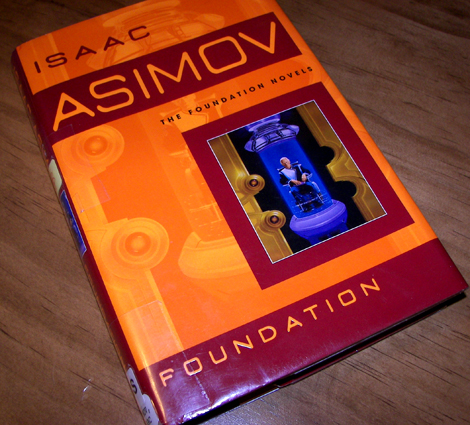
–published 1951
–244 pages, Bantam Books
–(trilogy won Hugo in 1965 for best all-time series)
–5/5 stars
Foundation. Oh how this novel–this series–has haunted me over the years. The Michael Whelan cover of the fourth book in this series, Foundation’s Edge, is one of the earliest books I recall seeing as a young man and becoming lost in the image. Many a time I pulled that book off of my uncle’s bookshelf and stared at it longingly. Something about the book’s description intimidated me, and has all these many years. I read primarily space opera as a kid: action adventure stories set in a futuristic universe. Foundation always seemed like something more, something too grand of scope for me to understand. Through the years as my reading habits evolved and I took on more challenging literature, Foundation has remained a series that in the back of my mind was still intimidating.
Something happened a few years back that began to change my mind. I saw another Michael Whelan image that I liked on a book called Second Foundation (the third in the original trilogy) and just had to have it. Scouring used bookstores and places like ebay finally yielded up a copy. For a year or so I’ve been wanting to read that book just because I like the cover image. But one cannot start with the third book in a series. This year’s emphasis on science fiction and a new goal to read more award-winning science fiction has finally given me the courage to read what is arguably the most well known science fiction series of all time. And it begins with Foundation.
Foundation is not my first experience with Isaac Asimov. I actually read another novel of his last year in my quest to read all the novels that I can recall from my youth that inhabited my uncle’s bookshelf that I did not get around to reading. That novel was The Stars, Like Dust and I was less than impressed. While it had its moments I felt like the writing was somewhat juvenile. I have since read comments of others whose opinion is that Isaac Asimov is not a good writer. After reading Foundation (and currently being over half way through book two: Foundation and Empire) I beg to differ.
From the dustjacket:
For twelve thousand years the Galactic Empire had ruled supreme. Now it is dying a slow death from entropy and corruption. Only Hari Seldon, creator of the revolutionary science of psychohistory, can see into the future–a dark age of ignorance, barbarism, and warfare…
So to preserve the accumulated wisdom of the ages and save mankind, Seldon gathers the best minds in the Empire–both scientists and scholars–and brings them to a bleak planet at the edge of the Galaxy to serve as a beacon of hope for future generations. He call his sanctuary the Foundation.
What proceeds is a novel in 5 parts, spanning hundreds of years, that focuses on various individuals of all levels of importance as they follow the course predicted by Hari Seldon’s scientific research and prediction of mob behavior. It all sounds a bit dry and dull. Or it certainly did to me as a young man soaring off on adventures with Han Solo and Slippery Jim DiGriz. It turns out that it is anything but dry.
Isaac Asimov has been given the title of a Grand Master of Science Fiction and it is easy to see why. He began this series at the age of 21 and by that age he obviously had a command of world-building and storytelling that was well beyond his years. Each section of Foundation focuses on a different class of people: The Psychohistorians, the Encyclopedists, the Mayors, the Traders, and the Merchant Princes. With each group Asimov focuses the story on a specific set of individuals in a specific period of time and shows how their attitudes, actions, and adventures play out along the grand scale of Hari Seldon’s predictions. Each section of Foundation occurs after a significant gap of time from the preceding section. By doing this as skillfully as he has done, Asimov builds a very believable world system with governments, religion, economics and trade being introduced into the story in ways that give the whole novel scope and depth while also being very interesting.
Although is sounds very contradictory, Asimov manages to keep the historical and political stuff in the background and the foreground at the same time. In this way the reader finds himself/herself caught up in the individual stories that are being told while at the same time soaking up knowledge of Asimov’s universe on a grand scale. Interestingly enough some of the concepts of the novel at first seem like they might be dated: the use of nuclear energy, for instance. However Asimov manages to demonstrate cycles of growth and destruction in such a way that one can see this as part of an ever repeating evolutionary cycle of history.
I had no idea over the years what Foundation was, and now that I am reading it I find the whole structure of the telling as interesting as the story telling itself. Although one is only with a certain group of characters for a very brief time, Asimov does a remarkable job of making those characters unique and interesting. Foundation manages to be very simple and very complex at the same time and yet at no point in the reading did I feel like the concepts were difficult to grasp. Despite all my preconceived notions, all Isaac Asimov has done with Foundation is to manage to tell a darn good story.
I feel I am doing a very poor job of representing just what this novel is. With seeming ease Isaac Asimov manages to tell a story in 244 pages that spans hundreds of years and the reader walks away from the experience with a sense of having absorbed an enormous portion of the far distant future history of mankind in the guise of a few very interesting character studies. I am very impressed.
While I did not find the reading to be as powerful an event in my own life as were my recent reads of Ender’s Game and Speaker for the Dead, I did find myself in the throes of a book that I could not put down and one that inspired me to go straight into the sequel without pausing to catch my breath. I am finding Foundation and Empire to be equally compelling and cannot wait to get to the third in the original trilogy, Second Foundation. What Isaac Asimov has achieved with this series is nothing short of amazing. The sense of history I get from reading a book whose stories were originally began over 60 years ago in the 1940’s adds another dimension to the reading experience.
With a man who wrote over 470 fiction and non-fiction books in his lifetime it is safe to say that there are probably some of those books that are not his best work. Foundation, however, is no doubt representative of his very best and it is good stuff. I am so glad that I overcame my childhood fears and decided to give this series a try. It was well worth the risk.
Sounds just like my type of book. I think I’ll be picking this one up at the library soon. Thaks for the review Carl.
I think you and I had similar experiences growing up, though for me it was my dad who had the books. Boxes and boxes of them. Some I read and loved as a ten or twelve year old, others were a little beyond my scope. He told me to give Foundation a try but I wasn’t really able to penetrate it. Maybe I’ll pick it up again this year.
I read Asimov’s Foundation series when I was young and loved it! I remember reading somewhere that Asimov had written at least one book in each category of the Dewey Decimal system- history, theology, fiction, etc. He was certainly prolific: http://www.asimovonline.com/oldsite/asimov_catalogue.html
Congrats! This has been one of my favorites for years and I have been rereading it over and over. It is a fun ride all the way through, and the prequels are also worth reading (The Killer B’s did a series of three novels on Seldon’s life that are well worth the read). Enjoy!!
I have had this series on my list off and on now for awhile. It seems like I always read conflicting reviews of it. I’ll read a glowing review like yours and then one saying Asimov isn’t a good writer (like you’ve heard). I still can’t decide what to do with this series!
I’ve come to the opinion that you should “rent yourself out” as a professional reviewer!
You need to attach yourself to some of the newer writers and get paid to do reviews! I know many do it (like on amazon) for free, but you’d be good to review books of authors you know you already like… they’d sure be happy with you, because besides knowing “how to write”, you give the enthusiam needed to push others to reading those books!
Deslily: Thank you so much for the encouragement and the nice compliments They are much appreciated. And hey, I’m willing to pimp people’s work that I like. Are you saying that Isaac Asimov isn’t going to rise up from the grave and send me a little coin for my glowing review? 🙂
Matt: It is a quick 244 pages, which is a plus, and the way this book is broken into smaller sections I think you could safely ‘test drive’ Foundation and if you aren’t sold within the first couple of sections then you could step away with little time invested.
Julia: I’m so glad I finally took the plunge and decided to read this. It has been a wonderful experience and I can easily see how this could be someone’s cherished series.
JenClair: He certainly was prolific, no doubt about it. I would like to check out some of his nonfiction sometime.
HomieBear: I know I would never have kept reading this if I had started it around the time I ‘discovered’ sci fi through the works of Harry Harrison and Brian Daley. There just wasn’t enough action to start with and I would not have appreciated the nuances of politics and religion, etc. that I can appreciate reading this as an adult. I can just imagine those boxes of your dads, they must have been like treasure chests. Great memories.
Jeff: I look forward to your thoughts when you read or listen to this.
Thank you for reminding me of this series—it’s been on my ‘someday’ list forever!
about Asimov… ummm, I wouldn’t hold my breath if I were you!
I’m glad to hear you liked Foundation! I love Asimov, and I think Foundation is his absolute best series. His writing shines best in short stories, and some of his later Foundation novels just got too long in my opinion, but the original ones are just fabulous.
I love how he manages to create an entire history and culture. Later in life, he tried to link all of his novels into a single galactic history.
If you have not read his “I, Robot”, it is also worth a read. It is short and sweet!
You know, I know this series is a classic, and I’d heard great things about it before, but until today I had not been able to make up my mind about whether or not it’d be something for me. Nobody had taken the time to actually explain to me what it is that makes it so great – not in the way you did. Now I definitely think that this series would interest me. Thank you, Carl!
“Although is sounds very contradictory, Asimov manages to keep the historical and political stuff in the background and the foreground at the same time.”
I know just what you mean. I am currently reading “Voices” by Ursula Le Guin, and it does exactly that. I think it’s amazing how some authors can achieve that balance.
I feel so old. All of the Foundation books have been part of my life since the ’70’s along with R. Heinlein. Has anybody read any of E.E. Doc Smith books? Oh well, my life takes a different path now and reality is stranger than sci fiction, at least in my universe.
Damn you, Carl! I’ve got this one sitting on my shelf too. Now, how am I supposed to read Moorcock, if you give a great review of Foundation? You are a book pimp. Teasing us…, go ahead the first one is free kids… shameful.
It could be worse, Cynthia. You could have said, “all of the Foundation books have been part of my life since they were originally published”! 😉
That’s what I do Cameron. I’m the magic man. I show a bit of cover, fan the pages just to give the kiddies a whiff, maybe let them try a few pages and then, BAM!
I finished listening to Foundation on audiobook yesterday. The reader was excellent and I enjoyed the novel quiet a lot. This was my second experience with Asimov. Last year I listened to I, Robot and I just thought it was ok. Needless to say the recent Will Smith movie, which I liked, was nothing like the original source material but since I didn’t love the book it didn’t bother me in retrospect. Foundation on the other hand I found to be quiet enjoyable. Asimov does a good job of throwing out scientifc concepts in this novel and making them easy for everyone to understand. I didn’t feel like parts were going over my head. The novel to me ends with me still having many questions though. I think this is definitely one series where you have to read all 3 books for the total picture. Needless to say I will be picking up the next two novels in the series. Thanks again for the review Carl!