(A Once Upon a Time Challenge Read)
Not surprisingly, my first official finished read for the Once Upon a Time Challenge is a book from my alternates list, and one that I didn’t possess at the beginning of the challenge!
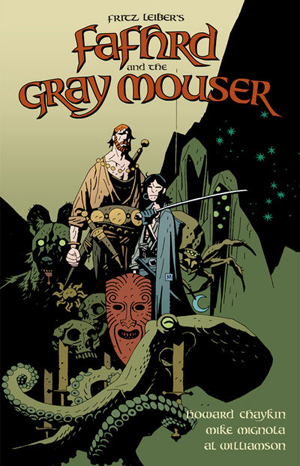
Fafhrd and the Gray Mouser is the re-release of the Howard Chaykin/Mike Mignola graphic adaptation of the classic characters created by Fritz Leiber and featured in stories that spanned a 50 year period beginning in 1939. The original comics have been out-of-print for years and Dark Horse has done a phenomenal job of collecting these for the first time in graphic novel format with a new cover image by Mike Mignola.
Fritz Leiber is one of those influential writers who I had heard of, but knew little about. He has quickly become an author who I am longing to read. Robert E. Howard is generally credited with creating the sword-and-sorcery genre with his Conan tales. Fritz Leiber further defined that genre through the creation of the world of Nehwon, the city of Lankhmar, and it’s most infamous inhabitants, Fafhrd and the Gray Mouser. Leiber defined the genre in more ways than one, actually. It was he who coined the term ‘sword-and-sorcery’ in 1961 when Michael Moorcock suggested a name be given to the type of stories written by the likes of Robert E. Howard.
Fafhrd and the Gray Mouser, the graphic novel, is both a puzzle and a treasure. At times confusing, at other times brilliant, it is a representation of two talents in the comics industry who have certainly improved with age. The issues were originally published in 1991, with stories by Chaykin, pencils by Mignola, and inks by Al Williamson. Not having read the stories previously, I felt somewhat at a disadvantage going in, and that is the only real weakness of this collection. That’s not to say that it isn’t good, because there are some real gems in here, especially for fans of Mike Mignola’s work on Hellboy.
Fritz Leiber’s Fafhrd and the Gray Mouser stories were unique in that he made a deliberate effort to avoid getting trapped by the many cliches of the genre, and also infused a great deal of humor into his characters. Like Howard’s Conan stories, there is a great deal of variety in the Lankhmar tales. Chaykin and Mignola chose to demonstrate that variety by picking seven different stories to adapt. The first story, Ill Met in Lankmar, is really indicative of the book taken as a whole: at times the flow of the story is a bit confusing and disjointed, as if Howard Chaykin was trying to move through parts of the story too quickly; at other times it is fantastic, conveying the variations of subtle and not-so-subtle humor of Leiber’s work and the deep, rich history present in the world he created.
If you are a fan of the work of Mike Mignola, it almost goes without saying that this is a book you need to pick up. While there is an occasional panel that isn’t quite up to the present-day Mignola standards, 99% of the artwork is vintage Mike Mignola. It has a slightly different look given that it is inked by Al Williamson, but it doesn’t take long to see Hellboyesque imagery throughout the book. The book is nicely colored by Sherlyn van Valkenburgh, giving each story an eerie, otherworldly feel.
Returning to my thoughts about the shortcomings of the book, I truly believe if I hadn’t read the introduction to the work that gave some history as to both the characters and to Fritz Leiber’s sense of humor, etc. I would not have gotten as much out of the earlier stories as I did. I felt like not enough time was taken for non-Leiber fans to get a grasp on the characters. But then, this book was primarily written by and for those with a soft spot for the works of Fritz Leiber, so I can understand the desire to get right to the meat of the first story rather than spending alot of time on establishing identities.
I’d give this book a 7, maybe a 7.5, out of 10. At least three of the stories were solid 10’s. The weakest story, chapter six’s Lean Times in Lankmar, turns out to be quite interesting by the end. The context of the story is not set up very well and I felt a bit lost during the first two thirds of the story. I was happy that this was the second to last story, rather than the first, as I feel it would have set a very bad tone for the book.
As an added bonus, the beginning of the first Fafrhd and the Gray Mouser novel, Swords and Deviltry, is printed at the end of this collection. I was instantly hooked by Leiber’s writing style and bitterly disappointed when the free sample ended, eventhough I know something about the direction the story takes from reading the graphic novel. This was a brilliant marketing move on the part of Dark Horse as they are reprinting all 8 novels in the Lankmar series (the first one was published last November).
In the end, this was a must-own book for me and one that I am thrilled to have picked up (thank you Cameron for pointing it out at the shop) and one with stories that I can see myself re-reading in times to come when I just have to have a Mike Mignola fix. I was entertained throughout and came away with a strong desire to both learn more about Fritz Leiber and to read his Lankhmar tales.
When I was a kid I would simply devour comics. I didn’t own that many. but there was a drugstore a block away and I could get a lot of them read before getting kicked out for the day. I would love to read some again. Great review, Carl. It makes me want to go buy some.
Great review! I can’t wait to read the copy of this I picked up last week, too.
What a coincidence. I’m actually reading the first volume of the Leiber stories right now.Was looking forward to picking up the graphic novel you’ve just read – but I must have missed this title when the shipment came in. Will go look for it soon. But from your review it seems better if I read the stories first before tackling the comic.
Thanks for posting this, Carl.
PS: Was looking at the covers on Amazon.com for the DH reissues of the stories – a little disppointed that they did not use Mike Mignola covers.
I’m disappointed with the DH covers as well. Very lame.
I love Mignola.
I finished my last book for this challenge today, so I have now read 5 books. I am just behind in my reviews.
Kailana, you amaze me! 🙂 Congrats! As I’m sure you will read more fantasy during this time period I hope you keep posting links to your reviews on the Once Upon a Time blogspot page.
I can’t say I’m a fan of his artwork, but I do like his Hellboy stories.
I will post them on there for sure. I still have a couple months left, and I think I will join in with reading A Midsummer’s Night Dream in June. 🙂
More and more I’m finding the introductory material an asset to my understanding and enjoyment of the story. Of course, it’s probably due to terminal nosiness. There’s always underlying currents I’d be totally unaware of.
Oh, and I forgot to say, Kailana’s an overachievor! [off to check out her list]
Ah, Fritz.
I have to say, I’m a little shy of him now, though I initially tucked into the adventures of Fafhrd and the Grey Mouser with enthusiasm, even abandon.
The reason? Fritz Leiber was, sadly, kind of a misogynist. Since that’s less uncommon than I’d like in fantasy/SF – land (particularly retro fantasy/SF-land) his was easily overlooked until I got to the story where the Mouser, who up to then I’d been thinking was the member of the duo I liked best, forces himself on a woman who’s sent to kill him…and she rather likes it. It left a rather unpleasant taste in my mouth, and thoroughly mixed feelings on my part to Leiber and his work.
Which is not to say that it wasn’t plenty of fun till then. It WAS. That’s why I think I have such trouble sorting out my feelings on it. 🙂
How timely you are, RB. I just posted something along these very lines over at the Poppet Planet forum: here
I understand how you feel, as will be revealed more if you read that post. It raises really good questions about whether or not we should separate the creator from the creation and whether or not things like you mentioned should mar the entirety of one’s work, especially if we like it otherwise. I’d appreciate you (and everyone else’s) thoughts over there.
I have to say that I am actually looking forward to reading these books sometime and am disappointed to hear about the part you mentioned. Reminds me of my feelings about the Bond books, about the one really racist story in Howard’s Conan tales, etc.
Great review; I appreciate the thoroughness. I mostly dropped in to mention the Fafhrd and the Grey Mouser also showed up as characters in the Wonder Woman comic back in the ’70s, when she didn’t have powers but wore long white boots. Somehow she ended up in their realm.
That’s great, Bill, thanks for sharing. Sounds like something that would happen in comics in the 70’s.
I know, Carl! It’s so hard to know how to feel at times like that…you like the WORK, but you want to also be able to like the person who MADE it. It’s like the terrible disappointment you feel on discovering that a favorite actor is really kind of a bastard. You want to believe that the hand that made this belongs to someone who thinks and feels as you do.
I took a peep over at PP, and though I haven’t time to make a proper response there tonight, I have a Dear Friend who loves Orson Scott Card’s work hugely…but he’s ashamed to admit it because he also knows about Card’s real-life philosophies, and hesitates to be associated with them himself.
Of course the actor is not the character, and the writer is not the writING…but…It’s like any relationship where you discover the one you love isn’t who you thought. It’s disconcerting! 🙂
That said, please enjoy Fafhrd & the Grey Mouser. There’s a lot to love! (Have you got to the one where Sheelba and Ningauble are leaving them messages everywhere? 🙂 )
There are references to that in the graphic novel, but Sheelba and Ningauble aren’t in the first book. I’m sure I will get to them, however!
I had a chance to read this graphic novel this weekend and I have to concur with Carl’s comments on artwork and story. Mignola’s artwork is a perfect fit for this series. My only complaint is with how he draws his ladies. Monsters and graveyards are really his fortay more than people. His angualr style really fits the mood of the series though. The story adaptions are rough at times but I think this is what happens with most adaptions. There is just too much story to whittle down to a comic. I guess that’s why I enjoy the illustrated novel concept like Stardust so much. I get the whole story and wonderful artwork at the same time with no since that I missing out on story for the sake of the artwork. I also would enjoyed the sampler story at the end of the book not quite hooked like you were Carl but I do wnat to read more of the original work some day. Thanks again for the review!
I honestly don’t mind how he draws women most of the time. They weren’t the best in this series, but I like the women in most of the Hellboy stories just fine.
I think you’d enjoy the Fafhrd books Jeff. The language is very interesting and they have a Conan-ish feel to them. I’m really looking forward to picking up the next volume when the DH version comes out.
I agree with you on his Hellboy women. I think he’s just a much better artist now than back when he did this series and his women were weaker back then than he draws them now. Just my two cents. I will agree with you on the novels. I liked the intro and I hope to find time to read the series someday. It’s just when can a fit that day in 🙂