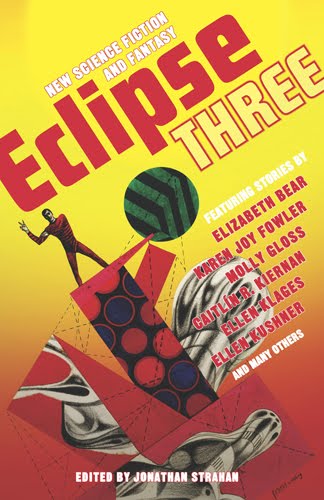
Eclipse Three ~edited by Jonathan Strahan
–published 2009
–281 pages, Night Shade Books
–4/5 stars
Eclipse Three is the just released third volume in Jonathan Strahan’s annual series, meant to showcase new, previously unpublished science fiction and fantasy short stories, unrelated to any specific theme.
To observe an eclipse is to witness a rare and unusual event. Under darkened skies the sun becomes a negative image of itself, its corona transforming the landscape into a strange space where anything might happen, and any story may be true…
In the spirit of classic science fiction anthologies such as Universe, Orbit, and Starlight, master anthologist Jonathan Strahan (The Best Science Fiction and Fantasy of the Year) presents the non-themed genre anthology Eclipse: New Science Fiction and Fantasy. Here you will find stories where strange and wonderful things happen–where reality is eclipsed by something magical and new.
I was there at the beginning, or nearly so, when the Eclipse series began. Older science fiction fans have had the privilege of “being there” when some of the great stories were told, revealed first in magazines and anthologies that, were I to try, would take years to go back and collect, let alone read. I remember being very excited to learn that this new anthology would be released and I, as a fan of the short story genre, would be able to follow along with it year after year. Eclipse One and Eclipse Two found their way to my local Barnes and Noble months after their official release dates. So it should come as no surprise that I was more than thrilled to visit the science fiction and fantasy section last week and see Eclipse Three waiting there patiently for me, at least two months before I thought I would have a chance to read it. I gifted myself a copy and started in on it right away when I arrived home. As with anything one is anticipating, there is always the chance of a let down. Couple that with the controversy surrounding the Eclipse series (which I will touch on later) and it is safe to say that I experienced a bit of trepidation.
Each volume of Eclipse has been different. As one would expect, Jonathan Strahan continues to be open to letting the anthology grow and evolve. He is not content with building a box for stories to fit nicely into, hence the fact that stories need not comply with a particular theme to be included for review. Jonathan Strahan also views stories across a wide spectrum when defining “science fiction” and “fantasy”, which is more readily apparent in this volume of Eclipse than in previous volumes. Eclipse Three is nothing if not expectation-defying, and there-in lies its strength or its weakness, depending on the open-mindedness of the reader. If one comes to this volume expecting standard science fiction or fantasy stories, there is a potential for disappointment. If one comes open to experiencing good short stories, there are enough to be had here to make this a book well worth taking a chance on. It is the non-stereotypical nature of these tales that make me believe that this volume would appeal to those who would admit to not being fond of standard science fiction and fantasy short fiction.
Eclipse Three contains fifteen short stories, some by well known, award-winning authors like Caitlin R. Kiernan, Peter S. Beagle, Jeffrey Ford, and Elizabeth Bear, and others by perhaps lesser known but equally lauded authors. None of these stories are overly long and only one is too-short (in my opinion) to be more than an entertaining conceit. As with the previous Eclipse volumes, the lack of a unifying theme and the diversity of the authors included in the collection means that as soon as one finishes devouring one story, regardless of the level of satisfaction, one cannot help wanting to see what the next tale has to offer.
I made mention of controversy earlier. To get a full picture of the controversy surrounding Eclipse Two, and the anthology series in general, one need only do a brief Google search. To over simplify it for space considerations, Jonathan Strahan and the publishers received a number of complaints about gender bias and a perceived favoritism for white, heterosexual males in the selection of stories for publication and the choice of names to be featured on the cover. Without commenting on the merit or lack of merit of these issues, I personally believe Jonathan Strahan when he asserted during the controversy that one of the main methods he employed when picking stories for his anthology was that he simply chose stories that he liked, with no thought of the sex, sexual orientation, or skin color of the author submitting the story. The controversy became so heated that at one time Strahan wrote that Eclipse Three would be the final volume in the series, something that he thankfully seems to have changed his mind about based on comments in the introduction to this volume.
I had a hard time getting that controversy out of my mind when I started this book. I was quick to notice that the number of female authors outweighed the male authors and that a name as notable as Peter S. Beagle was not included on an all-female-author cover list. Please don’t interpret this to mean that I was insulted by this or feel a need to start a controversy once again or have some gender bias of my own. I just couldn’t help shake the feeling that this seemed like an overkill move in the wake of the controversy over the last volume. If, however, it causes those who were thinking of boycotting this series to give it a chance and if it means that Jonathan Strahan will keep working on this series for years to come, then I will brook no complaint. I share this only to tell you the frame of mind that I was in and the fact that I felt the need to make an effort to not pre-judge this volume in a negative light. Given that the first two stories, by no means bad stories, felt more like they would be at home in a horror anthology, I was a bit afraid that Strahan might have lost his way. He hasn’t. This is another really enjoyable, worthwhile collection of short fiction and one that has the potential of appealing to a much wider audience.
Karen Joy Fowler starts the collection with a story that elicited really strong emotions in me as I watched the suffering of the protagonist. It got my dander up! A Practical Girl by Ellen Klages was good, but was certainly a story that I felt might be more at home in a horror anthology. Pat Cadigan’s Don’t Mention Madagascar, the third in the collection, was the first home-run for me. I really enjoyed the mysterious, Twilight Zone-ish vibe of the story. On the Road by Nnedi Okorafor felt like the kind of side story that would be right at home in Neil Gaiman’s American Gods novel (in case you don’t know, I mean that as a compliment). Elizabeth Bear’s story, Swell, is a foray into myth and music that reminded me very strongly of the kind of short stories that Charles de Lint writes and because of that suffers only ever so slightly by the fact that I could not help thinking what the story would have been like if de Lint had written it. It is patently unfair to Bear which means that I feel the need to reiterate that it is a very good story and I really did enjoy it.
Useless Things by Maureen F. McHugh was a story that I was really caught up in, but it left me a bit discontented because it ended. McHugh did such a good job fleshing out the main character that I felt cheated by my abrupt removal from her life. The Coral Heart by Jeffrey Ford was the first story that would fit in a more traditional definition of “fantasy”. It reads like a legend passed down from generation to generation and was terrific. It Takes Two by Nicola Griffith was a story that seemed really out of place for me. I understood by the end that the science/genetics elements gives it the grounds for inclusion into this collection, and it is by no means a bad story. I actually cared about the characters and certainly wanted to keep following them to find out how their lives progressed. It was just an odd choice in my opinion.
Sleight of Hand by Peter S. Beagle is great, absolutely great. A story about love and loss and choices that has a great mystery and magic element to it. It is worth getting the collection just to read this story. Daniel Abraham returns the reader to the more traditional fantasy realm with his story, The Pretenders’ Tourney. It is an interesting take on the idea of the divine right of kings and was another story that I thoroughly enjoyed. Paul di Filippo’s story, Yes We Have No Bananas, was the most difficult story for me to grasp. Di Filippo’s writing style took a bit of getting used to and I found that I had to pay very careful attention to what was being said during certain moments of the story or I would miss things. The effort was rewarding in that I enjoyed the main character and the world that di Filippo puts him in. I am not sure it entirely worked for me, but it was fascinating nonetheless. Mesopotamian Fire by Jane Yolen and Adam Stemple was a cute bit of fluff. Slight and silly, but smile-inducing.
The anthology ends with three very strong stories. Molly Gloss’ The Visited Man was an engaging page-turner, about loss, and ghosts and the bizarre relationship of two neighbors, one a painter and one a man determined to let life pass him by. Caitlin R. Kiernan’s Galapagos was the only traditional science fiction story in the collection. It had the same eerie feeling one got during the first half of the film Sunshine and reading it made me itch for more sci fi short fiction. An excellent story. And Ellen Kusher’s Dolce Domum took the collection out on a high note with a story that would be right at home in the urban fantasy genre.
Night Shade Books includes a very nice “About the Authors” section in each of the Eclipse volumes, a feature that I enjoy reading immediately after I’ve read that author’s story. The cover of this volume is by the late Richard Powers and was a previously unpublished find. When the cover art was first revealed I was unsure of what I thought, especially in comparison the the wonderful artwork of Micheal Whelan and Donato Giancola that graced covers one and two, respectively. However, when I got a look at it in the bookstore a wave of nostalgia washed over me because I recognized it as a Powers cover. The nostalgia came from the fact that Richard Powers’ artwork is featured on early versions of the first three Stainless Steel Rat novels. The enigmatic nature of the cover is a perfect representation of the stories contained within this anthology. Kudos to the art director for the choice.
Jonathan Strahan has tasked himself with paying homage to some of the ground-breaking anthologies in science fiction and fantasy history, while working to open up the genres to new and innovative works of short fiction. Each volume of the Eclipse series has proved to be difficult to fully define even after one partakes of the stories contained therein and each volume has included some immensely satisfying examples of the medium. Each of the previous two volumes have produced award-winning stories and I will be surprised if some of those featured in Eclipse Three don’t end up on short lists during the next award season. If you are a fan of short speculative fiction it is safe to say that there are stories that will please in this collection. If you tend to shy away from short fiction in the science fiction or fantasy realm, Eclipse Three would make a nice primer to the genre.
I tore through this collection, urged on by the experience to see what the next story had to offer. And while I am pleased to have been able to read this collection this close to its release date, I have to say that I am not looking forward to the long wait for Eclipse Four. Needless to say my expectations will be high. Congratulations Jonathan Strahan and Night Shade Books on another memorable collection.
the whole time I was reading your post all I could think of was about a fact I learned while reading for RIP that both Wilke Collins and Charles Dickens wrote their stories for a magazine, as the ones you are reading did. Of course society does not consider sci fi or fantasy “literature” but find it interesting that they went about writing for magazines such as collins and dickens did.. there’s a fine connection there I’m just sure of it!
Deslily: It is interesting that you mention that because I think about that whenever I read those kind of stories, or classic science fiction. Some of my favorite genre novels, short stories, and literature initially found their in a serialized form in magazines. Fascinating…to quote my favorite pointed-eared bastard.
Hmm. Interesting. First off, let me say how glad I am you enjoyed the book being such a fan of the series and the short story format. There’s nothing like tearing through a good book. I felt that same way recently as I tore through Peter and Max by Bill Willingham in four days.
I remember reading some of the controversy surrounding this series as well last year and it’s disappointing to me that that cover choose to emphasize all female authors. Seems the squeaky wheel does get the grease. It’s misleading to the reader for one thing. I would think at first it was an all female anthology. I would then be hesitant to purchase it once I read the table of contents and saw Peter S. Beagle’s inclusion and flip back to the cover to make sure his name wasn’t on it. I would assume, wrongly so from your review, that Mr. Beagle’s story must be quite below his normal standards if his name wasn’t chosen to be on the cover. I also would be surprised that Daniel Abraham’s name wasn’t on the cover as well. Without reading someone’s review I seriously wouldn’t even consider picking up this collection. I figure if the company putting together the anthology seems to be hiding something with there choices of top names to highlight on the cover then I wouldn’t pick it up because my first instinct would be that there is something slightly “off” with the collection.
Your review also sounds like that this collection should be stated more as a Fiction anthology and not a Science Fiction and Fantasy anthology. I realize though this is done more for a marketing choice than any other reason. Night Shade knows that these authors are known for making sales in the science fiction and fantasy sections of bookstores and it’s easier to market it there rather than try to sell it to new readers in the fiction section of the store. I hate the fact that all these books aren’t just under the heading of fiction instead of us having subcategories like Scifi-fantasy, Mystery, and Romance. Time Traveler’s wife is sheleved in Fiction instead of Scifi and Jane Austen novels in Fiction instead of Romance. All these seemingly arbitrary decisions from my reader’s perspective are completely confounding to me. People will look down on works in the subgenre’s and then laud works from the fiction category even though there ideas are completely similar. I guess I’m more annoyed at the fact that the mainstream wants to always look down on the book’s I love because they are from the Science Fiction and Fantasy section of the bookstore. Bookstores and the way they are arranged remind me so much of high school clicks. You’d think we would outgrow the need such labeling as adults but sadly it’s not true.
Sorry for my soap boxing Carl. 🙂
Jeff: No need to apologize for the soap boxing.
It is interesting that you mention Beagle and the quality of his story because I noticed on another review site that the reviewer felt this was one of Beagle’s lesser stories. I’ve only read a couple of his short stories so I have no basis for comparison, but I did feel like this was a strong story.
And it isn’t so much that this isn’t a true science fiction and fantasy anthology and that it is marketed wrong but that many of the stories contained in this volume could be classified as fitting or not-fitting the genre depending on how one felt. Here’s an example of what I mean. There are those who do not consider Firefly science fiction. They consider it a Western with sci fi elements. I tend to have a very broad and simplistic definition of science fiction…if it has space ships in it then I consider it sci fi. It isn’t that one definition is right or wrong, but it does point out that people can have very good arguments on both sides of the debate. And I’ve read very reasonable ones pro and con Firefly being science fiction. I think the same could be said for many of the short stories here.
Bringing up Time Traveler’s Wife is a really good example because the same logic used to place it in the fiction section could be used to place some of these stories in a general fiction anthology. In the end Strahan has put together some pretty good stories even if some of them do not have strong science fiction or fantasy foundations.
Labeling is a pain in the butt, and a good thing as well. I personally would rather not have to look through the entire fiction section to discover sci fi or fantasy books that I only notice because I’m spending time in those bookstore sections, and yet I feel so many other people who are close-minded about these genres miss out because they avoid these sections of the bookstore altogether.
As for the controversy, Strahan and Night Shade definitely seemed to be in a ‘damned if you do, damned if you don’t’ situation with this book. I would have liked to see the efforts at addressing the controversy result in something more balanced, but I also don’t know when in the course of planning the decisions were made. I do sincerely hope that this gets the complainers off their backs so that the series continues. I enjoy the adventure of seeing what each year’s volume will contain.
You just had to bring up Space Cowboys didn’t you! You know it always makes me sad when I’m reminded of how such a wonderful story was taken from us too soon.
I for one agree with you in the hope it gets the complainers of Mr. Strahan’s and Night Shades backs so the series will continue.
I understand what you mean by labeling being a pain but I do think we would all adjust in time if all fiction was shelved together. Think about it now. As often as we walk up and down the Scifi and Fantasy isles it doesn’t take us more than 5 minutes to see what is “new” each month when we make a trip or two to the local book store. I have no doubt we would adpat as well to entire fiction sections as well. In time we would be able to spot the “new” books just as easily in an even bigger section. It may take us longer to spot them but hey were book buyers we LOVE browsing for books anyhow. 🙂 I just don’t feel any stigma attached to genre authors will ever go away until all fiction is shelved together. Plus, I could see myself crossing over into other fiction genres much easier if they were shelved together.
Hopefully one day I can win the lottery and we can open a book store and experiment. Dare to dream!
I felt bad I forgot to mention in my previous post how much I like the Richard Powers cover as well. Very cool find and lucky for us. I would love it if someday some unused John Berkey art might be found and used as well.
I certainly wouldn’t be broken hearted if they decided to start shelving all fiction together. I would hope that it wouldn’t be an excuse for bookstores to buy less sci fi and fantasy titles though. Boy, I’m a cynical one, eh? I do a decent amount of browsing in the other sections, more particularly mystery, but definitely not as much as I would if it were all shelved together.
I’m with you there on that dream, buddy! And yes, wouldn’t it be cool to see some unpublished Berkey art be found?!?! Even more cool if we were the ones to find it!!!
“If one comes to this volume expecting standard science fiction or fantasy stories, there is a potential for disappointment.”
The problem I am having lately with fantasy and science fiction is that it is so hard to find fresh ideas. The same tired plot lines are simply being regurgitated with cooler covers meant to entice us, yet leave us disappointed once again. Thanks for pointing me to something new and fresh! I only feel completely satisfied after reading the genre that will always be my first love.
Tonya: Science fiction is my first love as well, and although many different kinds of reading thrills me, there is always that something special when reading science fiction. I am much more forgiving with the genre than with any other genres I read because of my lifelong affection for it. I’m not as concerned with fresh ideas personally as I am with a good story, but if you are looking for something that is not cliched, the Eclipse books have some great stories. Try Paolo Bacigalupi as well.
It was a cool collection – a cool slipstream collection, that is.
Leaving out the nerdy white men was a costly decision. The stiff doses of magical realism could really have used some Baxter or Stross to leaven the estrogen melange.
Bodirotta: I don’t know that I disagree with that at all. I certainly haven’t read enough of either author, so a little bit of each would not go amiss.