My father once told me that respect for the truth comes close to being the basis for all morality. “Something cannot emerge from nothing,” he said. This is profound thinking if you understand how unstable “the truth” can be.
~from “Conversations with Muad’Dib” by the Princess Irulan
A Duke is betrayed. The betrayer is silenced. And in the aftermath a boy and his mother set out into a barren desert wilderness, perhaps in fulfillment of an ancient prophecy.
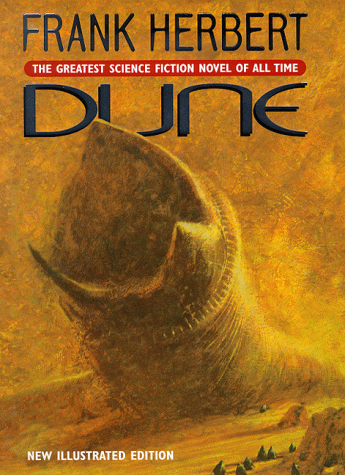
It is Saturday, and that means it is time for more conversation about Frank Herbert’s masterwork, Dune. This past week the group read covered Book Two: Muad’Dib, the gripping middle section of this unfolding drama. I cannot help but recall the words of Poe–
That the play is the tragedy “Man,”
And its hero the Conqueror Worm.
Andrea (Little Red Reviewer) took on the challenge of coming up with this week’s discussion questions. Thank you Andrea! She sent out a list of questions giving responders the option of answering all or just some of the questions. Below the jump you will find my reflections as well as our good friend Mr. Linky, who will guide you to the discussions of the other respondents.
Once again I feel obligated to warn you that spoilers are present in the Q&A portion of these posts. And once again I would like to encourage discussion from anyone who would like to participate, not just those who are currently a part of this group read.
And now, Book Two.
Was Liet’s identity a surprise? who do you think he really works for?
The entire concept of Liet was a surprise for me. Remember, I am coming at Dune seeing “through a glass, darkly”, that glass being multiple viewings of the film. One of the things that has piqued my interest while reading Dune is the role that religion and religious ideology play, in particular the way in which the Fremen’s beliefs are contrasted with the rather cynical and manipulated ‘religion’ of the Bene Gesserit as seen through the eyes of Jessica. That Liet was also Kynes was a pleasant surprise as he is a character I enjoyed from the first section of the book.
I’m not certain in some respects that, despite his devotion to the Fremen, he doesn’t work for Arrakis itself. In listening to his dialogue with his father (which I enjoyed) it seems that he has a deep devotion to the planet itself and certainly has some understanding of what needs to be done for the planet to be made more habitable. As we later learn it is the seeds of his vision that grow in the hearts and actions of the Fremen, a vision that would make Arrakis a habitable paradise for future generations. Even in his death I find Kynes to be a riveting character. I hear Spock’s voice in my head…”fascinating”.
What do you think of the Fremen culture? is this a culture you think you’d enjoy spending some time with?
Outdoor living, communing with nature, etc. is a very romantic notion. When spring is in the air or the chill of autumn creeps in I can think of nothing more pleasant than spending hours outdoors, walking through the woods and just appreciating creation. Were the Fremen to exist on a planet bathed in the glow of autumn leaves I could see myself stepping into that life and embracing it as if it were heaven itself.
But the reality is that I am a product of the 20th century. I like air conditioning. I like immediate access to cold water. I like to shower daily. I’m not fond of the idea of peeing my pants so that I can have a sip of it later on.
I think the Fremen are one of the most creative things about the novel. Their all-for-one devotion and their slow but steady process of working to turn Arrakis into a green, habitable place are very admirable. I also find their customs and their efficiency and attention to conservation (especially water conservation) very interesting. They would indeed be interesting to spend some time with, but I suspect they would find me weak and would quickly relieve me of my water. 🙂
What do you think of Count Fenring’s unusual verbal mannerisms?
The Count and his wife were great characters for a brief interlude of intrigue and espionage, but the humming secret conversation did not work for me at all. Maybe it will seem more necessary as the story unfolds, but as Herbert wrote it the scene was somewhat problematic. I get why he told us they had a secret language and I get why they would then employ it. But the fact that Baron Harkonnen seemed unfazed by their strange hum-filled speech that immediately went away in his ‘cone of silence’ conversation with the Count did not make any sense. I could not figure out why Herbert didn’t drop in some reference to this noticeable change. We get the impression that the Count and his wife are secretly communicating to each other even while conversing with others in the common tongue, and yet we are not privy to what they might be saying and so again it feels very unnecessary.
I like what they are up to as it adds more scheming to the story and creates new and interesting threads for Herbert to weave into the tail, but the affectation of the secret speech felt very contrived.
This is a far future empire with very little in the way of computerization. Information is often passed down orally, and schools (such as the Mentats and the Bene Gesserit) have formed to train young people in memorization and information processing. What are you thoughts on a scifi story that is very “low-tech”? Does that sound like a feasible future? a ridiculous one?
I like the low-tech science fictional elements. For one reason it adds to the timelessness of the story, which I will discuss more in answering an upcoming question. The other reason has to do with a point of view. If I were to live well past my years and history were to play itself out I am more apt to believe that with population growth and the course the Earth is taking, etc. that tech will reach a ceiling and then come crashing down upon itself. Normally I’m pretty optimistic, but I’m pragmatic as well and the low-tech way feels more realistic to me than an ever-increasing high-tech society. Dune entrances because you have both ends of the spectrum, but even with the more hi-tech elements like space-travel the Houses exist in a societal pattern that feels more like the days of Rome than other science fiction visions of our future.
So yes, it feels more feasible to me.
If you found the beginning of the book tough to get into, do you find that you’re having an easier time with the middle portion, now that all the “set-up” is complete?
I was sucked right into the book from the very beginning so I didn’t have any problems with it, but I do believe part two is better because longer moments of time are spent with one or two main characters and thus the story has a more natural flow to it. And there is some great slow-building suspense.
Even though I was aware of the Water of Life moment and how it would play out my heart was literally in my throat as I read that section and I felt the urge to read faster just so I could get to a point where I could take a deep breath again. Way to go Frank Herbert!
The center portion of the book is still pretty dialog heavy, but what I’ve noticed is the subtlety of the dialog. Things left unsaid are often more important than things that are said. What do you think of that as a stylistic choice? does it make the dialog more interesting? less interesting?
I think it makes the dialog very interesting. I didn’t have an issue with the dialog in part one and have not in part two either. Characters having conversations with each other or with themselves is very entertaining to me and I like the way Herbert writes. His characters at times know far less than we do as readers and other times they are enigmatic and what they might know or suspect is hidden from us (at least for the moment) and that makes for good storytelling.
Dune was written in the 60’s. Does it feel dated to you? How does it compare, writing style-wise, to more contemporary science fiction you’ve read?
Surprisingly enough Dune does not feel dated (to me) and I have not gotten that 60’s vibe from it at all. When you watch the film version, particularly because of the state of technology when it was made, you get a very dated feel from it. Someone (perhaps more than one person) pointed out in their discussion of part one that reading Dune right now feels very timely given the political, economic and environmental state of the world. I think that points to the timeless quality of Frank Herbert’s story and is one of the reasons why it is still read today and why it is considered one of “Science Fiction’s Supreme Masterpieces”.
One of the reasons I think Dune retains a timeless quality is that much of the story (thus far) is taking place in conditions that are not filled with shiny, high-tech gadgets. It is the gadgetry and machinery of classic science fiction that often shines a light on its dated elements. Dune has its fair share of mystical, magical elements that do not feel dated and certainly this second section is largely spent out in the kind of wasteland that could be the setting for any kind of novel, from historical fiction to a modern day trek through the arid wilderness. I mentioned before that I see some elements of historical Rome and that is a motif that has been repeated so often in fiction, and parts of it are also the basis of our Western society, and thus those elements also give it a timeless rather than dated feel.
I am also beginning to see more and more why this work is compared to Tolkien. Not that they are anything alike and what Tolkien did, in my opinion, is far more masterful. There are two comparisons I see–that Arrakis as a world is itself a character, much like Middle-earth is and that the language used, the names of people, places, etc, feels very grounded and very authentic. Tolkien based his languages off of very old and nearly forgotten languages and peoples. Herbert’s feels influenced by the Middle-east. I think this influence of real cultures and languages is what gives both of these works a depth and richness that few works of fantasy or science fiction achieve. One thing that really throws me out of a work of genre fiction is names that sound very “made up”. I won’t start naming names for fear of insulting someone’s favorite, but I imagine we can all think if examples where the author was obviously just trying to make up something that sounded unique rather than basing their created language on a good understanding of the way language works. I see evidence of Herbert having that kind of understanding when I read Dune. That too helps it rise above classic genre fiction that feels dated.
If you’ve never read this book before, where do you think the storyline is headed?
I haven’t read the book and while I have some overall idea where the story is heading because of the film, my honest answer is that “I have no idea”. Knowing film adaptations of books are rarely faithful to the source material I shouldn’t be surprised at how different the book is, or how much more complete, but I am. I have been frequently surprised by events both small and large and that has made this read so very pleasurable. I don’t feel like I am rehashing a story I have heard before.
I am digging this book!
I hope you’ll take the time to share a link to your post on Part Two below. Thanks everyone, look forward to your thoughts on this section of Dune, be they similar to mine or completely contrary.
I am, with Kailana having dropped out, probably the only one left who isn’t totally into the book but, I like it much better.
I answered some of the questions in a very similar way. Living in Europe I wouldn’t have a problem without air-conditioning as we do not have it (only rarely) but there are other things that are too archaic and that I wouldn’t enjoy. And I would miss plants and rain too much.
I also found the verbal mannerism odd and didn’t really understand it.
Low-tech is the way to go for me. Resources are limited, no way could we go on with more and more technology.
I don’t know any new sci-fi but had the feeling it wasn’t dated. You confirm my feeling.
I did think that part II was quite gripping, especially the beginning and I’m curious to see what comes next.
I had a feeling you would enjoy the second part more than the first since it seemed to shift gears and settle into a more natural, for lack of a better word, pace.
True, but if you lived out in the hot dessert instead of Europe I would imagine air conditioning might be something you would long for. 🙂
I would miss trees. I’d miss them terribly. Of course the Fremen wouldn’t hardly know what those things were.
One other thing I forgot to mention that I found very powerful was when Paul cried and the reaction the Fremen had to that. It was touching and a powerful scene.
I am not reading along but I’m loving the Q&A. Kudos to all involved, very entertaining 😀
Thanks Kelly, I hope that you and yours are having a great weekend.
Hi Carl. I loved your discussion on the Fremen. This line made me burst out into laughter, “I’m not fond of the idea of peeing my pants so that I can have a sip of it later on.” And I’m not fond of drinking any of my body fluids. And drinking the water from a dead friend or comrade would be difficult.
I also like his use of dialog.
I’m glad that you are enjoying the book and that you have almost completed the book that you have been chasing so long!
TBM: I am thrilled that I have finally (almost) conquered this book that I’ve been saying I was going to read for so many years. Wonder what book, like that, will be next?
Yes, the whole water reclamation thing is brilliant and would be so necessary, but it is something you don’t want to think about too much. I imagine living in those conditions would make your quickly abandon your qualms.
I have two books that I know I should read but I have been putting them off due to time constraints or other things. One is Moby Dick and the other is War and Peace. And I think both are on my 1001 list so I can’t put them off forever.
I would love to know what your next “one” will be.
I can only imagine if you grew up among the Fremen that their way of life would seem normal. Did you see the movie 127 Hours? The hiker guy learned the importance of drinking your own fluids. And he didn’t have a fancy way to change the taste and stuff.
TBM: I never had any desire to read Moby Dick until after I read Jeff Smith’s epic fantasy graphic novel series, Bone. The main character is madly in love with the novel and there are several running jokes about it. Reading that made me actually consider Moby Dick as a book I might want to read. The same thing goes for The Histories by Herodotus, a book I keep thinking I want to read because of Shadow, the main character in Neil Gaiman’s book American Gods.
I haven’t, but I want to see 127 hours. And yes, the idea of us comparing our lives to the Fremen is silly on one level because if we did live there it would all seem quite normal. Funny how it seems to be pretty consistent that everyone respects and likes the Fremen and would choose them over many of the other races in Dune.
Ah…The Histories by Herodotus is another one I should and want to read but I haven’t. (And I have a masters in history–but don’t tell my professors just in case they take it back.)
I didn’t see too many options in the novel of people I respected besides the Fremen.
I’ll have to look into the series you mentioned and see if that helps my desire to read Moby Dick and The Histories.
I’m not sure if you have read or have any desire to read graphic novels, but I would highly recommend Bone. You can pick it up uber-cheap in its large one-volume edition in many used bookstores and it has a nice, epic fantasy quality, brilliantly beautiful line work, and some really memorable, fun characters.
I haven’t read any, but I’d be willing to look into if it will make me want to read Moby. I’ll keep an eye out. Good thing I made my project a 50 year one so I don’t have to rush into things.
When I reviewed Bartleby the Scrivener not long ago there were interesting statements about Moby Dick. People love or hate it. I’m stuck in the middle of Anna Karenina since almost two years.
I’ve heard that about Moby Dick as well. My main reason for not even considering it in the past is that it is a bear of a book and I have plenty of other fat books here that I know I want to read that I have yet to get to.
I loved Anna Karenina. I think one of my reasons for loving the book so much was that my grandmother loved it and I was very close to my grandmother. We didn’t read it at the same time of course, but we both loved the story and could talk about it.
I have never read it. It stays on my radar mostly because we watch Shop Around the Corner every year at Christmas time and Anna Karenina is the book that the girl brings with her to her mystery date.
“I’m not fond of the idea of peeing my pants so that I can have a sip of it later on.”
This made me laugh out loud, and pretty much summed up my feelings on wanting to actually live with the Fremen, even though I found them fascinating. I would imagine that stillsuits would have better purification though than a modern day water treatment plant, so it might not actually be that bad.
Instead of the “Fear is the mindkiller…” mantra I would have to have a “its only water. Its really only water” matra to help me feel comfy in my stillsuit.
Just as others have mentioned, I got a great laugh out of your stillsuit musings! I completely agree with you about Liet’s devotion to the planet being his greatest desire. Why do my favorite characters have to depart so quickly?
I do love this second part of the story because they are in the outdoors more, but besides the horrible body odor I imagine in the sietch, I think I’d be afraid someone would kill my mate and then I’d have to hang out with the killer. Not cool.
I like the comparison to Rome. I’ll have to think about that more. The Baron strikes me as a Nero or a Caligula.
Since there had been discussion about the comparison with LOTR, I also had similar thoughts as you. They are very different, but in terms of the development of language and also the songs and poems that come of every now and again, it did remind me a bit of Tolkien. Nothing is as good as LOTR though. I keep looking, but to no avail…
Once in awhile (or often) the juvenile side of my personality works its way out. 🙂
I was quite shocked at Liet-Kynes’ death. I really expected him to be around for awhile.
The Fremen culture is one of those interesting cultures in which one would have to have a lot of acceptance. It is an honorable culture so in theory you wouldn’t be ‘called out’ unless you truly offended, and I suspect their beliefs would go so far as to be that if you died then that was what was fated. Women, or at least some of the women, seem to be as much possessions and second class citizens if they and their kids are passed on to the victor. Or it could be looked at that the culture is so intertwined that that is not the case but that it is all about responsibility and if either a man or woman is killed and that dead person has familial and marital obligations that the victor is obligated to take on those responsibilities because it is the honorable thing to do. It would be an interesting way to live, and not one I would truly want to try to adjust to.
Comparisons to Tolkien are always silly on one hand because of the uniqueness of what he did, but the more I read this the more I can see why someone could draw some comparisons, whether or not it is right to do so.
I can’t imagine that drinking your own pee is ever going to fill anyone with joy 🙂 but needs must in some circumstances.
I agree with you about Count Fennring, I found his speech mannerisms took me a little out of the book.
Some great questions, this round and last, thanks.
Fence, I hope I never find myself in those circumstances. 🙂
I’m hoping we don’t have to see too much more of Count Fenring in the third section, although I suspect he will reappear.
I found Count Fenring’s character interesting since I think he revealed some interesting aspects to what may or may not happen. But I just hated reading his dialog.
I’m in the same place, TBM.
well carl, my friend, i can talk about DUNE for hours. days! 🙂 i’ve loved reading them answers to these questions on yours & other people’s blogs!
the fremen are absolurely fascinating, aren’t they? i quite liked the idea of drinking my own (distilled) pee! i thought it made such sense and was v resourceful. (although that probably has something to do with my best friend’s older brother loving to fantasize about desert-shipwreck worst case scenarios and that sort of thing!) no doubt you thought the same! so i really want to do it, ’cause it was so efficient.
i love their spartan approach to things, and was rewlly taken in by their spirituality. having been in a desert, i can really relate.
i’m curious, why would say that LOTR is more masterful than DUNE?
JP: I give you permission to spend the hours, go for it!!! 🙂
It was very resourceful of the Fremen to harvest all of their ‘water’, but I’m not sure I could ever get to the point where I “quite liked the idea”. LOL! Usually when I’m fantasizing about the desert-shipwreck scenario it is trying to choose between Ginger and Maryanne. 😉 Not much of a choice really. Despite my love of redheads I would be drawn to the goodness of the cute Maryanne.
I felt like I just came in from the desert, temperature wise, but I’ve never really been in one so I can’t relate. I do think the desert is beautiful, but in that “scary and I have to respect it” way.
I think LOTR is more masterful than Dune partly because I have grown to be a Tolkien fanboy and partly because of Tolkien’s devotion to real (dead/dying) languages and the way that he used those and his understanding of these ancient cultures to craft a mythology that feels so very authentic. As much as I appreciate what Herbert has done I would have a hard time ranking his accomplishments, or quite frankly anyone’s, with Tolkien. But then again I have no real basis for comparison. I’ve studied a lot about Tolkien over the past 10 years and know next to nothing about Herbert, so my opinions are just that.
Finished the second part last night and just posted my answers to the questions. 🙂
I saw Fenring’s mannerisms more as a ruse to appear harmless and rabbit like, a way to mask his code. I still found it annoying though!
I’ll be over to see your post.
I certainly understand why Herbert made Fenring and his wife the way they were as it does make sense, I just think his execution of the idea was lacking somewhat.
As usual, I’ve arrived late at the party. The concept of still suits certainly gives new meaning to BYOB, doesn’t it? 🙂
Or BYOP! 😉 And the party is still going on, so you are just “fashionably late”.
I am a few days late but my answers are now posted.
Thanks Jim, I’m glad you got yours up. It was great to read and I look forward to your thoughts on this final section of Dune.
I’ll try to get my comments up on Saturday this week. I knew you would love this book once you started reading it.
I love hearing your thoughts on Dune! I’m going to have to re-read this book again at some point and come back to your posts. I have some others in the series unread on my shelf so I’ll have to do a Dune marathon. So glad you are enjoying it!