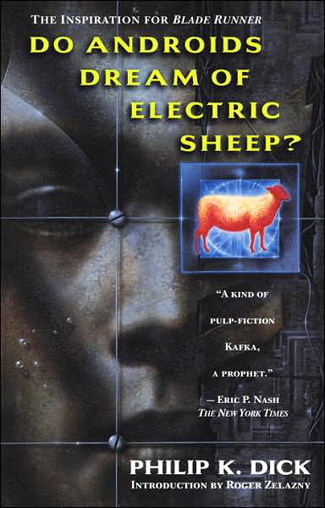
Do Androids Dream of Electric Sheep ~Philip K. Dick
–published 1968
–244 pages, Del Rey Books
–Nebula Award Nominee
–3.75/5 stars
Forget all you know or think you know about the story that inspired Ridley Scott’s 1982 science fiction classic, Bladerunner. Do Androids Dream of Electric Sheep–one of the greatest book titles ever in my opinion–is as different from its celluloid offspring as night is from day. Well, perhaps not that different but the comparison comes close.
It is easy to say forget about Bladerunner when reading Do Androids Dream. It is another thing altogether to actually be able to do that and I have to admit that I was unsuccessful in doing so. I would have loved to have read this book before seeing the film, or I would love to have had the ability to divorce myself temporarily from my affection to Bladerunner while reading this but I could not. On every page I envisioned Harrison Ford as Rick Deckard, the novels protagonist, and this did not always work. But more about the later.
Do Androids Dream of Electric Sheep tells the story of a future in which Earth is a post-apocalyptic mess as the results of the fallout of World War Terminus. Those who can afford to do so have left Earth to live in other off-world colonies. Those left behind range from the middle-class, who would like to leave but cannot, to those whose intelligence has been affected by the fallout and are unaffectionately designated ‘chickenheads’ or ‘antheads’. In this future world better and more sophisticated androids are being built, ostensibly to help man and make life better. As technology improves, some androids begin to envision a life of their own making and escape to Earth to attempt to do so. It is this android threat which gives our protagonist, Rick Deckard, his occupation: he is a bounty hunter (a ‘bladerunner’ in the film) whose job it is to administer an empathy test to suspected androids, ‘andys’ (‘replicants’ in the film version) and then to terminate them. So far it sounds suspiciously similar to the film. But this is where the two diverge from each other. While the film Bladerunner borrows this structure and plot from the book, Philip K. Dick’s classic story contains so much more that not only wasn’t in the film but would not have really worked with the kind of film Ridley Scott was trying to create.
One of the major plot lines of Do Androids Dream of Electric Sheep is mankind’s almost deity-like worship of animals. The chemicals from the war have caused countless species to become extinct. Thus it becomes a mark of social status to own animals. So much so that an entire industry has cropped up to make fake animals that look so real one can hardly tell one from the other. Rick Deckard is not a rich man and he and his wife have to make do with an electric sheep. Throughout Dick’s novel, Deckard is obsessed with obtaining more and better fake animals or, if possible, real ones. In fact it becomes his driving purpose during the time the reader is allowed to spend with Deckard. It is here that the images of Harrison Ford really interfered with my total immersion into the novel as I just could not picture the tough-as-nails Deckard as played by Harrison Ford wandering around waxing eloquent about animals. This is just one of many intriguing ideas PKD weaves into this story. Dick also introduces a religious ideology called Mercerism based on the one thing that supposedly separates mankind from the androids: the ability to experience empathy. There is also a subplot involving the state television network and a star personality who may or may not be an andy himself.
Like the film, Do Androids Dream of Electric Sheep introduces a set of androids who have escaped to earth together in an attempt to assimilate into society. Deckard is given the job to track, test, and terminate these androids as soon as is humanly possible. The reader is allowed to spend some time with these androids as well as with a chickenhead named John R. Isidore who by chance ends up housing the androids. What sounds like a confusing and unrelated jumble of ideas actually flows together quite well in the hands of Philip K. Dick. This is my first experience with his work and judging from this book alone I am convinced he is a very skilled craftsman. The majority of the story flows very well and it is an interesting and ultimately very different science fiction tale. The story has a few imperfections for which I rated it lower, the most obvious for me being a section of the book in which John R. Isidore goes on a religiously idealogical rant that took me out of the story and made me rush to get through that section. I think the points he was trying to make with that character were valid within the story but for some reason it didn’t flow as well with the rest of the story as it could have.
Where Do Androids Dream of Electric Sheep succeeds and the reason for its classic status is the power of the message of what it really means to be human. While I knew from the film that this was part of the point of the story, the way that Dick handles this message creeps up on you in such a way that it is really brought home strongly as the story unfolds. I was amazed by just how powerfully humanity and what that entails what illustrated by this story. The same message is there in the film version but it is not nearly as profound as what Dick has managed to do in this novel. Wow!
While this is a bizarre story that I would not recommend for first time science fiction fans, I do recommend giving it a chance. If you like challenging stories that are out of the ordinary you cannot go wrong by picking up Do Androids Dream. In a relatively small number of pages Philip K. Dick packs in a number of interesting ideas and ties them all together with the kind of skill which has made him one of the most filmed authors ever. I will certainly be reading more of PKD’s works in the future.
_________________________

In addition to reading this for The Sci~Fi Experience, this is my first book read for Annie’s What’s In a Name Challenge. It falls under the category of “A book with an animal in its title”. If you have not joined this challenge, please do. It is a delight!
I have always wondered how similar this book was to the movie. Now I know the answer.
I have to confess that I have only seem Blade Runner once, and that was many years ago, so I should be able to keep it out of my mind while reading the book.
Which I really want to do now. It sounds strange and powerful and great.
Strange and powerful and great certainly describes it. It is an odd book that isn’t odd just for odd’s sake, if that makes sense. It actually tells a coherent and interesting story.
I will admit that although I’ve read this book, I haven’t seen Blade Runner – and am now trying to imagine how the story works without the animals and Mercerism and so on! (OK, it’s not that hardm)
It is a powerful book, and the parts that stay with me most are the ones where Deckard is trying to distinguish whether the person he’s talking to is an android. What does make us human? How can we identify real humans, and if we can’t, does it matter?
The whole “empathy” question hit home with me particularly, since I have Asperger’s syndrome and while I feel empathy, I’m not at all sure I’d pass Deckard’s tests, even though I’m an animal-loving vegetarian…
Glad you liked it. I can’t believe you haven’t read Philip K Dick! I read this one last fall and liked it. I also enjoyed A Scanner Darkly which is pretty dark as well. Don’t mean to add to your TBR list; this one is also an awesome rotoscope animated film.
I just had the same experience with Heinlein’s “Starship Troopers.” Nothing like the movie at all.
I’ll stick a review up on the scifiexperience blog soon (if that’s still running – is it? I know the SF experience is over).
Stuart: For me The Sci Fi Experience is never over and I hope people keep adding reviews to it. In fact I’ll probably declare The Sci Fi Experience to be extended for all of 2008. I will certainly be adding my reviews to it and will be continuing to read sci fi (as there is a certain book on my pile I am almost to…wink, wink).
Melanie: I know, I’m a bad person! 🙂 I saw…and I think reviewed…A Scanner Darkly. I had sneak preview tickets. Interesting, dark film.
Kicking K: Hadn’t even thought about the empathy thing as Asperger’s or mood disorders, etc. That is a really interesting thing to think about in light of the book’s questions about the legitimacy of the test. I would certainly enjoy seeing a movie version that sticks more closely to the book despite my devotion to Bladerunner. It would be an interesting film.
Gee, I was fortunate enough to have read this first before watching the film. Well, that’s because I was too young when the film was shown in the theaters 🙂
And even if this is such a short read it made me want to read more of PKD as well. So I blame this book for making me buy three more PKD books 🙂
I hear you there, Lightheaded. I certainly want to read more PKD after reading this.
i really also wish i could’ve read it before seeing the film. especially since the differences between the two really jarred for me – most notably the ending.
it sounds blasphemous to say, but i prefer the film.
how did you find the discrepancies? and the ending? how do you feel about it in comparison with the film?
I like the film better but I think that is solely because of the fact that I have seen the film so many times and am a fan. I thought the book drove home the inhumanity of the humans much more powerfully than the film did. I certainly think the book is good but I can’t imagine reading it again and I will definitely see the film again.
I just posted my review of this… funny, after reading the book, now I really want to see the movie again to compare them. I’d like to see that new director’s cut that came out a couple of years ago, I heard that it makes more sense than the original film. I also had a hard time not thinking of Harrison Ford as Deckard… the few times PKD described Deckard I was thrown because he doesn’t sound at all like Harrison Ford! I found the focus on animals to be jarring, and I thought Mercerism was kind of frightening. Then again, I have an aversion to despairing futuristic scenarios; they make me anxious. That said, I did really enjoy the book. I was intrigued by his spare writing style (though it’s not my favorite kind of writing.)
Daphne: It is impossible to not see Harrison Ford as Decker! I was pretty fascinated with the parts of the book that were not featured in the film. It made for a very interesting read. I’ll certainly try out more of his writing in the future. I’ll head over to check out your review.