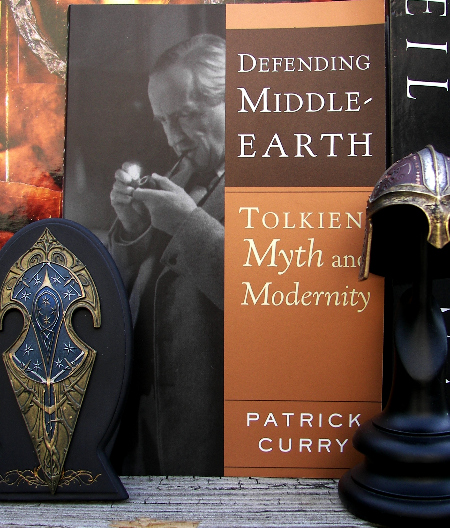
Defending Middle-earth, Tolkien: Myth and Modernity ~Patrick Curry
–published 1997, revised 2004
–Houghton Mifflin Company
–157 pages (198 with references, bibliography, and index)
–4.25/5 stars
I first became aware of Patrick Curry, as well as a number of other Tolkien experts, via the author-related documentaries on the extended editions of the three Lord of the Rings films. Each time I view them I am fascinated with the insights these men and women offer and I long ago determined to read the Tolkien books of those who were published authors. I began this quest a few years ago reading Tom Shippey’s superb book, The Road to Middle-earth: How J.R.R. Tolkien Created a New Mythology. It is a deeply academic work, particularly the first part of the book dealing with philology, but one I highly recommend, even if a person were to skip to the latter half of the book to read Shippey’s brilliant and well-reasoned debunking of Tolkien critics.
My recent return to high fantasy via George R.R. Martin’s A Game of Thrones not surprisingly put me in a Tolkien mood, so I decided to indulge this whim by purchasing and reading Curry’s book. While not as in-depth as Tom Shippey’s work, and certainly not a perfect work from where I stand, Defending Middle-earth is an excellent and relatively quick read in defense of a work that has defied all odds and abundant criticism to become one of the most beloved pieces of literature ever written. As a personal bonus, Defending Middle-earth has gone a long way towards helping me to coalesce my thoughts on ecology/conservationism and Christianity to the point where I am feeling an urge to actually write about it. But more on that later.
The crux of what Patrick Curry is attempting to do with Defending Middle-earth is to examine what readers the world over, across many generations and for many decades, are getting out of The Lord of the Rings. In doing so he examines the work in light of three areas–
The Shire: Culture, Society, and Politics:
In this section Patrick Curry briefly and succinctly answers many of the accusations of racism, imperialism, fascism etc. that have been leveled against Tolkien’s work. By using Tolkien’s own words as his defense, this portion of the book maintains a high level of objectivity. The majority of the chapter is used in pointing out how much Tolkien emphasizes a “love of place” in his work. For J.R.R. Tolkien this is most easily recognizable in The Shire, which was no doubt a picture of the pastoral English countryside, but it truth was actually much more a reflection of a very specific part of the country that Tolkien was enamored with. Curry goes on to discuss how this love of place, which so many of us who have a particular area of a country, or more simply a specific part of our community that we love, makes The Lord of the Rings resonate with people in cultures that on the surface are far removed from pastoral England. When communism collapsed in the former U.S.S.R. and books became more readily available, thousands of Russian people found themselves identifying with the land described in Tolkien’s work, because in it they saw a kindred spirit with their own love of the land, love of nature, etc.
In a world filled with ever-increasing reliance on technology and mechanization and greed-based politics, Curry asserts that one of the reasons The Lord of the Rings has such a powerful impact is that it calls for a return to a time when respect and love of place was much more prominent. I particularly like this quote from George Orwell (from ‘Some Thoughts on the Common Toad’, 1946) in this section of the book:
Is it wicked to take a pleasure in spring?…is it politically reprehensible, while we are all groaning, or at any rate out to be groaning, under the shackles of the capitalist system, to point out that life is frequently more worth living because of a blackbird’s song, a yellow elm tree in October, or some other natural phenomenon which does not cost money and does not have what the editors of left-wing newspapers call a class angle?
Middle-earth: Nature and Ecology:
In this section of his book, Patrick Curry comes closest to blurring the lines between applicability and allegory in his speaking out against modernity and his belief that what really needs to happen is a return to a time where nature is respected and protected rather than used to the point of wiping out entire species and reducing all of the forests to deserts. Don’t get me wrong, it is not that I disagree with him and I believe even a layman’s examination of Tolkien’s writings proves that he was very much a nature lover, particularly a tree lover, and that he was not a fan of rampant industrialization. Where I think the book goes off track a bit from its stated purpose is that it walks a fine line between preaching Patrick Curry’s ideology and discussing Tolkien’s views on nature. Personally I found it fascinating because, as I hinted at above, it helped me to focus some of my own personal thoughts on the nature of–I won’t say ‘environmentalism’ because I think the word has its own negative connotations politically and socially, especially today–but instead will use “conservationism” and what a Christian’s role is in regards to stewardship of the Earth. I will now veer away from this subject because if I were to begin writing down these thoughts this post would cease to be a book review and instead would become an essay. I hope to actually finish this essay at some point as I am curious to actually see these thoughts and ideas put down on paper and would be curious about your reactions. So save them, we’ll talk about that another time. 🙂
There is a John Ruskin quote in this section of the book that I wanted to share:
No air is sweet that is silent; it is only sweet when full of low currents of under sound–triplets of birds, and murmur and chirp of insects, and deep-toned words of men, and wayward trebles of childhood. As the art of life is learned, it will be found at last that all lovely things are also necessary: the wild flower by the wayside, as well as the tended corn; and the wild birds and creatures of the forest, as well as the tended cattle; because man doth not live by bread alone…
The Sea: Spirituality and Ethics:
Among other things, Patrick Curry asserts that one of the reason J.R.R. Tolkien resonates so strongly today is that he “found a way to provide something close to spirit in a secular age”. Curry examines the role of Tolkien’s deep commitment to Roman Catholicism and the manner in which he merges Christian thought and ideas with pagan mythology and ideology and humanistic ideas to create a unique but familiar mythology. I really appreciated Curry’s work in this area. While I feel he misses the mark a bit in sometimes minimizing the role of Tolkien’s faith in his work (something I don’t see as intentional, more a lack of kindred spirit), I think he does a fantastic job of discussing how these various ways of looking at the world, at nature, and at the spiritual realm were expertly brought together in a way by J.R.R. Tolkien that did not diminish his beliefs. This section of the book examines the role of story in our lives and discusses the influence of the northern myths on Tolkien’s writing.
Patrick Curry finishes the book with a brief examination of the literature of fantasy, including some comparisons/contrasts with other fantasy authors, discusses Tolkien’s idea of “hope without guarantees”, a fascinating concept that is discussed on the DVD extras, and ends with an afterward written in 2004 where he touches on the films and does a slight critique of his own work.
In speaking of his own personal experience with The Lord of the Rings at age 16, Curry writes:
“I was overcome from the beginning by the unmistakable sense of having encountered a world that was more real than the one I was then living in, or the reality of which was much more concentrated. Accompanying this feeling was the equally odd one of inexplicable familiarity with that world. And finally, there was a sense of loss when I had finished, which, combined with delight and curiosity, impelled me immediately to recommence reading it.”
Sound familiar? I believe those of us who have had a similar experience with The Lord of the Rings know exactly what Curry is talking about. He goes on to discuss how his is not a unique experience and breaks it down to examine the various aspects of this reaction that people have. I believe, as do Curry and many other LOTR defenders, that J.R.R. Tolkien built his mythology on those which were already deeply ingrained in us through generations of storytelling. Into that he poured a love of place and a viewpoint of history as one of struggle and sometimes defeat, with always a sense of hope, that strikes a cord with those who read it, regardless of age or culture or socio-economic status. I believe The Lord of the Rings to be a timeless work and enjoy reading books from scholars who have spent a great deal of time with that belief in mind.
At 157 pages it really was a quick read, but there was a lot of meat therein. It is not a perfect book, but I found that I actually got much more out of it than I expected to going in. Defending Middle-earth does not go into the detail on Tolkien’s mythology that it could, but that is understandable considering Tom Shippey’s singular work in that subject area. As it is apparent from the introduction and afterward that Patrick Curry received support and encouragement from Tom Shippey, it makes sense that he would not want to reinvent the wheel. The book suffers slightly in its examination of the spiritual components of The Lord of the Rings primarily because, in my own personal opinion, it does not go far enough into examining what J.R.R. Tolkien himself said about the role that his Christianity played in the realization of his work. And while I wholeheartedly agree with Curry’s assertion that Middle-earth is itself a character in the book, I disagree with his belief that the films did not capture this. Perhaps our differing viewpoint is a result of me not reading the books until after seeing the films coupled with the fact that scenery in films shot on location is one of the things I notice quite clearly whenever I watch movies. However, it really is a fascinating, well-written and informative book despite my very minor complaints. Because the book caused me to think about things I had no idea I would be contemplating while reading about Middle-earth, I have to give it high marks.
If you are looking for a manageable text that examines the phenomenon that is The Lord of the Rings, you owe it to yourself to find a copy of Defending Middle-earth. Additionally, if you are passionate about “going green” and would like to read a viewpoint of this that is not as full of political rhetoric as that which we hear regularly in the United States, I think you would be surprised at how relevant this book is. I look forward to discussing its influence on my thoughts about nature in a later post. I had been looking forward to reading this book for many years, it did not disappoint.
“There are still places on Earth that are beautiful, and loved, and cared for; there are still wonders, people who can wonder, and indeed who work wonders. And that is what The Lord of the Rings itself, which is what people read and what therefore chiefly matters, conveys: Arda (the Earth) unmarred, and healed. That includes us.”
________________________________________
This was my final selection for the Once Upon a Time IV Challenge.
In a sense, isn’t the role of fiction to take us to a different world, one we prefer over the one we where we live? And we want more than just Shire like beauty, but love, friendship, adventure, danger and a clear definition of good and evil. Is Jane Austen’s Regency England no less of a magical place than Middle Earth? Or Sherlock Holmes’ London, or Kip Russell’s hometown in Have Space Suit-Will Travel?
I think what’s interesting psychologically is comparing the destinations we each choose. My magical places are found in the movies of the 1930s and westerns from the 1940s and 1950s, or the Moon and Mars of Heinlein’s juveniles.
Jim:
Oh yes, I agree. I’m not sure it always has to be about a place we would prefer to be rather than where we are, but that is certainly one aspect of fiction. I think another is to remind us of the good things about where, and who, we are and to point us towards hope for a better future in comparison to any negative things in our world/lives. Fiction has many roles, which is why I cannot understand anyone who reads, but won’t read fiction. They don’t know what they are missing.
I think Lord of the Rings, on some levels, give us all those things that you mention. I do think those are all magical places, and there are many, many more in so many examples of well known and not so well known fiction that we have all taken journeys to. And the great thing about it is that there is always a new journey just around the corner, or more accurately just inside the cover pages of the next book.
I don’t believe Lord of the Rings is the best novel ever written. For some, myself included, it is somewhat agonizing to read until they finally get past meeting Tom Bombadil. (Just my opinion, don’t want to be hanged for it! 🙂 ). But I do think LOTR has something extra special about it because of Tolkien’s understanding of language and the way that he breathed new life into old mythology and (practically) dead languages by his passion for them. It is one of the few stories that I get as much pleasure reading about as I do reading the actual book itself.
And I’ll second you on the movies from the 30’s. Not sure that we like the same ones from that time period, but there are so many from in and around the 30’s and early 40’s that are just fantastic.
I think the destinations that we choose are interesting as well.
Some critics take the word “critic” literally and believe it is their duty to be as negative as they can about anything anyone else enjoys. They are the kid who enjoyed spoiling the party grown up and seeking a way to negate the good or popular or loved for their own ego gratification, or a need to have the last word and be “right”. That so many critics – and people in general – get so much satisfaction out of being critical and condescending of anything others enjoy is too bad, but what’s sadder is that they are heard and elevated to expert status. I myself need to remember this when being critical of the Stephanie Meyer books and films, I guess, though I see little value in them.
First and foremost, Tolkein’s works are one thing to the writer who created them, an intellectual and cultural exercise, and another to the reader, who can simply enjoy them as terrific stories or delve more deeply. Since I read for entertainment, I respect the books and the cultures, language and mythology the author created, but I mostly enjoy the stories themselves, not looking for moral, parable, or deep meaning. I’ve lost count of the times I’ve read TH and LOTR, and certainly the experience was different the first time, in 1962 than it was last time a few years ago, but it’s still very enjoyable. It’s too bad the books have to be defended against the self-aggrandizing naysayers.
In reply to Jim’s comment above in which he says “one we prefer over the one we where we live?”… Not always. Many people enjoy reading books about places they would most definitely NOT want to go, books such as dark thrillers about serial killers, or horror novels, or historical fiction or non-fiction about the middle ages.
Richard: That is true as well. And even the places we think we would want to go, lets use Middle-earth as an example, are not somewhere many of us would *really* want to go if given the choice, or Holmes’ London, or Austen’s England….because quite frankly most of us enjoy our air conditioning in summer and central heat in winter. We enjoy our easy to access reading material and our modern sanitation system. And although there is a definite romance about the tales of what happens in Middle-earth, it is far outside the danger level I would actually want to exist in. Because, let’s be honest, there was only one Aragorn. I would most likely have been Orc fodder! 🙂
It is too bad that an entire occupation, a paid one at that, exists because of the ability to be negative about everything. Now I realize there are good critics and good criticism is itself interesting and thought-provoking and does not always have to agree with what I agree with. But I hate it when a person, myself included (because I’ve been this way), is snobbish and grandiose about their negative opinions about something. It is okay to dislike something, but to me a truly talented critic is one who can do so and can write about it intelligently without denigrating the creator or the people who have a fondness for the creation.
Right-o. I’ve always thought if I lived in Middle Earth, I’d have had a small bookshop somewhere safe, beautiful and interesting (not the kind of interesting in the Chinese curse!).
I have not read one Lord of the Rings book to complete, not one. Can you believe that? I wanted to read the series this past winter, but the idea and my earnest thought fell quickly to the wayside. For whatever reasons, these books are very daunting to me.
I always find it interesting how people can pick books apart, find pieces and meaning within the pages that never entered my mind. I also find it interesting when people criticize works of fiction based on today’s thinking. For me, I see this criticism with historical fiction in regards to women’s role in life because they were largely subservient roles.
Anyway, a few of the quotes you placed in your review resonated with me.
For instance, the quote from John Ruskin. I was just thinking of this the other day…not in exact words and thought of course, but in essence of ” As the art of life is learned, it will be found at last that all lovely things are also necessary: the wild flower by the wayside”.
The quote from Curry, when he stated, “when I had finished, which, combined with delight and curiosity, impelled me immediately to recommence reading it” is exactly how I feel about the Outlander books that I love so.
I wonder if I were to ever read and get through a LOTR book if I would feel the same. Not so certain.
Amazing that this book is only 157 pages, it sure does seem like it packs a lot within the pages. If I ever get through a LOTR book, and like it, I will keep this book in mind.
So you know, I look forward to hearing your thoughts about nature.
It isn’t that surprising, Ibeeg. After all, I didn’t read them until after the films were released, and I’ve considered myself a fan of the fantasy genre for most of my life.
The book really did pack a lot in for its few pages. Many wonderful quotes from others as well as from Mr. Curry himself. Really good stuff.
I have the same viewpoint when it comes to looking at any kind of ‘classic’ literature, be it “the classics” or older science fiction, etc. I think it must be judged in part by the time period it was written in.
I’ve heard before people say the books are intimidating, but I don’t understand it. I read them when I was a senior in high school in the early 1960s, and I could not put the books down, they were completely fascinating and enthralling. There had been nothing else like The Hobbit and LOTR until that time and Tolkein just pulled me into his world.
Perhaps Ibeeg and others are daunted not by the books themselves but by the choice of thousands of other, adventure-fantasy books and series now available. Also, I see iBeeg expressed a love for the Outlander books, which have a prominent modern romance element in them, very different from the light-dark, good-evil world at stake themes in more classical fantasy.
Richard R, I have to disagree. Sometimes I think our lives are so boring, indifferent and bland that we would like to escape to danger and thrills. I think some men would love a bit of violence in their lives, although they’d like to be committing the violence and not receiving it. I think the appeal of westerns, an art form I love, is all about violence. The solution is simple in westerns, kill or be killed.
Of course real thrill seekers jump out of planes instead of reading about adventures. So maybe we only seek armchair thrills, or substitute violence. But remember, for the Tolkien fans, to return to the Shire the Hobbits must also endure a lot of hardship.
The real question we must ask ourselves: Would we really want to trade places with a steely-eyed detective or a cowboy with grit?
I think us bookworms take the easy way out but we all dream of being different.
You make several good points, Jim. When it comes to that choice you give at the end, I’m not sure. The wide-open spaces has allure, but I can’t ride a horse. Maybe I could be the chuck wagon guy, but that doesn’t sound very heroic. As for danger, personally, I;d rather have the armchair, the cool drink, the good book. I’ll let someone else have the danger.
Richard R. – you said “I see iBeeg expressed a love for the Outlander books, which have a prominent modern romance element in them, very different from the light-dark, good-evil world at stake themes in more classical fantasy.”
Well, really the Outlander books, while yes …do have a romance element it is not a typical romance novel by any means. It also is a historical fiction read, for sure. There are adventures that do take place too. These books have a far greater scope than one would think. True though, they are not your classic fantasy…they are not fantasy reads. Also true, I do love historical fiction.
LOTR is daunting to me, and I don’t know why. It is not because I do not gravitate towards fantasy books because I do as this genre is neck to neck with historical fiction as a favorite.
I am really liking the second book of The Wheel of Time series (the Great Hunt) and I LOVE GRRM’s books… A Song of Ice and Fire series…Love them…they are currently my second favorite series. So, in your opinion, how would GRRM’s books and Jordan’s books rank in regards to LOTR? Curious. Carl, any thoughts?
Anyhow, Richard, you probably have a point with the fact that there are so many fantasy book choices… it is easy to set aside a book that daunts a person.
Ibeeg: In regards to SOIAF and WOT compared to LOTR, in some ways there really are no comparisons. Sure, they all have some of the basic structure of high fantasy, but Jordan’s and Martin’s works are vastly different. Some would say they are superior in that there is a great deal more characterization in them and that they are better written, at least from the standpoint of today’s novel structure vs. the way some older books are written. For me, LOTR is special not because it is a vastly superior book purely for its writing style, but because in creating his world it was all about the languages and old mythology for Tolkien. He was drawing on a lot of real things that had practically been lost and forgotten and was breathing new life into them. His books, particularly The Silmarillion, read more like an overview of history than they do a standard story. This is not so true with The Hobbit, but LOTR certainly returns to that idea somewhat in that there is a lot of reference to the past and deep intimate characterization is not what you get. It is really more about Middle-earth. I don’t think it would be daunting to you once you got started. If I was a betting man I would be more inclined to think that you will instead be disappointed by it if your expectations were too high. But that is just an uneducated observation of something that “might” happen.
Richard/Jim:
No horse riding for me either, though I wouldn’t be averse to learning. They are beautiful animals. I’m not sure that I agree that readers take the ‘easy’ way out, at least not with the examples we’ve been speaking of. The only people who right now voluntarily put themselves in any dangerous situation that is equivalent to fighting Orcs or battling with Native Americans across the American plains, etc. are those who join the Armed Forces. In today’s world there is no (current) threat that has us having to pick up arms and leave our homes to fight an evil presence taking over our land. The West is just another career path, one that many people would love, but it isn’t anything like the gun fight at the OK Corral today. We can all go through our own versions of Pride and Prejudice as far as loves and losses go. People have the options to be a detective, but it isn’t something a person can just pick up and do because they feel bored.
I do agree that life can be boring, but I’ve always believed the old yarn that “only boring people get bored”, at least to some extent, because, unless you are bed ridden or some such thing, you have the option of escaping boredom by doing any number of things besides reading. I read because it is pleasurable, not because I am sitting around being bored and trying to fill time. There are a ton of other things I like to do, and actually do, because I enjoy them. Some active, some passive, but all are because I get something out of it.
Now I’m not arguing that readers don’t get vicarious experiences out of the violence, danger, etc. in books because we do. Amen for it, that is part of the fun. On the surface there is some truth to the idea that the appeal of Westerns is violence, but I don’t believe that is all there is too it nor is even the main thing. I think the appeal of a lot of literature written in a real or imagined past is the romantic notion that life was simpler then. Kill or be killed is right, but is that appealing because of the violence or is it appealing because a person in that kind of setting would know where he or she stood. We imagine people in simpler times had more control over their own destiny, or at least took that control. Today things are so complicated and confusing and you can be the best worker at a job and lose it because the company has to cut salary and you are the highest earner, and other such examples.
I think the appeal of Middle-earth in Tolkien’s stories can be the violence. But our world is violent too. I think part of the appeal of Middle-earth is that the “free peoples” banded together, set their petty differences aside for a time, and had a clear cut evil to fight and rid their world of. Frodo had a purpose, and though it nearly killed him (and in some respects did kill him), he is a character who had an opportunity to do something heroic and he did. How did he succeed? In part because of a band of friends who joined him. When I read LOTR, and when I watch the films, what always speaks to me are those bonds of friendship, the love between various characters, etc. The violence is exciting, to be sure, and it is device that draws these things out of the characters, but I think we’ve all watched films, and read books, where all that exists in the “story” is violence for violence sake and while occasionally those can be entertaining, they are more often lifeless and hollow and are not something we return to again and again. When LOTR ends, I am always sad, for many reasons, but the major one is always that now that the threat is gone these people who have journeyed together will now drift apart. I’m not sad because they don’t have someone to fight. I’m sad because of the return to “normal life”. Not because “normal life” is boring, but because they each have their own lives to return to and I hate to see them parted.
I’ll give another example. I love playing video games and most of my favorites involve an aspect of shooting or swordplay or some sort of violence. It is an important and integral part of the experience (and something that is important in these stories, like I said, I don’t disagree, I just don’t agree on the weight violence carries on its own). The ones where you are just running around and shooting get boring as hell very quickly. The games where the writers actually make an effort to put some story together, that see characters develop and grow…those are great games to play, and to play again and again. Even the very weakest “story” makes a game, or film, or book better if there is something we can connect to in the person and/or in the relationships they form within the story.
Anyway, that is enough verbal diarrhea for now. 🙂
Carl: I’ve been a long-time fantasy fan and LOTR has been on my list since before the movies, but just never got to it or the Hobbit. I’m booked for the summer, but maybe in the fall I’ll finally get around to reading Tolkien.
Ibeeg: Perhaps LOTR is daunting because it’s been around and loved for so long? Tolkien is referred to by only his last name like many of the “classic greats”…Shakespeare, Twain, Tolstoy, etc. I think that in itself can sometimes be intimidating. I’m still in coffee mode so does that make sense?
Makes sense to me, Mish. Asimov (another who fits your example) was an author I was very intimidated about reading until I just got around to doing it…and discovered that his works were accessible and that I enjoyed them immensely.
Wonderful comments by everyone! This thread is really outstanding.
Mish…you make sense to me, and yeah… you are most likely correct.
My son read these books, and really liked them. We have (or I should say, he has) a red bound edition of all the books. I opened it up tonight, and to my surprise, the books are not that long. Geesh, I have read books far longer than these, so the length is not it. I started reading, keeping Carl’s perspective in mind that “It is really more about Middle-earth”…well, let me say, I had to stop myself from reading. I have other books in line for reading this summer. Again Mish, I think you are right, it may be that Tolkien has “been around and loved for so long”…it seemed as if reading his work would require a lot of deep thinking that is beyond me. why is that? (rhetorical question). Also, I will admit, I thought there would be a possibility that the books would be boring. Okay…enough of my rambling…I will read these books. A personal challenge to be sure, and maybe I will start them this fall.
Ibeeg: Perhaps because of the films being released in their Extended Editions versions in November each year after their theatrical release, I consider fall perfect LOTR time, so that is a good time in my opinion to give them a read.
As good as many people believe the films to be, the books are clearly superior. I wouldn’t ever encourage anyone to skip the book, watch the movie. Not that I’m saying you are doing that, Carl.
Richard: No, definitely not doing that at all. The two will always be like two parts of a whole in my mind because the films are how I came to Tolkien, but I certainly would never encourage anyone to skip the books. I think they are wonderful, and I’m one of those who pushes The Silmarillion as well, despite the fact that I know in my heart that I’m tilting against windmills with a lot of folks who will not have the passion for it that I did after just my first reading.
I find really interesting parallels in my experience with the films and the books. With both I absolutely love the main story….but with both I am also increasingly passionate about the ‘behind the scenes’. I have yet to get enough of reading about or watching (and re-watching) making of info about all aspects of the films. And I feel the same way about Tolkien. I have an ever-growing passion to learn more about him, to read Christopher’s histories to see how the stories developed, to read critiques of his work…though I am very one-sided in this as I have no interest in reading any anti-Tolkien or anti-LOTR stuff. I am all for the pro- side. And although I wouldn’t go so far as to say that I enjoy the ‘behind the scenes’ of the books and movies, I have to admit that in any given year I spend more hours on the ‘behind the scenes’ stuff than I do re-reading the books.
Really great comments on this thread. Additionally sounds like a very interesting book as well.
I find it hard to compare the LOTR books to modern fantasy novels. I think it has a lot to do with the writing style that Tolkien used is different from modern authors. Its n.ot bad it just has a very classic feel to it. I think the WOT books are closer in modern terms to the Tolkien books in the world building aspects. I see the SOIF books as more character driven. The problem with the WOT series is that it became to bloated by letting the wqorld building take over that the determent of the story. JRR was able to balance his love of setting and lanuage with keeping the reader engaged in the story and knowing when to wrap it up. I think that is what will keep the WOT series from being regarded as a classic 30 years from now. The SOIF series was once compared to Tolkien but I think its a false comparison when one really examines the works. They are apples and oranges to mE.
My main disappointment with the LOTR books is the lack of good roles for women. I think its a refletion of the times atleast i hope so. I never have read why Tolkien choose to focus almost exclusively on men in bhis stories. I think that is one of the aspects that Jordan got right bin his books is that he elevated the roles of women in his series although he still made the big three all men. I see I have gotten off on a gender tangent. sorry.
Jeff: Good comparison of the WOT, SOIAF, and LOTR books. I agree with you on all points. It will be interesting to see if Sanderson can somehow make the ending of WOT good enough to keep people reading these decades from now. GRRM’s series is much more character driven, in fact it is completely so. But in doing so he still does some world building. LOTR is an exception to the rule in my opinion. I love it, and it is mostly about the world. But I prefer books that are about characters and that the world comes alive within that. I think Alastair Reynolds did a good job with that in Chasm City, to pull in a sci fi example.
My own speculation about Tolkien and women’s roles is that he was raised mostly in an all boys setting, in schools, and his mother died at a very young age. From all accounts he had a very romantic relationship with his spouse, but it wouldn’t be out of the realm of possibility to assume that Tolkien didn’t really feel an compulsion to try to ‘write women’, if that makes any sense.
Since the story was always more about Middle-earth anyway and because his inspirations were often old stories where the male characters were more prominent, it makes sense that he would concentrate more on the male roles.
I would also guess that since his strongest early relationships where with the male friends of the TCBS and that since two of the four died in WWI, that those experiences profoundly effected his writing. Some of the strongest relationships in the book are those between male friends and there a great deal of the attraction of the story, in my mind, are the bonds formed in ‘the fellowship’. I have to believe that was all born out of those early relationships of Tolkien and the profound effect WWI and those deaths had on him.
Anyway, just my theories based on a little reading and watching EE extras a thousand times. 🙂
So what you’re saying is you want me to read Chasm City. 🙂
That’s really the whole point of this post isn’t it?
As for the gender reasons I agree and I already had taken that in account. Even though I guess why he did what he did it doesn’t take away from the way I feel about it if you know what I mean. It’s one of the main reasons I wouldn’t hand this book to my daughter as an introductory book into fantasy reading. It’s much more of a guys book even though the world is an important element. I don’t think women wouldn’t like the book it’s just I don’t think it would strike the same cord with her as it did for me because of the gender bias. Again it’s just my two cents and my only real knock on the books. Don’t get me wrong either. I love them. They are in my top 5 book series for me of all time it’s just I don’t find them perfect plus the first book starts off too slow.
Jeff: Am I that transparent? Just kidding. Actually I had forgotten about getting you Chasm City until after I typed that. It was just the first example that sprang to mind.
I totally get what you mean. I’m pretty sure I wouldn’t steer anyone to Tolkien for their first taste of fantasy. I think I’d have to know more about the person first. And while I do agree with your opinion that I wish there were more fleshed out female roles in the book, I don’t think the gender bias has done much to hurt Tolkien’s impression on women. Since we both know that more girls than boys read I would bet you good money that there are at least as many, if not more, Tolkien fans who are female than male. I certainly ran into more women at work when the films came out that had read LOTR as teenagers, and younger, who loved the stories than I did guys. Not that it is a representative sample, but I’m just saying.
I doubt any book is truly perfect. And I agree with you, it takes some commitment to get past the first part of Fellowship. At least it did for me. If I hadn’t seen the films I’m not sure I could have kept reading. But once it gets going…whoa, is it one great read.
Yes. You are that transparent!!! 🙂
Jeff: Glad I’m wearing my lead-lined underpants!
Dear Carl. I just found your review of Defending Middle-Earth. Very fair and intelligent, both on the book and the issues. Thank you!
Patrick Curry
Thank you Mr. Curry, and thank you so much for writing the book. I always enjoy what you have to say on the extras on the LOTR film DVD’s and thought your book was great. I’ll definitely be re-reading it sometime in the future.