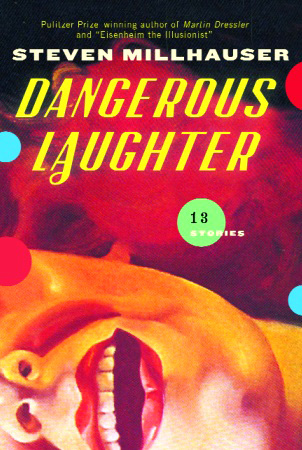
Dangerous Laughter ~Steven Millhauser
–published 2008
–Alfred A. Knopf
–244 pages
–4/5 stars
With this volume of short stories, author Steven Millhauser proves that triskaidekaphobia is not in his vocabulary. Dangerous Laughter gathers together 13 examples of Millhauser’s unique voice into a collection that is wildly unpredictable. I recently read and reviewed Millhauser’s novella, Enchanted Night, which, while wholly satisfying, merely whet my appetite for more of his work. Though I would have said with all sincerity after reading his novella that Millhauser is now on my list of favorite writers, it helps to know that, for me at least, he is not a one-hit-wonder.
Dangerous Laughter opens with the story Cat ‘n’ Mouse. While it is never acknowledged, it is my firm opinion that this story, a more personal view of the relationship between a cartoon cat and mouse, is based on the classic Tom and Jerry cartoons. It seems impossible that anyone could sit down and write out the actions of a typical Tom and Jerry cartoon and make it as interesting as actually viewing one, but Millhauser does just that. Good writing can certainly cause one’s imagination to run as if they were watching a film unfold, and that is exactly what happened when I was reading this story. The descriptions were so perfect and flowed so beautifully that it was like I was a child again watching cartoons after school. Brilliant!
The rest of the collection is split up into three thematic sections: Vanishing Acts, Impossible Architectures, and Heretical Histories, each with four stories. As with any short story collection, the quality and impact of each story varies and undoubtedly a group of readers would have completely different opinions about which they preferred and why. The great thing about this collection is there were no ‘throw away’ stories. While I did not love them all, I was impressed and entertained by each in its own way.
Among my favorites were:
The Disappearance of Elaine Coleman— a somewhat melancholy examination of how easy it is to not notice those around us until something horrible happens that draws our attention. It was a deliciously slow building, mysterious story that felt like a distant cousin to Neil Gaiman’s short story, The Facts in the Case of the Departure of Miss Finch.
The Room in the Attic was a suspenseful, brooding tale narrated by a young man who becomes obsessed with his friend’s sister, who spends all of her days and nights in the dark in a room in the attic.
The title story of the collection, Dangerous Laughter, is one that is hard to describe without it sounding odd beyond belief. One summer when the town’s youth becoming exceedingly bored they begin to engage in forced laughter parties that continue to escalate to unsafe levels. It is a straight forward yet odd little story that builds in menace and ends up being a powerful tale.
The stories in the architecture section were not among my favorites, but they did have some marvelous visuals in them. The collection is strongest, in my opinion, in its first and third act tales. The final two stories wrapped things up on a high note. Steven Millhauser wrote the short story, Eisenheim the Illusionist, on which the film, The Illusionist, was based. In his tale, A Precursor of the Cinema, similar themes are touched on and although I have yet to read Eisenheim, this story is definitely kin to elements of the film. It is the story of a painter who continues to use more and more advanced techniques to make his paintings come alive. The imagery if fascinating and the story is anachronistic in all the right ways.
The final story, The Wizard of West Orange, began in a sort of halting, journal style that was initially hard to get into, but once events started to unfold it became a very effective way in which to relate the story. In Wizard, a researcher is drawn into a series of secret experiments that begin to change the very fabric of who he is. His obsession with the experiments and the mystery surrounding them builds in momentum until the very end of the story. There is a bit of mad scientist about the Wizard and I enjoyed that part of the story as well.
All told this is a really great collection for fans of the short story genre and for those who are fans of Millhauser’s work or would like to see what all the fuss is about. There is a great deal of variety here and Millhauser keeps you guessing all the way through each of his stories. I’m thrilled to know that there are more of his works for me to discover.
________________________________________
This book is a selection for:
The 2010 Support Your Local Library Challenge
and
The Short Story Challenge 2010
and
My first experience with Milhauser was his short stories, in the collection The Barnum Museum. I got the book specifically for Eisenheim the Illusionist, but ended up loving the first story in the collection, A Game of Clue, better than the rest. He’s an amazing story writer.
Also, I love triskaidekaphobia. It would be even better if there were 13 letters in it. 😀
Amanda: It is too bad there aren’t 13 letters in it, that would be too fun! I have ordered The Barnum Museum from interlibrary loan because I really want to read both Eisenheim and The Game of Clue, the later simply because I read the title not long ago and thought it sounded very interesting.
short stories … this is one thing I’ve tried a number of times and I just don’t care for them… if i like the story I get mad its so short!
I’m not normally a huge fan of the short story, but then I loved Enchanted Night so much, there’s a very good chance I’ll be giving one of Millhauser’s collections a chance.
If you enjoyed Enchanted Night, Bart, I do think you’ll enjoy some of his short stories. I picked up a book with three of his novellas in it at the library the other day. Will be interesting to see what those are all about. He is very creative.
Deslily: I know there are many who don’t like them, I’ve always been a big fan and just love short stories.
I liked this collection too. I actually liked the architecture stories as a whole, although The Disappearance of Elaine Coleman was probably my favorite.
Kim: I didn’t dislike the architecture stories, but did like the others better. I thought The Tower and The Other Town were both pretty fascinating ideas. I’d probably say The Disappearance of Elaine Coleman was mine as well, it is certainly a story I’ve thought of often since I read it several weeks ago.
Oh yes, this does sound very good as well… Bah why does it take days and days until a delivery arrives. I want to read them right away. While reading Enchanted Night I realized that he managed to mmake me travel back to the world of my childhood imaginations. The magic and the enchantment. It sounds as some of the stories have been written in the same spirit. I’m looking forward to reading them.
I know what you mean, Caroline. Patience is supposed to be a virtue, but it is a real pain when it comes to having to wait for books to arrive that we desperately want to read immediately.