Category Archives: Film

Ebert and Roeper eat your heart out.

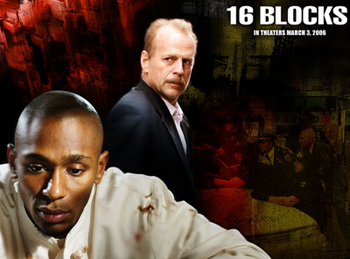
16 Blocks

(non-spoiler review)

Mary and I took the day off yesterday to celebrate her birthday. Being a Bruce Willis fan, as I am myself, she chose to go see his latest offering, 16 Blocks. If you haven’t seen the trailers, 16 Blocks tells the story of an alcoholic, burnt out detective, Jack Mosley (Bruce Willis). Jack Mosley’s drunkeness has reduced him to an ineffectual officer who is given one last throw away assignment before his shift ends…to transport a witness, Eddie Bunker (Mos Def), 16 Blocks from the jail to the courthouse to testify to a grand jury whose term expires in two hours. On the way Mosley’s need to feed his addiction leads to a stop at a local liquor store. While inside there is an attempt on his witnesses’ life that ends when Mosley’s years of ingrained police training kick in and he shoots the intended killer. Quickly hiding out in a frequently visited bar Mosley calls for back up hoping that his work for the day is at an end. Unfortunately it turns out the Bunker is set to testify against a cop…a dirty cop who, if testified against, will out the other guys mixed up with him. Leading the crusade to do away with Bunker is Mosley’s former partner of 20 years, Frank Nugent (David Morse). Nugent hands Mosley a bottle and advises him to go home while they take care of business. And that is where the fun begins.

That part of the plot is essentially what you get in the trailer which gives the impression that 16 Blocks is another Bruce Willis action film in the vein of Die Hard. It is not. While there is plenty of action in 16 Blocks it is not an overblown, unrealistic action movie. 16 Blocks is more of a character study between Jack Mosley’s washed up, “life is too long” detective and Eddie Bunker’s incessantly optimistic “you can change” petty criminal. The bulk of the film is a drawn out chase scene that has a smoldering intensity that reminds me of The Fugitive though slightly toned down. The level of suspense in the film was just enough to keep me close to the edge of my seat. What makes this film better than your average chase movie is the dialogue between Mosley and Bunker. Mos Def plays Eddie Bunker as a nasal-toned, non-stop talker who at the beginning of the film is almost distractingly annoying. However, as was no doubt the intention of the film maker, Bunker’s manic speech pattern soon grows on you and you find yourself really rooting for him. You also know right from the beginning that Jack Mosley is not a good or particularly likeable detective but the way that Willis plays him you can see that there is still something noble under the surface and you root for him as well. And David Morse is simply excellent as the bad guy. His calm, “I’m in control” demeanor belies a very dangerous nature which creates a tension that you can feel in his performance.

Richard Donner, best known for his Lethal Weapon movies, directs 16 Blocks. He brings to the table an ability to direct a good action film while injecting humor and pathos into what is often a very cliched film genre. 16 Blocks is not as over-the-top as the Lethal Weapon movies. All the elements are the same but they are significantly dialed down for this film. Taking that edge off while maintaining the intensity of this film is what made it much more entertaining than I expected going in to the film. I knew I would like the movie simply because it was a Bruce Willis film but what I did not know is that I would enjoy it this much. This is one of the better Willis movies I have seen in awhile. Although Willis is set up to be the hero, 16 Blocks is not a one-man-against-the-world action film. He portrays Jack Mosley as a man who needs help to be what he once was.

The thing I enjoyed most about 16 Blocks was that because it wasn’t your run-of-the-mill action film with an obvious, upstanding hero I honestly did not know how this dark and gritty film was going to end…and I really enjoyed that fact. If you are a Bruce Willis fan, or if you miss one of the best television shows ever to be on the air, NYPD Blues, then I predict that you will enjoy 16 Blocks for what it is and will not be disappointed at the price of your movie ticket.

Night Watch: Nochnoi Dozor

Armed with hammer, sickle and our Russian dictionaries Jeff and I ventured out last night to spend our rubles on the Soviet smash hit Night Watch. Night Watch, or Nochnoi Dozor in the local lingo, is the first of three movies based on a best selling series of science fiction novels by Russian Sergei Lukyankenko (The books are Night Watch, Day Watch, and Dusk Watch and one can only assume the movies titles will follow suit).

Night Watch was a break out hit in its native Russia upon its release in July of 2004. It shattered all previous box office records and surpassed both Return of the King and Spider-man 2 in revenue. The movie received international acclaim and was nominated for an Oscar in 2004’s foreign language category. While its sequel, Day Watch, is burning up the Russian charts we in America are getting our first taste of this fantasy/horror hybrid film.

The biggest sin in reviewing Night Watch would be to give away too much of the story. Despite the impression given by the film’s trailer Night Watch is not a film laden with special effects. That is not to say they aren’t present, because there are many special effects shots, but like any good film based on a novel it is the story that is important. And that is true with Night Watch. I had to stifle a giggle based on my recent rants about voice-overs in my Ultraviolet review as Night Watch opens with one recapping an ancient struggle of good vs. evil. Interestingly enough, though the film is in Russian and subtitled, the opening is voiced entirely in English. The voice-over is most necessary in a film like this as one gets the impression that there is a lot going on in the novel and at a trim 88 minutes Night Watch had to get right to the thick of the story. The basic plot, which you learn in the opening narrative, is this:

For as long as humanity has existed, there have been “Others” among us; Witches, Vampires and Shape-Shifters who are soldiers in the eternal war between Light and Dark.

Light Others protect mankind from Dark Others, who plague and torture humans.

Over 1000-years ago a truce was struck between Gesser, Lord of the Light, and Zavulon, General of Darkness. They agreed that no one could be forced to good or evil, people must choose freely for themselves. To uphold this truce, each side established underground forces; the soldiers of the Light would be called Night Watch, making sure Dark Others obeyed the truce. And the soldiers of Darkness would be called Day Watch, to do the same.

Ancient prophecy foretells that one day the Great One will arrive who can end the threat of an apocalyptic battle between Light and Dark Others. That day has come, and the Great One, once he or she is identified, must choose whether to destroy the light within or battle the surrounding darkness. This choice will reveal mankind’s destiny.

As I said, this is what you learn in the first 30 seconds of the film. How the story unfolds from there is where the enjoyment of Night Watch comes into play. And Night Watch is a very enjoyable film. To say that it was good but not great, or to give it 3.5 stars out of 5 seems somewhat of a disservice to a very fascinating foreign film. Did it blow me away, was it the most amazing fantasy or horror film I have ever seen? No. However it was no where near much of the dreck that is released in those genres every year. Night Watch feels like the opening act in a three act play yet at the same time a complete story is present in this first film. It has a definite ending that wraps up the first story arc in a very satisfying way while making it obvious that this is indeed round one. I left the movie last night with anticipation for the release of Day Watch. I also thought last night that it was not a movie that I would need to see over and over again. I find myself this morning, however, mulling over the film and actually wanting to see it again. Hopefully it will find its way to DVD release quickly. If I have confused you as to my feelings on the film I am sorry. I really liked it…quite a lot. Describing Night Watch as great conveys with it the idea that the film was outstanding. Describing it as good sounds as if the film was merely okay. It was much, much better than okay, was close to great, but was not outstanding. The story has many interesting twists and revelations along the way which occurred at just the right moments in the film to propel the story forward and keep me intensely interested throughout.

This was my first Russian film. As such I have no idea who any of the actors/actresses are or what their level of fame/success is in their native land. That being said I was very pleased with everyone. All the characters rang true and I enjoyed every performance. Many of the cast looked familiar however in researching their bios they have not acted in any movies that I have seen. The fact that the leader of the Dark Others looks like Rutger Hauer was a nice bonus for me as this is just the type of film if made in America you would expect Hauer to have a part in.

The special effects were great. I especially liked the little creepy doll with spider legs that you see in the film. The movie is of course very dark, occuring mostly in the night hours, but not so dark that you could not see and appreciate what was going on in the film. The special effects having to do with the Gloom…some sort of evil parallel dimension…were really cool and I enjoyed the use of mirrors in the scenes involving characters and the Gloom. I was amazed to discover that this movie was made for a mere 4 million dollars. Making something like this for that money in America is unheard of.

Director Timur Bekmambetov was joined by the author of the trilogy, Sergei Lukyanenko, in adapting the screenplay. Eventhough I have not read the novels…the first translated edition of Night Watch comes out in July of this year…I have to believe it is a very promising sign that the author was involved in the making of the film. There are a great many things that go on in this first episode and although many major plot points are resolved by the end there are also many things left to be explained in the following two films. Many of the negative reviews that I read indicated that the movie was confusing at times. I did not find it to be so. If you are the type of person that needs every little nuance of a film explained then maybe it was confusing. There were moments when there was a great deal of action occuring onscreen and you are not able to catch all of what is happening but that is true movies in America as well as the rest of the world. The story and the path followed by the characters was not at all confusing. Everything isn’t spelled out at the end, but that is because this is a trilogy.

Overall Night Watch was a very satisfying experience and I am so glad that I was able to see this on the big screen. At the beginning of the movie the film was not adjusted properly and the subtitles were below the viewing area of the screen. Thankfully there was a guy in the theatre who gave every appearance that he was expecting this and he went out immediately and got it taken care of. We were able to follow the gist of the scene and it was actually re-shown later in a flashback sequence so no harm done. I am excited to see the second film in this trilogy, Day Watch, and hope that it does not take another year for this one to arrive here from Mother Russia. If you are a fan of this genre of films then I recommend you check out Night Watch. It was interesting, entertaining, fun to watch and leaves you hungry for more. You can view the trailer for Night Watch here. There is also a non-English trailer for Day Watch at the main site here. (Click on the red writing in the upper left hand corner which will open another window. If you click the second drop down menu and choose the last setting it will give you the largest trailer. Then click in the third box and the trailer will begin downloading.)

Friday Favorites will return next week!

Ultraviolet

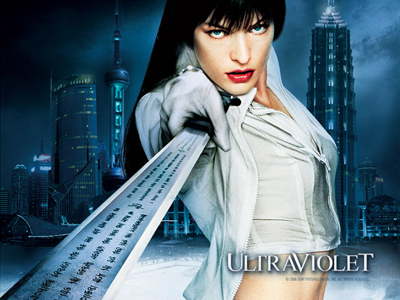
Despite the recent unmitigated disaster that was Aeon Flux I warmed to the idea of another futuristic action-chick flick. I had some slight hope given the fact that it starred Milla Jovovich who had cemented herself as a self-sufficient ass-kicker in the very fun zombie movies Resident Evil and its sequel Resident Evil: Apocalypse. My expectations were increased when I heard that Ultraviolet was directed by Kurt Wimmer as I really enjoyed his last futuristic movie Equilibrium. In the end that bad taste of Flux in my mouth and the fact that, like Aeon Flux, this film was not to be pre-screened for critics tempered my expectations. None-the-less Friday morning when I decided to take an impromptu day off I immediately called James to see if he wanted to attend the first screening of the day with me. I won’t keep you in suspense ladies and gentlemen…it was bad. While at best Aeon Flux was a 1 out of 5 star rating, Ultraviolet struggles to earn a 2. It gets the other star only because of the fact that despite it being a very poor film I enjoyed seeing it.

The plot summed up from the official releases is thus:

“Set in the late 21st century, a subculture of humans have emerged who have been modified genetically by a vampire-like disease (Hemophagia), giving them enhanced speed, incredible stamina and acute intelligence, and as they are set apart from “normal” and “healthy” humans, the world is pushed to the brink of worldwide civil war (a war between humans and hemophages) aimed at the destruction of the “diseased” population. In the middle of this crossed-fire is – an infected woman – Ultraviolet (Milla Jovovich), who finds herself protecting a nine-year-old boy who has been marked for death by the human government as he is believed to be a threat to humans”.

The plot of course seems very cliched. It and its offspring have been done over and over again. But that is not my complaint. I would be the first to admit that no matter how overused a plot is if the film is a good one I can forgive that, enjoy it, and perhaps watch it over and over again. The Underworld movies are an example of movies whose plots are not entirely unique and yet they are highly enjoyable films. The plot is not the weakest part of Ultraviolet, however. Like Aeon Flux it was the way the plot was executed that left one with little faith in Hollywood’s ability to churn out quality female-driven action films. And while on the subject of plot, someone please tell movie-makers that an introductory “serious” voice-over is not necessary in every fantasy/sci-fi film. Let the audience figure out some things for itself. The last two times this was done well was in Serenity and Fellowship of the Ring. Both are excellent examples of creative voice-over introductions. I would say that if one cannot match the quality of those two films it is best to forget it and let the movie tell the story.

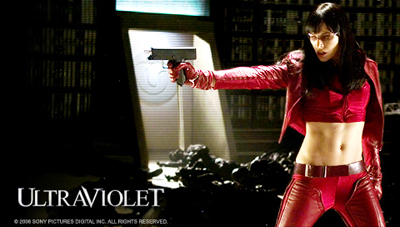
If you’ve seen the trailers you know that Ultraviolet has a unique, futuristic, soft-focus look. In this the movie did not disappoint. The special effects were very well done and the look of the film was one of the main reasons I left the theatre having enjoyed the film in spite of itself. The world and its inhabitants has a fascinating computer-generated look that made me think of this as a 21st century Tron. There are rich colors in Ultraviolet’s ever-changing look and wardrobe that are contrasted against the very shiny, dark and bleak look of the healthy human world to great effect. Ultraviolet is almost good enough to see just for the way that it looks. While this is one of the coolest elements to the film it is also one of the elements that make absolutely no sense. In the beginning there is an obvious reason for the deception of Violet’s appearance. After that it is obvious that the director was just trying to take advantage of Milla Jovovich’s model good looks by putting her in as many outfits as he could in a one-hour, 25 minute film.

The acting is what you would expect from a film like this. Milla Jovovich plays Ultraviolet in much the same way that she does her action scenes in the Resident Evil series. She maintains a look of serious concentration despite the fact that some of her lines are painfully cheesy in the extreme. While Milla Jovovich is indeed beautiful to look at there was entirely too many shots of her face coming at you on the screen…the presence of her often shimmering lipstick made me feel that I was watching a commercial for some new Maybelline color-stay lip gloss.

Jovovich is a very competent action herioine and it was a shame that this movie wasn’t better. The rest of the cast were just actors filling roles. William Fichtner, the leader of the rebel band in Equilibrium, makes an appearance here as Garth, Ultraviolet’s weapon supplier, friend, and unrequited love interest. Nick Chinlund plays the evil overlord Daxus and does an adequate job with the paper-thin role and Cameron Bright inhabits the stoic, mysterious child role.

The saddest thing about Ultraviolet is that with a little more direction it really could have worked. Regardless of the impression given thus far there is really alot of fun stuff in the film. As I said the effects and look are great. The actions scenes are no different than those in Equilibrium, but I like them. I like Wimmer’s gun-kata style even though it makes for a slightly silly, unrealistic way to fight. And there were some generally funny lines in the film that meant to be funny. The problem is that there were an equal number of lines that were played seriously that were just as funny because of how bad they were. While watching Ultraviolet it appears as if Wimmer couldn’t make up his mind about whether he was doing a serious apocalyptic film or an over-the-top comic book film. Had he sold himself completely on doing a film with the humor of a movie like Big Trouble in Little China he could have had a cult classic on his hands. As it is the story just seems convoluted for no reason and you are never sure as to whether you should be laughing derisively or taking the whole thing seriously.

There are times when one just needs to see a movie. Any movie. The end of last week found me in desperate need of a distraction. Ultraviolet was that distraction and although I think it is a really bad movie I enjoyed seeing it and am not at all disappointed that I spent the time or money watching it. It was not boring like Aeon Flux and there were enough fun elements to keep my attention on-screen. There are unfortunately too many weak points and ridiculous lines for this to ever be a movie that I would want to have on my shelf. Do I recommend seeing it in the theatre? Not unless you are in the same circumstances I was in. I can say that the opening credits done in comic book style with artists whose work looked really familiar will make me Netflix the DVD just to listen to the commentary about that part. It is VERY cool.

In the end I wish that someone in these major movie studios would have sat down the directors of Aeon Flux and Ultraviolet and said, “hey, we have half of a good movie here. Go back in there and film the other half”. Instead they rush these poorly done films out the door in hopes of a big opening weekend to make up for the long-run disaster that they turn out to be. Let’s hope that the future will bring us action-oriented films with female leads that have the interest and quality of the Underworld films rather than the boredom and ridiculousness of films like Flux and Ultraviolet.

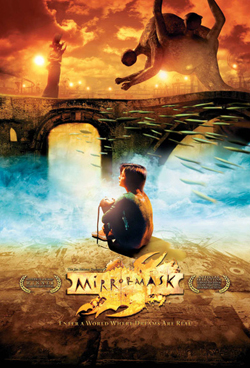
Mirrormask

Enter a World Where Dreams Are Real…after waiting impatiently for several months I was finally able to do just that. Unlike many things in life, Mirrormask was worth the wait.

Before we get started with the review, here is some

Background:

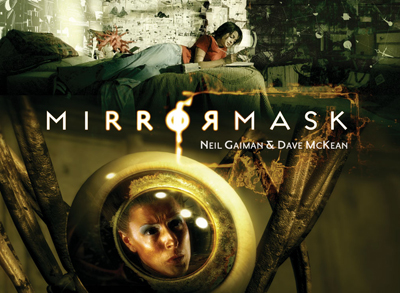
If you have read this blog for any length of time and you don’t know who Neil Gaiman is, shame on you! Not only is he my favorite living author, his journal has always been the adult blog that my one-year old aspires to be. Before Neil Gaiman was in fact, Neil Gaiman, he hooked up with an equally obscure illustrator named Dave McKean and started working on comics. Their collaboration brought them reknown with the World-Fantasy-Award-Winning, genre-defining comic series The Sandman for which Dave McKean did all the covers. Years go by in which both have much success. Enter Lisa Henson.

Lisa Henson and others in the Henson company had been talking about the fact that 20 years had gone by since their father Jim Henson had made movies like Labyrinth and The Dark Crystal. Despite the fact that they were not box office phenomena, the last two decades have seen continued sales in both video and DVD format and both films garner a dedicated fan base to this day. The Hensons wanted to make a movie of the same tenor while maintaining the innovative spirit of their father. The fly in the ointment was that although Labyrinth and The Dark Crystal had 20 million dollar budgets the Hensons could only afford to dedicate 4 million to this project. Enter Neil Gaiman and Dave McKean. More seasoned film makers would have run, not walked, out the door. Neil and Dave, blissfully free from Hollywoodization, took on the challenge with a passion and commitment that would have made Jim Henson smile. Neil wrote the screenplay, Dave threw himself into the director’s chair (and then some) and Mirrormask was born.
The Story:

There is a certain type of story that I cherish above all others. At its heart it is a simple story. It is the tale that is told by Lewis Carroll in Alice in Wonderland, by L. Frank Baum in The Wonderful Wizard of Oz. It is told by Jim Henson in Labyrinth. Neil Gaiman does it marvelously in his novel Neverwhere. It is a quest tale, a tale of light and dark, a coming of age tale, a tale of heroism and redemption not set in one world alone but in two worlds that intersect via a rabbit hole, a cyclone, a wish spoken in anger, or contact with someone from the world down below. For Helena Campbell that world is as close as the drawings on her bedroom wall.
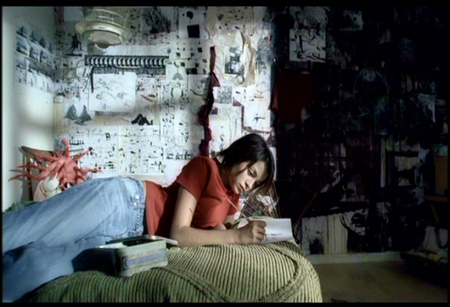
Helena is a 15 year old girl who is tired of her unconventional life as part of her family’s circus. She longs for a “real life” and spends her free time daydreaming through her art, creating a world through pictures. After a heated exchange with her mother in which she selfishly wishes for her mother’s death, her world begins to crumble as her mother becomes extremely ill. The night before her mother’s surgery she goes to sleep and wakes up in a dream world. One in which a sleeping White Queen cannot be wakened and in which a Dark Queen has lost her daughter. To right this realm a charm must be found. Thus begins her quest to make right a world that looks suspiciously like Helena’s (and Dave McKean’s) own drawings.

There is a universal appeal to these type of stories because we can all identify with that adolescent struggle of no longer wanting to be a child but not wanting to let go of childish things. I think it is something that we all struggle with long after adolescence for that matter as we go through life balancing our realities against our hopes and dreams, trying to find a way to live in both worlds.

The Look:

Dave McKean has a signature style. He is a mixed media artist and illustrator who over the years has added the use of the computer to his collage style repertoire. Neil Gaiman has written a good script but it is the unique vision of Dave McKean that makes Mirrormask one of the most inventive films in years. Mirrormask is filmed in much the same way that Sky Captain and the World of Tomorrow was…with few actors, extremely sparse sets and an enormous amount of blue screen, but that is where the similarities end. You may think you have some idea of what the film looks like by seeing pictures or watching the trailer but believe me, you don’t. It takes seeing the movie in its entirety to truly appreciate the wonder of what Dave and his 15 person digital crew have created.

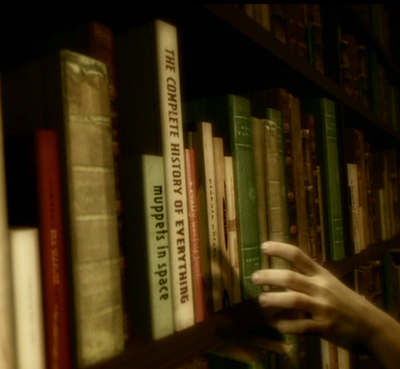
Dave McKean’s art has been described as dreamlike, dark, magical, haunting, whimsical; those qualities are present in Mirrormask in abundance. From the opening credits (which are so great!) on through the end credits Mirrormask is as much a feast for the eyes as it is a feast for the imagination. Dave McKean’s pen and ink drawings are every bit as unique as his mixed media work and it was a stroke of genius to give Helena this drawing ability as a way to showcase more of McKean’s work. Every time I have watched Labyrinth I have noticed something new and one gets the feeling that Mirrormask holds the same opportunity for discovery with each viewing. All told this weekend I have watched it three times, once with the commentary on, and each time I was rewarded with something that I had not seen before. There is no wasted space on the digital canvas of Mirrormask. Symbolism and metaphor are everywhere. Little fun things await the diligent viewer. For example I captured this frame from the library sequence just to see what titles were on the bookshelf.
In addition to the ones featured in the film there is a fun nod to Jim Henson’s most well known creations. And like the Henson creations in Labyrinth and The Dark Crystal nonsensical, whimisical, marvelous creatures abound in Mirrormask. Like:


(the sacrificial chicken)

and
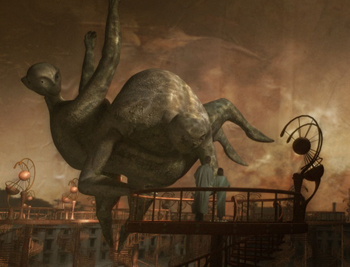

(the orbiting giants)

and


(The monkeybirds)

and
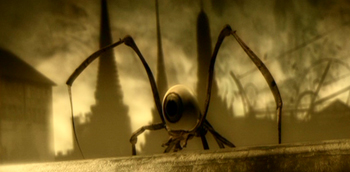

(the spidereyes)

to name but a few. Flying fish, psychotic cat creatures, book people, masked residents and other indescribable entities abound.

The world and its inhabitants created by Dave McKean and his effects crew are truly a wonder to behold. It is even more wondrous when one considers the infinitesimal budget that they had to work with in comparison to other digital effects laden films. I am staggered by the quality, talent and imagination this film displays. I am not doing this film justice, only seeing it can do that.

The Cast:

Being a small budget, largely digital film Mirrormask has an understandably small cast, but man are they effective. As in film versions of The Wizard of Oz and Alice in Wonderland the people in the real world make appearances as other characters in the dream world and so each cast member was able to play multiple parts in the film. Despite all the digital wizardry of this film its lasting success depends largely on the person chosen to play the heroine and in the case of Mirrormask they struck gold. Stephanie Leonidas was a little known actress is Britain, completely unknown in the United States, and she was a marvelous choice.
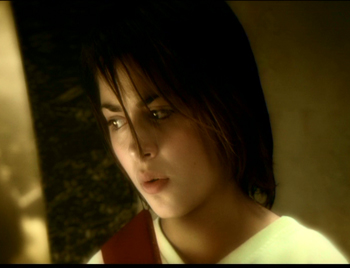
Despite being 19 when filming Mirrormask, Stephanie is able to convincingly pull off being a younger and more naive girl. She is so adorable that you simply fall in love with her character onscreen and, from all accounts, that was also her affect on the set. Her enthusiasm for the project was infectious and shows in her performance. She is so much fun to watch. Keeping in mind that most of what she and the other actors performed to was empty space on the blue screen stage makes all of their performances that much more impressive. Helena’s father is played by Rob Brydon. It is Brydon’s character who runs the circus. It is established early on that the circus is in fact his dream. Brydon does a great job being a born performer who is something of a fish out of water when it comes to dealing with the reality of life outside of the circus tent. Gina McKee is terrific in her three-part role of Helena’s mother, the White Queen, and the Dark Queen.
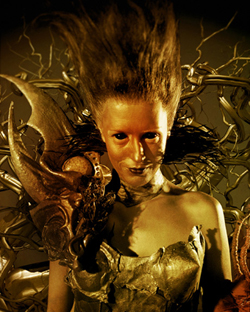
The Dark Queen is obviously one of the villains of the piece but McKee plays her in such a way that you can sympathize with her dismay over losing her daughter while still loathing her wickedness. Rounding out the main characters is Jason Barry as Helena’s dreamworld guide, Valentine. Despite the fact that he is wearing a mask through 99% of his performance Barry’s voice inflection and physicality transform the character Valentine into the stealer of the show. He is outstanding and mutliple viewings make you appreciate him even more. It is easy to see that he put his whole self into his performance. Dora Bryon has a small role as Helena’s quiz-show-watching aunt and is hysterical (her performance strongly reminds me of the little junk yard woman in Labyrinth).

There other wonderful characters in Mirrormask. Stephen Fry (of Jeeves and Wooster fame, among others) makes an appearance as the dreamworld’s librarian. Although his lips are the only thing you see on screen his voice gives him away long before you can confirm his presence via the credits. (And oh my gosh, that library!!! They could’ve stayed in there forever, I loved it!) Lenny Henry, legendary British comedian, stopped by and lent his voice to the policemen. Dave McKean himself did some voice work and strapped on a motion capture suit to play the porcupine-type character featured towards the end of the film.

The Sound:

Iain Bellamy created an enchanting musical score that enhanced the film quite well. One particular musical piece reminded me greatly of the music in Labyrinth when Sarah is given the poisoned peach to eat. I don’t know if this was intentional or not, either way it gave me a nice feeling of the spirit of connectedness between these two films. There is an ethereal lyricism to the music that gives depth to the digital dreamscape. The sound effects were great as well. I particularly liked the scuttling sounds the spiders made. Another nice sound effect is during the opening sequence of the film where Helena’s father opens the circus curtain and there is an explosive sound followed by the unveiling of the Mirrormask title. The sound that accompanies this is like that of an old rusty gate being opened. That may or may not have been what they were aiming for but I like the gate opening idea as a metaphor of what is about to happen in the film. Dave McKean and Neil Gaiman are no strangers to writing music and Dave wrote the music to the closing credits song and asked Neil to write lyrics for it. The song is “I apologize” and is hauntingly sung by Josefine Cronholm. Melodically and lyrically it is a wonderful end piece for the film.

Spoiler Discussion:

Although I have already written a small novel I want to take some time to discuss things about the film that have the possibility of spoiling it for those who haven’t seen it. Feel free to read on, as the end of these type of films is a foregone conclusion, but be warned that you may want to wait and discover these things for yourself. As a key to let you know when the spoilers are over so you can scroll down quickly thus missing said spoilers, look for the band of fish that follows. Thence starts spoiler discussion. When you see the fish again, spoiler discussion is over. Warning: babbling will likely ensue, now, follow those fish:
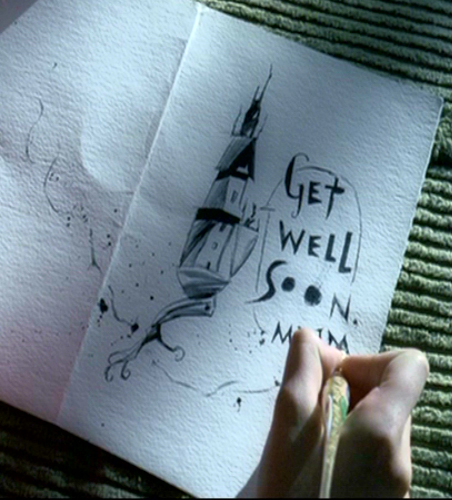
I love this movie for everything that it is and everything that it is trying to be. Labyrinth (which I will do a post on soon because I feel the need to) was such a magical experience for me and although Mirrormask doesn’t quite have the same resonance with me it comes very, very, very close. Like Labyrinth the whole fantasy world part of the film is filled with objects that are present in the real world. In both Labyrinth and Mirrormask it is the items in the would-be heroines’ room, tangible reflections of her personality, that make their way into the dream world. Those are the things I like most to discover as I re-watch these films. It took me three viewings to notice that the awesomely cool Get Well Soon card that Helena draws for her mum is a picture of Valentine’s tower that is so important later in the film
and that the sea anemone stuffed animal in her room gets a cameo as Spiney during the early palace sequence.

I saw so many other Labyrinth parallels in this film and am curious if anyone else noticed them. I don’t know if any of these were intentional or not but I would like to think that they were since Mirrormask is an in spirit sequel to Labyrinth. The room thing mentioned above is one. There are two quick moments backstage where circus performers are spinning crystal balls in the exact same way that David Bowie did as Jareth. The talking chicken, most especially her line and its delivery, reminded me of the talking hat worn by the old man Sarah encounters in trying to find the Goblin City. That same man and his slow talking (with the hat trying to finish his sentences for him) mimics that orbiting giants speech pattern and how Valentine tries to hurry them along by finishing their sentences. The “you shall not pass” griffin reminds me of Sir Didymus guarding the bridge over the Bog of Eternal Stench (and Tim from Monty Python and the Holy Grail for that matter). Valentine’s off again, on again friendship with Helena and his obsession with jewels is very familiarly Hoggle-like. When Helena is getting her extreme dark queen makeover the hands brushing across her face remind me of the hands in the chasm that led Sarah to the oubliette. Those are just a few.

I also saw references to the Wizard of Oz (monkey birds anyone?), The Sandman (the fish and the key which looks somewhat like the design to the key to Hell), and several things that reminded me of Neverwhere.

I love the idea that Helena created this world with its light and dark sides just by drawing the various pictures that are hanging on her bedroom wall. (This idea is the basis for a really fun cartoon network show called Chalk Zone too!) And what a fantastic idea to have Helena and Anti-Helena able to view each other through windows that are actually a part of those drawings and the destruction of the dream world being related to Anti-Helena’s destruction of Helena’s pictures. There is so much depth to the idea of one’s good and bad side having a window into the other’s world.

And that’s the thing about this movie, and Labyrinth, and The Dark Crystal, and numerous other similar works: there is an almost endless amount of philosophical, psychological, and spiritual discussion that can be had about what looks on the surface like a very simple plot. There are many and varied interpretations that can be had regarding the story itself and all the various oddments that Dave McKean and his crew littered throughout this fantastical world.

Does anyone else think the black tendrils in the dream world can be representative of whatever cancerous enemy is attacking Helena’s mothers’ brain in the real world? When they tear apart the giant couple and the male gets dragged down while the female floats away doesn’t it seem like foreshadowing of what could happen if the mother’s surgery is not successful? Or it could be representative of Helena’s dad’s seeming ineffectiveness during his wife’s ordeal and his inability to hold on to her and to Helena.

The use of books in Mirrormask really excites me, being the book lover that I am. Like I said, I loved the look of the library. The idea that books that were no longer desired would return themselves to the library was funny and fantastic. I also enjoyed the Really Useful Book and the idea of books having feelings and personalities in the dream world. Wonderful!

I also love the way the movie ended, first with an animated art sequence that looked so very much like McKean’s Wolves in the Walls story art that I found myself wishing they would take this team and immediately make that book into a short film, and then with the hint of romance for Helena at the very end. I also enjoyed how the waiter line played into the ending. That too felt similar to the ending of Labyrinth in that it brought the dream world stuff back into the real world.

To sum up this was indeed everything that I wanted it to be and more. Dave McKean’s art and his teams’ ability to translate that into a three-dimensional form was more than magical, it was miraculous. The film is filled with hundreds of little touches that make multiple viewings a distinct pleasure. There is a Britishness to the humor that makes it even more entertaining to me because I am a big fan of British comedy. The relationships between the characters are wonderful and the top-notch acting talent that Dave and Neil were able to get onboard is amazing. This is a movie that will stay with me a long time. For me it is a nice emotional bookend to the connection I have with Labyrinth. I hope that this is just the first of many Gaiman/McKean film collaborations and I encourage you to see it if you have not already done so and to watch it again if you have.
_________________________

And now a few notes on the DVD.

The packaging is okay. I was hoping for something more elaborate but then I remembered the whole small budget thing. There is a really nice picture on the insert inside the jewel case with Helena looking through a keyhole that I like and am glad that they put it in there.

The extras on the DVD range from really good to quite poor.

1. The poor are the parts where Neil and Dave talk. The reason that they are poor to me is that they really don’t do a great deal of talking about this specific project and as such they are way too short. The Q and A from the San Diego Comicon was also poor mainly because it rehashed information that most Gaiman fans already know and the sound quality was quite abysmal.

2. There is an okay short documentary about how the Mirrormask project began which I’ve pretty much summed up for you already.

3. There is a really nice but way too short interview with various cast and crew members. In it you get a glimpse of how much fun it would have been to work with both Stephanie Leonidas and Jason Barry…their enthusiasm is palpable.

4. The Day 16 extra is a really fun time lapse photography bit showing all the various set ups that were done in the blue screen room on day 16 with their corresponding finished shots playing at the same time in a split screen mode. All the while various facts appear on the screen including what was had for lunch that day and how much film was used, etc. Quick and entertaining.

5. The sequences showing the storyboarding of the orbiting giants and the making of the monkeybirds scene are both well worth watching.

6. Lastly there is the ability to watch the film with commentary by both Neil Gaiman and Dave McKean. While I found the commentary very good I also wish Neil Gaiman would have done a separate commentary. Neil seemed to be more prone to talking about little elements of the story but Dave would frequently interrupt him to talk about more technical, but interesting aspects of the film. Time was taken way too often to tell who worked on what shots. While this is probably nice for the various members of the digital effects crew this information is also laid out specifically in the credits and so was redundant and unnecessary in the commentary. They both brought up various things that were cut out of the film all primarily due to budgetary restraints that I really wish they could’ve kept in. There was also an interesting and funny line in the Mask Shop indicating that the absence of the shop keeper’s husband may have had something to do with the odd cat creatures that sadly was cut. Despite some complaints this is a very nice commentary and I did learn a great deal more about the film. If you’re a dvd extra geek you should really watch the film with the commentary on. One of the really interesting things for me was learning that a pier seen in the distance when Helena is on the rooftop
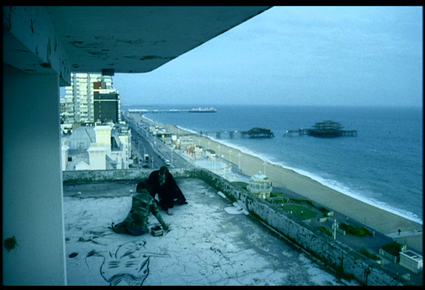
is the famous Brighton Pier that has since collapsed into the ocean. Another article about the pier can be seen here.

The sound quality and picture quality are excellent. The DVD is a bargain, pick it up.
_________________________

If you have stayed with me this long, bless you. I hope you find Mirrormask as magical as I did. Pleasant dreams everyone.
Murderball

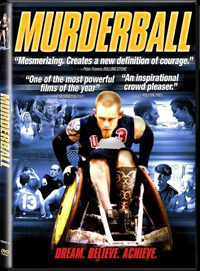
Continuing a recent trend with documentaries, Mary and I sat down last night and watched Murderball. Murderball tells the story of men from the United States quadraplegic rugby team as they make their way towards the Olympic Games in Athens in 2004. It is a hard hitting, rough, in your face documentary that echoes the ferocity of the sport. The movie chronicles the lives of several different men from the United States team as well as Joe Soares, an American cut from the US team due to age, who seeks his revenge by becoming the coach of the Canadian team.

Make no mistake, these guys are athletes in the truest and purest sense of the word. Watching Murderball now, during Olympic season, fires the fuel of patriotism even more as you watch these competing nations duke it out for gold. The documentary goes far beyond the action on the court, however, and reveals an intimate portrait of men whose lives were forever changed by a wide variety of horrific accidents and illnesses. There are some truly touching stories here and the men that the documentary focuses on are all personable, charismatic, rough and tumble guys that you can’t help but like as you watch their stories unfold.

The men of Murderball have all been quadraplegic for years and have learned to thrive despite any initial setbacks. To get a different perspective the film makers chronicle time in a young man’s life, Keith Cavill, starting 4 months after a motorcross accident leaves him paralyzed. It gives a very real look into what early life was like for the rugby players and the film makers interconnect these two stories in a very cool and touching manner.

Murderball is not a movie to watch with the kids on your lap…unless of course you want your kids to perfect their skill at using expletives. It is a very real movie that meets these guys where they are. It also tackles the question that the guys insist is on everyone’s mind: can you still have sex? Though funny and sometimes graphic this issue is addressed maturely in Murderball.

I cannot really say much more without ruining the film. What I will say is that even if you are not a particularly avid sports fan Murderball is a great film that has something for everyone. Family relationships, friendship, romance, team work, individual accomplishment, triumph, pain, pride and spirit all find their way into this film. Murderball is an entertaining film from start to finish and I highly recommend a viewing. And after you watch the film I suggest watching both the follow up with Joe Soares Q and A and the Jackass Murderball short in the extras section. Yes, the Jackass feature is exactly what you would expect but it is a fun watch just the same.

To view the trailer click here to go to the main Murderball site.