It has been more than four decades since Larry Niven released what would become his seminal work, Ringworld. The novel and its titular creation has inspired storie in book, game and film format for decades and it remains a story that excites. I made my first foray into Ringworld back in 2009 and I tore through it in a day. Much of what Niven writes can be classified as “hard” science fiction and although Ringworld has its share of scientific exposition, it is in service to a good solid story. In discussing hard science fiction and my predilection towards less scientific fiction, I said of Ringworld in 2009:
“If a story is good, it is good, and even large amounts of scientific exposition, as are present in Ringworld, don’t get in the way of me enjoying a book. That said, I would be reluctant to recommend a book like this to someone who has any trepidation about “getting” science fiction. So much of what I read is more easily classified as “adventure in space”. While this is true of Ringworld, there is a great deal of scientific explanation as Niven builds this fascinating world. Please don’t misunderstand. This is not an intelligence thing, it is really just a preference thing”.
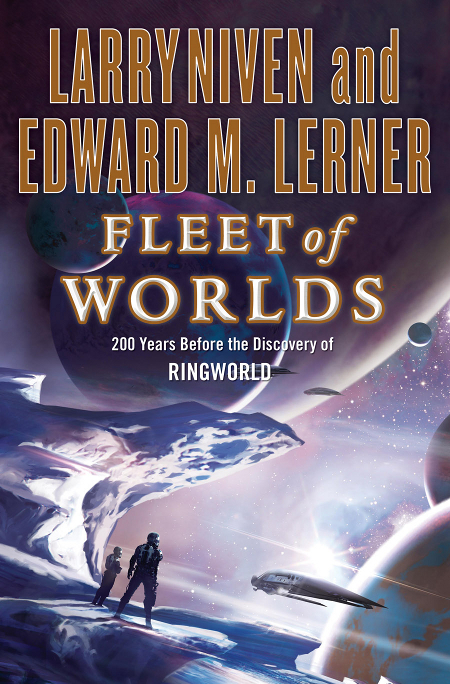
Three years removed I feel the same way. While I wouldn’t recommend Ringworld to new readers looking to explore science fiction, I might just recommend the first in a series of prequels to that novel, Fleet of Worlds. Set 200 years before the discovery of the Ringworld, Fleet of Worlds is a novel of space exploration filled with interesting science fictional concepts, an examination of human vs. alien cultures, and interesting political maneuvering, espionage, and intrigue.
Continue reading Fleet of Worlds ~Larry Niven, Edward M. Lerner