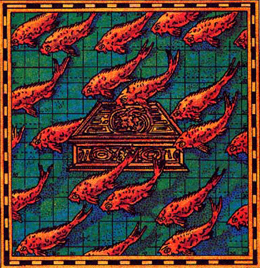
Picture this: The year is 1875, the setting London. A dirigible on a pre-set course helmed by a skeleton sails the night sky and a city full of would-be heroes and thieving scoundrals watch for its inevitable crash landing in the hopes of retrieving the homunculus…the little man in the little box rumored to hold the key to eternal life. Sound bizarre? You haven’t heard the half of it. Enter the world of James P. Blaylock’s Homunculus and you will see this and more.
Scientist Langdon St. Ives and the rest of the amatuer scientists and philosphers of the Trismegistus Club have their work cut out for them as they are slowly but surely drawn into the plot of the homunculus. If they are to keep this powerful being from falling into the wrong hands they will have to out think and outwit a cast of nefarious villians including an insane street evangelist who believes he is the new Messiah, his congregation of corpses reanimated by the hunchback vivisectionist Ignacio Narbando, the alchemist Will Pule who sports a bad complexion and is hell-bent on stealing the heart of an innocent young girl, and many more too numerous to mention. Everyone wants to possess the box, made by a craftsman named Keeble, to use the homunculus’ powers to their own ends. To add to the confusion there isn’t just one Keeble box, and no one knows exactly which box he is in.
Homunculus belongs to the genre of stories known as steampunk. A simplistic definition is that steampunk “concerns works set in the past, or a world resembling the past, in which modern technological advances occurred earlier in history, but were accomplished via the science already present in that time period”. A more detailed dissertation on steampunk can be found on the Wikipedia site here (It is worth reading simply for all the marvelous books, comics, games, etc. that the article references).
Homunculus is a modern treasure of a story in that is an amalgam of plots and settings and characters reflected in the classic works of Jules Verne, H.G. Wells, G. K. Chesterton, Sir Arthur Conan Doyle, Edgar Rice Burroughs, Edgar Allan Poe and P.G. Wodehouse. It also calls to mind the graphic novel work of Alan Moore in his League of Extraordinary Gentlemen volumes. It is a tale that is by turns dark and menancing, and at times absurd and humorous. The heroes are noble and upstanding though some have skeletons in their own closets whose revelation adds to the intricacy of Blaylock’s twisting and turning plot. Homunculus boasts bad guys who are insane, bad guys who are sinister, and bad guys with the vaudevillian traits of Snidley Whiplash and similar villians from the classic melodramas. James P. Blaylock’s writing style in this novel is very reminiscient of Chesterton’s The Man Who Was Thursday and the plot is every bit as deliciously convoluted as that work.
Any book that contains perpetual motion dirigibles, alien space craft, zombies, carp bladders, hunchbacked mad scientists, toy-makers, giant emeralds, kidnappings, suspense, mystery, wild inventions, diabolical schemes, drunken slow-witted philosophers, wet cigars, pea-pots, misdirection, explosions, disguises and the rich atmosphere of 19th century London cannot be anything but enjoyable and I wish I could convey the sheer pleasure I received from reading this book. Its style rewards the careful reader and there is a large enough cast of characters that you do have to pay attention at times to keep everything straight. Reading this novel one can envision how much fun it would be to do as a movie or television show similar to the classic Wild, Wild, West or the more recent Adventures of Brisco County, Jr.
James P. Blaylock has written a sequel of sorts with the same cast of characters entitled Lord Kelvin’s Machine: A Novel that I have ordered from the library and cannot wait to read. I had to utilize the library for Homunculus as well because it has been out long enough to not be readily available in the bookstores. The same characters can also be found in two short stories in the book Thirteen Phantasms and Other Stories which I reviewed back in January.
My only real complaint about the novel is the terrible packaging. As bad as the mass market paperback cover is, the trade paperback is even worse. Lord Kevin’s Machine has a really fun hardback version with a cover that reminds me of Sky Captain and the World of Tomorrow. I hope someday someone with some clout falls in love with this story and republishes it in a worthy format.
If you are in the mood for something outlandishly fun, dripping with atmosphere, somewhat challenging and a reflection of some work of the masters of classic adventure/science fiction and if lines like “Does the night seem uncommonly full of dead men and severed heads to you?” tickle your fancy then I highly recommend that you scour up a copy of Homunculus and give it a good read. It is a wacky, whimsical, farcical science fiction historical mystery that is simply too good to pass up.