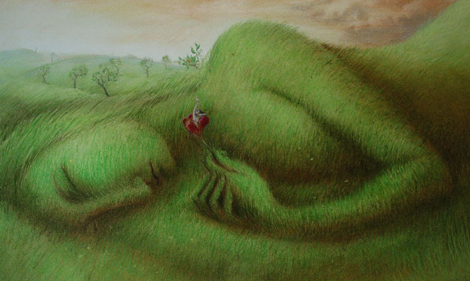
“The best time to plant a tree is twenty years ago. The second best time is now.”
~Anonymous
“For in the true nature of things, if we rightly consider, every green tree is far more glorious than if it were made of gold and silver.”
~Martin Luther
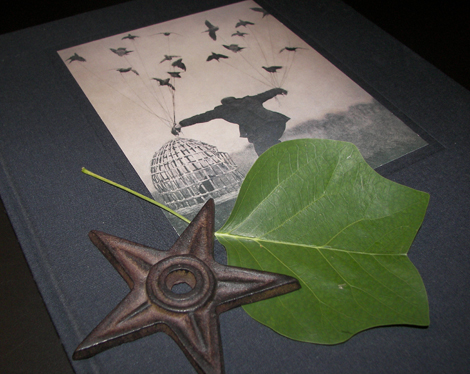
Many years ago, approximately 17 to be exact, my wife listened to the little hints I was dropping and bought me this wonderful book, The Architect’s Brother, featuring the photography of Robert ParkeHarrison that I had been eyeing with envy at my Waldenbooks job. I love that woman!
From Decordova: “Robert ParkeHarrison collaborates with his wife, Shana, on the conception and execution of complex images that combine performance, sculpture, photography, and painting. Their innovative approach to picture making draws upon their use of paper negatives and collage to construct stories of loss and struggle amid landscapes scarred by technology and over-use. At the heart of these pictorial tales is a lone individual–ParkeHarrison himself as “Everyman” engaged in Herculean struggles with nature and artifice. The mythic world he creates mirrors our world, where nature is domesticated and controlled. In actions that are both humorously metaphorical and lyrically poetic, ParkeHarrison constructs beguiling stories that make us consider what we have done or are doing to our earth.”
I fall pretty squarely in the middle on environmental issues most of the time. I see both sides using faulty, skewed statistics towards their own ends. That being said, I love this world. I love nature, and I love trees. As I see more and more of my favorite country drives to and from work being robbed of all vegetation to build big houses with no yards, I get very frustrated.
These images are all very powerful, and need no description by me to accompany them.
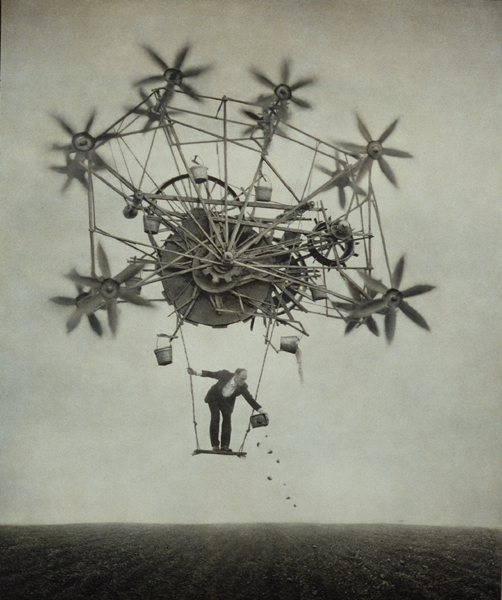
(The Sower)
Suffice it to say that I love this work. The combination of the things they construct for these pictures and the fact that the photographer himself appears in each one is just amazing to me. There is also a darkness and a steampunk element to many of these pictures that attracts me to them even more.
At the end of the book he includes the story Unchopping a Tree by W.S. Merwin. It was, I believe, part of his inspiration.
I give you now some examples of the work of Robert ParkeHarrison (each image can be clicked upon for a larger version), accompanied solely by the words of W.S. Merwin: