Today’s short story discussion focuses on the newest story by E. Lily Yu, “The Urashima Effect“, which is featured in the June 2013 issue of Clarkesworld Magazine. Yu is one of the newer stable of writers whose name in a magazine will have me scrambling to pick up a copy. I really enjoy her work.
Leo Aoki wakes from a cold sleep, disoriented and alone on a ship bound for the planet Ryugo-jo in the Alpha Lyrae system. He has been under for three years, awakened as the ship attains a closer proximity to its destination. Leo’s mission is to establish a small liveable base. His astrophysicist wife, Esther, will join him on a ship launched two years after his. In addition to necessities and entertainments, the ship contains recordings from family and friends, meant to assuage Leo’s loneliness. Esther’s recording begins with a story about a man named Urashima Taro and the rescue of a small turtle. Leo rations this story, completing necessary tasks and engaging in other entertainments to make these moments last. As Urashima’s tale unfolds, the reader is shown how the stories of these two men intersect, and E. Lily Yu leaves her protagonist with a decision that will have the reader contemplating the options for days to come.
E. Lily Yu has crafted a story that focuses on a man in isolation which manages to beautifully convey the importance of relationships and the costs that must be paid in the name of progress.
The story can be read at the Clarkesworld site or listened to via podcast.
After you take some time to read the story, come along and check out my spoiler-filled thoughts and leave some of your own.
E. Lily Yu had me from “Leo Aoki awoke with a shudder in the cold green bubble of the ship…”. There is something simultaneously haunting and compelling about stories in which a character in a space ship awakens from some form of suspended animation. When that character is alone, it gives me chills of anticipation. Leo Aoki wakes up and is unsettled and confused, and Yu communicates those feelings to the reader right from the beginning of the story. What is so effective about this is that as Leo calms and begins to take steps to settle into a routine, with the help of the recordings made for this purpose, the reader also settles into the rhythm of the story.
I found it interesting that the story that Esther tells Leo is a fairy tale, because as a reader it is an unexpected genre shift in an overtly science fictional story. It works well in part because Urashima Taro’s story is engaging in and of itself, but it becomes an important part of the greater whole as the reader, along with Leo, comes to see how this fairy tale parallels his own life.
Some of the themes that I pick up on when I read “The Urashima Effect” are that of the importance of relationships, of coping with loneliness, and the idea that duty and progress sometimes necessitates sacrifice. These ideas are part of the reason I enjoy science fiction stories in which a character, or even a small group of characters, are out in the vast reaches of space, their only liveable space being the confines of their ship, with no guarantee of success. There is something so powerful and terrifying and exciting to imagine what an adventure like this would be like.
As I read Urashima Taro’s story I felt myself wanting to shout “no”, wishing I could reach into the story and stop him when he decided to go back to tell his family that he was okay. His act of kindness to a small, defenseless turtle opened up this wonderful experience to him in which he found love and to see that all swept away is so sad. I love my parents. I love them very much. In spite of that fact I found myself wishing that Urashima had been content to stay where he was and enjoy the love that he had found, especially when I think of it from a romantic perspective, knowing that his parents had each other. That being said, they would no doubt be devastated and as a loving son Urashima wants to shield them from that heartbreak. I also wondered if my reactions were more of a Western reaction, something born out of my culture that is different from Eastern cultural norms regarding familial relationships.
A typical question regarding Urashima’s story that might be asked is why did the Princess not explain to him what would happen if he left? My only answer to that is the fact that fairy tales have their own internal set of rules and life in a fairy tale setting does not often conform to expectations of life in the mundane world.
While Urashima Taro’s story is very poignant on its own, it becomes more so when it is revealed that Esther told Leo this story as a means of beginning a very difficult message to him. Given that both of these characters are scientists who had been briefed and prepared for this method of space travel it makes such great sense within the setting that Yu established that Esther would realize the importance of Leo acclimating to his environment first before the truth of his circumstances was revealed. Urashima’s story also acts to prepare the reader for the sadness that is to follow when Esther tells Leo that her mission has been canceled and that he must make a very difficult decision.
On one hand it is obvious from what little we see of Leo and Esther that theirs is a deep love. It seems especially true for Leo as it appears that he would have been the kind of person who would very easily have isolated and lost himself in his work if it was not for her. I imagine what it must have been like for Esther as she recorded this message and programmed the ship so that Leo would have the option of returning to her. Esther’s own sense of duty would be fighting against all her instincts to somehow do all she could to stop Leo from going in the first place. The entire time she would be recording for Leo she would be struggling with the fact that she was losing her husband. Even if he chose to return, she would be so much older than her and would not be the same woman. She points out in her recording that “at this moment I love you”. I could not help reading into that statement that Esther was also a pragmatist. She is young, she has a whole life ahead of her. Would she not feel on some level that Leo had passed away? What if she were to fall in love again? Have a new family? What would Leo return to if he returned?
On the other hand you have Leo. This is the mission he had worked and trained for. This was his career, his life’s work would be tied up in this mission and its success. His wife also devoted her time and energy in her career to ensure this mission’s success. Does he abandon that to return to Earth in the hope that his wife is still alive? And if so what would that relationship be like with her having aged and he not having done so at all? Could that kind of relationship work on any level? Would she resent his youth? Would he return only to be caretaker instead of lover? I agonized over this for days after I read this for the first time.
What would I do? What would you do?
I’m not certain that Yu indicates what choice Leo made. My interpretation leans towards him going ahead with his mission, and I have to admit to feeling guilty that this is the decision I hoped he would make. I was surprised that E. Lily Yu drew that out of me as I am such a hopeless romantic; under usual circumstances I would be advocating that he yank the lever and return to Earth. I have to admit that it is that small part of me that longs for an adventure in space that leaves me hoping that he will continue on, land on the planet, and succeed in establishing a base there. Of course the “have my cake and eat it too” part of me hopes that whatever conflicts have scrapped Esther’s mission will be resolved in a reasonable amount of time and that she will once again be winging her way towards Leo. I like to dream that he will one day look up in the sky and see a new star and it will be Esther coming to him.
I hope you enjoyed “The Urashima Effect” and would love to know both your thoughts on the story and what you would do if you were in Leo’s place.
________________________
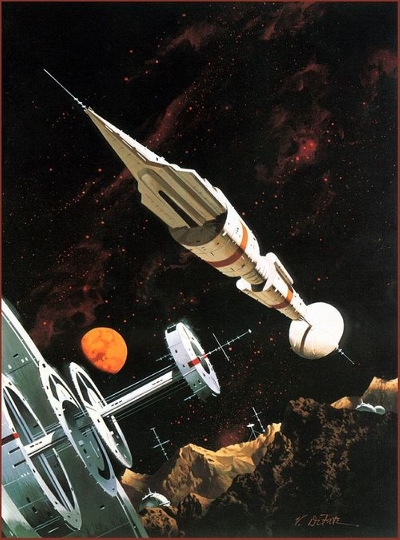
The image used for this post is a work of art created by one of the great science fiction book illustrators, Vincent di Fate. Vincent di Fate ranks right up with John Berkey, John Harris and contemporary artist Stephen Martiniere in my estimation. He creates images of space that make me believe that the adventures we all wish we were having are indeed possible.
The next Sunday short story discussion with be Sunday, July 14th. We will be reading a sweet fantasy story, “Princess Lucinda and the Hound of the Moon” by Theodora Goss. You can read the book on the Lightspeed website linked above or listen to the podcast at that same link. In my earlier SF Signal review of the story I wrote:
The Queen of Karelstad cannot have a child and though her husband tries to comfort her with the assurance that rule will pass down through his nephew, her sorrow will not be abated. On one cheerless, cold, moonlit night Queen Margarethe escapes the pomp of the evening’s celebration to walk the grounds. When she returns she does so with a baby found in a basket underneath a chestnut tree. Though they advertised the discovery, no one answered and the Queen became the mother of a daughter, Lucinda. Princess Lucinda was a fairly ordinary child, though she liked to read books and play in ways not typical among the children of royalty, and her life was nice if unremarkable. On the day of her sixteenth birthday, a rumbling shakes the castle and a voice announces that Princess Lucinda is being summoned. This extraordinary occurrence in her otherwise ordinary existence leads Lucinda to revelations that will change her life and the lives of those around her.
Theodora Goss has created a fairly straight-forward fairytale that is nevertheless lovely in the telling. She has built her imagined kingdom on a real-world framework which adds elements to the story that ground it. Goss captures simple beauty with her prose. It may seem dismissive to describe a story as “sweet”, but “Princess Lucinda and the Hound of the Moon” is just that, leaving the reader with a warmly satisfied smile.
I love how the folk tale was embedded into the story. I was very shocked for the reason;my heart ached when Esther segwayed into her reason for the story. I felt that Esther and Leo loved each other deeply; Leo and his longing to hear Estehr’s voice, and Esther with her loving care to tell a tale in order to deliver bad news. And her painstaking measure to record Leo’s history in order so that he would know more about his family.
All the questions you asked do not lend themselves to easy answers. It is as if each answer that one could give would be a troubling one.
Yu does not give us Leo’s decision, but I am with you. I think he continued onward with the mission, I am not with you as for being okay with that decsion as that is not what I wish for him to do. I realize that Esther is lost to him forever regardless of his choice. (The Esther he left). But living elsewhere, all alone, that does not jive with me. How could he survive such a lonely existence? I think he would be better off returning and creating a new life for himself with however Esther could be or not be apart of his life. From what I understand, there would be no other people following him as they have cancelled all further missions.
Yu did a fabulous job settling the reader into a reading rhythm. I really did find myself utterly absorbed into the story. She kept me on edge with wondering what was to come next. She created connections for me with Leo and Esther and even with Urashima. That is pretty superb considering how qckly those facts for me occured and for how little time (word count wise) she had to accomplish that feat. This story is not quickly leaving me. I hope more people will read it and love it. It certainly is one that I can readily recommend as reading material for my reading friends regardless of genres that they like.
I would love to read more short stories that Yu has penned.
I was pretty shocked by the folk tale too and how Esther used it to break the bad news to Leo. I did not expect the story to go that route at all.
I was surprised too about my reaction to what I *think* Leo’s decision was. I think part of it is because if he went back either Esther would already be dead or she would be at the end of her life and even though he could make a new life with someone else he would always be wondering “what if” in regards to the mission he was supposed to accomplish. I’m also not convinced that just because the governments shut down further missions that this meant forever, governments are of course very fickle when it comes to changing the rules.
Either way meant heartbreak for both Leo and Esther which is why the story is so powerful.
I agree with your assessment of Yu’s writing. Here is a link to one of her more award-nominated stories. I have yet to read it myself.
http://clarkesworldmagazine.com/yu_04_11/
True. The government shut down does not mean forever. But, would he not be alone for much longer than the expected three years he and without any sort of idea that he would ever see anyone again? Forever alone until death — that seems dismal and a set up to go crazy, eventually. Although, Tom Hank’s character in Cast Away did pretty good. 😉 anyway, that’s why I would choose to go back to earth and take my chances there and at least not live the rest of my life alone with no human contact ever again.
Thanks for the link, I am headed over there now.